Quick answer: Clean a cycled freshwater tank with a small weekly water swap, not a full drain. Treat tap water before it goes in. Leave wet filter media in place.
Change 10 percent of the water weekly, treat tap water, and skip any change over 25 percent.
This page is a home-aquarium research-desk guide that compares published maker specs and public water rules.
The 10-and-25 Rule we used for this guide
Our research team only covers cycled freshwater community tanks on municipal tap water that already have a working filter.
That is the selection rule for this page. If ammonia or nitrite is not at zero, stop and finish how long to cycle a fish tank first.
We do not cover saltwater, ponds, or a full teardown wash.
Aqueon’s aquarium do’s and don’ts page states a concrete schedule. Change 10 percent of the water every week, or 25 percent every two weeks.
The same Aqueon page says to avoid water changes of more than 25 percent. We named that published pair the 10-and-25 Rule, and it is the only routine in this article.
Aqueon’s page also says replacement water should match tank temperature, and that tap water must be treated before refill.
Why a deep clean crashes a tank
A crash is a sudden rise in ammonia or nitrite after you wipe out the bacteria that eat those wastes.
Those bacteria live on wet surfaces in the filter, on gravel, and on decor. They do not live in the water you siphon out.
Aqueon’s page says not to tear the tank down completely. It warns that a full teardown can destroy the biological balance.
The Merck Veterinary Manual’s freshwater table lists total ammonia nitrogen at 0 mg/L and nitrite at 0 mg/L. Those two zeros are the crash line for a stocked tank.
The same Merck table lists freshwater nitrate below 20 mg/L. Nitrate is the waste you export with a partial water change.
Low dissolved oxygen and high ammonia are the two parameters the Merck page names as most likely to kill fish directly. A long filter shutdown during a deep clean can hit both.
Treat tap water before it touches fish or media
Legal drinking water can still carry enough chlorine to harm fish and filter bacteria.
The EPA’s National Primary Drinking Water Regulations set the maximum residual disinfectant level for chlorine at 4.0 mg/L as Cl2. The same table sets chloramines at 4.0 mg/L as Cl2.
The Merck Veterinary Manual’s chlorine notes list adverse effects at 0.02 mg/L and mortality at 0.04 mg/L. Our research team compared those published numbers side by side.
Tap water that is legal for people can sit 100 times above that 0.04 mg/L Merck mortality mark. That gap is why untreated refill water can crash a tank that looked fine an hour earlier.
The EPA’s chloramines page states that more than one in five Americans uses drinking water treated with chloramines. The same page notes utilities have used chloramines since the 1930s.
Chloramine is chlorine bound to ammonia. Sitting a bucket out overnight does not reliably remove it.
The Merck page says tank water from a municipal supply should read 0 mg/L total chlorine. Free chlorine should also read 0 mg/L after you treat the new water.
Dose a conditioner into the new water before it enters the tank. Seachem’s page for Prime states 1 capful (5 mL) treats 200 L (50 US gallons) of new water.
For smaller volumes, Seachem’s page says each cap thread is about 1 mL.
- 5 mL of Prime treats 50 US gallons of new water.
- 1 mL treats about 10 US gallons of new water.
- Seachem’s page allows a double dose for high chloramine.
- If ammonia or nitrite is above 2 ppm, Seachem’s page allows up to 5 times the normal dose.
- If water is above 86°F (30°C) and chlorine or ammonia is low, Seachem’s page says to use a half dose.
Seachem’s page also says Prime binds ammonia, nitrite, and nitrate for up to 48 hours. It says you can dose every 24 to 48 hours if those wastes return.
Match temperature as you refill. Aqueon’s page says replacement water should be the same temperature as the tank.
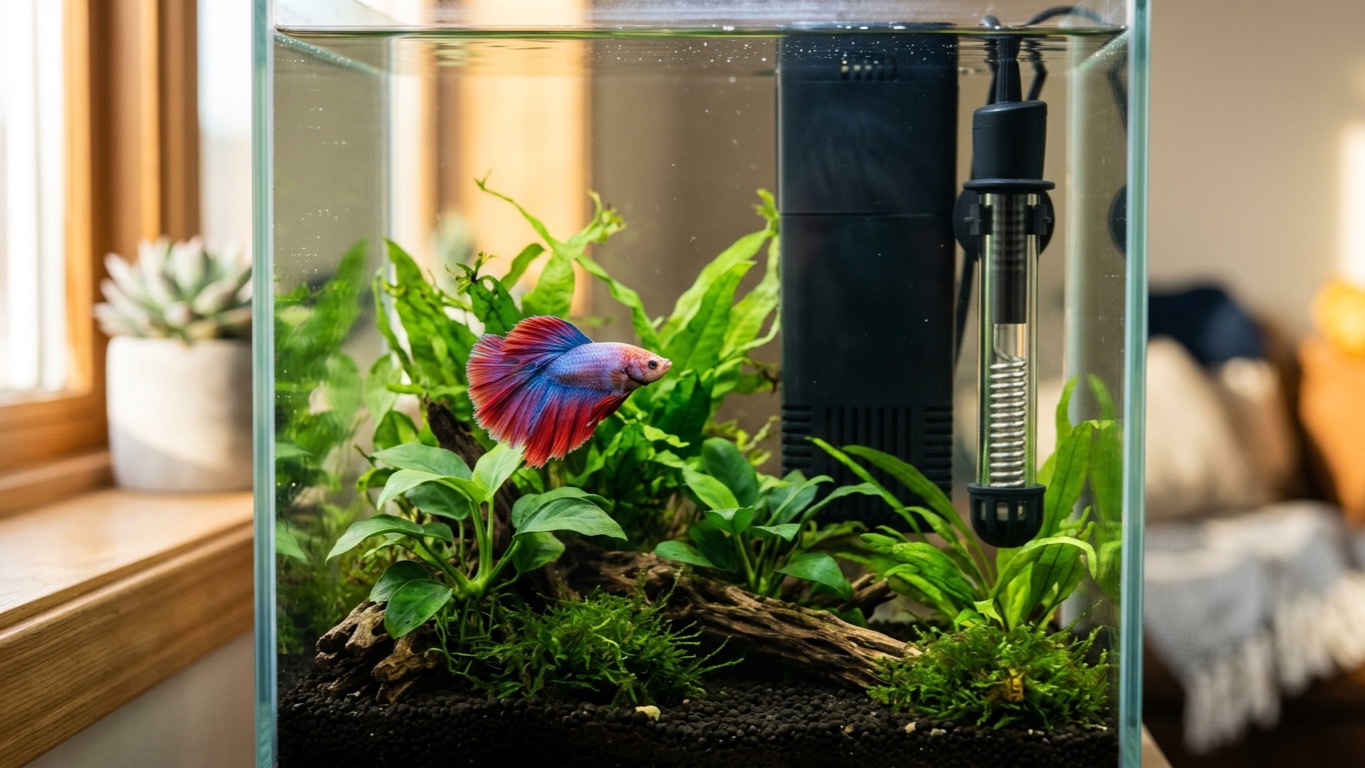
If you use a filter and heater in one, check that the unit is running before you start the siphon.
Clean gravel and glass without wiping the biofilm
Vacuum waste and wipe algae, but leave most of the thin film on rocks and wood.
That film holds the same useful bacteria as the filter. Scrubbing every surface is a teardown by another name.
Use this short list:
- Unplug heaters and filters only if the water line will drop below the hardware.
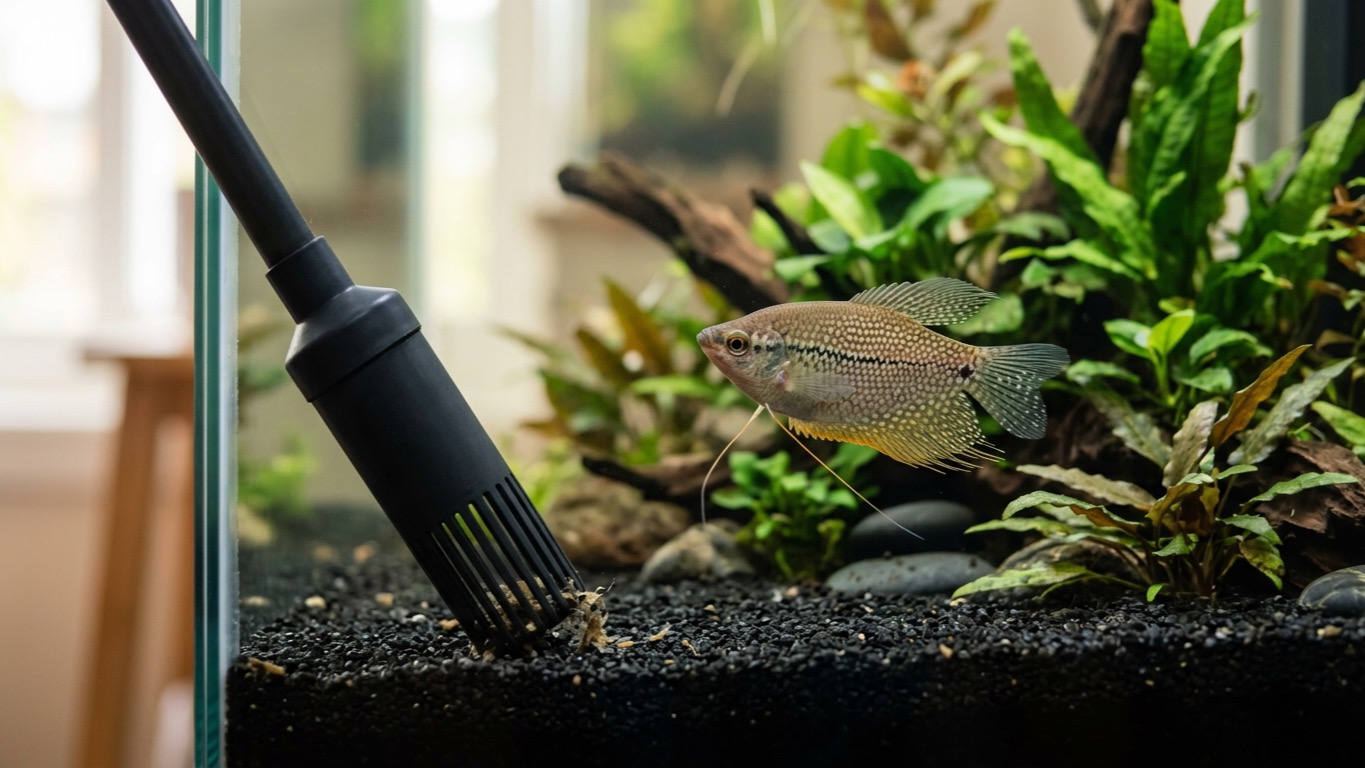
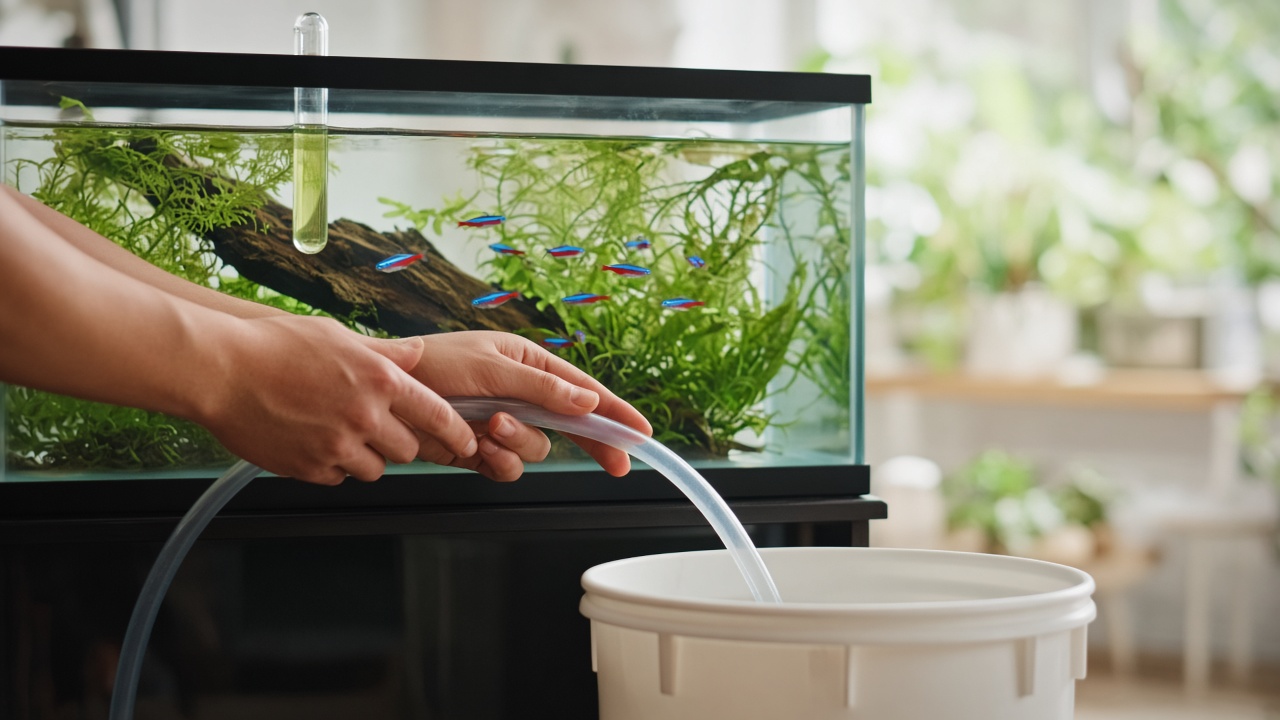
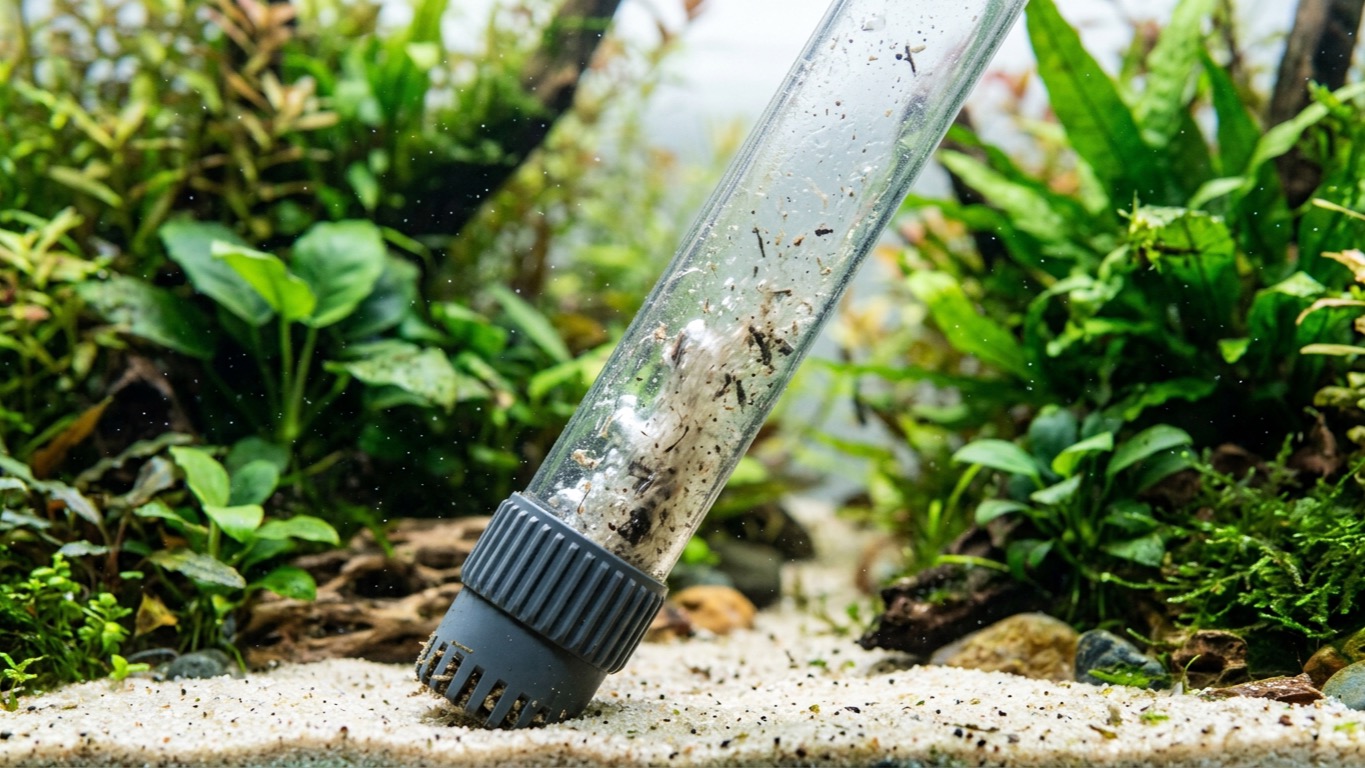
- Siphon 10 percent of the water through a gravel vacuum.
- Lift the wand as you go so you do not empty pockets of black sludge into the water.
- Wipe interior glass with a dedicated algae pad that has never touched soap.
- Leave plants, wood, and rock in place unless they are rotting or shedding.
Aqueon’s page says not to use buckets, pads, or tools that have touched soap or other chemicals. Keep one bucket for tank work only.
Aqueon’s page also says not to leave the light on all day and night. A 24-hour light cycle stresses fish and feeds algae.
Feed only what fish can eat in under 2 minutes. Aqueon’s page states that leftover food pollutes the water.
Wash your hands with soap after you finish, and keep soap off every tank tool.
Service the filter last, and keep media wet
Rinse filter media in removed tank water, and never rinse it under the tap.
Tap water can carry the same 4.0 mg/L chlorine residual the EPA table allows. That dose can strip the bacteria you just protected during the water swap.
Aqueon’s page says to change filter cartridges at least once a month. It also says to check them weekly and rinse as needed.
Do not swap every cartridge on water-change day. Stagger cartridge changes so some colonized media stays in the box.
For cartridge types and swap timing, see fish tank filter cartridges. Use this filter list on clean day:
- Pull the cartridge or sponge only after the water change is done.
- Rinse it in a bowl of old tank water until the worst sludge leaves.
- Put the wet media back at once.
- Replace a cartridge on its monthly mark, not because the water looks cloudy that day.
- Never use soap inside the filter.
If flow is weak, check the intake strainer before you replace all media.
Test before you start and after you refill
Weekly liquid tests tell you whether the clean worked.
API Fishcare’s page for the Freshwater Master Test Kit tells keepers to test weekly and compare four test tubes to a laminated color card.
API’s page lists ammonia, pH, high-range pH, nitrite, and nitrate as the levels to track. API’s page also states a pH of 7.0 is neutral.
The Merck freshwater table gives the targets our research team used when we compared published specs:
| Parameter | Merck freshwater mark |
|---|---|
| Dissolved oxygen | Above 5 mg/L |
| Carbon dioxide | Below 12 mg/L |
| pH | 6.5 to 9.0 |
| Total ammonia nitrogen | 0 mg/L |
| Nitrite | 0 mg/L |
| Nitrate | Below 20 mg/L |
| Total chlorine | 0 mg/L |
| Total hardness | Above 20 mg/L as CaCO3 |
| Total alkalinity | Above 100 mg/L as CaCO3 |
The Merck page also notes oxygen saturation of 8.27 mg/L in freshwater at 77°F (25°C) at sea level. A long power-off during cleaning can drop oxygen toward the 5 mg/L danger line.
Test tap water as well as tank water. Aqueon’s page says to have tap water checked for pH, alkalinity, nitrate, and phosphate before you use it.
If tank nitrate stays above 20 mg/L after a 10 percent weekly swap, do not jump to a 50 percent change. Stay inside the 25 percent cap, and add a midweek 10 percent swap instead.
If ammonia or nitrite reads above 0 mg/L after the refill, treat the water again per the conditioner label. Then retest the next day.
A weekly sequence you can repeat
Do the same short list every week so chemistry stays boring.
- Test ammonia, nitrite, nitrate, and pH.
- Confirm ammonia and nitrite are 0 mg/L.
- Confirm nitrate is below 20 mg/L, or plan a second 10 percent swap later in the week.
- Mix replacement water. Match temperature. Dose conditioner for the gallons you will add.
- Siphon 10 percent through the gravel.
- Wipe the glass with a tank-only pad.
- Refill slowly with the treated water.
- Rinse the filter cartridge in the old tank water. Seat it wet.
- Restore power to the filter and heater.
- Test chlorine on the finished tank if your tap uses chloramine.
- Wash your hands.
That is the whole clean. The glass does not need to look sterile, but the bacteria bed needs to stay wet.
Skip extras that are not on this list. Do not bleach decor, replace all gravel, add soap, or pause the filter for hours.
FAQ
How often should I clean a fish tank?
Aqueon’s page says to change 10 percent of the water every week, or 25 percent every two weeks. API’s test-kit page says to test weekly, and those two weekly marks are the cadence this guide uses.
If nitrate stays under 20 mg/L on that schedule, keep it. If nitrate climbs, add a second 10 percent swap and do not jump past 25 percent in one session.
Can I empty the tank and scrub everything?
No. Aqueon’s page says not to tear the tank down completely. A full drain removes the water and also dries the surfaces that hold bacteria.
The Merck table wants ammonia and nitrite at 0 mg/L. A teardown is how those zeros break, so clean glass and gravel and leave the rest wet.
Do I need to dechlorinate if I let tap water sit overnight?
Yes, if your utility uses chloramine. The EPA’s chloramines page says more than one in five Americans get chloramine-treated tap water.
Chloramine does not gas off the way free chlorine can. Dose the new water before it enters the tank, because the Merck table wants 0 mg/L total chlorine.
Should I clean the filter on the same day as the water change?
You can rinse media the same day if you use old tank water and keep it wet. Do not replace every cartridge that day.
Aqueon’s page says to change cartridges at least once a month and check them weekly. Stagger replacements so some old media stays in the filter.
What numbers mean the tank is safe after a clean?
Ammonia and nitrite should read 0 mg/L. Nitrate should stay below 20 mg/L, and total chlorine should read 0 mg/L.
Those four marks come from the Merck freshwater table.
API’s page says to test weekly and compare the tubes to the color card. Retest the day after a change if anything looked off.
What if ammonia or nitrite shows up after I clean?
Stop adding fish and dose conditioner per the label. Seachem’s page allows a repeat dose every 24 to 48 hours.
If those readings are above 2 ppm, Seachem’s page allows up to 5 times the normal dose. Check that the filter is running and the media is still wet.
If the tank was not cycled, go back to the cycling timeline.
How do I clean the glass without scratching it?
Use a pad that has never touched soap or grit. Aqueon’s page bans soap-used tools on aquarium gear.
Wipe inside glass only, and do not scrape silicone seams. Outside glass can take a dry cloth.