Quick answer: Identify the algae type, then cut its light and leftover food. Scrape what you can. Change about 10 percent of the water each week, and keep décor-only lights on 8 hours or less.
Yes: scrape visible algae, change 10 percent of the water weekly, and keep décor-only lights at 8 hours or less.
This page is a type-by-type home-tank guide from our research desk.
What this guide covers, and what it skips
A type gets a section only if you can see it on glass, plants, décor, or in the water of a freshwater tank.
That is our selection rule. We skip saltwater reef films, outdoor pond mats, ranked product lists, and any mix that needs a prescription.
Our research team analyzed maker labels and public water rules, and we kept a figure only when the named page prints it.
Match the film before you pick a fix
The same green smear is not one problem, so the first job is a match.
Use this look-up, then open the matching section.
| What you see | Likely type | First move |
|---|---|---|
| Green, cloudy water you cannot wipe away | Green water | Cut light and leftover food. |
| Hard green dots on the glass | Green spot | Scrape the glass, then shorten light. |
| Long green strings | Hair algae | Pull the strands, then cut leftover food. |
| Soft brown dust that wipes off | Brown diatoms | Wipe it, then finish the tank cycle. |
| Dark tufts on décor or leaf edges | Black beard algae | Trim coated leaves, then steady the routine. |
| Slimy blue-green sheets | Blue-green slime | Siphon the sheets, then raise flow. |
Shared first steps that starve most blooms
Light, leftover food, and stale water feed every type on this page.
Aqueon’s FAQ states a 10 percent water exchange done weekly is ideal. It also says changing about 25 percent once or twice a month is enough for most tanks.
The same FAQ says to avoid changing more than 50 percent at once, because a large swap can swing temperature, pH, and chemistry.
Do the shared steps in this order:
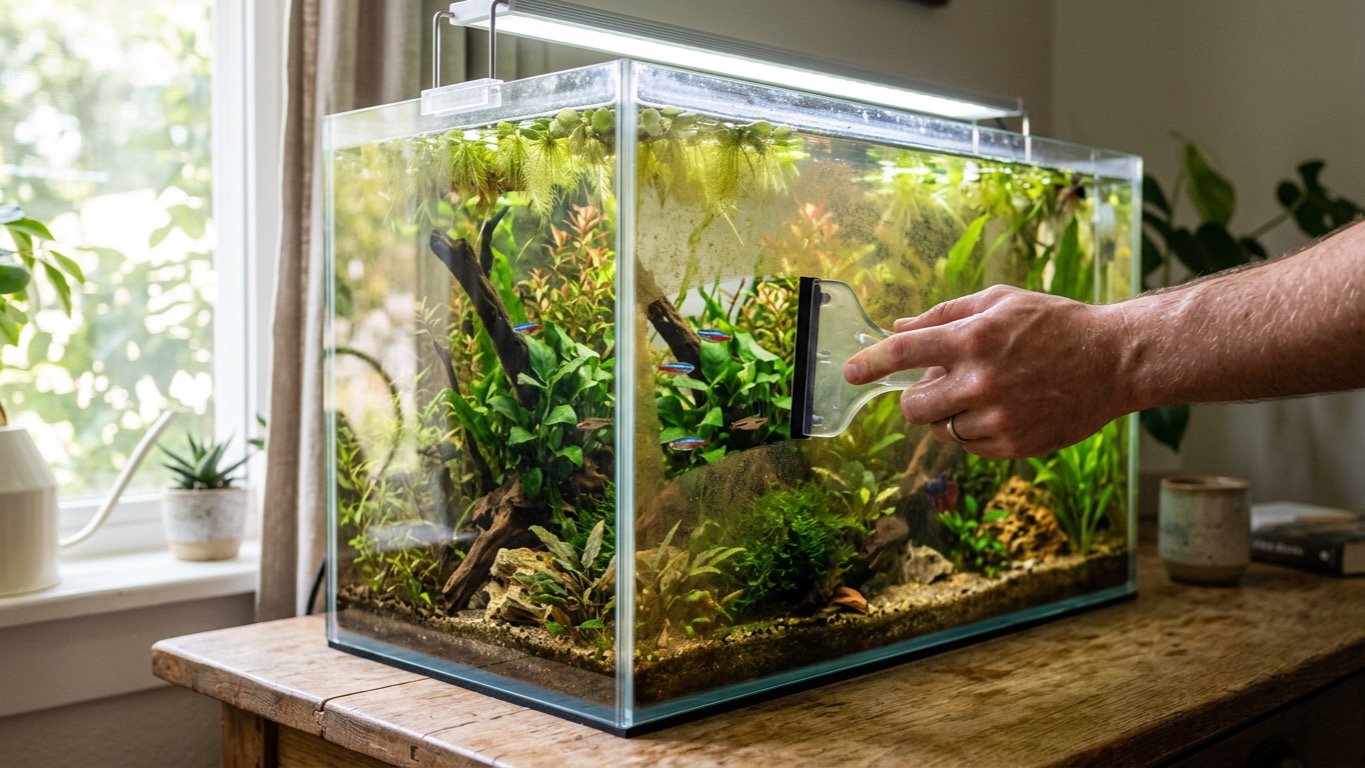
- Scrape glass and lift loose mats into a siphon.
- Match light hours to what is actually in the tank.
- Feed only what fish finish in a short window.
- Change a small share of the water on a fixed day.
- Keep the filter moving, and rinse clogged pads in tank water.
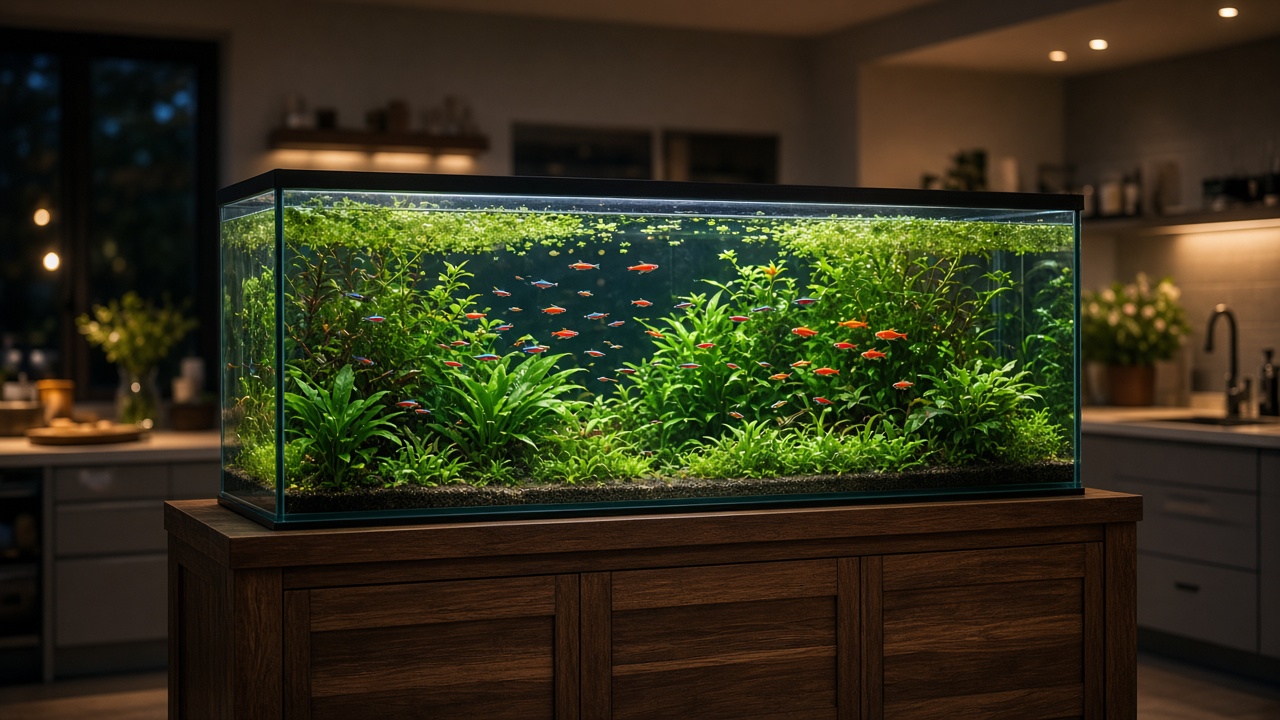
Aqueon’s FAQ splits light by tank type. Tanks with live plants should get 10 to 12 hours of high-quality light each day.
Tanks with only artificial décor need 5 to 8 hours, and those hours should stay the same each day on a timer.
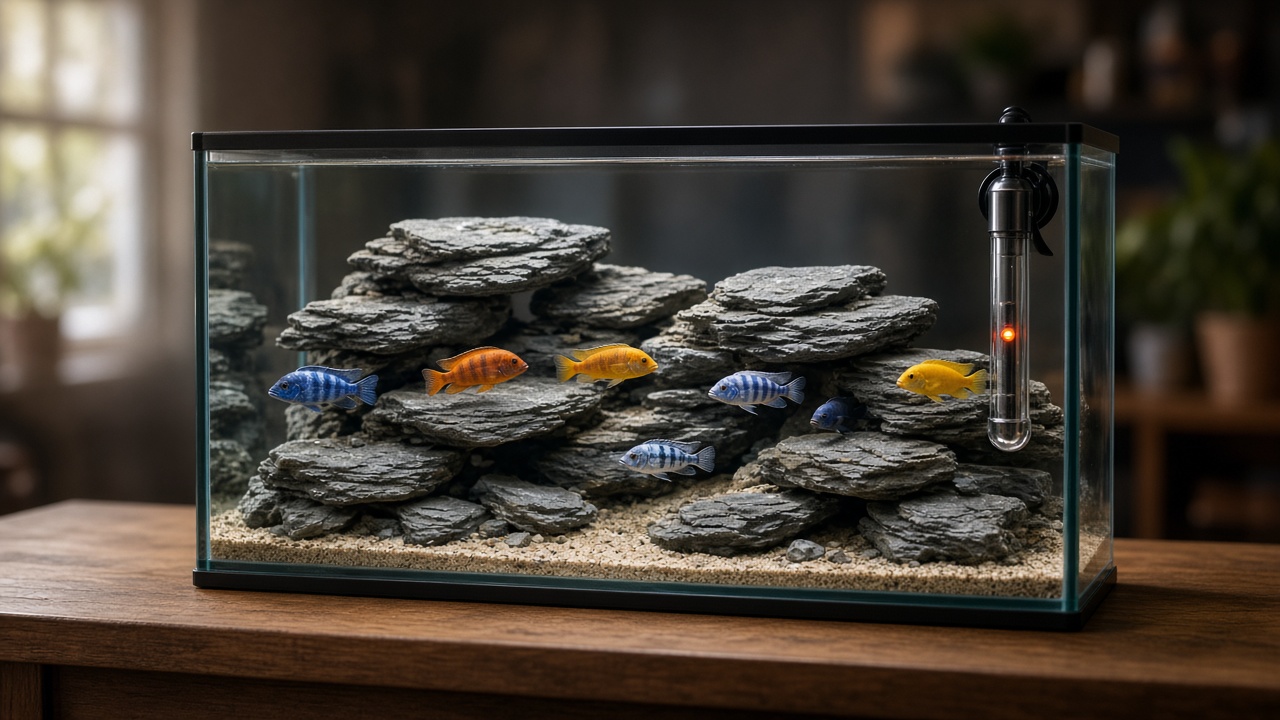
For a décor-only bloom, stay at the top of the 5 to 8 hour band. Do not leave the light on all day, and slide the tank off a sunny sill.
Aqueon’s FAQ says most fish do best when fed only what they can eat in 2 minutes or less, once or twice a day. Leftover food pollutes the water.
Aqueon’s FAQ also says a decorated 10 gallon tank holds about 8 gallons of actual water. Dose treatments on water volume, not the glass size on the box.
EPA’s National Primary Drinking Water Regulations list a nitrate MCL of 10 mg/L, measured as nitrogen. The nitrite MCL is 1 mg/L, also as nitrogen.
Those caps protect tap water for people, and they are not aquarium algae targets. If your tap sits near that nitrate cap, weekly changes will not dilute tank nitrate much, so test both the tank and the tap.
Green water and green spot algae
Green water lives in the water column, so wiping the glass will not clear it.
It often follows extra light plus leftover food. Aqueon’s FAQ says algae grows when nutrients and light are both high.
For green water, work this list:
- Move the tank off a sunny window, or block the sun.
- Set décor-only lights to 8 hours or less on a timer.
- Stay at Aqueon’s 2-minute feeding cap.
- Do the 10 percent weekly change, not a giant dump.
API’s product page for ALGAEFIX states it controls many algae types, including green water blooms and string or hair algae.
The same page says to add 1 ml for each 10 gallons (38 L), or 5 ml for each 50 gallons (190 L). Repeat every three days until the bloom is controlled, then add one dose per week.
Siphon or scrape dead algae after it lets go, and do not use this bottle with shrimp, crabs, or lobsters.
Dose on real water volume. In Aqueon’s 10 gallon example, that is about 8 gallons, not 10.
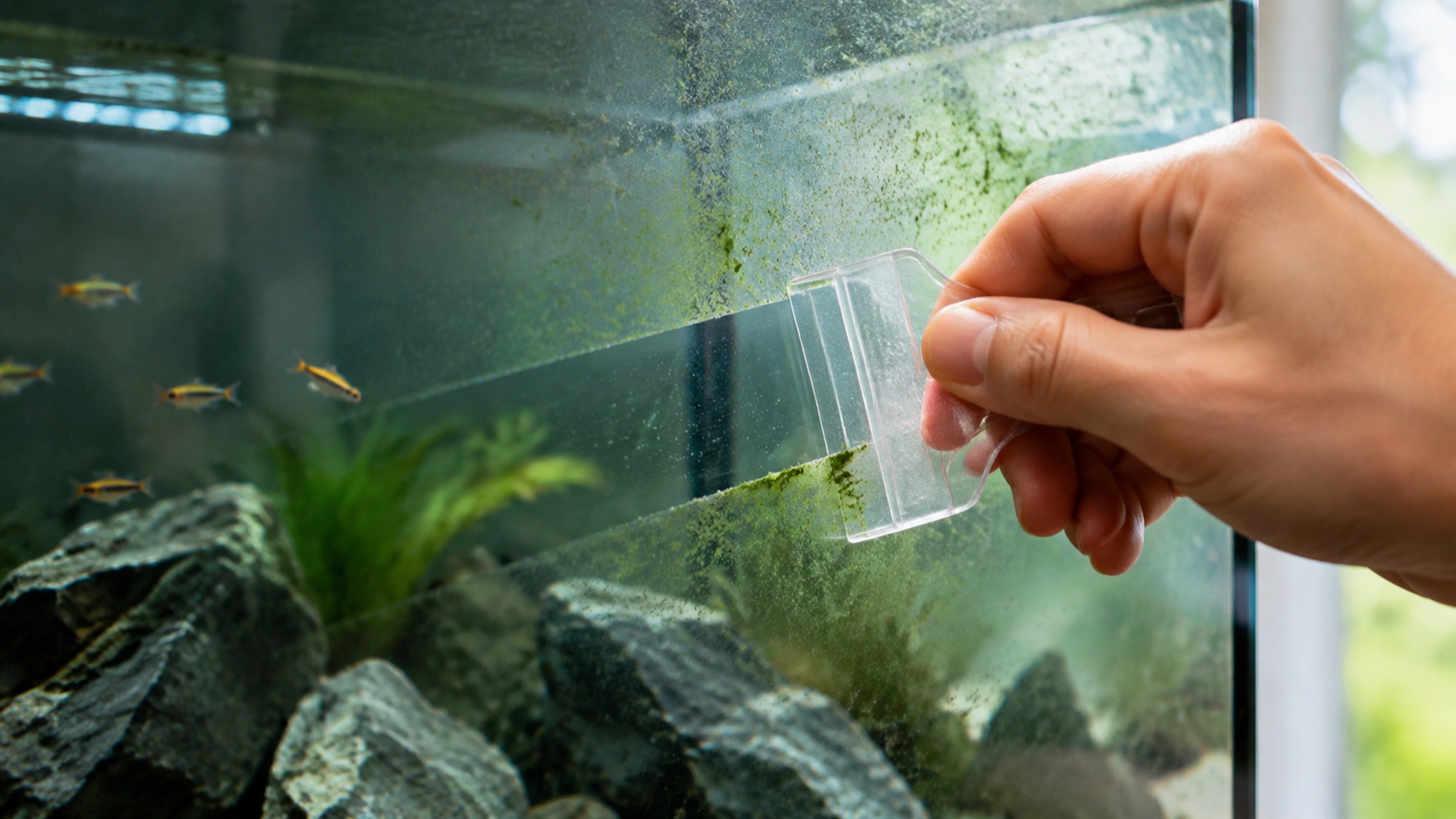
Green spot algae is the hard green dots on glass. Scrape them with a pad made for aquarium glass, then match Aqueon’s décor or planted light range.
Stay under the 50 percent water-change cap. If dots return on the same pane, the day is still too long.
Hair algae and brown diatoms
Hair algae is long green strands you can grab, so pull them out and then cut leftover food and extra light.
Work this list for hair algae:
- Twist strands around a toothbrush and lift them out.
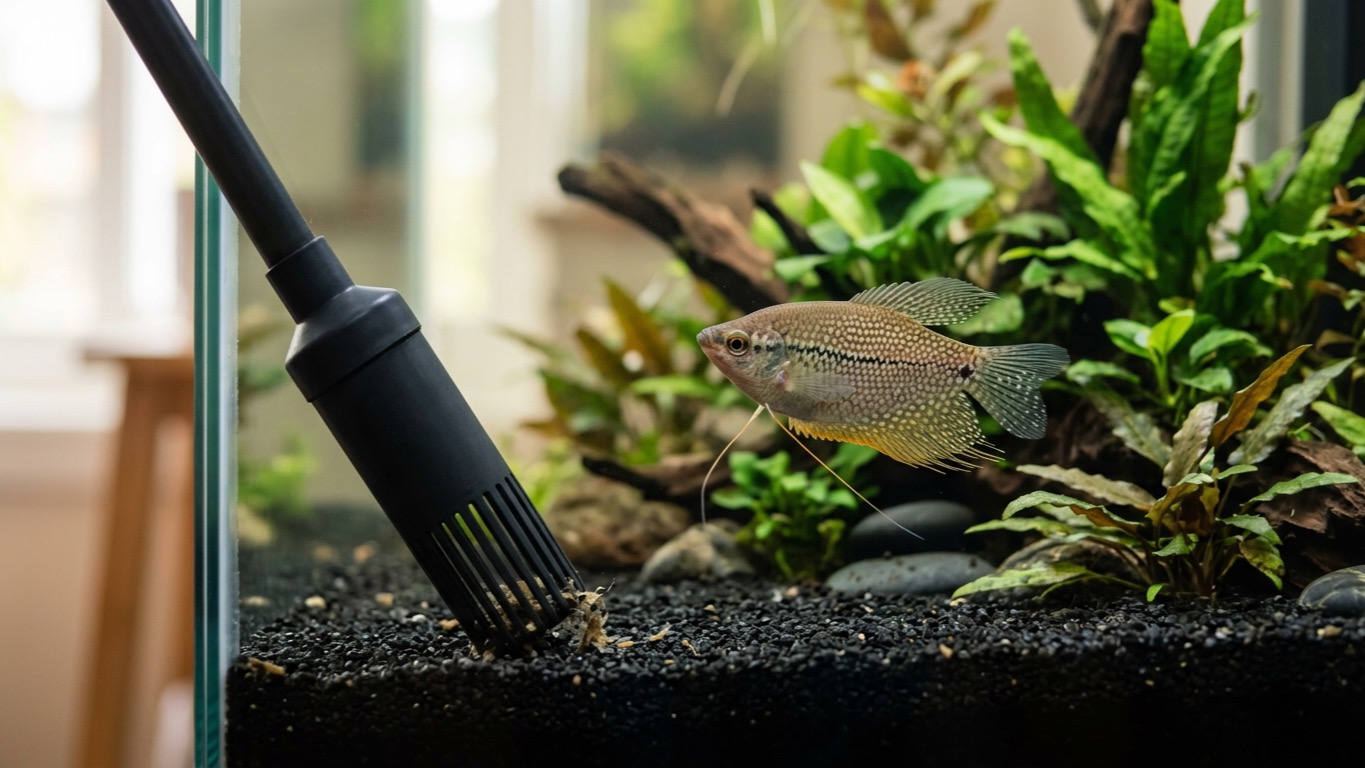
- Siphon fragments during the weekly 10 percent change.
- Keep feeding inside the 2-minute window.
- Reset décor-only lights to Aqueon’s 5 to 8 hours.
- If you use API ALGAEFIX, stay at 1 ml per 10 gallons every three days.
Do not shred the mat and walk away, because loose bits settle and restart on the next rock.
Brown diatoms look like soft brown dust that wipes off glass and sand. They show up most in new tanks that are still building bacteria.
That is a cycle problem more than a light problem, so finish the cycle before you chase every brown smear.
Our how long to cycle a fish tank guide walks through that wait. Wipe the dust, siphon it, and keep the small weekly change.
Aqueon’s FAQ says to change a filter cartridge about once per month. If the pad is packed with brown dust sooner, rinse it in a bucket of tank water.
Do not wash media under tap water while the tank is still cycling, because tap chlorine can knock back the film you need.
Black beard algae and blue-green slime
Black beard algae clings in dark tufts on décor, outlets, and leaf edges, and it does not wipe off like dust.
Seachem’s Flourish Excel page is a carbon source for planted tanks, and it is not sold as an algaecide.
That page notes some keepers see less black beard algae at the directed dose. Seachem says it does not make or market the bottle as an algicide.
Seachem’s Flourish Excel page states the start dose as 1 capful (5 mL) for every 40 L (10 US gallons).
Use that same start dose after a change larger than 40 percent. After that, use 1 capful for every 200 L (50 US gallons), daily or every other day.
Each cap thread is about 1 mL. The page says the carbon can stay available for up to 24 hours.
If you keep Anacharis, Seachem’s page says to use Excel every other day, not daily, because that plant is listed as sensitive.
For black beard algae, work this list:
- Trim leaves that are more tuft than leaf.
- Steady the light timer, and do not swing hours day to day.
- If you dose Flourish Excel, use Seachem’s capful math, not a guess.
- Raise flow so the outlet does not dump waste onto one rock.
Blue-green slime is a bacteria film, not true algae, and it peels in sheets that often sit in still corners.
Siphon the sheets out, then fix flow and leftover food, because a clogged cartridge can choke flow.
Our best fish tank filter cartridges guide covers pads you can rinse without tossing the whole insert.
Aqueon’s FAQ says to pick a filter rated one size larger than the tank, because extra flow helps still corners.
If slime returns on the same log, move that log into the current.
Filters, heat, cycling, and labeled bottles
Dead spots and wild temperature swings let slime and tufts hold on.
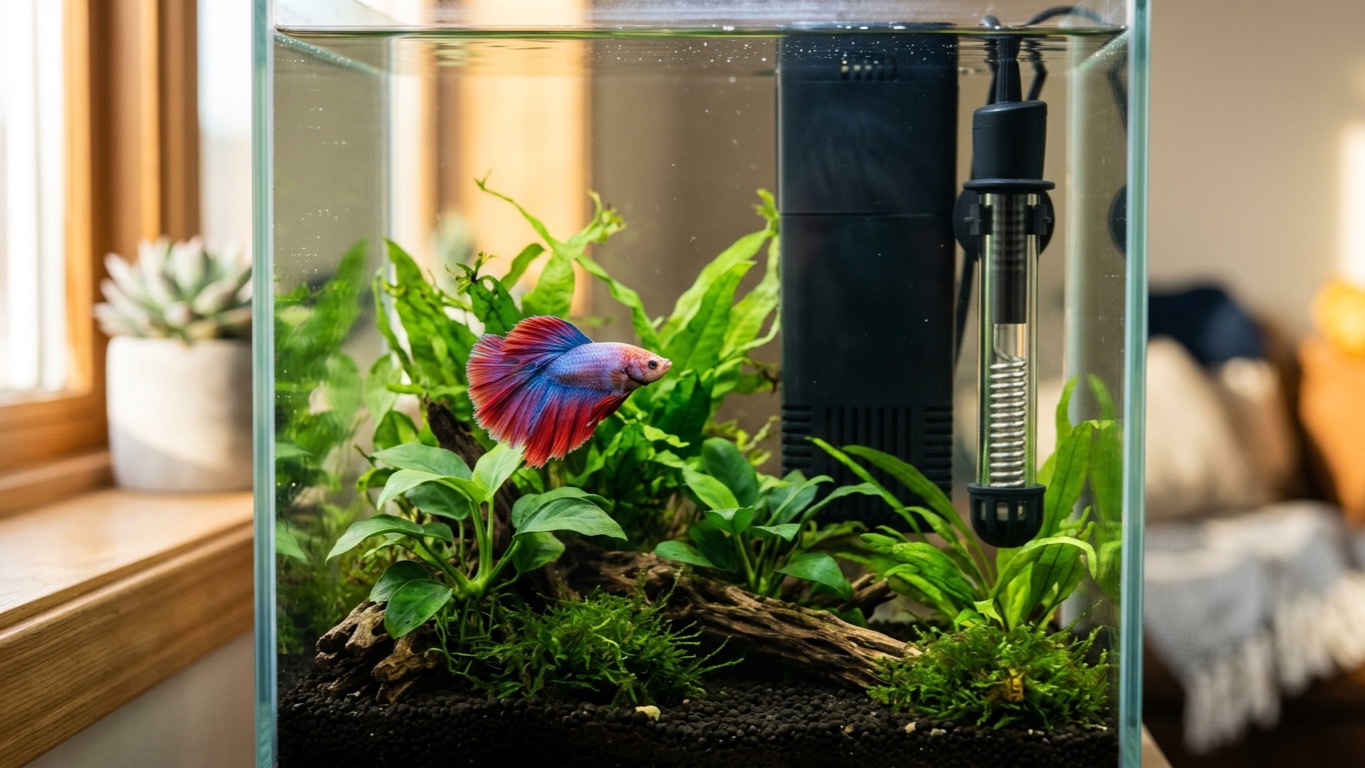
Aqueon’s FAQ says most tropical fish prefer 76 to 80°F. A filter and heater in one unit can keep that band steady while water moves.
Aqueon’s FAQ says filled tanks weigh about 10 pounds per gallon, so use a stand made for that load.
Keep the heater where flow passes it, because still water next to a heater can cook one corner and chill the rest.
If ammonia or nitrite still reads above zero, you are not done cycling, and algae will use that leftover waste.
Aqueon’s FAQ says many experts wait at least 48 to 72 hours after setup before the first fish. That is a start delay, not a finished cycle, so use the longer window in our cycling guide.
Do not scrape so hard that you strip new bacteria from décor. Aqueon’s FAQ says to check temperature, pH, and ammonia before you add fish, because many cities add chloramine.
A bottle is a last step, not a first step. Comparing published specs shows two jobs: API ALGAEFIX is labeled to control algae, and Flourish Excel is labeled as plant carbon.
API’s ALGAEFIX page says weekly doses will control growth once the bloom is down. It also says do not overdose, and it is not for freshwater crustaceans.
Seachem’s Flourish Excel page says Excel plus injected CO2 can help when more CO2 would push pH too low.
If you add a treatment, use this list:
- Calculate gallons of water, not the tank’s box size.
- Remove shrimp and other crustaceans before API ALGAEFIX.
- Repeat API’s 1 ml per 10 gallons every three days only until control, then weekly.
- After a change larger than 40 percent, use Seachem’s 5 mL per 10 US gallons start dose if you use Excel.
- Siphon dead mats so they do not rot and feed the next bloom.
Do not mix mystery doses, because one labeled plan at a time is enough.
FAQ
These answers cover the questions keepers ask after they match a type and start the shared steps.
How long does it take to get rid of algae in a fish tank?
Glass films can look better the same day you scrape them. Green water and tufts take longer because the cells stay in the water or cling hard.
Keep Aqueon’s 10 percent weekly change and a fixed light timer. If the bloom is still spreading after several weekly changes, match the type section again.
Does a water change get rid of green water?
A single change rarely clears green water, because the cells are mixed through the whole tank. Aqueon’s FAQ still calls a 10 percent weekly exchange ideal for lowering leftover waste.
Stay under the 50 percent cap on that same FAQ. Pair the small change with a shorter light day and less leftover food.
Can I use API ALGAEFIX with shrimp?
No, API’s ALGAEFIX page says not to use it with freshwater crustaceans, including shrimp, crabs, and lobsters.
If you keep shrimp, skip that bottle and stay with scrape, light, food, and water changes.
Is Seachem Flourish Excel an algaecide?
No, Seachem’s Flourish Excel page says the company does not produce or market it as an algicide.
Some keepers report less black beard algae at the directed dose, but a spot overdose on a plant can damage that plant.
How many hours should aquarium lights stay on?
Aqueon’s FAQ says live-plant tanks should get 10 to 12 hours of high-quality light each day, and décor-only tanks need 5 to 8 hours.
Keep the same hours every day on a timer, and never leave the light on all the time.
Why does brown algae keep coming back in a new tank?
Brown dust is common while a tank is still cycling, and the film often fades as bacteria take up more waste.
Wipe it, siphon it, and finish the cycle. Do not replace all filter media at once.
Will more plants stop algae?
Fast plants can use leftover nutrients that algae also want, but they do not cancel extra light or extra food.
Aqueon’s planted-tank light range is 10 to 12 hours. If you add plants, hold that range and keep the 10 percent weekly change.