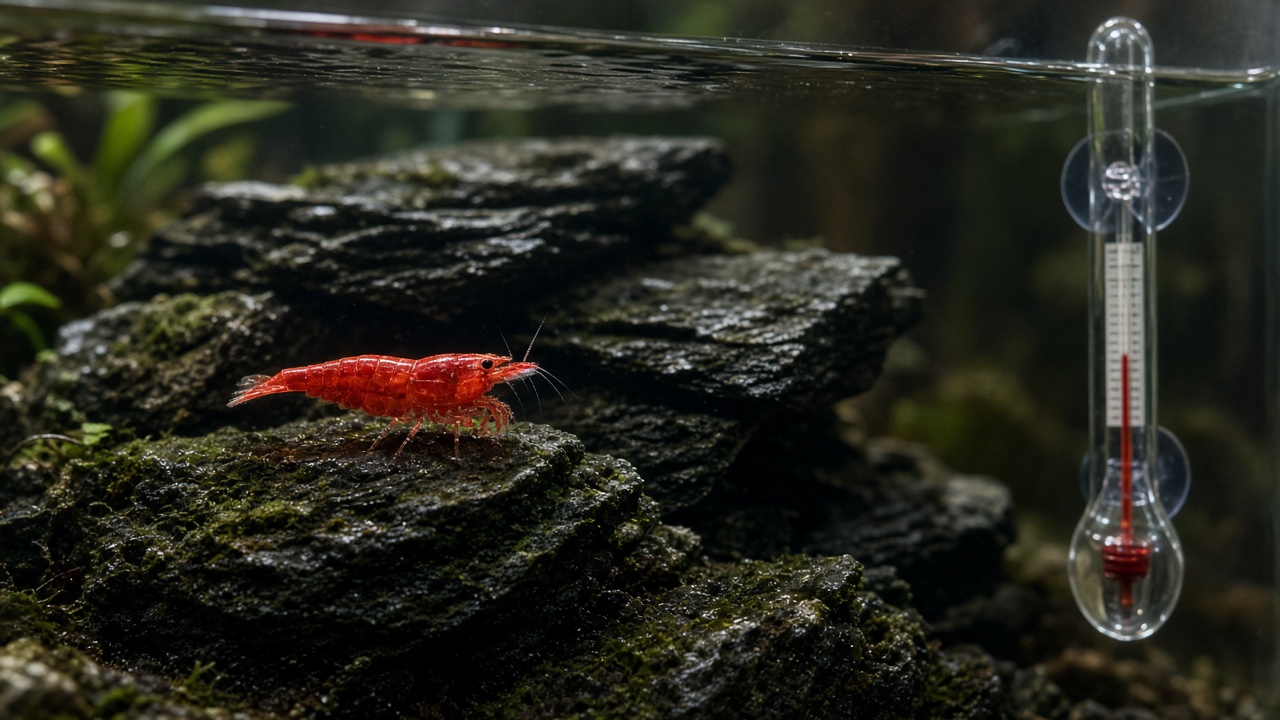
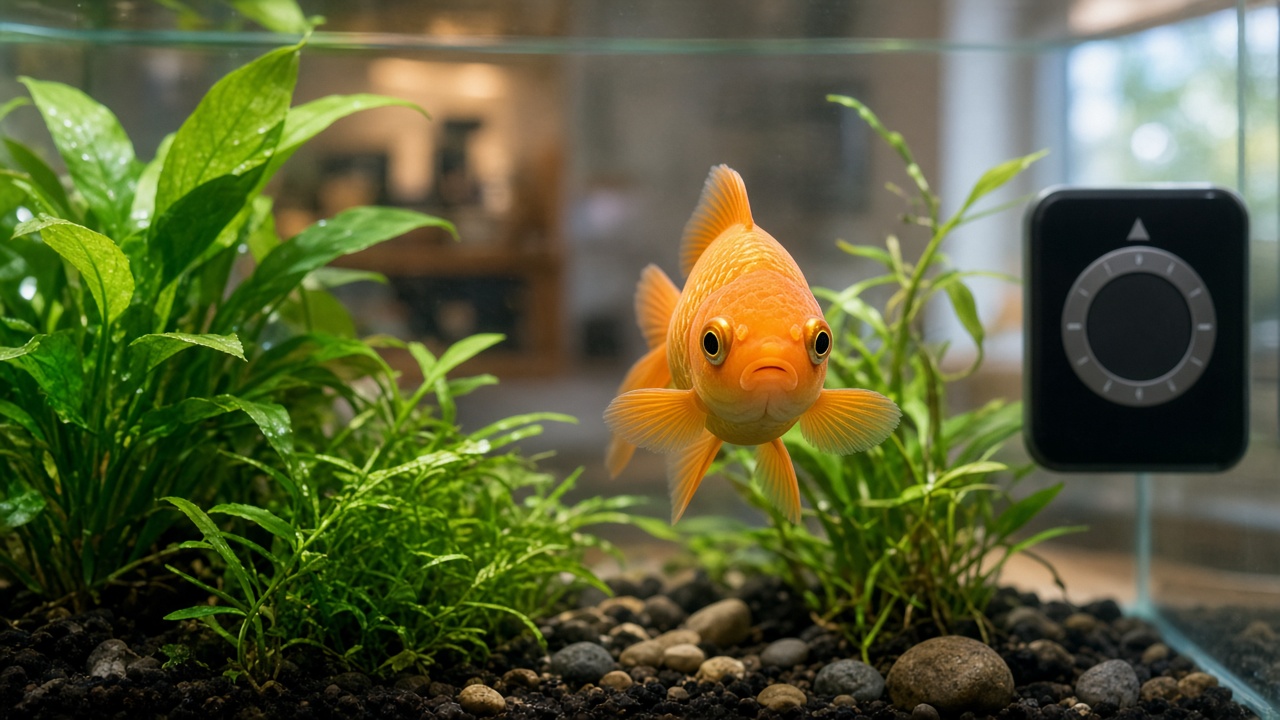
Quick answer: Keep goldfish in stable water between 65 and 75 F. Add a heater only if the room drops below that range. Skip tropical presets near 78 F.
Keep goldfish water between 65 and 75 F, and do not treat them as tropical fish.
This page is a spec-comparison guide for indoor goldfish tanks.
Our research team analyzed published care sheets and heater maker pages, and we used one selection rule.
Selection rule: We covered indoor aquarium goldfish and currently sold heaters whose maker page lists a numeric setting or preset plus a tank-size rating. We left out pond de-icers, chillers, unbranded sticks, and outdoor wintering.
The indoor range that answers the query
PetMD’s goldfish care sheet is the indoor target we use on this page.
PetMD’s goldfish care sheet lists 65–75 F as the water-temperature range, and the same sheet says goldfish are not suited for tropical aquariums.
That range covers the varieties named on that sheet, including fantail, oranda, ranchu, black moor, comet, and shubunkin.
OATA’s goldfish aquarium care sheet lists a wider guideline of 4–25 C, which is a published tolerance span, not a daily indoor target.
Use PetMD’s 65–75 F band for a heated or climate-controlled room, and treat OATA’s 4–25 C span as the wider published limit.
PetMD’s goldfish care sheet also sets a stability rule: temperature should not move more than plus or minus 2 F in 24 hours.
A tank can sit inside 65–75 F and still stress fish if it swings hard each day. Stability is part of the range, and it does not replace filtration or water tests.
Heater or not: a room-first rule
A goldfish tank needs a heater only when the room cannot hold 65–75 F.
OATA’s goldfish care sheet says a heater is not required unless the fish are kept in a very cold room. PetMD’s goldfish care sheet says to install a thermostat heater in cooler climates or colder seasons.
Those two pages agree on the trigger, so heat when the room, not the species, is the problem.
Use this check before you buy a heater:
- Read the tank with a thermometer in the morning and at night for three days.
- If both readings stay inside 65–75 F, you may skip a heater.
- If any reading falls below 65 F, add a heater with a listed setting at or below 65 F.
- If any reading rises above 75 F, cool the room or shade the tank. Do not add heat.
PetMD’s goldfish care sheet says to check tank temperature daily. OATA’s goldfish care sheet folds temperature into a weekly test routine, so daily checks catch overnight drops and weekly logs catch seasonal drift.
PetMD’s goldfish care sheet gives a watt rule of 2.5–5 watts per gallon. On that page, a 10-gallon tank needs a 25- to 50-watt heater.
The same sheet says tanks over 50 gallons may need two smaller heaters on opposite sides to limit cold spots, not to chase tropical heat.
OATA’s goldfish care sheet says an adult goldfish needs at least a 100-litre aquarium and adds 50 litres for each extra adult.
Larger water volumes change temperature more slowly, which is one reason OATA’s sheet favors the largest practical tank.
Heater settings that miss the goldfish band
Many home heaters are built for tropical setpoints, not for 65 F.
We call this comparison the WaterPuppy Setpoint Floor Check, a side-by-side read of listed settings, not a lab trial.
PetMD’s goldfish care sheet starts at 65 F and stops at 75 F, and we compared that band with four currently sold heater lines.
Maker pages list these settings:
- The Aqueon Pro Adjustable Heater page lists 68–88 F, with a thermostat accurate to plus or minus 1 F.
- The EHEIM thermocontrol page lists 18–34 C, with control accuracy of plus or minus 0.5 C.
- The hygger 273 Controllable Aquarium Heater page lists 59–93 F (15–34 C).
- The Tetra HT Submersible Heaters page lists a fixed 78 F preset.
EHEIM’s 18 C floor sits just under 65 F, while Aqueon’s 68 F floor sits 3 F above PetMD’s 65 F start.
hygger’s 59 F floor sits 6 F below PetMD’s start, and Tetra’s 78 F preset sits 3 F above PetMD’s 75 F ceiling.
Two of those four listed settings cannot hold the full 65–75 F band. Aqueon starts at 68 F, and Tetra locks at 78 F.
EHEIM’s listed floor and hygger’s listed floor both reach 65 F.
| Product | Listed setting | Listed accuracy | Listed tank rating | Other listed spec |
|---|---|---|---|---|
| Aqueon Pro Adjustable Heater, 50 W | 68–88 F | ±1 F | Up to 20 gal | 1.5 × 1.75 × 9 in |
| EHEIM thermocontrol | 18–34 C | ±0.5 C | 20–1,000 L, 9 sizes | About 170 cm cable |
| hygger 273 Controllable Aquarium Heater, 100 W | 59–93 F | No ± figure listed | 10–20 gal | Cuts off above 97 F |
| Tetra HT10 Submersible Heater | Preset 78 F | Not listed | 2–10 gal | 50 W |
| Tetra HT30 Submersible Heater | Preset 78 F | Not listed | 10–30 gal | 100 W |
Aqueon’s Pro page lists five wattages: 50, 100, 150, 200, and 300, and the specs we used are the 50-watt row on that page.
hygger’s 273 page covers 25–300 W for tanks from 2–80 gal. Tetra’s HT page also lists HT40 at 150 W for 30–40 gal and HT55 at 200 W for 40–55 gal. Those two Tetra sizes still hold 78 F.
EHEIM’s thermocontrol page says the line can be recalibrated by plus or minus 2 C and lists automatic dry-run shut-off.
If you need a heater for goldfish, pick a listed setting that can sit at 65–72 F. Do not buy a 78 F preset for a goldfish-only tank.
A betta tank is a different job, because bettas are kept at tropical heat that sits above this goldfish band.
Seasons: winter heat, summer heat, air conditioning
Seasonal room swings, not the calendar month, decide whether you heat or cool.
In winter, unheated rooms and drafty windows can drop a tank below 65 F overnight. OATA’s goldfish care sheet flags that case as a very cold room.
If winter nights fall below 65 F, use a heater whose listed setting can hold 65–70 F. Recheck the thermometer after the first cold night.
In summer, direct sun and a closed room can push water above 75 F. OATA’s goldfish care sheet says to keep the tank out of direct sunlight and away from heat sources.
If summer readings pass 75 F, take these steps:
- Move the tank off a sunny sill.
- Run the room air conditioner if you have one.
- Increase surface movement so gas exchange stays high.
- Do not add a heater “just in case.”
Air conditioning can also overshoot, and a tank beside a vent can fall below 65 F while the rest of the house feels fine.
PetMD’s goldfish care sheet says newly added water should match the tank temperature, which matters more in January and July than in a stable spring.
OATA’s goldfish care sheet recommends a 25% water change at least once a week. PetMD’s goldfish care sheet lists 10–25% every two to four weeks, and a cold winter bucket is a hidden swing if you skip matching.
OATA’s goldfish care sheet says spawning can be induced by slowly raising temperature to about 20 C. That 20 C figure is a published breeding cue, not a year-round display target.
Daily swings and water-change matching
A two-degree daily swing is the published indoor limit, not a goal to use up.
PetMD’s goldfish care sheet says temperature should not fluctuate more than plus or minus 2 F in 24 hours. Plan water changes and heater use around that number.
Use this matching routine:
- Measure tank water with the same thermometer you trust.
- Measure the replacement water in the bucket before you pour.
- Add water only when the two readings match within 2 F.
- Recheck the tank one hour after the change.
OATA’s goldfish care sheet describes a floating-bag method for new fish. Float the bag for 10 minutes, then add tank water for up to 20 minutes.
That slow mix is about temperature and chemistry, not a shortcut for a heater that is set too high.
hygger’s 273 page says to unplug the heater and let it cool for 15 minutes before a water change. Do not run a glass heater dry.
Aqueon’s Pro page says the unit is fully submersible and shuts off if it overheats, so still treat any heater as a wet-only device.
PetMD’s goldfish care sheet says an aquarium filter should turn the tank over at least four times an hour. For a 20-gallon tank, that means at least 80 gallons per hour.
Flow spreads heat, but it does not replace a correct setpoint.
What temperature stress looks like
Color fades, appetite drops, and breathing speeds up when water leaves the published band.
OATA’s goldfish care sheet lists color going darker or paler as a watch point, plus faster or slower gill movement and a drop in feeding.
If a goldfish turns white after a cold snap or a hot week, log the temperature first. Color change has more than one cause, and heat swings are one of them.
PetMD’s goldfish care sheet lists an average lifespan of 30-plus years with proper care. OATA’s goldfish care sheet cites common reports of 6–8 years, and up to 20 years or more.
Warm water speeds metabolism and waste, which can shorten the long life described on those pages. See how long goldfish live for the space and water side of that clock.
OATA’s goldfish care sheet lists hanging at the surface or sitting on the bottom as swimming changes to watch. Those signs can follow a swing even when the new number looks close.
If you see those signs, test temperature, ammonia, and nitrite the same day. OATA’s goldfish care sheet says ammonia and nitrite should stay at zero milligrams per litre.
OATA’s goldfish care sheet also caps nitrate at 20 milligrams per litre above tap-water levels, so heat does not excuse a dirty tank.
FAQ
Do goldfish need a heater?
Not if the room holds the tank at 65–75 F. OATA’s goldfish care sheet says a heater is not required unless the tank is in a very cold room. PetMD’s goldfish care sheet says to add a thermostat heater in cooler climates or colder seasons.
Can goldfish live at 78 F?
That number sits above PetMD’s 75 F ceiling. Tetra’s HT heater page lists a fixed 78 F preset for its whole HT line. A goldfish-only tank should not use that preset as the plan.
What temperature is too cold for an indoor goldfish tank?
For day-to-day indoor care, treat anything under 65 F as too cold. That is the floor on PetMD’s goldfish care sheet. OATA’s goldfish care sheet lists a guideline down to 4 C, which is a published tolerance, not a home target.
Do fancy goldfish need warmer water than commons?
PetMD’s goldfish care sheet applies 65–75 F to fantails, orandas, ranchu, and comets on the same page. Hold the same band for both body types.
How fast can I change the tank temperature?
Stay inside PetMD’s plus-or-minus 2 F in 24 hours rule. Do not chase a new number in one water change. Match new water to the tank, then wait and recheck.
Do goldfish need a heater in summer?
Usually no. Summer risk is water that runs too warm, not too cold. OATA’s goldfish care sheet says to keep the tank out of direct sun and away from heat sources.
Can goldfish share a tank with a betta?
Not on temperature. PetMD’s goldfish care sheet says goldfish are not suited for tropical aquariums. A betta’s water temperature target sits in the tropical band that this goldfish page tells you to avoid.