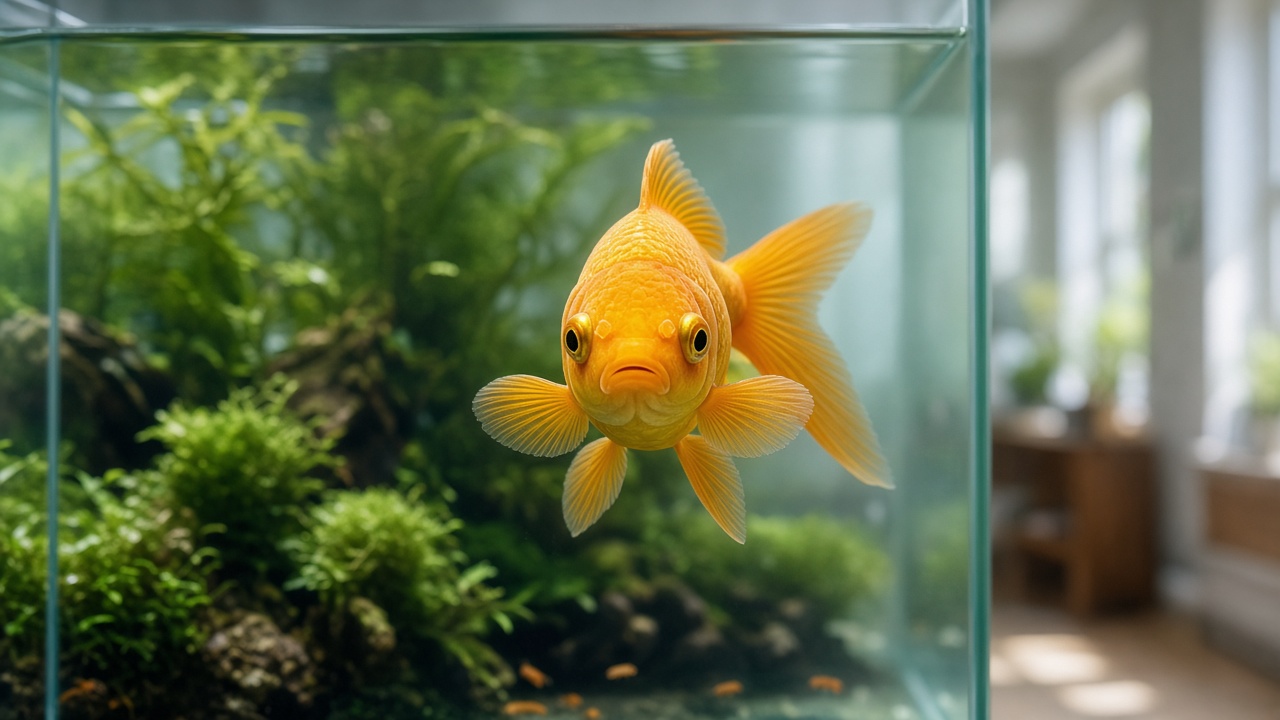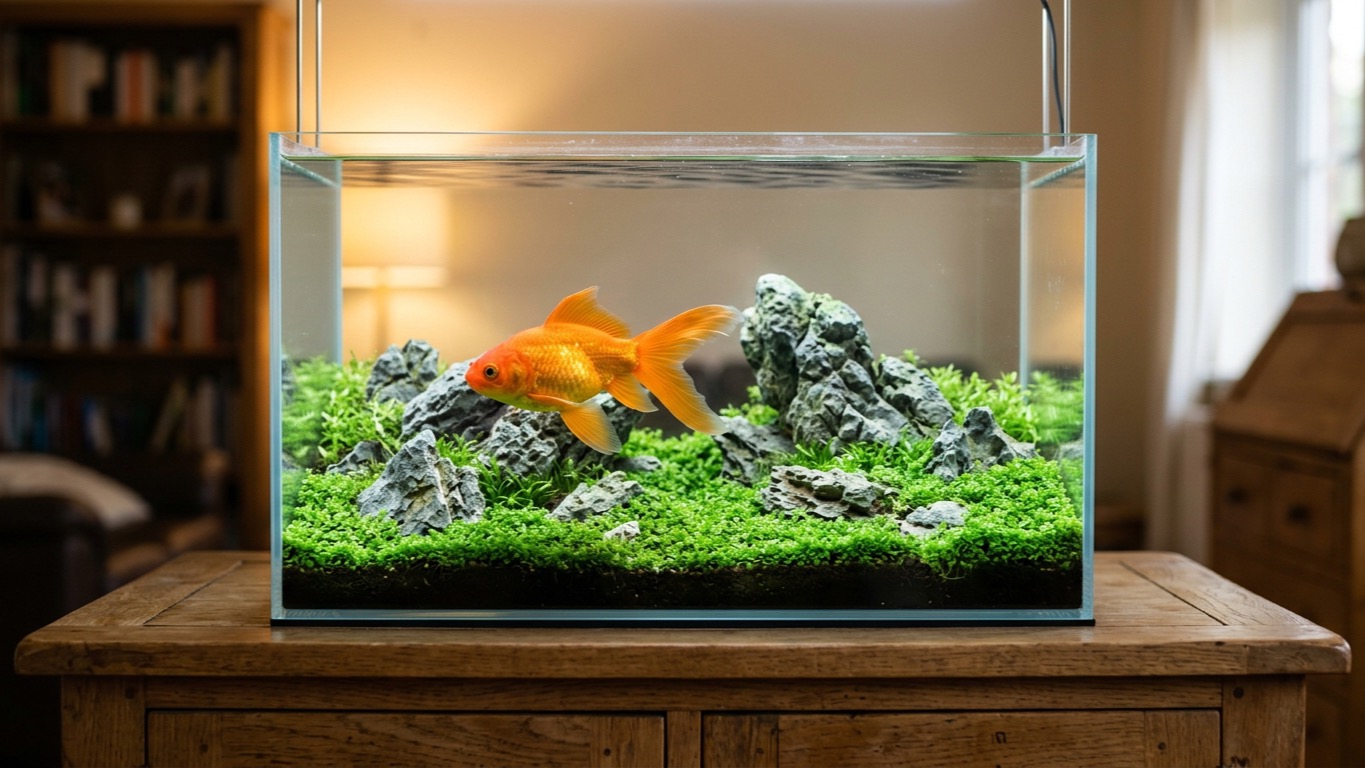
Quick answer: Plan for 10 to 15 years, not a carnival month. Guinness World Records lists that range as the average. The fish reaches it only in a filtered tank sized for an adult.
Guinness World Records lists the average goldfish lifespan as 10 to 15 years. This page compares published lifespan and housing figures;
What the published lifespan numbers say
Four publishers print four clocks, and the gap between those clocks is the real story.
Our research team analyzed lifespan lines from Guinness World Records, the U.S. Geological Survey, the Ornamental Aquatic Trade Association, and Aqueon. We left every unattributed “two-year average” from other sites off this page.
Published figures from those four organizations:
- Guinness World Records lists an average of 10 to 15 years, plus Tish at 43 years and Fred at 40 years.
- The U.S. Geological Survey species profile lists a usual life span of 6 to 7 years and a recorded maximum of 30 years.
- The Ornamental Aquatic Trade Association care sheet reports many fish living 6 to 8 years, and some living 20 years or more.
- Aqueon’s goldfish care guide states that goldfish can live over 20 years in captivity.
Those are not the same claim, because a wild-stock clock and a pet-care clock answer different questions.
Guinness World Records names Tish as the oldest verified goldfish. He was won in 1956 and died on 6 August 1999 at age 43. Guinness also lists Tosh at 19 years in 1976 and Fred at 40 years in 1980.
Guinness World Records notes reports from China of fish older than 50 years, and it states those reports have not been authenticated.
The USGS profile is a wild-species sheet, and its 6 to 7 year usual span sits below the Guinness pet average. That gap is expected, because wild fish face predators, winters, and food gaps that a living room does not.
What got into this article, and what did not
We used one selection rule: a number enters this page only if Guinness, USGS, OATA, Aqueon, or Tetra printed it.
That rule kept this article on published clocks and housing floors, and it kept carnival stories, koi records, and uncited bowl-death claims out. We covered home aquariums for common, comet, shubunkin, and fancy goldfish, and
We compared maker and agency pages, and ”
The 26-gallon adult floor
OATA’s adult space rule is larger than many pet-store starter kits, and that gap tracks the short lives people remember.
OATA’s care sheet says an adult needs at least a 100 litre aquarium, plus 50 litres for each extra adult. 100 litres is about 26 U.S. gallons, and 50 litres is about 13 U.S. gallons.
We call that converted OATA floor the 26-Gallon Adult Floor, which is a unit change, not a new study.
Aqueon’s goldfish care guide prints a lower housing line, and the published floors in gallons are:
- OATA adult floor: about 26 gallons for the first adult, plus about 13 gallons for each extra adult
- Aqueon common, comet, or shubunkin floor: 20 gallons per adult
- Aqueon fancy floor: 10 gallons per adult
The first adult on OATA’s sheet needs about 2.6 times the water Aqueon lists for one fancy adult, the largest housing split we found.
Aqueon’s guide says goldfish should never be kept in bowls, small aquariums, or any unfiltered container, yet Guinness still describes Tish in a bowl. Those two published pictures do not agree, so this desk does not treat a record fish as a housing model.
OATA says aquarium goldfish commonly reach 25 cm, about 10 inches, and some reach 40 cm or more. The U.S. Geological Survey size line is close to that upper report:
- Typical standard length: 120 to 220 mm, about 5 to 9 inches
- Maximum standard length cited: 410 mm, about 16 inches
- Ecology note: some fish reach 59 cm total length and 3.0 kg
- Common wild size in that note: 15 to 20 cm total length and 100 to 300 g
A 2-inch store fish is not the adult you are housing, so plan the tank for the published adult, not the bag.
Fancy bodies and slim bodies are not the same roommate
Slim single-tail goldfish need more swimming room than short-bodied fancy fish, and the care sheets split them on purpose.
Aqueon lists comets and shubunkins with common goldfish at 20 gallons per adult, and it lists fancy strains at 10 gallons per adult. Aqueon names fantails, orandas, ryukins, moors, and ranchus as fancies, and OATA does not split its 100 litre floor by body type.
OATA says non-fancy fish can move to an outdoor pond, and it warns against housing comet goldfish with fancy goldfish. Comets swim faster and often take the food, and the same OATA sheet reports fin-nipping of slower fancy fish.
Aqueon makes a similar point: commons, comets, and shubunkins may become too rough for smaller fancy fish as they grow. If you keep one body type, match that published floor; if you mix types, the faster fish sets the space and the food risk.
Water numbers that sit next to long lives
Ammonia and nitrite at zero show up on the care sheets next to every long-life claim.
The Ornamental Aquatic Trade Association lists these water targets:
- Temperature: 4 to 25°C
- pH: 6.0 to 8.0
- Ammonia: 0 mg per litre
- Nitrite: 0 mg per litre
- Nitrate: no more than 20 mg per litre above normal tap water
- Hardness: 5 to 19°dH
Aqueon’s goldfish care guide lists a tighter comfort band:
- Fancy goldfish: 68° to 74°F
- Comets and shubunkins: 60° to 70°F
- Ideal pH: 7.0 to 8.4
Those temperature lines overlap, but they are not identical. OATA’s 4°C floor is pond-cold, while Aqueon’s fancy band is room temperature.
Aqueon says a heater is optional in many rooms, and OATA says a heater is not required unless the room is very cold. Both warn against sudden swings, and Aqueon says rapid changes in temperature or chemistry can be fatal.
The U.S. Geological Survey profile cites survival between 0 and 41°C and laboratory pH tolerance from 4.5 to 10.5. A tolerance range is not a home target, so use the OATA and Aqueon tank bands, not the wild extremes.
OATA says to test water at least once a week, because goldfish are very dirty and can raise ammonia and nitrite fast. OATA describes “new tank syndrome,” when new fish outpace filter bacteria and ammonia and nitrite rise.
A tank needs a cycle before it holds a goldfish, and our page on how long to cycle a fish tank walks through that wait.
Published water-change sizes differ:
- OATA: a 25% partial change at least once every week
- Aqueon: 10% weekly, or 25% every 2 weeks
Pick one schedule and keep it, and do not skip weeks because the water looks clear.
Aqueon also lists one tablespoon of aquarium or sea salt per 5 gallons as an optional health aid, a published dose on Aqueon’s page.
How much to feed without shortening the clock
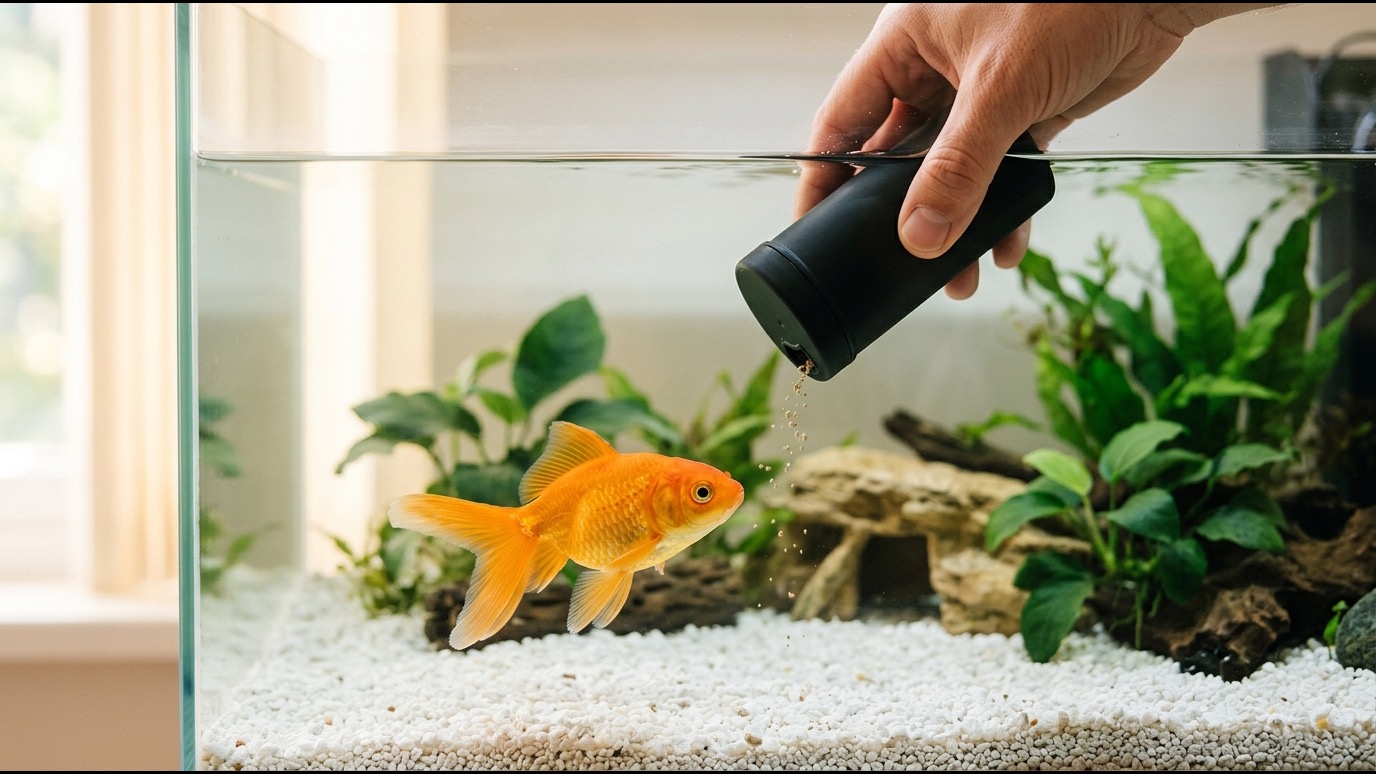
Overfeeding is the fastest way to turn a large tank into a short life.
The three feeding rules we found do not match:
- OATA: feed what they can eat in a few minutes, once a day
- Aqueon: feed what they can consume in 2 to 3 minutes, once or twice a day
- Tetra’s page for Select Goldfish Flakes: feed two to three times daily, only what they can eat in three minutes
OATA says goldfish need more carbohydrates than many other pet fish, so use a food made for goldfish, not a generic tropical flake.
Tetra’s page for Select Goldfish Flakes prints this guaranteed analysis:
- Crude protein: 42.0% minimum
- Crude fat: 11.0% minimum
- Crude fiber: 2.0% maximum
- Moisture: 6.5% maximum
- Vitamin C: 300 mg/kg minimum
That same Tetra page lists package sizes of 1 oz, 2.2 oz, and 7.06 oz.
Aqueon says goldfish may gulp air on floating food and then float upside down, so soak flake food briefly and avoid floating pellets.
A simple way to stay inside all three published windows:
- Use a goldfish flake or pellet, not a random tropical mix.
- Offer a pinch, then stop when food is gone.
- Stay inside a two- to three-minute eating window.
- Start at one feeding a day if waste is climbing.
- Do not add a second or third feeding if leftover food remains.
Leftover food becomes ammonia, which is the clock you can see on a test kit.
Color change is not a lifespan clock
A goldfish that turns pale or silver is not automatically dying of old age.
Guinness World Records says Tish’s scales turned from bright orange to silver as he aged, so color shift can mark years or water stress. Aqueon notes many colors and body forms, all still Carassius auratus, and color variety is not a published lifespan table.
If color change is slow and the fish still eats, start with water tests. If it is fast, test ammonia and nitrite the same day.
Our page on why goldfish turn white separates aging fade from sudden loss.
Aqueon says larger goldfish eat many live plants, with possible exceptions of Cryptocorynes, Java fern, and Anubias. Those same three plants appear in our live plants for betta fish guide, though goldfish may still uproot them.
OATA says live plants are ideal when the fish will not eat them all, and plastic plants are the fallback on that sheet. Do not release a goldfish outdoors, because OATA states that release is illegal in its guidance and can harm wild water.
The U.S. Geological Survey profile says goldfish are established or reported in every U.S. state except Alaska. A long-lived pet does not belong in a creek.
FAQ
How long do goldfish live?
Guinness World Records lists the average as 10 to 15 years and a verified record of 43 years. OATA reports many lives of 6 to 8 years and some of 20 or more. Aqueon states that proper care can push captivity past 20 years.
How big of a tank does one adult goldfish need?
OATA says at least 100 litres for one adult, about 26 U.S. gallons, plus 50 litres for each extra adult. Aqueon says 20 gallons per adult common, comet, or shubunkin, and 10 gallons per adult fancy. Both say a filter is required, and Aqueon says bowls and unfiltered containers are not housing.
How often should I change the water?
OATA strongly recommends a 25% partial change at least once a week, while Aqueon lists 10% each week or 25% every two weeks. Test ammonia and nitrite weekly either way, because OATA sets both of those readings at zero.
Do goldfish need a heater?
OATA says a heater is not required unless the room is very cold. Aqueon says many rooms already sit near its 68° to 74°F fancy band. Comets and shubunkins on the Aqueon page sit at 60° to 70°F, and both warn against sudden temperature swings.
How much should I feed a goldfish?
OATA says once a day, only what they eat in a few minutes. Aqueon says once or twice a day, in 2 to 3 minutes.
Tetra’s Select Goldfish Flakes page says two to three times daily, in three minutes. If leftover food rises, drop back to the OATA once-a-day line.
Can a goldfish really live 40 years?
Guinness World Records lists Fred at 40 years and Tish at 43 years, which are verified record fish, not a typical pet clock. Plan on the Guinness average of 10 to 15 years, and treat anything past 20 years, as Aqueon describes, as a long, well-managed life.