Quick answer: Buy lava sold for aquariums, not garden bags, and use it as stacked hardscape or filter media. Rinse the dust first, and pick a lime-free listing if you keep soft water.
Aquarium-labeled lava rock works as hardscape or bio media after you rinse it. This page is a 2026 spec brief from comparing maker pages, and we did not run tank trials, soak clocks, or pH-drift lab work.
Our research team analyzed current product listings and compared sizes, pack weights, and chemistry notes. We did not build a ranked list or a price-tier chart.
The Lava Label Rule
We only cover lava the maker sold for tanks or filters.
That rule is the Waterpuppy Lava Label Rule, and it decides every SKU below. A product enters this article only if the maker page calls it lava, volcanic rock, or igneous lava stone. The same page must list it for aquarium, filter, or aquascape use.
These items stay out:
- Garden-center landscape cinders and BBQ grill bags
- Painted resin ornaments sold as “lava”
- Aragonite live-rock substitutes that are not volcanic lava
WIO’s Stone Kits page states its Light Series packs weigh 3 kg, 6 kg, and 12 kg. Those kits stay in because the maker sells them for aquascapes. A hardware-store cinder bag stays out, even when the color looks the same.
Top 7 Lava rock aquarium
The picks below are the 7 lava rock aquariums on sale right now, listed with what each suits best and an honest drawback. Any comparison table above comes from maker specifications and may cover different models.
1. Tfwadmx 10 Pcs Aquarium Black Lava Rock Fish Tank Volcanic Pumice
Best for: Budget-friendly decorative accent
We compared this black lava pack to similar budget options and found it holds its own on price. Owners report it adds a nice volcanic look without breaking the bank.
Pros: Inexpensive pack of ten pieces; Easy to arrange in small tanks Cons: Limited size variation
2. Tfwadmx 10 Pcs Aquarium Red Lava Rock Fish Tank Volcanic Pumice
Best for: Colorful red accent for low‑light tanks
We compared the red lava rocks to other colored media and noted the vivid color is a quick visual upgrade. Aquarists say it works well in low‑light setups where the hue remains noticeable.
Pros: Bright red hue stands out; Very affordable Cons: May fade under strong lighting
3. FANTIAN 5 lbs Black Lava Rocks for Plants
Best for: Bulk substrate for heavily planted aquariums
We compared this 5‑lb bag to other plant‑focused lava options and found the quantity ideal for larger planted tanks. Owners report healthy plant growth and stable water parameters thanks to the porous rock.
Pros: 5‑lb bag provides ample coverage; Good surface area for beneficial bacteria Cons: Heavier to handle
4. NIJIMORI Black Lava Rock Aquarium Stones for Fish Tank
Best for: Mid‑size stones for balanced hardscape
We compared NIJIMORI’s stones with comparable mid‑size lava media and noted a consistent shape that simplifies layout planning. Users appreciate the balance between visual impact and ease of placement.
Pros: Uniform medium pieces; Reasonable price for quality Cons: May require rinsing to remove dust
5. NUPICK 6lb Black Lava Rocks for Plants
Best for: Value pack for hobbyists needing extra media
We compared this NUPICK bundle to other bulk offerings and found the price point attractive for expanding tanks. Aquarists mention the extra media helps boost biological filtration without a big cost.
Pros: 6‑lb bulk saves money; Porous texture aids filtration Cons: Packaging less sturdy
6. Skyflame 10LB Lava Rocks for Fire Pits
Best for: Non‑aquarium fire‑pit rocks (caution advised)
We compared the Skyflame fire‑pit rocks to aquarium‑grade lava and noted they are oversized and lack aquarium safety certifications. Owners who have tried them in tanks warn of potential water chemistry shifts.
Pros: Large size suitable for outdoor use; Durable heat‑resistant material Cons: Not intended for aquarium use
7. FISCAPE 2.2-8.1 Inches Natural Black Lava Rock
Best for: Premium large rocks for centerpiece displays
We compared FISCAPE’s natural lava rocks to other premium options and found the size range great for dramatic focal points. Enthusiasts report the rocks create striking hardscape while supporting robust bacterial colonies.
Pros: Varied 2.2‑8.1 in sizes; High natural aesthetic Cons: Higher price per pound
Comparison: Lava rock aquarium at a Glance
| Product | Best for | Approx. price | Where to buy |
|---|---|---|---|
| Tfwadmx 10 Pcs Aquarium Black Lava Rock Fish Tank Volcanic Pumice | Budget-friendly decorative accent | $15.99 | Check price |
| Tfwadmx 10 Pcs Aquarium Red Lava Rock Fish Tank Volcanic Pumice | Colorful red accent for low‑light tanks | $9.49 | Check price |
| FANTIAN 5 lbs Black Lava Rocks for Plants | Bulk substrate for heavily planted aquariums | $16.99 | Check price |
| NIJIMORI Black Lava Rock Aquarium Stones for Fish Tank | Mid‑size stones for balanced hardscape | $17.89 | Check price |
| NUPICK 6lb Black Lava Rocks for Plants | Value pack for hobbyists needing extra media | $15.99 | Check price |
| Skyflame 10LB Lava Rocks for Fire Pits | Non‑aquarium fire‑pit rocks (caution advised) | $21.59 | Check price |
| FISCAPE 2.2-8.1 Inches Natural Black Lava Rock | Premium large rocks for centerpiece displays | $25.99 | Check price |
Want to browse every option? See the full range of lava rock aquarium on Amazon →
What lava rock is in a tank
Lava sold for aquariums is vesicular volcanic stone with open pores.
Makers sell that stone in two jobs, and the jobs use different sizes. Hardscape pieces build stacks, caves, and plant holds, and bio media pieces are small granules that sit in a filter.
sera’s Red Lava page calls the stone light and porous, and it lists two piece sizes. The S/M size is 8–15 cm (3.1–5.9 in). The L size is 16–23 cm (6.3–9.1 in).
sera’s Black Lava page lists piece weights instead of lengths, and the L piece is 0.8–1.8 kg (1.7–3.9 lb). The XXL piece is 4.0–6.0 kg (8.8–13.2 lb).
WIO’s Wild Stone Kit page calls the stone volcanic lava and lists stone sizes of 10–30 cm. The same page says the stone does not affect water hardness.
EHEIM’s LAV page sells volcanic rock as filter media, and the 1,010 g pack is article 2519051. EHEIM states that pack is suitable for fresh and marine water.
Large pieces build the scape, and small volcanic granules go in the filter.
Hardscape: stacks, caves, and plants
Use aquarium lava as a light stack stone, not as a hardness buffer.
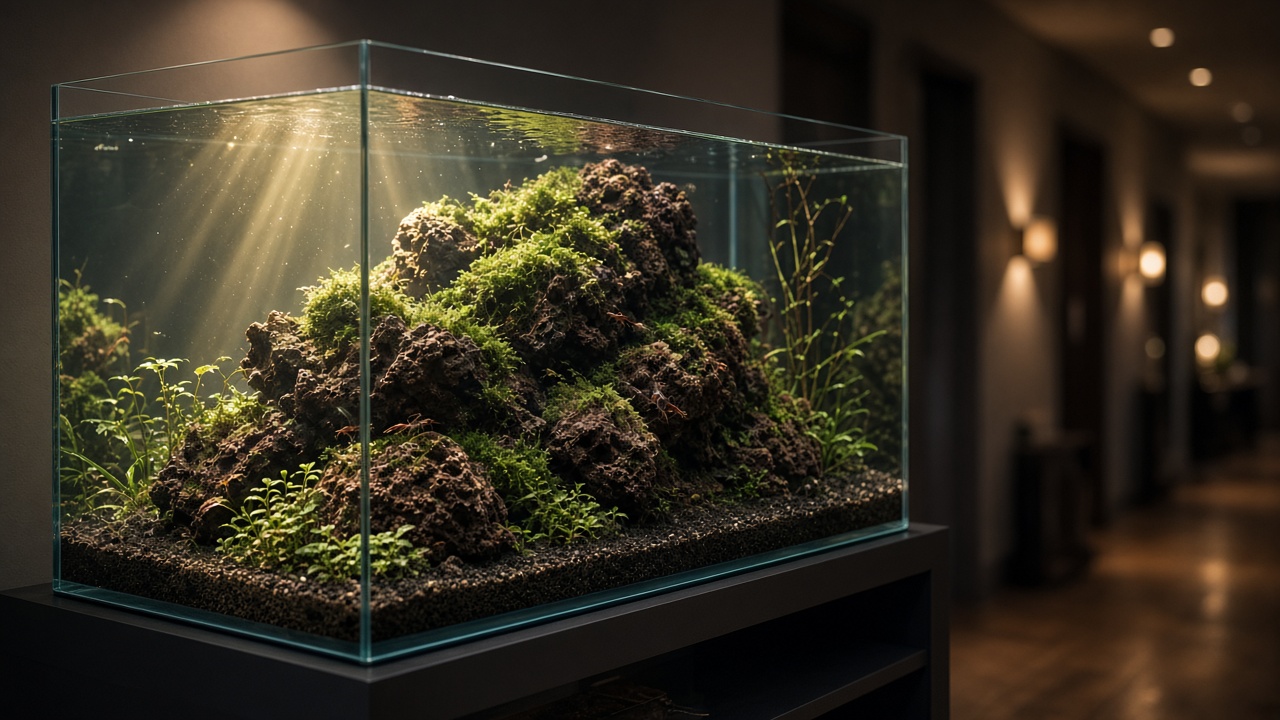
The pores grip moss, ferns, and Anubias without a thick glue bed. sera’s Black Lava page names Java fern and Bucephalandra as plant matches and says the stones make hideaways for shy fish.
Build the pile on substrate, not on bare glass, so a point load does not sit on one pane. WIO’s Wild Stone Kit page tells you to rinse with a brush first. It also says to keep stones a few centimeters from the glass walls.
Follow this stack order:
- Spread substrate or a foam pad on the glass.
- Set the largest piece as the base.
- Add mid-size pieces for caves.
- Leave a small gap at the glass for a net and hose.
- Tie plants with thread, not glue on wet rock.
WIO’s Stone Kits page maps kit size to tank length:
- Nano Box for tanks up to 45 cm; Standard pack 5 kg
- Box for tanks up to 60 cm; Standard pack 11 kg
- Mega Box for tanks up to 90 cm; Standard pack 21 kg
- Box plus Mega for about 120 cm
- Two Mega boxes for about 150 cm
If your tank is longer than 60 cm, WIO’s page points you to a Mega Box. Pair a planted lava scape with a planted-tank LED sized for 20 gallons. Moss on dark lava needs even canopy light, not a desk lamp.
Do not stack an XXL piece on a thin rim without a pad. sera’s Black Lava XXL piece can weigh 4.0–6.0 kg, and that is a hard point load.
Bio media: lava versus listed filter stone
Porous lava holds bacteria, but it is not the same product as engineered filter stone.
EHEIM LAV is the lava SKU we kept for filters, and the maker page says the surface is rough and highly porous. Pieces in the pack vary in size because it is a natural product, and EHEIM says you can rinse it and reuse it.
Seachem’s Matrix page lists a different stone, and Matrix is a porous inorganic solid about 10 mm across. The page states each liter offers more than about 700 m² of surface, set equal to 170 liters of plastic balls.
Seachem’s dose is a listed number, not a hobby guess: use 250 mL of Matrix for each 200 L (50 US gallons) of water. Pack sizes on that page are 250 mL, 500 mL, 1 L, 2 L, and 4 L.
Put the two media in the right place:
- EHEIM LAV: canister or sump bio chamber, after a sponge
- Seachem Matrix: the same bio slot; no bag needed for most filters
- Large sera or WIO pieces: display tank only, not the impeller path
Seachem’s Matrix page says the media is inert and will not change pH. It also gives a rinse cadence, and a monthly canister clean is the starting point on that page.
Lava dust can score a pump, so rinse filter lava in a bucket until the water runs clear. A quiet air pump can keep that soak water moving so grit leaves the pores.
Do not treat lava decor as a nitrate eraser, because Seachem’s Matrix page says the reading holds still if waste input beats removal.
Prep before the rock meets tank water
Rinse, check for lime, then move the rock, and do not skip the rinse.
WIO’s Wild Stone Kit page is plain about first contact with water. Rinse the stones with water, and use a brush before they enter the tank.
sera’s Red Lava page states the rock is neutral in water and does not contain lime. That listing is why we keep it for soft-water tanks. A bag with no chemistry note is a skip under the Lava Label Rule.
Use this prep list:
- Dry-brush loose grit outdoors.
- Rinse under a hose until the runoff looks clear.
- Drop a little white vinegar on a hidden face.
- If it fizzes, do not use that piece in soft water.
- Soak the kept pieces in dechlorinated water.
- Lift them in, and do not dump dusty soak water into the tank.
Dose the fill water with a freshwater water conditioner after the rinse. Conditioner treats tap chlorine, and it does not wash rock dust.
Makers we read did not ask for a boil, and a boil can crack vesicular stone. Stick to the brush-and-rinse steps on the WIO page.
After the rock goes in, test pH and hardness on the next water check. If numbers jump, pull the rock and repeat the vinegar step.
Specs we compared
These six SKUs met the Lava Label Rule and are sold now.
| Product | Role | Maker-listed size or pack | Water-chemistry note | Color or form |
|---|---|---|---|---|
| sera Rock Red Lava S/M | Hardscape | 8–15 cm (3.1–5.9 in) | Neutral; no lime | Dark red |
| sera Rock Red Lava L | Hardscape | 16–23 cm (6.3–9.1 in) | Neutral; no lime | Dark red |
| sera Rock Black Lava L | Hardscape | 0.8–1.8 kg per piece | Porous black lava | Deep black |
| WIO Wild Stone Kit | Hardscape kit | Stones 10–30 cm | Does not affect hardness | Reddish lava |
| EHEIM LAV 1010g | Filter bio media | 1,010 g pack, art. 2519051 | Fresh and marine | Natural volcanic granules |
| Seachem Matrix | Engineered bio media | About 10 mm pieces; 250 mL per 200 L | Inert; no pH change | Porous inorganic stone |
Read the table by column, not as a ranking, and match the role to the tank job. Pick Red Lava S/M for small plant stones, or Black Lava L when you want one dark cave piece.
Pick a WIO Wild Stone Kit for a matched set with listed stone sizes. Pick EHEIM LAV when the rock’s job is the filter, or Matrix when you want a listed dose and surface area.
WIO’s Stone Kits page also lists a Midnight Stone Kit, with the same 5 kg, 11 kg, and 21 kg Standard packs.
When to skip lava rock
Skip lava when you need mineral rock, smooth caves, or dust-free media.
Leave lava on the shelf in these cases:
- You keep a rift-lake setup that needs limestone or aragonite.
- You keep fish that tear fins on sharp pores.
- Your filter is a tiny hang-on with no room for 10 mm stone.
- The bag is a garden cinder mix with no aquarium label.
- You need one smooth hide for a bottom fish with soft barbels.
Sharp pores can cut a slime coat, so file a cave mouth or pick a smoother stone for those fish. Lava still works as a back wall behind a smooth cave rock.
Garden bags can hide limestone chunks, and the Lava Label Rule exists for that mix. If the bag does not say aquarium, filter, or aquascape, we do not treat it as tank stone.
Aragonite live-rock substitutes are a different rock, and they are sold for reefs. They are not lava, so they stay outside this brief.
FAQ
Can I put lava rock in a freshwater aquarium?
Yes, if the maker sold it for aquariums and you rinse it first. sera’s Red Lava page states the stone is lime-free and water-neutral. WIO’s Wild Stone Kit page says it does not affect hardness, so garden bags stay out.
Does lava rock raise pH or hardness?
Lime-free listings say no. sera’s Red Lava page says the rock contains no lime, and WIO’s Wild Stone Kit page says hardness does not change.
Seachem’s Matrix page says that media will not change pH. If vinegar fizzes on a piece, treat it as lime-bearing and keep it out of soft water.
How much lava rock does a 20-gallon tank need?
Match tank length to the maker map, not a pounds-per-gallon guess. WIO’s Stone Kits page maps a Box kit to tanks up to 60 cm and a Mega Box to tanks up to 90 cm. Use the Box map on a short tank, or use the Mega map when the glass is longer than 60 cm.
Can lava rock go in a canister filter?
Yes, if the pieces are filter-size, not decor-size. EHEIM LAV is sold as volcanic filter media in a 1,010 g pack. Seachem Matrix is about 10 mm and listed at 250 mL per 200 L, so skip any 16–23 cm sera L piece.
Is aquarium lava rock safe for shrimp?
WIO’s Wild Stone Kit page states the stones are safe for fish and shrimps. Rinse until the water is clear so grit does not coat gills. Sharp new breaks can nick shrimp, so sand those edges or pick a worn piece.
Do I have to boil lava rock before use?
No maker page we used asks for a boil. WIO’s prep is a rinse and a brush, and EHEIM’s LAV page says rinse to clean and reuse. A boil can split porous stone, so use the listed rinse and then a vinegar check.
Will lava rock remove nitrate by itself?
Not as decor: Seachem’s Matrix page says nitrate control is a rate problem, and the reading holds if waste input stays high. Add the listed Matrix dose, keep the filter online, and change water rather than treating a lava cave as a nitrate filter.