Quick answer: Put a coarse mechanical mat first so solids never reach the bacteria. Then add a high-surface bio media such as Evolution Aqua K1 Micro or Seachem Pond Matrix. Use Seachem Pond PhosGuard only after a phosphate test is high.
A working pond stack uses mechanical media first, bio media second, and chemical media only after a phosphate test is high. This page compares five sold pond media and does not include pond trials, ranks, or hatchery visits.
Our research team analyzed maker pages and converted each listed surface figure to the same units.
What we included, and what we left out
We only covered pond media whose maker page lists a quoteable size, dose, or surface number.
That number could be a sheet size, a bag size, a dose, or a surface-area figure. We left out aquarium-only rings, lava rock, and spare foams cut for one closed filter body.
The five media below cover the three jobs a pond filter does.
- Mechanical catch, shown by rigid fiber mats
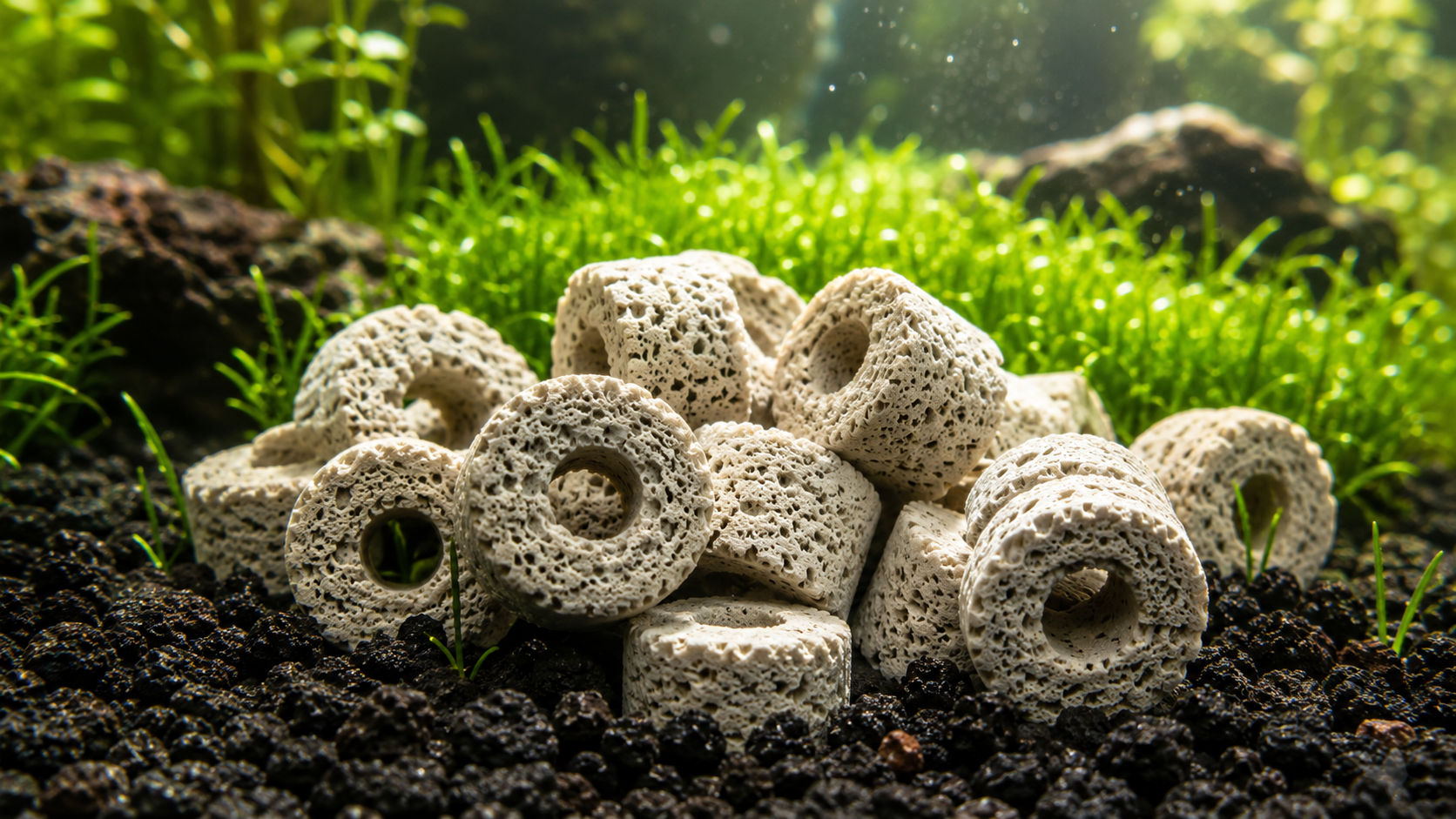
- Biological housing, shown by moving-bed wheels and porous ceramic
- Chemical binding, shown by a spherical phosphate adsorbent
This is a pond guide, and tank media is a different stack. For indoor tanks, see our freshwater bio media guide.
Top 7 Pond filter media
The picks below are the 7 pond filter medias on sale right now, listed with what each suits best and an honest drawback. Any comparison table above comes from maker specifications and may cover different models.
1. Classic Koi Pond Filter Pad FINE
Best for: Polishing water in high-end koi setups
We compared various mechanical media and found this fine pad excels at capturing microscopic debris. Owners report it significantly improves water clarity in koi ponds when used as a final stage.
Pros: Traps fine particulates; Durable construction Cons: Clogs quickly
2. Aquatic Experts Classic Koi Pond Filter Pad COARSE
Best for: Initial debris removal in heavy-load ponds
This coarse pad is a staple for pre-filtration. Owners report that its open structure handles large waste effectively without restricting water flow too early in the cycle.
Pros: Prevents premature clogging; Easy to rinse Cons: Allows smaller particles through
3. ALEGI Aquarium Sponge Filter Pad
Best for: Small-scale biological filtration for nano ponds
For smaller water features, this sponge offers a simple biological solution. We compared its utility to larger media and found it ideal for hobbyists who need a budget-friendly, low-maintenance option.
Pros: Very affordable; Compact footprint Cons: Limited surface area
4. Koral Filters Koi Pond and Aquarium Filter Media Roll
Best for: Customizing large-scale DIY filtration systems
The roll format allows pond owners to tailor their filtration to unique box dimensions. Owners report that it is a practical choice for those maintaining multiple systems who need bulk media on hand.
Pros: Highly versatile sizing; Cost-effective bulk format Cons: Requires manual cutting
5. Demiwise Fine Pond Filter Pad 18" x 36" x 1"
Best for: Replacement media for standard 18x36 filter boxes
This pad is designed for standard filter housings, making it a convenient drop-in replacement. We compared its density to generic alternatives and found it offers a reliable balance of flow and filtration.
Pros: Precise dimensions; Consistent thickness Cons: Not suitable for heavy sludge
6. UBeesize Aquarium Filter Floss
Best for: Final water polishing and debris capture
Filter floss is often the secret to crystal-clear water. Owners report that while it requires frequent replacement, it is unmatched at catching the fine dust that other pads miss.
Pros: Excellent fine filtration; Dense material Cons: Difficult to clean thoroughly
7. BBJARESKY Koi Pond and Aquarium Filter Media
Best for: General purpose mechanical and biological support
This media serves as a reliable all-rounder for mixed-use filtration. We compared its performance to specialized pads and found that owners appreciate its ability to house beneficial bacteria while filtering out waste.
Pros: Versatile application; Good value Cons: Variable density consistency
Comparison: Pond filter media at a Glance
| Product | Best for | Approx. price | Where to buy |
|---|---|---|---|
| Classic Koi Pond Filter Pad FINE | Polishing water in high-end koi setups | $49.99 | Check price |
| Aquatic Experts Classic Koi Pond Filter Pad COARSE | Initial debris removal in heavy-load ponds | $49.99 | Check price |
| ALEGI Aquarium Sponge Filter Pad | Small-scale biological filtration for nano ponds | $8.99 | Check price |
| Koral Filters Koi Pond and Aquarium Filter Media Roll | Customizing large-scale DIY filtration systems | $33.91 | Check price |
| Demiwise Fine Pond Filter Pad 18" x 36" x 1" | Replacement media for standard 18x36 filter boxes | $33.05 | Check price |
| UBeesize Aquarium Filter Floss | Final water polishing and debris capture | $17.95 | Check price |
| BBJARESKY Koi Pond and Aquarium Filter Media | General purpose mechanical and biological support | $19.99 | Check price |
Want to browse every option? See the full range of pond filter media on Amazon →
Mechanical media: catch solids before they rot
Mechanical media is the first layer, and it must catch solids before they reach bacteria.
A clogged bio chamber is a sludge bed that steals oxygen from ammonia-converting bacteria.
Two rigid mats on this page list cut sizes you can verify.
- The Aquascape Medium Density Rigid Filter Mat page lists a 24 inch by 39 inch sheet that is 1.5 inches thick.
- The Matala Water Technology page lists a rigid SM365 blue full sheet at 48 inches by 39 inches by 1.6 inches.
Matala’s page lists a specific surface of 111 ± 3 square feet per cubic foot for SM365 and 94 percent free volume.
Matala lists four color densities, so use them in order from coarse to fine.
- Black SM190 for large debris
- Green SM290 for mid-size waste
- Blue SM365 for fines
- Gray FSM460 only as a last polish
Aquascape’s mat page does not list a surface-area figure. It tells you to cut the sheet with a serrated knife and to stack more than one density.
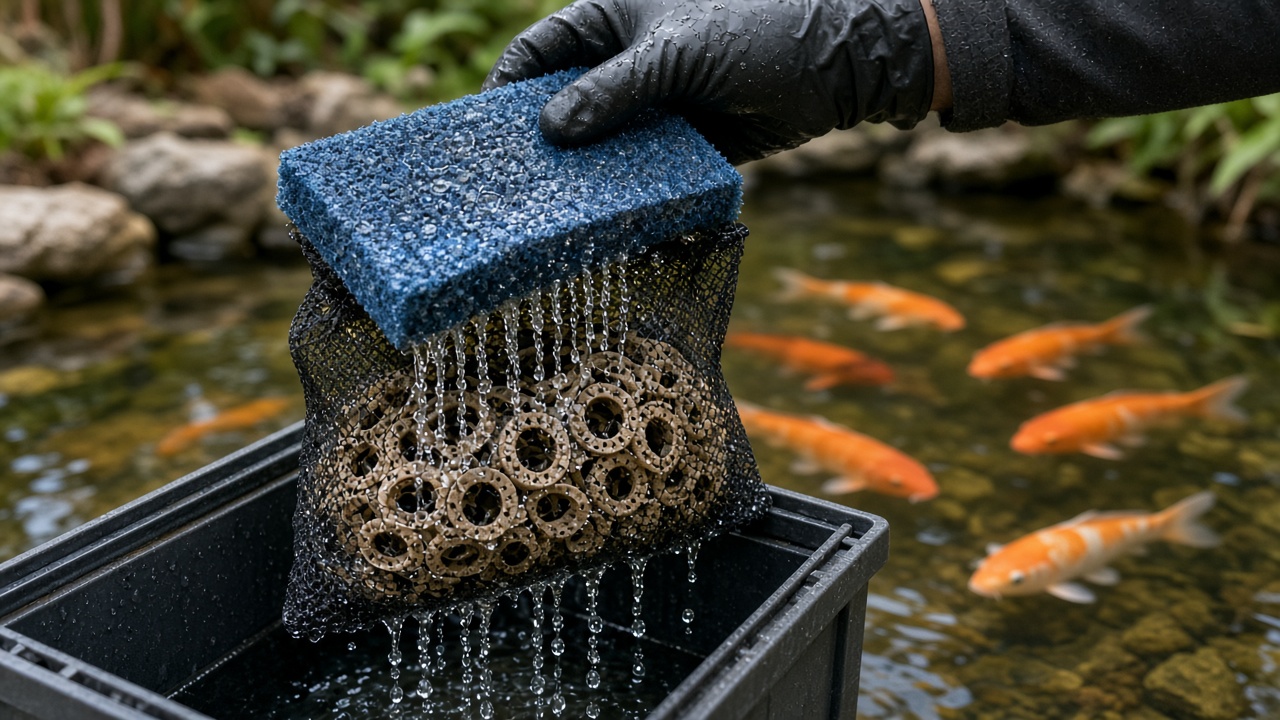
Rinse mechanical mats in a bucket of pond water, because tap water can strip the film you still want on a dual-use mat.
Bio media: give bacteria a listed surface
Bio media is the second layer, and it houses bacteria that convert ammonia.
EPA’s 2013 freshwater ammonia notice lists an acute value of 17 mg TAN per liter at pH 7 and 20 degrees C. The same notice lists a chronic value of 1.9 mg TAN per liter at that pH and temperature.
Those EPA numbers are for wild waters, but they still show why ammonia cannot sit in a stocked pond.
Two bio products on this page list surface figures you can quote.
- Evolution Aqua’s K1 Micro page lists a 7 mm diameter and a 9 mm length.
- The same page lists 1,400 square meters per cubic meter of total surface.
- It also lists 950 square meters per cubic meter of protected surface.
- Seachem’s Pond Matrix page lists 160,000 square centimeters per liter.
Our research team converted Pond Matrix’s 160,000 cm²/L figure to 16,000 m² per m³. That is about 11 times the total surface Evolution Aqua lists for K1 Micro.
The two products are not the same shape, so the conversion is a unit check, not a winner call.
Use each product the way its maker page describes the dose or housing.
- Evolution Aqua lists K1 Micro for bead filters, conventional pond filters, and aquarium filters.
- Bags are sold in 25 liter and 50 liter sizes.
- Seachem’s Pond Matrix page says to use 1 to 2 liters for each 100 US gallons.
- The directions also say 2 liters for each 200 gallons.
- Pond Matrix is sold in 1 liter, 2 liter, 4 liter, and 20 liter sizes.
- Seachem says it need not be replaced.
K1 Micro is a floating wheel and needs air or flow so the wheels tumble. Pond Matrix is a static ceramic that should sit after a mechanical stage.
Do not rinse bio media under a hard tap stream, and a gentle swirl in pond water is enough.
Small patio tubs sometimes use a canister instead of a box filter. If that is your housing, see our canister filter picks because the media order stays the same.
Chemical media: use only after a test
Chemical media is the third layer, and it is optional.
It binds a dissolved nutrient and does not replace pads or bacteria.
Seachem’s Pond PhosGuard page says a 2 liter size treats over 600 US gallons. The same page says each liter treats about 100 to 300 gallons for 1 to 3 months.
That dose range depends on load, and a heavy fish load sits at the low end of the gallon range.
Pond PhosGuard is sold in 1 liter, 2 liter, 4 liter, and 20 liter sizes. Seachem says to place it in the chemical module, or in the highest-flow path if the filter has no module.
Seachem also gives a heat warning on first contact with water. Pre-wet 1 liter of product with 2 liters of water before it goes in the filter.
Do not leave a phosphate binder in place just in case. Test phosphate first, and skip this layer if the reading is already low.
Five products compared by published attributes
This table compares five products by maker-listed attributes, not by rank.
Empty cells mean the maker page did not publish that figure for the column.
| Product | Job | Maker-listed size or dose | Maker-listed surface or treat range | Housing the maker names |
|---|---|---|---|---|
| Evolution Aqua K1 Micro | Bio, moving bed | 7 mm × 9 mm pieces; 25 L and 50 L bags | 1,400 m²/m³ total; 950 m²/m³ protected | Bead filters and conventional pond filters |
| Seachem Pond Matrix | Bio, static ceramic | 1–2 L per 100 US gallons; 1 L, 2 L, 4 L, 20 L packs | 160,000 cm²/L | Any pond filter; wet or wet-dry |
| Aquascape Medium Density Rigid Filter Mat (SKU 80004) | Mechanical and bio mat | 24 in × 39 in × 1.5 in | No surface-area figure listed | Skimmer boxes and pond filters |
| Matala SM365 Blue | Mechanical and bio mat | Full sheet 48 in × 39 in × 1.6 in | 111 ± 3 ft²/ft³; 94% free volume | Progressive-density stacks |
| Seachem Pond PhosGuard | Chemical phosphate binder | 1 L treats about 100–300 gallons for 1–3 months | 2 L treats over 600 US gallons | Chemical module or high-flow path |
Of the five rows, only Pond Matrix and Pond PhosGuard list a gallons-per-liter dose. The two mats list sheet sizes, and K1 Micro lists piece size and bag volume.
That split is why one bag of media is not a full filter. You still need a solids stage in front of any bio charge.
How to load a pond filter in order
Load the chamber so water hits coarse solids media first, then bio media, then chemical media only if a test says so.
Use this order in a gravity box, a pressure filter, or a barrel.
- Coarse mechanical mat or black Matala SM190
- Medium mechanical mat, such as the Aquascape 1.5 inch medium-density sheet or Matala SM290
- Fine mechanical polish, such as Matala SM365
- Bio charge: K1 Micro if you have air, or Pond Matrix if the chamber is static
- Pond PhosGuard only after a phosphate test is high
Keep each stage in its own mesh bag or tray if the filter allows it. That lets you rinse the front mat without dumping the bio charge.
Match volume to the maker page, not to a store bin.
- Pond Matrix: 1 to 2 liters per 100 US gallons
- Pond PhosGuard: about 1 liter per 100 to 300 gallons, then replace after 1 to 3 months
- K1 Micro: fill the moving-bed chamber so the wheels can still tumble
Evolution Aqua sells K1 Micro in 25 liter and 50 liter bags.
A tiny patio tub on a hang-on filter is still the same order, and our Top Fin EF-S guide covers that housing.
Swap the pads on that housing, but do not skip the mechanical stage.
Mistakes that clog a stack
The most common failure is putting bio media first, because solids coat the surface and ammonia climbs.
The second failure is washing everything with chlorinated tap water on the same day, which removes the film that was doing the work.
The third failure is treating chemical media as a standing layer. Pond PhosGuard has a 1 to 3 month window on Seachem’s page.
Watch for these signs that the stack is out of order.
- The last chamber slimes first
- The pump strains after a leaf fall
- Ammonia stays up after a big feeding
- Phosphate stays high while algae blooms
Fix the order before you buy a larger pump, because more flow through a clogged mat just packs the mat tighter.
If fish gasp or lie on their sides, stop adding media and get local fish-health help. This desk compares spec sheets and does not treat sick fish.
FAQ
These answers use the same maker-page numbers already quoted in the sections above.
Do I need all three types of pond filter media?
No, you need mechanical and bio media in every stocked pond. Add chemical media only after a phosphate test is high.
A plant-heavy pond with few fish may run on mats plus a small bio charge. A koi pond needs more bio volume because the ammonia load is higher.
How much Seachem Pond Matrix do I need?
Seachem’s Pond Matrix page says to use 1 to 2 liters for each 100 US gallons. The directions also say 2 liters for each 200 gallons.
Start at 2 liters per 200 gallons if the pond is lightly stocked, and move toward 2 liters per 100 gallons if you feed heavily.
Can I use Evolution Aqua K1 Micro in a still chamber?
Evolution Aqua lists K1 Micro for bead filters and conventional pond filters, and the piece is a 7 mm by 9 mm floating wheel.
Wheels that sit still can nest and channel, so use a static ceramic such as Pond Matrix if you lack air.
How often should I rinse pond filter mats?
Rinse the first mechanical mat when flow drops or the pad feels heavy, and use pond water rather than tap water.
Leave the bio charge alone unless it is packed with sludge. Aquascape’s mat page says the 24 by 39 inch sheet is easy to cut and to clean.
Does Matala blue work as both mechanical and bio media?
Yes, as a dual-use sheet. Matala’s SM365 page lists 111 ± 3 square feet per cubic foot and 94 percent free volume.
That open volume holds bacteria and still passes water, but it is not a substitute for a dedicated bio charge in a heavy koi load.
When should I add Seachem Pond PhosGuard?
Add it after a phosphate test is high, not on a calendar. Seachem says each liter treats about 100 to 300 gallons for 1 to 3 months.
A 2 liter tub treats over 600 US gallons on that page. Pre-wet 1 liter of product with 2 liters of water.
Will more bio media lower ammonia below EPA’s chronic number?
More listed surface helps bacteria, but it is not a guarantee. EPA’s 2013 freshwater ammonia notice lists 1.9 mg TAN per liter as a chronic value at pH 7 and 20 degrees C.
That figure is a wild-water criterion, not a pond target. If ammonia stays high after the stack is in order, reduce feeding and get local fish-health help.