Quick answer: Pick a submersible pump by the GPH on the maker page, not by brand slogans. Size listed flow to 4–10 times your tank gallons. A 20-gallon tank usually needs 80–200 GPH.
A 20-gallon fish tank needs a submersible pump listed at 80 to 200 GPH.
This page is a 2026 desk comparison of maker-listed GPH, and we did not bench-measure flow, run pumps overnight, or open any housing.
GPH means gallons per hour, and it is the flow number printed on the box. A listed number is a ceiling, because head height, tubing, and a dirty intake all cut real flow.
Our research team analyzed five maker pages that still sell these units. We compared only the numbers those pages print.
The Waterpuppy GPH Ladder is our selection rule
We kept a unit only if it is sold now, sits in the tank, and lists numeric GPH at or under 800.
That desk rule is the Waterpuppy GPH Ladder, not a store ranking. A unit had to meet every item below.
- It is sold now as a submersible in-tank pump or an internal filter-pump.
- The maker page prints a numeric GPH.
- That listed GPH is 800 or less.
We left out hang-on-back filters, air stones with no water pump, and pond pumps listed above 800 GPH. We also left out any unit whose maker page skipped GPH.
Top 7 Submersible water pump fish tank
The picks below are the 7 submersible water pump fish tanks on sale right now, listed with what each suits best and an honest drawback. Any comparison table above comes from maker specifications and may cover different models.
1. PULACO 95GPH 5W Mini Water Pump with 3.3 ft Tubing
Best for: Nano tanks requiring a complete starter kit
We compared this entry-level option against standard nano equipment and found it ideal for hobbyists needing a quick, all-in-one setup. Owners report that the included tubing simplifies installation for small desktop aquariums.
Pros: Includes essential tubing; Extremely compact footprint Cons: Limited flow adjustment
2. GROWNEER 550GPH Submersible Pump 30W Fountain Aquarium Water Pump
Best for: Large aquariums needing high-volume water circulation
For those managing larger tanks, this high-GPH pump provides the necessary power to maintain consistent water movement. Owners report that it handles heavier circulation demands effectively, though its size makes it less suitable for tight corners.
Pros: High flow capacity; Durable construction Cons: Larger footprint requires space
3. PULACO 160GPH Small Submersible Water Pump with 3.3 ft Tubing
Best for: Mid-sized tanks needing reliable, quiet flow
We compared this unit to other mid-range pumps and found it strikes a balance between power and noise control. Owners report that it serves as a dependable workhorse for standard community tanks.
Pros: Versatile flow rate; Reliable performance Cons: Suction cups may wear over time
4. 90 GPH Mini Submersible Pump
Best for: Budget-conscious hobbyists with very small setups
This pump is a go-to for those looking to save on equipment without sacrificing basic functionality. Owners report that it is perfect for simple water agitation in small, low-load environments.
Pros: Very low price point; Minimal energy consumption Cons: Basic build quality
5. WUCIOOO 210GPH Submersible Water Pump Ultra Quiet (780L/H
Best for: Bedroom aquariums where silence is critical
We compared this model's noise levels to other budget pumps and found it stands out for its quiet motor. Owners report that it is an excellent choice for tanks located in sleeping or study areas.
Pros: Ultra-quiet operation; Easy to disassemble for cleaning Cons: Flow rate can vary slightly
6. AQUANEAT Small Fountain Pump
Best for: DIY fountain and decorative aquarium projects
This pump is frequently cited by hobbyists as a reliable solution for small custom water features within an aquarium. Owners report that it provides just enough movement for aesthetic purposes without overwhelming the tank.
Pros: Extremely affordable; Simple to install Cons: Not intended for heavy-duty filtration
7. VIVOSUN 210GPH Submersible Fountain Water Pump for Pond
Best for: Indoor ponds and larger custom aquatic displays
We compared this pump's utility in larger setups and found it offers the robust output needed for pond-style aquariums. Owners report that it performs well as long as the intake is kept free of debris.
Pros: Strong output for larger volumes; Versatile mounting options Cons: Requires frequent intake maintenance
Comparison: Submersible water pump fish tank at a Glance
| Product | Best for | Approx. price | Where to buy |
|---|---|---|---|
| PULACO 95GPH 5W Mini Water Pump with 3.3 ft Tubing | Nano tanks requiring a complete starter kit | $9.99 | Check price |
| GROWNEER 550GPH Submersible Pump 30W Fountain Aquarium Water Pump | Large aquariums needing high-volume water circulation | $19.99 | Check price |
| PULACO 160GPH Small Submersible Water Pump with 3.3 ft Tubing | Mid-sized tanks needing reliable, quiet flow | $11.59 | Check price |
| 90 GPH Mini Submersible Pump | Budget-conscious hobbyists with very small setups | $8.99 | Check price |
| WUCIOOO 210GPH Submersible Water Pump Ultra Quiet (780L/H | Bedroom aquariums where silence is critical | $9.99 | Check price |
| AQUANEAT Small Fountain Pump | DIY fountain and decorative aquarium projects | $7.99 | Check price |
| VIVOSUN 210GPH Submersible Fountain Water Pump for Pond | Indoor ponds and larger custom aquatic displays | $13.59 | Check price |
Want to browse every option? See the full range of submersible water pump fish tank on Amazon →
Size listed GPH to your tank gallons
Use 4–10 times tank gallons, then turn the output down if fish fight the current.
hygger’s page for the Cuboid DC pump states a simple match rule. It says to match GPH to 8–10 times tank volume, and its example is a 50-gallon tank needing 400–500 GPH.
Fluval’s U4 page is milder. It lists 260 US GPH for tanks up to 65 US gallons, which is four tank volumes per hour at the top of that range.
Our research team analyzed those two printed ranges side by side. We use 4–10 times tank gallons as the working band. The low end follows Fluval, and the high end follows hygger’s 8–10 times rule.
Use this list, and do not guess from the photo on the box.
- 5 gallons: look for 20–50 listed GPH.
- 10 gallons: look for 40–100 listed GPH.
- 20 gallons: look for 80–200 listed GPH.
- 40 gallons: look for 160–400 listed GPH.
- 55 gallons: look for 220–550 listed GPH.
- 75 gallons: look for 300–750 listed GPH.
Start in the middle of the band, then use the flow knob. A betta or a long-fin fish often wants the low end, while a messy goldfish tank can use the high end.
If the maker lists both a tank range and a GPH, trust the GPH first. Tank-range labels vary by brand.
Five current units compared by listed attributes
These five units span 35 to 800 listed GPH, so you can match a tank without a ranked list.
The table uses only numbers the maker pages print, and a dash means that page did not list the field.
| Model | Listed GPH | Listed watts | Maker tank range | Listed lift or head | Body size |
|---|---|---|---|---|---|
| Aqueon QuietFlow Internal SmartClean Extra Small | 0–35 | — | 0–5 gal | — | 4.375 × 3.25 × 6.375 in. |
| Fluval U4 Underwater Filter | 260 | 12 W at 120 V / 60 Hz | 34–65 gal | — | 13 × 4 × 4.5 in. |
| Marineland Penguin Power Head 1140 | 300 | — | — | — | — |
| hygger Cuboid DC HGY0004 20W | 530 | 20 W | 50–66 gal | — | — |
| VIVOSUN 800GPH Submersible Pump | 800 | 24 W | — | 10 ft | 4.1 × 2.6 × 3.5 in. |
Aqueon’s QuietFlow Internal SmartClean page lists 0–35 GPH for the Extra Small size. It also lists a 0–5 gallon tank range and a body size of 4.375 × 3.25 × 6.375.
That unit is an internal filter-pump. It is built for bowls and tiny tanks, not a 40-gallon stand.
Fluval’s U4 page lists 260 US gallons per hour, or 1,000 liters per hour. It lists 12 W at 120 V / 60 Hz, a 34–65 US gallon range, and a 13 × 4 × 4.5 inch body.
The U4 is a filter first, with the pump and media inside one case.
Marineland’s Penguin Power Head page lists three sizes. Model 550 is 145 GPH, Model 660 is 170 GPH, and Model 1140 is 300 GPH.
The 1140 is the high listing in that line. Marineland’s page we used does not print watts for it.
hygger’s Cuboid DC page lists the 20W size at 530 GPH and assigns that size to 50–66 gallon tanks. The same page lists 20 flow levels, 20 wave modes, and a 10-minute feeding pause.
VIVOSUN’s 800GPH page lists 800 GPH, or 3,000 liters per hour. It lists 24 W, 110–120 V, and a 10-foot max lift. The same page lists a 4.1 × 2.6 × 3.5 inch body and a 5-foot power cord.
Our research team analyzed the three pages that print both GPH and watts.
- Fluval U4: 260 GPH / 12 W = 21.7 listed GPH per watt.
- hygger Cuboid 20W: 530 GPH / 20 W = 26.5 listed GPH per watt.
- VIVOSUN 800GPH: 800 GPH / 24 W = 33.3 listed GPH per watt.
Those ratios compare printed specs only. They do not prove which motor runs cooler in your stand.
Match flow to the animals, not just the glass
The same 20-gallon box can need 80 GPH or 200 GPH, depending on the animals.
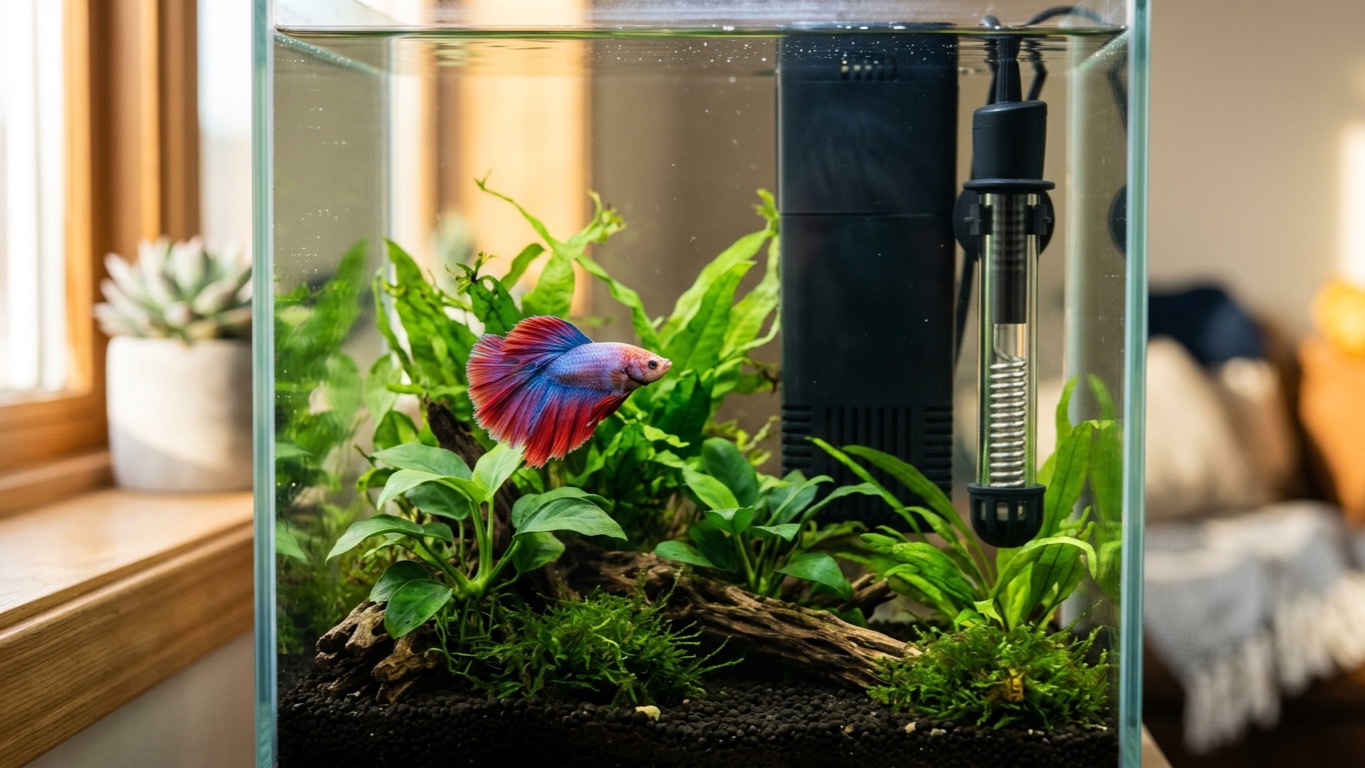
A community tank with mid-water swimmers can sit near the middle of the band. A betta tank should sit near the low end.
Bettas also need stable heat. Pair a gentle pump with the range in our betta fish water temp guide.
A long-fin fish can get pinned to the glass by a hard jet. Use the flow knob, and aim the outlet along the long wall, not at the fish.
Turtles make more waste than most fish of the same tank size. A pump is only one part of a turtle tank setup.
For a turtle, stay near the high end of the GPH band. Then hide the intake behind a sponge so gravel does not jam the impeller.
Goldfish and other messy eaters also push you up the band, because they load the water with waste even in a short day. Shrimp and fry need the opposite, so use the lowest listed setting that still moves debris off the sand.
If you keep plants, aim flow so leaves sway, and do not shred them against a wall jet.
Head height cuts the GPH on the box
Listed GPH is the zero-lift number, so any climb or long hose reduces flow.
VIVOSUN’s 800GPH page lists a 10-foot max lift. That is the height where the maker says the pump still pushes water.
Most fish tanks do not need a 10-foot climb, though a canister return or a sump can.
If you lift water even a couple of feet, expect less than the printed GPH. A sharp elbow or a thin hose cuts flow again.
Use this install list when the pump feeds a hose.
- Keep the hose short.
- Use the largest nozzle the maker ships, if flow is the goal.
- Avoid extra elbows.
- Do not pinch the outlet to quiet the pump for long stretches.
Aqueon’s SmartClean Extra Small page does not list a lift height. That unit returns water inside the same tank, so lift is not the buying point.
Fluval’s U4 page also skips lift, because the outlet sits in the tank. You are buying circulation and media, not a tall push.
hygger’s Cuboid page says the pump can sit in the tank or run outside it. If you run it outside, you add lift, so plan for a lower real flow than 530 GPH.
Place the pump, then keep the intake clear
A buried intake can cut flow in a day, even when the listed GPH is correct.
Set the pump after you fill the tank. Most of these units need water over the intake before you plug them in.
hygger’s Cuboid page says to fully submerge the pump for in-tank use. It also says not to run the pump without water.
VIVOSUN’s page says you can sit the pump on its base or rotate the outlet. Pick the pose that hides the body and still feeds the hose.
Fluval’s U4 page says you can stand it vertical or lay it horizontal. Horizontal helps a shallow tank or a low water line.
Aqueon’s SmartClean page says the pump is self-priming. It also says the pump restarts if power drops and returns.
Use this placement list.
- Keep the intake off bare sand if the sand is fine.
- Add a pre-filter sponge if gravel is loose.
- Point the outlet along the long wall.
- Leave a path so you can lift the unit for a rinse.
Rinse the intake when flow drops, and do not wait for the tank to cloud.
A pump moves water, and it does not replace a water change. Use the schedule in our how often to change aquarium water guide.
Aqueon’s SmartClean Extra Small page says to change the cartridge every 4 weeks. That is a media rule, not a pump-impeller rule.
Fluval’s U4 page includes foam pads, poly/carbon cartridges, and BioMax rings. Rinse mechanical media in tank water, not tap water, if you want to keep the bacteria on it.
Unplug the pump before your hands go in, and coil the cord so it cannot drape into the stand’s water.
FAQ
These answers use the same maker pages as the table above.
How many GPH does a fish-tank submersible pump need?
Use 4–10 times your tank gallons, so a 20-gallon tank needs 80–200 listed GPH. hygger’s Cuboid page prints the 8–10 times rule, and Fluval’s U4 page lists 260 GPH on a tank as large as 65 gallons. Start in the middle, then turn the knob down if fish struggle.
Can I leave a submersible pump running all day?
Most of these units are built for continuous duty in water, and the maker pages we used do not print an hours-per-day cap. hygger’s Cuboid page warns against dry running, so unplug the pump if the water line will drop below the intake. If the pump has a feed pause, use that button at meal time; hygger lists a 10-minute pause on the Cuboid controller.
Why is my flow weaker than the GPH on the box?
Listed GPH is a maximum at little or no lift. A dirty intake, a thin hose, or a tall climb all cut flow, and VIVOSUN’s page lists a 10-foot max lift on the 800GPH unit. Rinse the intake first, then check the hose for kinks.
Do I need a separate pump if I already have an internal filter?
Not always. Fluval’s U4 is a filter with a 260 GPH pump inside, and Aqueon’s SmartClean Extra Small is listed at 0–35 GPH. Add a second mover such as the Marineland Penguin 1140, listed at 300 GPH, only if dead spots remain.
What listed GPH is gentle enough for a betta?
Stay near the low end of the 4–10 times band. A 5-gallon betta tank then wants about 20–50 GPH, and Aqueon’s SmartClean Extra Small lists 0–35 GPH for 0–5 gallon tanks. Keep heat steady as well, using the ranges in our betta temperature guide.
How often should I clean a submersible pump?
Clean it when the outflow slows, or at each water change if the tank is dirty. There is no single maker-wide day count on the five pages we used, though Aqueon prints a 4-week cartridge change on the SmartClean Extra Small. Unplug first, pull the cover, and rinse sludge off the impeller well.
Can one pump serve both a fish tank and a small pond?
Only if the maker lists both uses and you stay inside the listed GPH and lift. VIVOSUN’s 800GPH page lists ponds and tanks, and hygger’s Cuboid page assigns the 20W size to 50–66 gallon tanks. A pond with a long hose will not see the full listed GPH.