Quick answer: Size a pond UV clarifier by measured gallons and the maker’s max flow rate, not wattage alone. Match pump GPH to the unit’s chart. Replace bulbs on schedule and keep the quartz sleeve clean.
Size UV by pond gallons and max flow, then keep contact time long enough to clear green water.
This page is a 2026 research-desk guide to ornamental pond UV clarifiers and gallon-based sizing. It compares maker wattage, volume, and flow charts. It does not run side-by-side pond trials. It does not rank units. It does not invent “sterilizes every pathogen overnight” claims.
Selection rule: Include currently sold pond UV clarifiers with named gallon ratings and flow limits. Exclude aquarium-only sterilizers without pond ratings, priced leaderboards, and rank columns. Skip medical advice for people or pets beyond electrical and handling cautions on the label.
What a pond UV clarifier actually clears
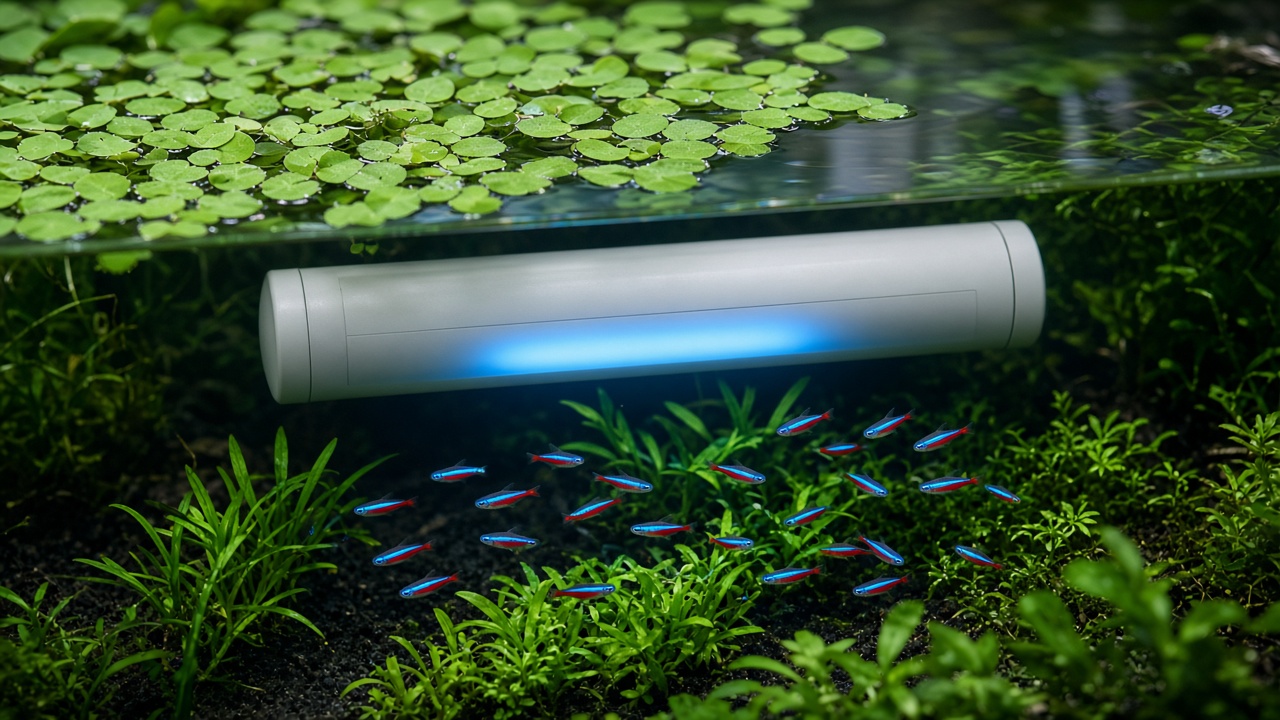
UV-C light damages free-floating green-water algae as water passes the bulb.
It does not scrub string algae off rocks. It does not replace mechanical pads or leaf nets. Clarifier-rated units aim at cloudy green water. Higher dose setups marketed as sterilizers need more watts per gallon and slower, controlled flow. Marketing names blur; the maker’s pond-gallon and GPH chart still decides the buy.
UV can and cannot:
- Can: knock down pea-soup green water when flow and watts match the pond
- Can: help filters catch clumped algae after exposure
- Cannot: clear clay mud or pollen alone
- Cannot: erase blanket weed without netting and nutrient control
- Cannot: work with a dirty quartz sleeve or a dead bulb
Plan UV as one loop on a bypass or after mechanical filtration. Dirty water shades the lamp and wastes wattage.
Green water that returns every week after a clear spell usually means nutrients are still high. UV buys time while you fix feeding and leaves. It is not a license to overstock.
Top 7 Pond uv light
The picks below are the 7 pond uv lights on sale right now, listed with what each suits best and an honest drawback. Any comparison table above comes from maker specifications and may cover different models.
1. 18W Aquarium UV Light for 100-1000 Gallon
Best for: First-time keepers of small ponds
Maker pages rate this 18-watt aquarium UV light for 100 to 1,000 gallons. That’s the common backyard band at a $59.99 mid-list price. Owners report clearer water when they hide the lamp in a filter and treat 1,000 gallons as a hard stop.
Pros: Mid-list 18-watt rating; Covers typical backyard ponds Cons: Caps at 1,000 gallons
2. 100W Aquarium UV Light for 1000-10000 Gallon
Best for: Keepers of extra-large estate ponds
Published specs put 100 watts against a 1,000 to 10,000 gallon claim, the widest band here. The $169.99 tag is the top of this list, yet this is still an aquarium UV light, not a plumbed high-dose chamber. Owners report it is wasted below 1,000 gallons and still needs a shield so stock never see the lamp.
Pros: Highest wattage on list; Widest gallon-range claim Cons: Overkill below 1,000 gallons
3. 32W Aquarium UV Light for 200-3000 Gallon
Best for: Midsize ponds doubling as display tanks
Maker pages list 32 watts and a 200 to 3,000 gallon aquarium rating. That is a wider midsize claim than the pond-labeled 32-watt sibling at the same $79.99. Owners report better luck in the lower half of that range when water actually moves past the lamp.
Pros: 32 watts at mid price; Widest midsize gallon claim Cons: Optimistic 3,000-gallon ceiling
4. 20W Pond UV Light for 100-1500 Gallon
Best for: Pond-labeled midsize water gardens
The name is a 20-watt pond UV light for 100 to 1,500 gallons at $58.99. That’s a small step in watts and volume from the 18-watt aquarium stick, still a drop-in light. Owners report using it on patio water gardens and calling the 1,500-gallon claim generous.
Pros: Pond-labeled 20-watt light; Priced under sixty dollars Cons: Modest gain over 18 watts
5. 55W Pond UV Light for 500-5000 Gallon
Best for: Full-sun ponds in the 5,000-gallon class
Maker pages list 55 watts and a 500 to 5,000 gallon pond rating. At $119.99 this is the mid-high price and the pond-labeled step that claims the 5,000-gallon class. Owners report it for bigger, sunnier water, and they still hide the tube so fish never swim in the beam.
Pros: 55-watt pond-labeled light; Claims the 5,000-gallon class Cons: Double the 18-watt price
6. 32W Pond UV Light for 200-2000 Gallon
Best for: Lined koi ponds near 2,000 gallons
This pond-labeled 32-watt light claims 200 to 2,000 gallons at the same $79.99 as the wider aquarium-labeled 32-watt unit. The tighter gallon band is the difference on the spec sheet. Owners report sizing to that 2,000-gallon cap and parking the light in a filter box, not in open water with koi.
Pros: Pond-labeled 32-watt light; Tighter 2,000-gallon rating Cons: Same price as wider 32W
7. 13W UV Water Clarifier with 9.84 ft Cable for Up to 300 Gallon
Best for: Prefab tubs under 300 gallons
The name sets 13 watts, a 9.84-foot cable, and a 300-gallon ceiling. At $19.99 it is the budget pick on this page. Owners report it for stock tanks and small patio tubs; a real pond will outgrow it.
Pros: Lowest price on list; Named 9.84-foot cable Cons: Only rated to 300 gallons
Comparison: Pond uv light at a Glance
Want to browse every option? See the full range of pond uv light on Amazon →
Size by gallons first, then check max flow
Wrong volume is the fastest path to a unit that never clears.
Measure length × width × average depth × 7.5 for U.S. gallons in near-rectangle ponds. Tetra Pond UV selection materials use cubic feet × 7.5 for gallons before matching wattage. Then read the maker’s recommended pond size and maximum flow. Flow that is too fast shortens dwell time in front of the lamp.
Sizing checklist:
- Calculate real gallons, not “it looks like 2,000”
- Pick the maker row that matches or exceeds your volume
- Confirm pump GPH at the UV outlet sits near the optimal or max chart
- Add a valve or bypass if the pump is stronger than the UV allows
- Place UV after mechanical filtration when the layout allows
Hobby rules of thumb such as about 10 watts per 1,000 gallons for clarification appear in retailer guides. Maker charts still win when they disagree. Full sun and heavy fish loads often need the next size up.
Attribute table of pond UV clarifiers sold in 2026
| Product | Maker cue | Flow / notes |
|---|---|---|
| Aquascape UltraKlear 1000 | About 1,000 gal pond; 14 W | Max flow about 500 GPH |
| Aquascape UltraKlear 2500 | About 2,500 gal pond; 28 W | Max flow about 1,000 GPH |
| Aquascape UltraKlear 5000 | About 5,000 gal pond; 55 W | Max flow about 1,500 GPH |
| Tetra Pond UVC-9 | About 1,800 gal; 9 W | Optimal flow about 900 GPH per maker chart |
| Tetra Pond UVC-18 | About 4,400 gal; 18 W | Optimal flow about 2,200 GPH per maker chart |
| Oase Bitron C 55 W | Maker pond ratings vary with fish load | High-flow design with bypass control on Bitron C line |
No rank column and no price column appear here. Confirm the model and bulb SKU in your hand; charts change.
Flow rate, dwell time, and pump matching
Wattage without contact time is empty marketing.
Aquascape UltraKlear specs list maximum flow rates of 500 GPH, 1,000 GPH, and 1,500 GPH on the 14 W, 28 W, and 55 W models. Tetra Pond UV charts pair each wattage with an optimal flow within about ±10%. One chart row uses about 330 GPH for a 5 W unit on a 660 gallon pond. Another uses about 4,400 GPH for a 36 W unit on an 8,800 gallon pond. Pushing a big waterfall pump through a small chamber often fails even when the watt label looks big.
Flow tips:
- Measure return flow out of the UV when possible
- Use a T-fitting or bypass so excess water skips the chamber
- Slow is better than a blast that starves dwell time
- After filters beat before filters for sleeve cleanliness
- Watch indicator windows so you know the bulb is lit
Oase Bitron C models publish separate pond volumes for light stock, fish stock, and koi, plus min and max flow figures. Heavier loads need more UV power for the same gallons.
Installation habits that keep green water down
Mounting and maintenance matter as much as the first purchase.
Aquascape UltraKlear units include brackets for vertical or horizontal mounting and list a 3-year limited warranty on the clarifier line. Keep the ballast dry and cords GFCI-protected outdoors. Clean the quartz sleeve on the schedule in the manual. Replace the bulb even if it still glows, because UV-C output falls with age.
Care list:
- Wipe or replace sleeves when film builds
- Swap bulbs on the maker’s hour or season schedule
- Keep spare bulbs matched to wattage SKUs
- Never stare into a lit UV-C lamp
- Shut power before opening the chamber
Cloudy water after a sleeve cleaning can settle once flow resumes. Persistent green after a new bulb usually means oversized flow or undersized watts.
When UV is the wrong first move
UV treats green water. It does not fix a nutrient firehose.
Cut leftover feed, net leaves, and shade baking shelves before you chase a larger lamp. String algae needs mechanical removal. Bacteria bottles and algaecides are different tools with their own oxygen rules. A UV on a bypass cannot clear a pond that never circulates through the chamber.
Skip or delay a UV buy when:
- Volume is unknown and you refuse to measure
- The pump has no way to meet the max-flow chart
- Green water is actually clay after a storm
- Electrical outdoor outlets are unsafe or ungrounded
- You expect UV to replace weekly skimming
The common misconception is that any “pond UV” clears every algae type. Filamentous mats ignore the chamber. Free-floating blooms are the real target.
How to choose among similar UV lights in 2026
Choose the chart you can actually match with your pump.
Compare recommended gallons, max GPH, bulb replacement cost, and mounting options. Prefer units with an on indicator. Size up for full sun or dense koi if the maker publishes stocked ratings. Keep a log of gallons, GPH, bulb install date, and clarity notes.
Decision cues:
- Under 1,000 gal: small 9–14 W class if flow stays low enough
- 2,000–5,000 gal: mid 18–55 W class per maker rows
- Heavy koi load: use the maker’s koi or fish-stock column
- Strong pump: require a bypass before you buy
- Combo pressure filters: confirm the built-in UV watts still fit gallons
Replace guesswork with a measured GPH at the UV outlet. Do not invent a “more watts always wins” rule while blasting past max flow.
Write the install date on the ballast with a marker. Future you will thank present you when green water returns in July.
FAQ
How many watts of UV do I need per gallon?
Maker charts beat generic ratios. Retailer guides often cite about 10 watts per 1,000 gallons for clarification and higher doses for sterilizer-style goals. Always cross-check the unit’s pond-gallon and GPH limits. Edge case: full sun ponds often need the next size up even when math looks fine.
Can UV clear string algae?
Usually no. UV targets free-floating cells that pass the lamp. String and blanket weed need netting, nutrient control, and sometimes labeled algaecides. The common misconception is that a bigger bulb scrapes rocks clean.
Where should I install the UV in the plumbing?
After mechanical filtration is the usual preference so the sleeve stays cleaner. Follow the maker’s orientation and hose sizes. Use a bypass if pump flow exceeds the max chart. Never run UV dry.
How often should I replace the UV bulb?
Follow the hours or annual schedule on your model. Output fades before the bulb looks dead. Indicator lights only prove the lamp is powered, not that UV-C dose is full strength. Keep the correct wattage spare on hand.
Will UV harm my fish or plants?
Water returns to the pond after exposure; fish are not sitting under the lamp. Follow outdoor electrical safety and never look into a lit UV-C tube. Plants in the pond are not inside the chamber. Edge case: poor wiring near water is the real hazard, not the clarified return flow.
Why is my pond still green after installing UV?
Check gallons, max flow, sleeve film, and bulb age first. Confirm water actually passes the chamber each hour. Nutrient load and sun can outrun a marginal unit. Size up or slow the flow before blaming the brand.
Clarifier vs sterilizer—what is the difference?
Both use UV-C chambers. Clarifier ratings focus on green-water control at maker gallon and flow numbers. Sterilizer-style goals need higher dose and stricter flow control. Trust the chart for your model more than the word on the box.
This guide is for general information and does not replace the manufacturer’s instructions.