Quick answer: Corydoras are small South American bottom catfish. Keep five or more of one species in a tank at least 60 cm long, on soft sand, with sinking food and weekly water tests.
FishBase lists a 60 cm minimum tank and groups of five or more for bronze corydoras. This page is a published-spec care brief, and we did not keep a school, cycle a tank, or collect a spawn.
Selection rule: We included only species and products whose publisher or maker page lists a number we can quote. We left out pond fish, gravel with a typical size over 2.0 mm, and any food that does not sink.
What corydoras fish are
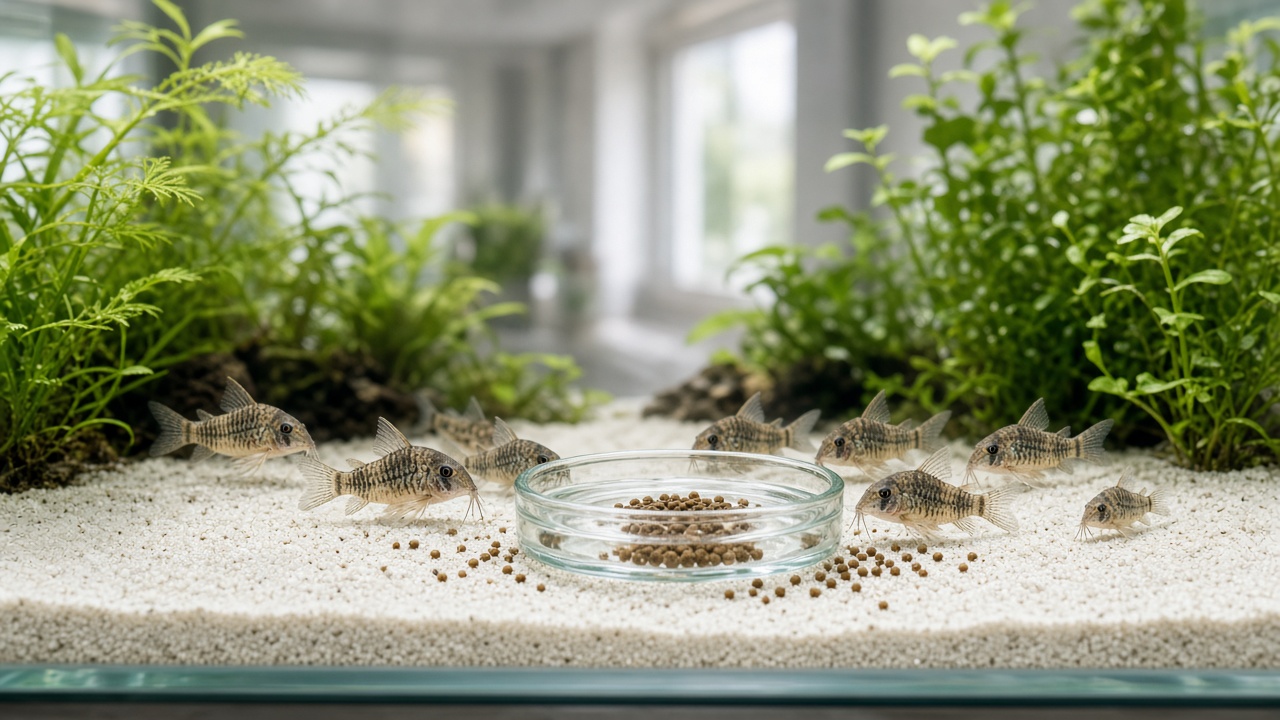
Corydoras are armored South American catfish that live and feed on soft bottoms.
FishBase now files the common bronze cory as Osteogaster aenea (Gill, 1858). Pet shops still sell it under the older hobby name Corydoras.
FishBase lists a maximum length of 7.5 cm SL, or about 3 inches of body without the tail. The same record lists a pH range of 6.0 to 8.0 and a hardness range of 5 to 19 dH.
FishBase sets a subtropical band of 25°C to 28°C, which is about 77°F to 82°F. Adults stay in schools of 20 to 30 in the wild and take air 1 to 45 times per hour.
They can breathe through the gut, so a dash to the surface for air is normal. That gulp is not, by itself, a sign the filter failed.
FishBase says they feed on worms, crustaceans, insects, and plant matter. The listed range runs from Colombia and Trinidad to the La Plata basin east of the Andes.
FishBase lists the IUCN Red List status as Least Concern, with an assessment date of 7 November 2018. That status is a wild-stock note, not a care score for your tank.
Tank size and footprint
Floor length matters more than tank height for these bottom-dwelling fish.
FishBase sets a minimum aquarium size of 60 cm for bronze corydoras, or about 24 inches along the long side. A tall tank with the same gallons can still be too short, so measure length first.
CaribSea’s FAQ gives a substrate load of 1 to 2 pounds per gallon. Use that number to size the sand bag, not the fish count.
The same CaribSea FAQ gives a slow-start stocking cap for new tanks:
- no more than 1 inch of fish per 20 gallons for the first two weeks
- then no more than 1 inch of fish per 5 gallons in total
Our research team analyzed those two published rules side by side. The 60 cm length is the floor, and the CaribSea inch caps are a later stocking brake.
A 60 cm tank can hold a starter school of five of one species. A longer tank holds the 20-to-30 wild group size more honestly.
Leave open sand in the front third of the tank. Pile plants and wood at the back so the school can forage in a line.
We call the FishBase pair the 60-and-Five rule: 60 cm of glass and five fish. Do not drop either number to “save space.”
Schooling
A group is required, not optional, for this genus.
FishBase’s aquarium note is a group of 5 or more, while wild adults school in groups of 20 to 30. Five is the database floor, and a larger group on a long floor looks more like the wild count.
Keep one species in the school so shy fish cannot hide in a mixed pack. Mixed “cory packs” make a true count hard and leave one kind outnumbered.
They gulp air on a timer, and FishBase’s range is 1 to 45 breaths per hour. Leave a small gap at the surface, because a sealed lid with no air space blocks that habit.
Watch for a lone fish that hides all day and skips food. Add more of the same species before you add new décor or new tank mates.
Water
Clean, stable water beats chasing one perfect pH or temperature number.
FishBase lists pH 6.0 to 8.0, so stay inside that band and hold it still. The listed temperature band is 25°C to 28°C; set the heater to hold that range and do not swing it day to night.
API’s Freshwater Master Test Kit page says to test weekly. The kit checks ammonia, pH, high range pH, nitrite, and nitrate.
API’s page says a pH of 7.0 is neutral, and the kit ships with four test tubes and a laminated color card. API says it has made aquarium products for almost 60 years.
Treat the kit as a weekly check, not a one-time setup step. Do not add salt, because FishBase lists this fish as freshwater and non-migratory.
Weekly test steps:
- Fill a tube and add the drops listed on the API card.
- Wait the time on the card, then match the color in good light.
- Keep ammonia and nitrite at the lowest printed color.
- Change water if nitrate sits at the high end of the card.
- Match new water to the tank temperature before you pour.
Substrate that will not shred barbels
Smooth sand at or under 2.0 mm protects their barbels.
CaribSea’s FAQ says Super Naturals grains are smooth and fit bottom dwellers. The same FAQ names Peace River as its favorite for corys.
Our cutoff was a listed typical size of 2.0 mm or finer. We dropped Gemstone Creek, Zen Garden, Jelly Beans, and Raven River Pebble.
| Product | Typical grain size | Average density | Listed bag sizes |
|---|---|---|---|
| CaribSea Super Naturals Moonlight Sand | 0.25–0.75 mm | 95 lb per cu ft | 5, 10, 20, 40 lb |
| CaribSea Super Naturals Sunset Gold | 0.25–1.0 mm | 94 lb per cu ft | 5, 10, 20, 40 lb |
| CaribSea Super Naturals Crystal River | 0.5–1.0 mm | 95 lb per cu ft | 5, 10, 20, 40 lb |
| CaribSea Super Naturals Jungle River Sand | 0.5–1.5 mm | 100 lb per cu ft | 5, 10, 20, 40 lb |
| CaribSea Super Naturals Peace River | 1.0–2.0 mm | 93 lb per cu ft | 5, 10, 20, 40 lb |
CaribSea’s FAQ formula uses 100 pounds per cubic foot for Super Naturals. Across the five sands that met our cutoff, listed density runs from 93 to 100 pounds per cubic foot.
Moonlight Sand is the finest at 0.25 to 0.75 mm. Peace River is the coarsest we kept, at 1.0 to 2.0 mm.
Use CaribSea’s 1 to 2 pounds per gallon rule to pick a bag. A 20-gallon tank then needs 20 to 40 pounds of sand.
CaribSea says a new sand bed should begin to clear within hours and be fully clear in 24 to 48 hours after pumps start. Rinse Super Naturals before they go in, and keep rinsing until the water goes from milky to cloudy.
Do not cap an old bed with a new layer. CaribSea warns that a cap can start another cycle.
Diet
Food must sink to the floor, or the school will miss the meal.
Hikari’s Sinking Wafers page names corydoras catfish as a target. Comparing published specs on that page, the guaranteed analysis is:
- crude protein min. 36%
- crude fat min. 9.0%
- crude fiber max. 4.0%
- moisture max. 10%
- ash max. 16%
- phosphorus min. 0.8%
Hikari’s feed window for that wafer is 20 minutes, and leftovers should come out after that window. Listed sizes on Hikari’s page include 0.88 oz (25 g), 1.76 oz (50 g), and 3.88 oz (110 g).
Hikari Tropical Algae Wafers are a plant-heavy add-on, not the sole staple. That maker page lists:
- crude protein min. 33%
- crude fat min. 4.0%
- crude fiber max. 3.0%
- moisture max. 10%
- ash max. 17%
- phosphorus min. 0.8%
The Algae Wafers feed window is 2 hours, which is six times the 20-minute Sinking Wafers window. Comparing those two Hikari pages, Sinking Wafers list 3 more protein points and more than double the fat (9.0% vs 4.0%).
Use Hikari Tropical Sinking Wafers as the daily food, and offer Algae Wafers as a side, not the only meal. FishBase says adults eat worms, crustaceans, insects, and plants, so frozen bloodworms can fill that list if you siphon leftovers.
Feed steps:
- Drop sinking wafers in two spots so mid-water fish cannot hog one pile.
- Wait up to 20 minutes, per Hikari’s Sinking Wafers page.
- Siphon crumbs you can still see on the sand.
- Add a plant wafer on a later night if you want variety.
Flakes that stay on top do not count as a cory meal. If the food does not hit the sand, it is not their food.
Tank mates
Pick small, calm mid-water fish that leave the sand alone.
Corydoras stay on the sand and pair well with small tetras and rasboras that ignore the floor. They are a poor match for goldfish. Goldfish want cooler water and make more waste.
Skip large hunters such as oscar fish. An oscar can eat a 7.5 cm cory whole.
Do not mix them with outdoor koi. Koi live in ponds, not a 60 cm indoor tank.
Avoid other bottom bullies that steal wafers, and leave a clear sand runway in the front third of the tank. Skip fin-nippers that chase the school off the glass, because a stressed cory hides and stops eating.
FAQ
How many corydoras should I keep?
FishBase’s aquarium note is a group of 5 or more, and wild adults school in 20 to 30. Start at five of one species on a 60 cm tank, and add more only if the floor is still open.
What tank size do corydoras need?
FishBase lists 60 cm as the minimum aquarium size for bronze corydoras, which is about 24 inches. A short, tall tank can meet gallons and still fail that length.
What water do they need?
FishBase lists pH 6.0 to 8.0, hardness 5 to 19 dH, and 25°C to 28°C. API’s kit page says to test weekly, so hold the numbers still and do not chase daily swings.
What substrate is safe for their barbels?
CaribSea’s FAQ says Super Naturals grains are smooth and fit bottom dwellers. Our table keeps only sands with a listed typical size of 2.0 mm or finer. CaribSea names Peace River as its favorite for corys.
What should I feed corydoras?
Use a sinking food such as Hikari Tropical Sinking Wafers, whose page names corydoras and lists 36% min protein. Feed what they finish in 20 minutes. Hikari Tropical Algae Wafers list 33% min protein and can be a side dish.
Why do they dart to the surface?
FishBase says they breathe air through the gut and take air 1 to 45 times per hour. A gulp is normal; test the water if they gasp at the surface and will not leave it.
Do bronze corydoras breed in tanks?
FishBase describes a “T” spawn, and the female may lay about 20 eggs of 1 mm. The same record then lists 100 to 200 eggs across 2 to 3 hours, with hatching in 5 days at 22°C. We did not spawn a group for this page.