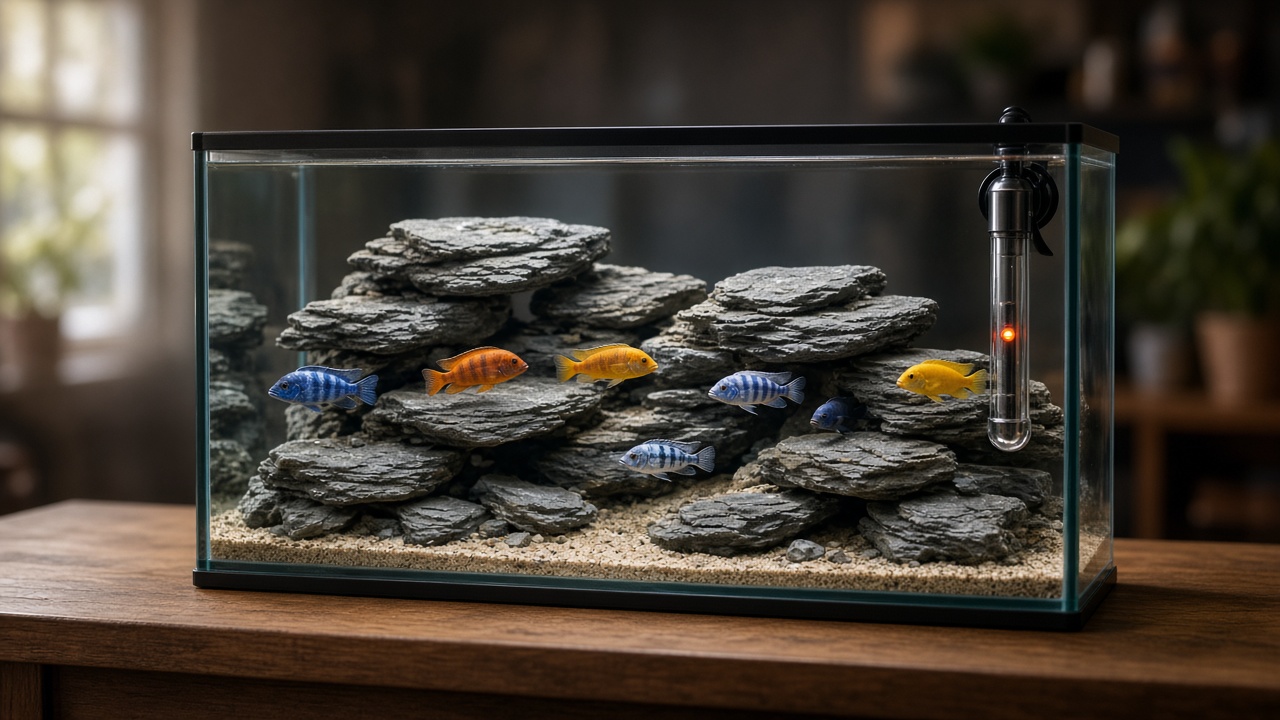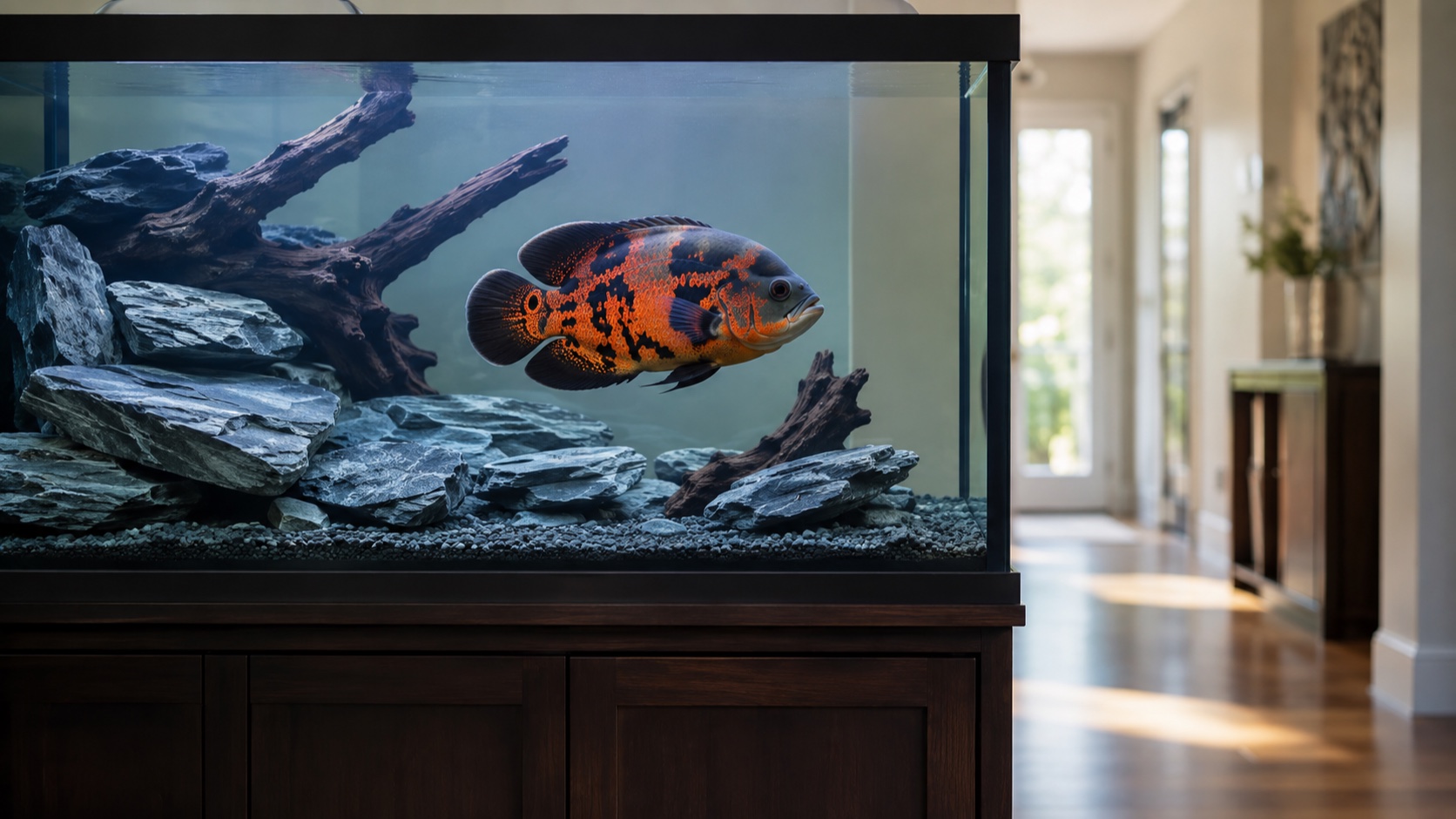
Quick answer: Plan for one large cichlid that will live a decade or more. Buy a tank at least 52 inches long before you bring an oscar home. Feed a cichlid pellet with at least 37% crude protein, and do not add small fish as companions.
An oscar fish is a South American cichlid that reaches 33 cm and commonly lives 10–20 years. This page is a desk brief on tank length, daily pellets, tank mates, and lifespan.
Our research team analyzed published species pages and maker labels.
Selection rule: Daily pellets enter only if the maker lists at least 37% crude protein and names cichlids. Tanks enter only if length is at least four times the Florida Museum’s 33 cm adult figure. We skip flakes, betta pellets, feeder-fish menus, and any plan that starts under 52 inches.
What an oscar fish is
An oscar is a stocky Amazon cichlid sold in pet shops, not a small community tetra.
The Florida Museum of Natural History identifies it as Astronotus ocellatus. Common English names on that page include oscar, velvet cichlid, and tiger oscar.
FishBase lists the western Amazon and Orinoco basins as the native range and marks the species as freshwater only.
The Florida Museum page states captive oscars commonly live 10–20 years. It also lists an adult length of 33 cm and a maximum weight of about 1.1 kg.
FishBase publishes a higher maximum total length of 45.7 cm and a common length of 24.0 cm. It also lists a maximum published weight of 1.6 kg.
We use the Florida Museum’s 33 cm figure for home-tank math, because FishBase labels 45.7 cm as a maximum, not a typical pet size.
FishBase lists length at first maturity as 12.0 cm, so a shop juvenile is not a finished adult fish.
The Florida Museum describes the wild diet as smaller fishes, crustaceans, gastropods, and aquatic insects. FishBase adds crayfish, worms, and insect larvae to that same prey list.
That prey list is why small tank mates fail: an oscar is built to grab and swallow them.
The Florida Museum notes a 1982 Florida Game and Freshwater Fish Commission study. The mean lower lethal temperature in that study is 12.9°C (about 55°F).
FishBase lists a pH range of 6.0–8.0 and a hardness range of 5–19 dH. It lists a tropical temperature band of 22°C–25°C (about 72°F–77°F).
FishBase also records IUCN status as Least Concern, and the assessment date on that page is 4 November 2020.
The Florida Museum says breeding pairs can lay 1,000–2,000 adhesive eggs, with hatching typically inside 3 to 4 days. FishBase reports the same 3- or 4-day hatch window.
The 52-inch tank rule
A long tank is the first purchase you make, not a later upgrade after the fish outgrows a box.
Here is the length math our research team used:
- Adult length we use: 33 cm, from the Florida Museum page
- Four times that length: 132 cm, which is 52 inches
- Record length we do not use: 45.7 cm maximum on FishBase, which would imply about 72 inches
A tank shorter than 52 inches fails the rule, and volume slogans on a box do not override length.
A bonded pair needs more than one body-length budget. The Florida Museum states that oscars form breeding pairs and defend eggs and young.
Do not start in a 10-gallon or 20-gallon box. A 12 cm juvenile from FishBase’s maturity figure will outgrow that short tank.
We also skip “temporary grow-out” plans, because the 10–20 year span on the Florida Museum page is a home, not a weekend project.
Place the tank before you buy the fish. A 52-inch glass box is furniture, so measure the stand, the floor, and the door.
Water, cycling, filters, and heat
Cycle the tank first, then add the oscar, not the other way around.
An oscar is a heavy eater, and the Florida Museum calls captive feeding voracious and somewhat indiscriminate.
Finish the nitrogen cycle before the fish arrives. Our guide on how long to cycle a fish tank walks through that wait.
Hold water inside these published bands:
- Temperature: 22°C–25°C on FishBase, about 72°F–77°F
- Lethal floor to stay above: 12.9°C on the Florida Museum page, about 55°F
- pH: 6.0–8.0 on FishBase
- Hardness: 5–19 dH on FishBase
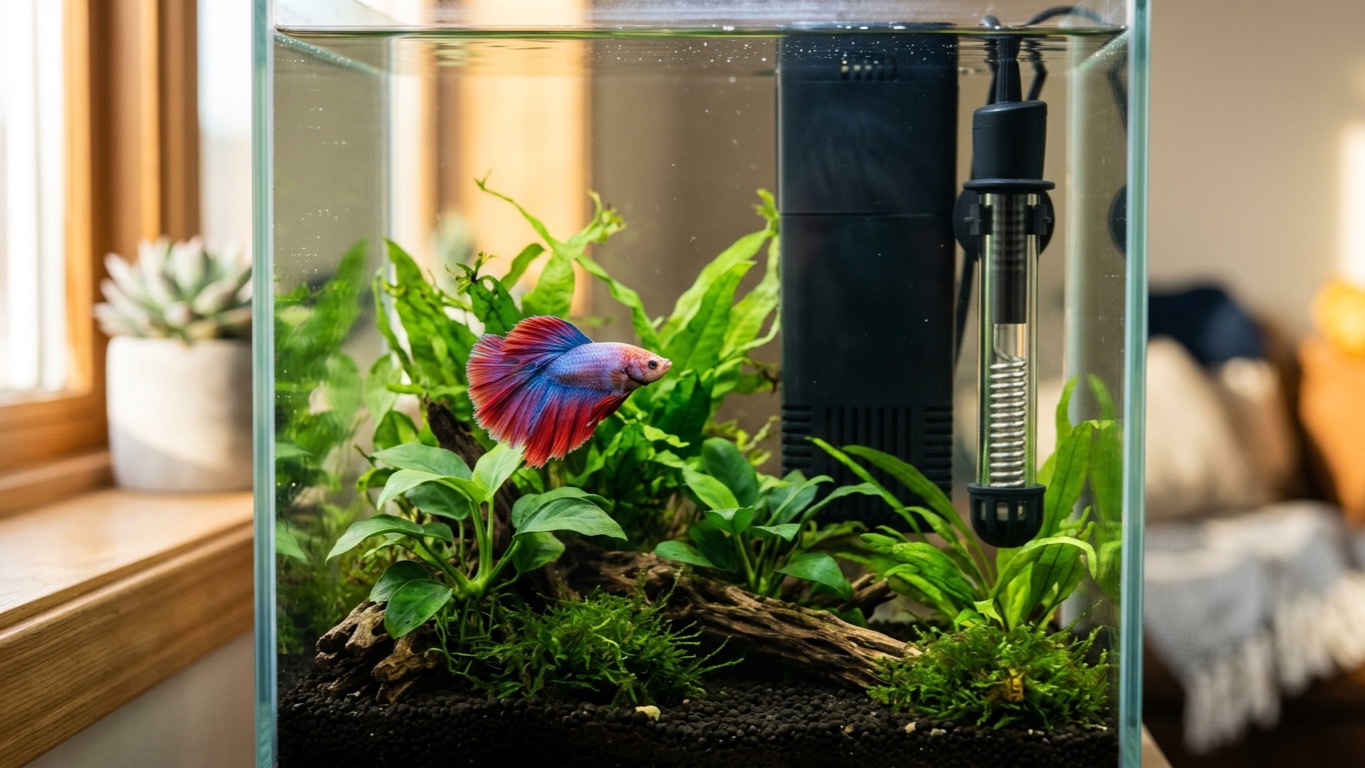
Use a heater rated for a long tank, and place a thermometer at the far end, not only by the heater.
Most filter-and-heater combos are built for short tanks. Our page on a fish tank filter and heater in one covers those compact units.
An oscar tank needs a separate heater plus a large external filter, so leave room under the stand for a canister.
Do not chase a single “perfect” number. Stay inside those published bands and change water on a fixed schedule.
Plan large water changes, because this fish eats a lot and sits on the bottom at night, per the Florida Museum habitat notes.
Use a tight lid on the tank, since oscars can surge when they strike floating food.
Diet: cichlid pellets we compared
A labeled cichlid pellet is the daily staple, not a flake mix written for small tetras.
The Florida Museum wild diet is animals, not lettuce flakes, and FishBase lists the same prey groups. We compared four pellets that still meet the 37% protein floor by reading maker labels.
The same Hikari page lists baby pellets at a minimum of 32% crude protein. Those baby pellets fail our 37% floor, so they stay out of the table.
Hikari’s feeding line is two to three times daily, and only what fish finish in a few minutes.
Omega One’s Cichlid Pellets Large Sinking page lists a minimum of 42% crude protein and 12% crude fat. Pack sizes on that page are 9 oz and 20 oz.
Omega One’s Small Cichlid Pellets (Sinking) + Super Color page lists 2 mm pellets. That label lists 39.40% crude protein and 13.37% crude fat.
The same Omega One small-pellet page says to feed up to three times daily, using only what the fish can eat in two minutes.
New Life Spectrum’s Cichlid page lists a minimum of 37% crude protein and 8% crude fat. Pellet size on that page is 1 mm to 1.5 mm, and most pellets sink.
That New Life Spectrum page also lists vitamin A at a minimum of 10,000 IU/kg. Across those four labels, listed minimum protein runs from 37% to 42%.
Do not use a betta pellet as the oscar staple, because those formulas target a small labyrinth fish. We cover that category in best food for betta fish.
Skip live “feeder” goldfish as a routine meal. The Florida Museum already lists smaller fishes as wild prey, and dirty feeders add waste and risk.
| Product | Form | Crude protein (min) | Crude fat (min) | Maker note |
|---|---|---|---|---|
| Hikari Cichlid Gold (mini, medium, large) | Floating | 40% | 4% | Feed 2–3 times daily; finish in a few minutes |
| Omega One Cichlid Pellets Large Sinking | Sinking | 42% | 12% | Sold in 9 oz and 20 oz packs |
| Omega One Small Cichlid Pellets (Sinking) + Super Color | Sinking | 39.40% | 13.37% | 2 mm pellets; finish in 2 minutes |
| New Life Spectrum Cichlid | Sinking | 37% | 8% | 1–1.5 mm pellets; vitamin A 10,000 IU/kg |
Pick a pellet the fish can swallow whole, then step up from the 2 mm Omega One size as the mouth grows.
If you use the 1–1.5 mm New Life Spectrum pellet for a large adult, feed more pieces, not a bigger unlisted size.
Follow the maker feeding caps, then remove leftovers:
- Hikari Cichlid Gold: two to three times daily, only what fish finish in a few minutes
- Omega One Small Cichlid Pellets: up to three times daily, only what fish finish in two minutes
- Omega One Large Sinking: no timed line on that page, so stop at two minutes
Tank mates we will not list
Small fish are food on the published prey list, not friends for a shared community tank.
The Florida Museum prey list starts with smaller fishes. FishBase repeats small fish, crayfish, worms, and insect larvae.
Our mate rule is simple: if the animal fits the published prey list, it does not go in the oscar tank.
That bars tetras, guppies, shrimp, snails kept as cleaners, and any fish shorter than the oscar.
We also skip “oscar community” lists written for 55-gallon tanks, because those tanks fail the 52-inch length floor.
A second oscar is a pair project, not a default add-on. The Florida Museum says pairs defend the nest and the young, and males may lock jaws over space.
If you want two adults, start with a tank well past 52 inches, and add the second fish only after the first tank is stable.
Large, armored fish still get bitten, so we do not publish a safe-species roster drawn from hobby blogs.
Empty hardscape is safer than a crowded list. Give one oscar wood to sit on, as the Florida Museum describes cover from sunken branches and logs.
Lifespan and the long home
This is a 10-to-20-year fish, not a school-year pet.
The Florida Museum states that captive oscars commonly live 10–20 years, so budget filter media, pellets, and water for that span.
A 12.0 cm fish on FishBase’s maturity line is still growing. The 33 cm museum length is the adult you are buying toward.
Do not release an oscar into local water. The Florida Museum records established non-native populations in no fewer than 6 South Florida counties after 1950s farm stockings.
FishBase also marks the species as introduced elsewhere. A surplus adult belongs at a rehoming desk, not in a canal.
The Florida Museum notes captive oscars are quite susceptible to hole-in-the-head disease, tied on that page to the protozoan Hexamita. We do not give treatment steps.
Ask a fish-health clinic if signs appear. Watch waste and missed meals first, because those are husbandry problems.
Keep the lid on, the heater steady, and the protein staple consistent.
FAQ
These answers repeat the length, pellet, and mate rules in short form.
How big do oscar fish get?
The Florida Museum of Natural History lists 33 cm and about 1.1 kg. FishBase lists a common length of 24.0 cm and a maximum total length of 45.7 cm.
FishBase also lists a maximum published weight of 1.6 kg.
What size tank does one oscar need?
Our rule is a tank at least 52 inches long, which is four times the 33 cm adult length on the Florida Museum page. A shorter tank fails the rule, and a pair needs more length than one fish.
What should I feed an oscar fish?
Use a daily cichlid pellet at or above 37% listed crude protein. Hikari Cichlid Gold lists 40% on mini, medium, and large sizes, Omega One Large Sinking lists 42%, and New Life Spectrum Cichlid lists 37%.
Can oscar fish live with tetras or shrimp?
No, because the Florida Museum wild diet includes smaller fishes, crustaceans, and gastropods. FishBase lists small fish, crayfish, worms, and insect larvae, and those animals match the prey list.
How long do oscar fish live?
The Florida Museum page states that captive oscars commonly live 10–20 years. That span is why the first tank should already meet the 52-inch rule.
What water temperature do oscars need?
FishBase lists 22°C–25°C, about 72°F–77°F, and you should stay far above 12.9°C. The Florida Museum cites that figure as the mean lower lethal temperature from the 1982 Florida Game and Freshwater Fish Commission study.
Can I raise a baby oscar in a 20-gallon tank?
No under our selection rule. FishBase lists maturity at 12.0 cm, and the Florida Museum lists 33 cm adults.
Buy the 52-inch tank first, cycle it, then buy the fish.