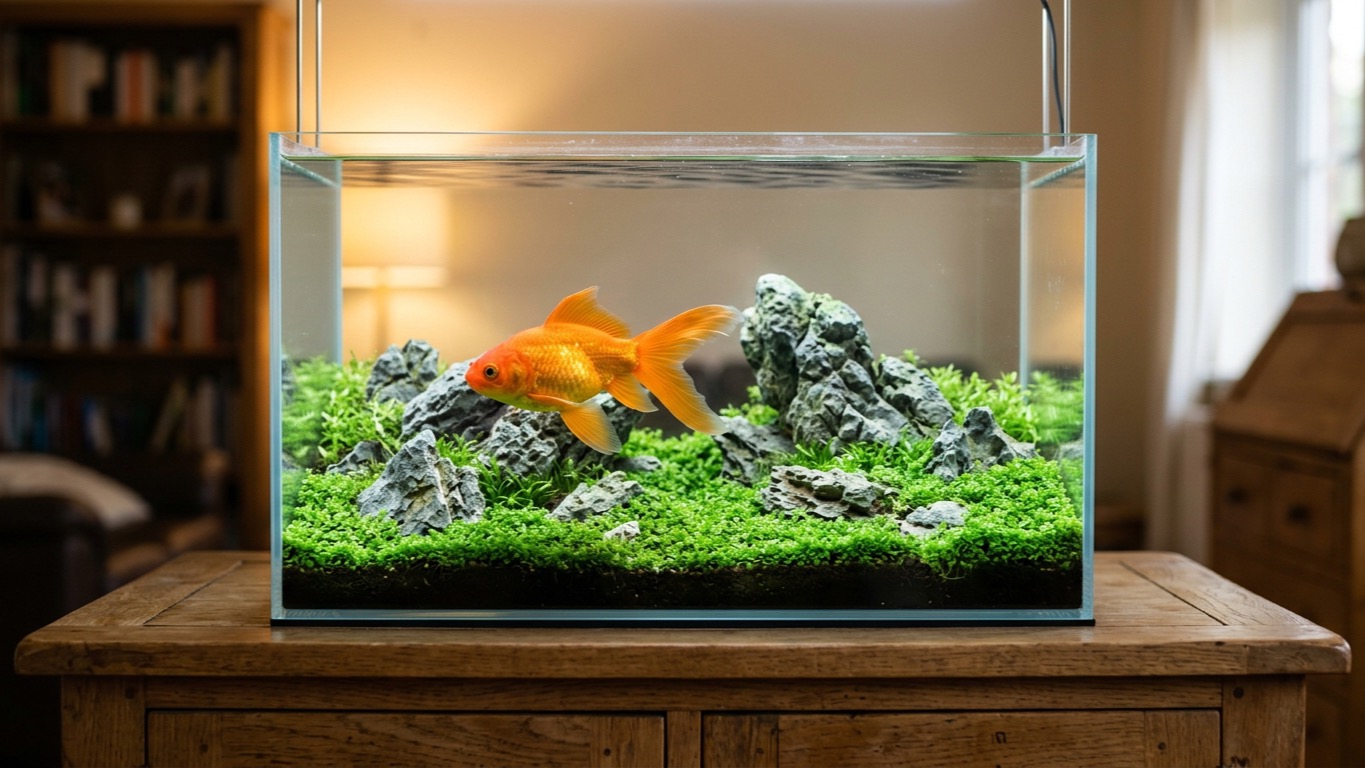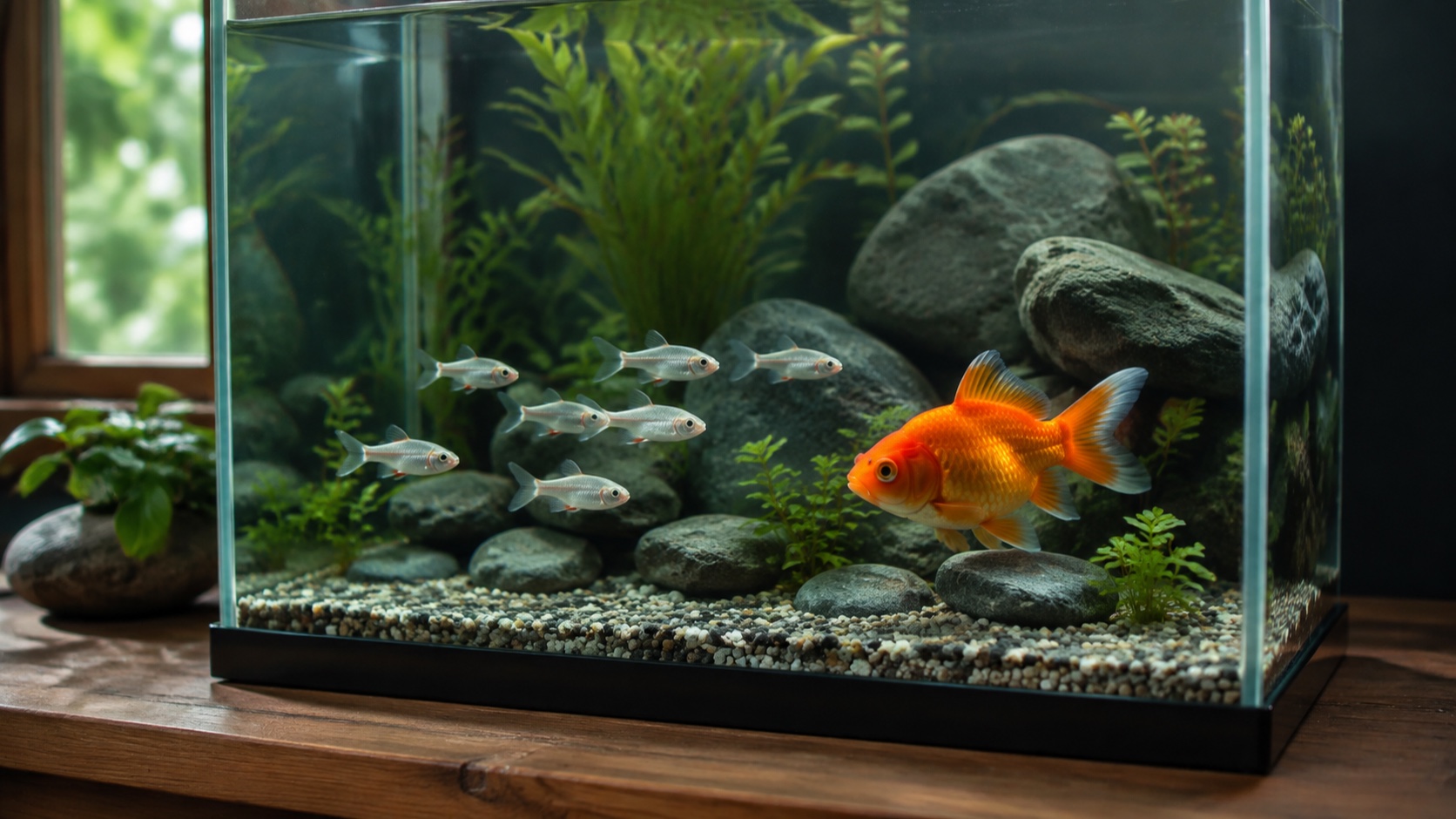
Quick answer: Keep goldfish with other goldfish of the same body type in an unheated tank. Add only cool-water fish, such as zebrafish or white cloud minnows. Do not add tropical fish that need water near 78°F.
Goldfish can live with other goldfish and a few cool-water fish, not with tropical fish that need 78°F water.
This page is a desk comparison of published goldfish care sheets.
Our selection rule is narrow and easy to check against a maker page. A fish enters only if that page names it as a cool-water roommate, or it is another goldfish of the same tail type. We left out every tropical fish Tetra places in the 72–80°F band.
The Three-Gate Roommate Rule
A goldfish roommate must pass three gates: temperature, tail type, and waste space.
Our research team compared published specs from Aqueon, Tetra, and the USGS goldfish profile. We asked whether a species can share unheated goldfish water for life.
Use these three gates before you buy a second species:
- Temperature: the fish must live in the cool band Aqueon and Tetra publish for goldfish.
- Tail type: fast single-tails stay with single-tails. Slow fancies stay with fancies.
- Waste space: the tank must already fit adult goldfish, plus the new fish.
The USGS species profile reports that goldfish typically grow to 120 to 220 mm in standard length. That size describes a large, messy carp, not a small tropical community fish. Any roommate that needs tropical heat fails the first gate at once.
Match Temperature Before You Match Color
Goldfish and tropical fish do not share one safe heater setting in the same tank.
Tetra’s water-quality page lists common goldfish at 65–68°F and fancy-tail goldfish at 65–72°F. The same page lists tropical fish at 72–80°F, with 78°F as the optimal point.
Aqueon’s goldfish care guide splits the band by body type:
- Fancy goldfish: 68–74°F
- Comets and shubunkins: 60–70°F
Our research team laid those ranges side by side on the same sheet. Aqueon’s comet band of 60–70°F does not overlap Tetra’s tropical band of 72–80°F.
Aqueon’s tank-mate article says goldfish live in an unheated tank and need cool roommates. It tells you to avoid tropical fish, including guppies, bettas, and plecostomus.
A heater preset at 78°F sits above both goldfish ranges Tetra publishes.
| Fish group | Published temperature | Publisher |
|---|---|---|
| Common goldfish | 65–68°F | Tetra |
| Fancy-tail goldfish | 65–72°F | Tetra |
| Fancy goldfish | 68–74°F | Aqueon |
| Comets and shubunkins | 60–70°F | Aqueon |
| Tropical fish | 72–80°F, optimal 78°F | Tetra |
If your room stays inside the goldfish band, skip the heater. If the room drops below that band, heat only to the goldfish numbers. Do not heat to 78°F so a tetra or guppy can move in.
Other Goldfish Are the First Safe Match
The most reliable roommate for a goldfish is another goldfish of the same body type.
Aqueon’s tank-mate article names other goldfish as a pair and says to choose the same breed in a different color. That keeps swimming speed matched and cuts food fights at mealtime.
Aqueon’s care guide warns that commons, comets, and shubunkins can become too boisterous for smaller fancy goldfish. Separate them if the fast fish out-eat the slow fish over weeks.
Aqueon’s types page gives adult sizes you should plan for before you add a second fish:
- Common goldfish: 12 to 14 inches, with a 10- to 20-year lifespan
- Comet goldfish: 4 to 12 inches, with a 5- to 14-year lifespan
- Ryukin: up to 10 inches, with a 10- to 15-year lifespan
- Oranda: 8 to 12 inches, with a 15- to 25-year lifespan
Aqueon’s tank-mate article also says a comet can reach 12 inches. The USGS profile lists a maximum of 410 mm standard length, and some wild fish reach 59 cm total length and 3 kg.
Your tank plan should assume the long end, not the two-inch shop length. Aqueon lists orange, black, yellow, and white goldfish among more than 200 breeds.
Color is not a compatibility test on its own. If a fish later loses pigment, read why goldfish turn white before you blame the new roommate.
Keep these pairings:
- Single-tail with single-tail: common, comet, shubunkin
- Fancy with fancy: fantail, oranda, ryukin, moor, ranchu
Do not mix a fast comet with a bubble-eye or ranchu. The slow fish loses food, and delicate eyes get bumped in the chase.
Aqueon’s care guide says goldfish are gregarious, meaning they like company of their own kind.
Cool-Water Fish Aqueon Names, and Fish It Rules Out
Aqueon names only a short cool-water list: zebrafish, ornamental minnows, snails, and other goldfish.
That short list is the one this article covers.
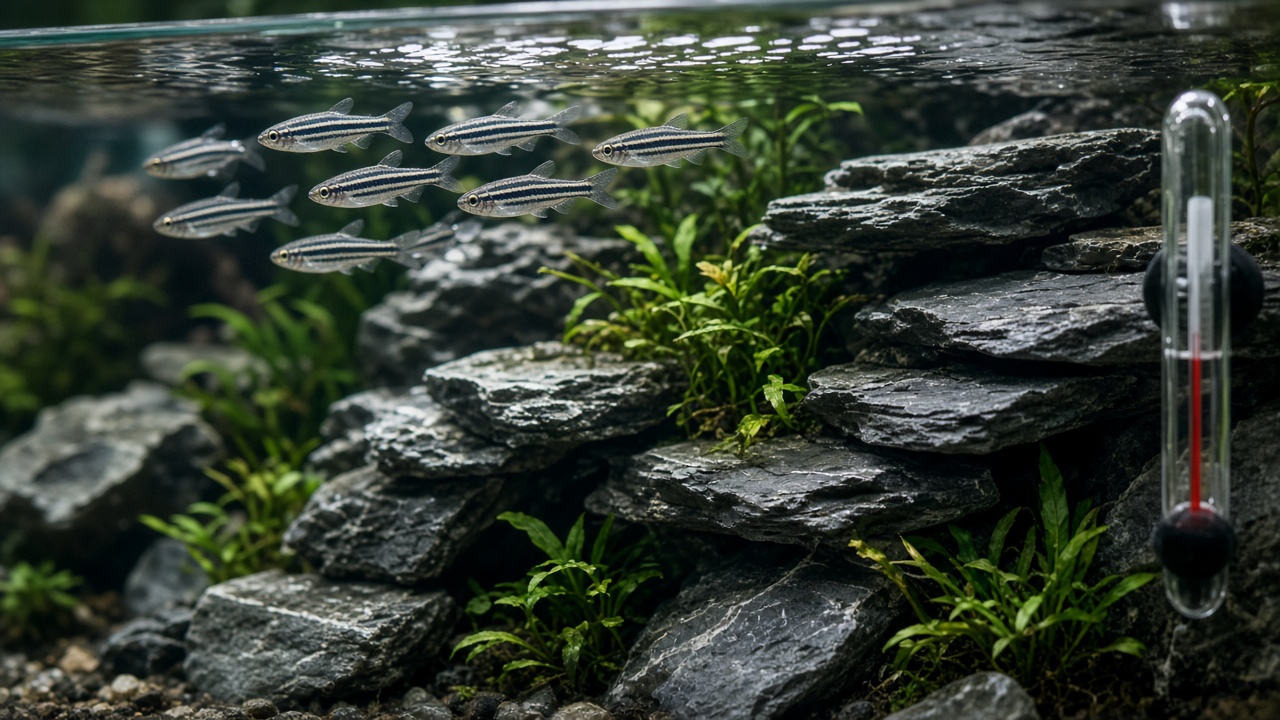
Aqueon’s tank-mate article says zebrafish, also called danios, tolerate 68–74°F and grow to about two inches. Pick zebrafish larger than your goldfish’s mouth, and keep them as a school around smaller fancy goldfish only.
Aqueon also names ornamental minnows and points to rosy red and white cloud varieties. It does not publish an adult length for those minnows on that page. Treat them as small, fast fish under the same mouth-size rule.
Aqueon lists apple, nerite, and mystery snails as calm algae eaters. Snails are not fish, and goldfish may still pick at them. Watch the first week and remove a snail if the goldfish worries the shell.
Tropical community fish cannot share the tank if they need Tetra’s 78°F target. Aqueon’s tank-mate article is plain: skip guppies, bettas, and plecostomus.
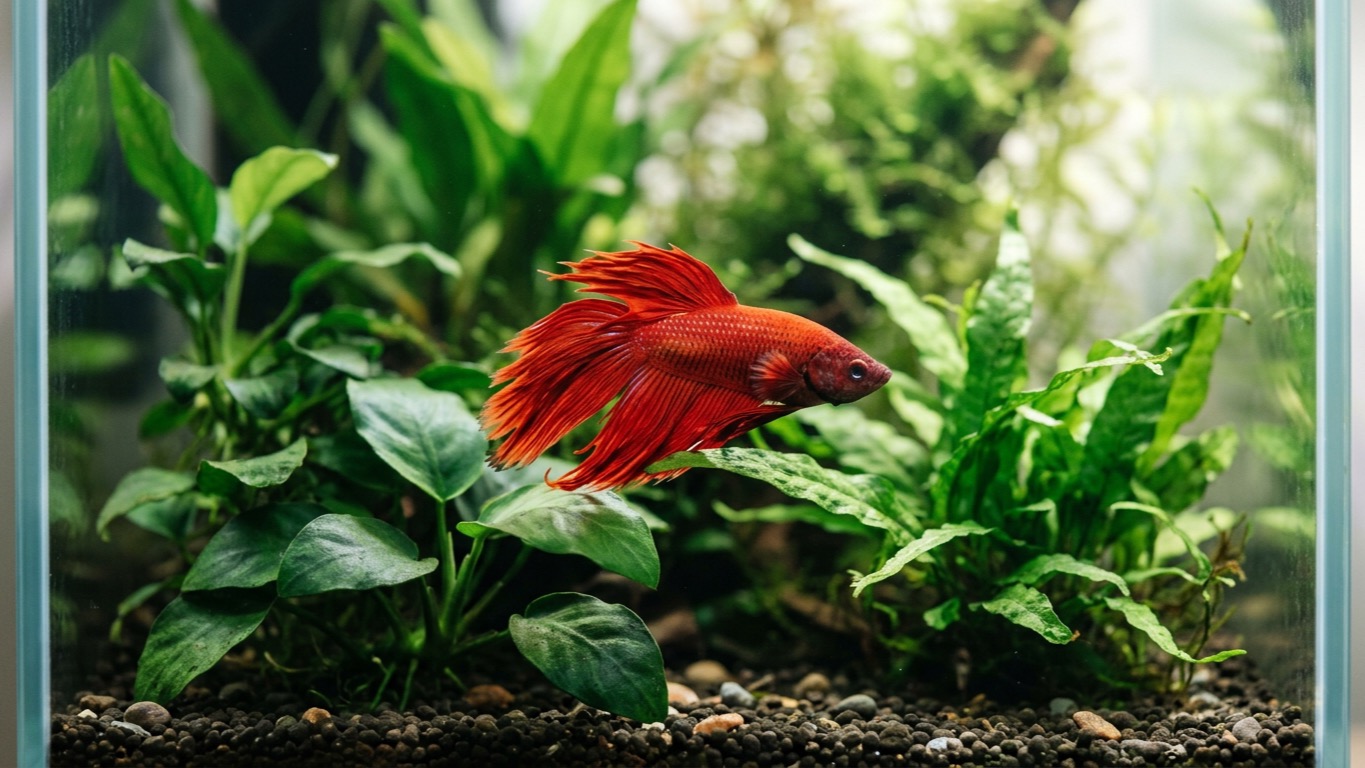
Bettas fail for heat and for fins, because Aqueon’s goldfish pages describe goldfish as active foragers that root and graze. A long-finned betta is a slow target in that water.
Aqueon’s care guide says to avoid fin nippers and boisterous fish, because fancy goldfish have long, split tails those fish shred. A one-inch tetra is food once a comet nears 12 inches. Shrimp fail too, because the USGS profile lists planktonic crustaceans in the wild goldfish diet.
Do not add a second species to use up leftover food. Extra mouths raise ammonia and do not clean a goldfish tank.
Goldfish also eat plants, so plan greenery with that habit in mind. Aqueon’s care guide names Cryptocoryne, Java fern, and Anubias as plants they may leave, though they may still uproot them. That list is much shorter than the best live plants for betta fish, because bettas do not graze like carp.
Aqueon’s types page says pet goldfish eat flake and sinking pellet food made with up to 38% protein. Soak flakes before feeding, as the care guide says, and skip silk plants that page says goldfish may swallow.
Tank Size and Waste Come First
You cannot add roommates until the tank already fits adult goldfish.
Aqueon’s care guide says adult commons, comets, and shubunkins need at least 20 gallons of water per fish. Adult fancy goldfish need at least 10 gallons per fish. It says never keep goldfish in bowls or unfiltered containers.
Aqueon’s tank-mate article uses a different starting math:
- 20 gallons for one goldfish
- 15 more gallons for each extra fish
- Adult length added together, at one gallon per inch, as a rough check
Aqueon’s types page starts with a 20-gallon tank for one goldfish, then adds one gallon per inch of adult fish. Those three Aqueon pages do not use one identical formula, but the shared floor is still 20 gallons for the first goldfish.
Goldfish waste is the hidden roommate problem on every care sheet. Aqueon’s care guide says they generate a significant amount of waste and calls for a slightly oversized filter.
Aqueon’s care guide sets a water-change rhythm:
- Change 10% of the water weekly, or
- Change 25% every 2 weeks
Tetra’s water-quality page sets nitrate below 40 ppm for a healthy freshwater tank and nitrite below 0.5 ppm, with 0 as ideal. API’s cycling page calls a cycle complete at 0 ppm ammonia, 0 ppm nitrite, and 5–20 ppm nitrate.
If you cannot hold those numbers with goldfish alone, do not add a second species. Aqueon’s care guide gives a salt dose of 1 tablespoon of aquarium or sea salt per 5 gallons. Use that only as that page describes, and do not treat salt as a license to overstock.
Feed to the clock Aqueon publishes on the care guide. Offer only what the fish consume in 2 to 3 minutes, once or twice a day. Extra food becomes ammonia, and extra fish make that worse.
Add a Roommate Only After the Cycle Holds
Add tank mates only after the nitrogen cycle is done and the goldfish already live in stable water.
API’s cycling page says the nitrogen cycle can take 2 to 6 weeks. Tetra’s water-quality page says the wait lasts about four to six weeks before a tank cycles. Our how long to cycle a fish tank guide covers that wait in more detail.
API’s cycling page gives the finish line in numbers:
- 0 ppm ammonia
- 0 ppm nitrite
- 5–20 ppm nitrate
It also says to test every 3 to 4 days while the cycle runs. If ammonia or nitrite rises, it calls for a 30% partial water exchange.
When you do add a fish, keep the load small:
- Confirm the three API finish-line readings on more than one test day.
- Match the new fish to the goldfish temperature band, not to 78°F.
- Add one fish or one small school, not a full restock.
- Test again over the next week. Repeat the 30% change if ammonia or nitrite leaves 0 ppm.
Aqueon’s care guide says goldfish eggs hatch in 48 to 72 hours if a pair spawns. Extra fry raise the waste load fast, so remove eggs on plants if you are not ready to raise young.
The USGS profile notes that goldfish can survive 0–41°C in the wild, which is a survival range, not a tank target.
Never dump extra goldfish or unwanted tank mates into local water. The USGS profile records goldfish as established or reported in every state except Alaska.
FAQ
Can goldfish live with bettas?
Goldfish cannot live with bettas, and Aqueon’s tank-mate article says to avoid them because they need much warmer water. Tetra’s page sets tropical fish at 72–80°F, with 78°F as optimal, which sits above Tetra’s goldfish ranges.
Can goldfish live with guppies or tetras?
Goldfish cannot live with guppies or typical tetras. Aqueon names guppies as tropical fish to skip. Tetras sit in Tetra’s 72–80°F band and often stay small enough to fit in a goldfish mouth.
Can fancy goldfish live with common goldfish?
Fancy goldfish should not share a tank with commons as a long-term plan. Aqueon’s care guide says commons, comets, and shubunkins may become too boisterous for smaller fancy goldfish as they grow. Keep single-tails with single-tails and fancies with fancies.
How many goldfish can share one tank?
Start with Aqueon’s care-guide floor of 20 gallons for each adult common, comet, or shubunkin, and 10 gallons for each adult fancy. Aqueon’s tank-mate article starts at 20 gallons for one goldfish and adds 15 gallons per extra fish. Use the larger of those two math paths if they disagree.
Can goldfish live with snails or white cloud minnows?
Aqueon lists apple, nerite, and mystery snails as tank mates and names white cloud minnows as ornamental minnows. Watch both, because goldfish may pick at snails or eat minnows that fit in the mouth. Aqueon gives zebrafish a 2-inch adult length and the same mouth warning.
Do I need a heater if I add other fish?
You do not need a heater for goldfish roommates in a typical indoor room. Aqueon says goldfish live in an unheated tank and need cool-water friends. Heat only if your room falls below the Aqueon bands of 60–70°F for comets or 68–74°F for fancies.
When is it safe to add another fish?
Wait until API’s cycling page finish line holds: 0 ppm ammonia, 0 ppm nitrite, and 5–20 ppm nitrate. API says that cycle can take 2 to 6 weeks. Test every 3 to 4 days during the wait, then add one small group.