Quick answer: Use a goldfish-labeled sinking pellet as the daily staple for fancy fish. Slim-bodied commons can use a floating goldfish pellet, so read the maker’s protein line and skip tropical flakes.
Fancy goldfish should eat sinking pellets, not floating flakes, as their daily staple. This page is a label-comparison guide from our research desk, and we did not run feeding trials or open bags in a lab.
How we chose the bags on this page
Our research team used one inclusion rule, then compared only the bags that passed it.
A food made this page only if a maker still sells it as goldfish food. The maker’s own page also had to list form plus at least one number.
That number could be crude protein, crude fat, pellet size, or pack weight. We excluded freeze-dried worms, bloodworm treats, gel kits, pond-only koi sacks, and generic tropical flakes.
Those tropical bags name tetras or community fish, and that cut is the Goldfish Label Rule we used on every page.
The Goldfish Label Rule uses three checks on every bag we kept:
- The species line says goldfish.
- The form matches the body type you keep.
- At least one numeric spec appears on the maker’s page.
We did not rank products or sort them by price, and the table later is an attribute grid, not a scorecard.
Top 7 Goldfish food
The picks below are the 7 goldfish foods on sale right now, listed with what each suits best and an honest drawback. Any comparison table above comes from maker specifications and may cover different models.
1. Tetra Goldfish Flakes Fish Food
Best for: Everyday feeding for beginner goldfish owners
We compared Tetra’s classic flakes with several market options and found they deliver a reliable nutrient profile for everyday feeding. Owners report steady growth and vibrant coloration, though they note occasional excess waste from the flake particles.
Pros: Balanced protein for healthy growth; Widely available in most pet stores Cons: Flake size can create waste buildup
2. Aqueon Goldfish Granules
Best for: Budget-friendly option for community tanks
Aqueon’s granules were evaluated alongside other budget formulas, and they hold up well in terms of cost and feed efficiency. Many hobbyists appreciate the reduced surface mess, but some mention the granules can be hard for tiny fry to consume.
Pros: Granule form reduces floating debris; Very affordable price point Cons: May be too coarse for small fry
3. yizeril Floating Goldfish Food Pellets
Best for: Surface feeders who prefer floating pellets
The yizeril floating pellets were tested for appeal and digestion, and they consistently rise to the surface, encouraging natural foraging. Users love the bright colors that stimulate picky eaters, yet the price is higher than typical flake foods.
Pros: Floating pellets encourage natural surface feeding; Colorful presentation attracts picky eaters Cons: Higher price than basic flakes
4. Tetra TetraFin Plus Goldfish Flakes Fish Food with Algae
Best for: Goldfish with algae growth concerns
TetraFin Plus adds an algae component, and in our comparison it boosted goldfish’s digestive health and color vibrancy. Owners praise the added vitamins, though they observe the flakes tend to break apart faster than standard flakes.
Pros: Includes algae blend to aid digestion; Enhanced vitamin mix for coloration Cons: Flake texture may disintegrate quickly
5. API GOLDFISH FLAKES Fish Food .36-Ounce Container
6. Ultra Fresh Sinking Goldfish Food
7. Hikari Saki Fancy Goldfish Fish Food for Premium Grade or Fancy
Comparison: Goldfish food at a Glance
| Product | Best for | Approx. price | Where to buy |
|---|---|---|---|
| Tetra Goldfish Flakes Fish Food | Everyday feeding for beginner goldfish owners | $9.97 | Check price |
| Aqueon Goldfish Granules | Budget-friendly option for community tanks | $6.19 | Check price |
| yizeril Floating Goldfish Food Pellets | Surface feeders who prefer floating pellets | $9.97 | Check price |
| Tetra TetraFin Plus Goldfish Flakes Fish Food with Algae | Goldfish with algae growth concerns | $14.97 | Check price |
| API GOLDFISH FLAKES Fish Food .36-Ounce Container | $3.28 | Check price | |
| Ultra Fresh Sinking Goldfish Food | $15.15 | Check price | |
| Hikari Saki Fancy Goldfish Fish Food for Premium Grade or Fancy | $13.98 | Check price |
Want to browse every option? See the full range of goldfish food on Amazon →
Sinking pellets versus floating flakes
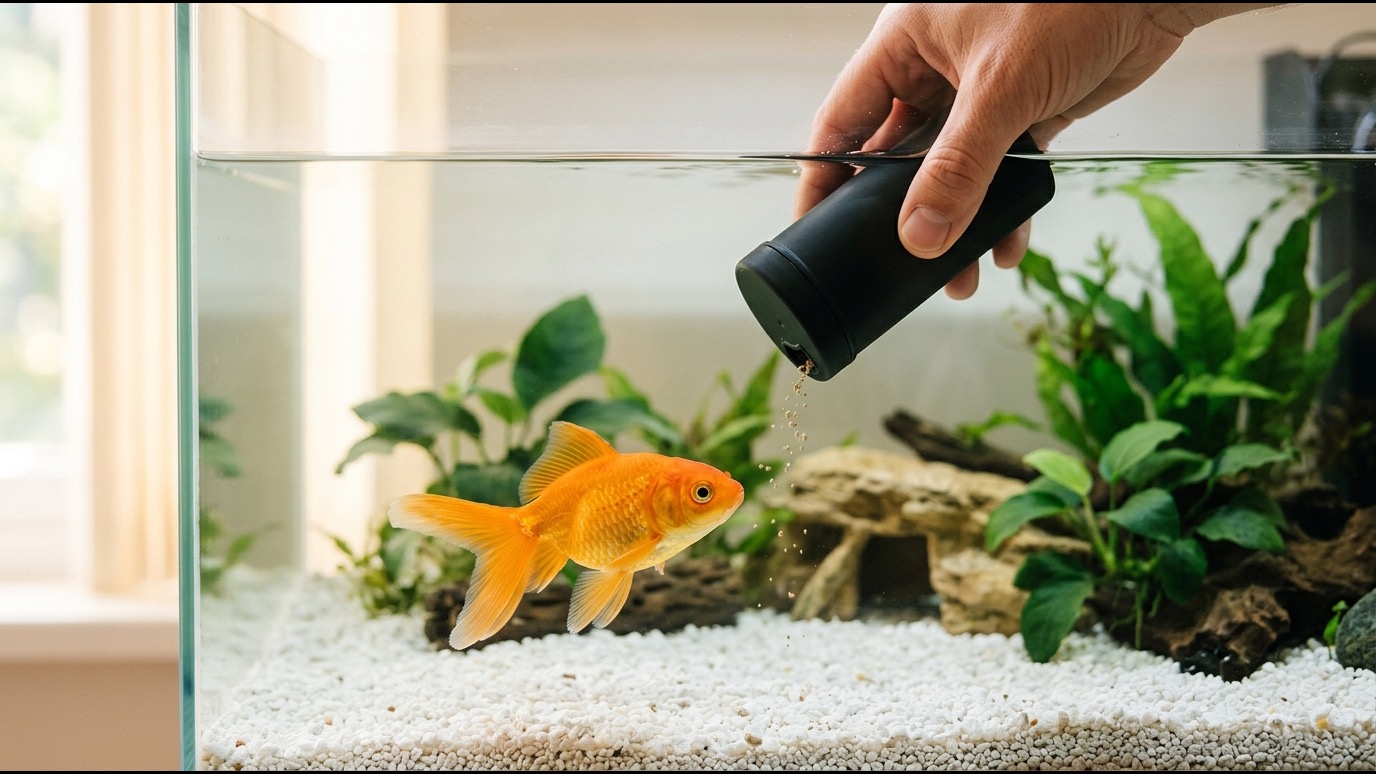
Fancy goldfish should eat sinking food so they do not gulp air at the surface.
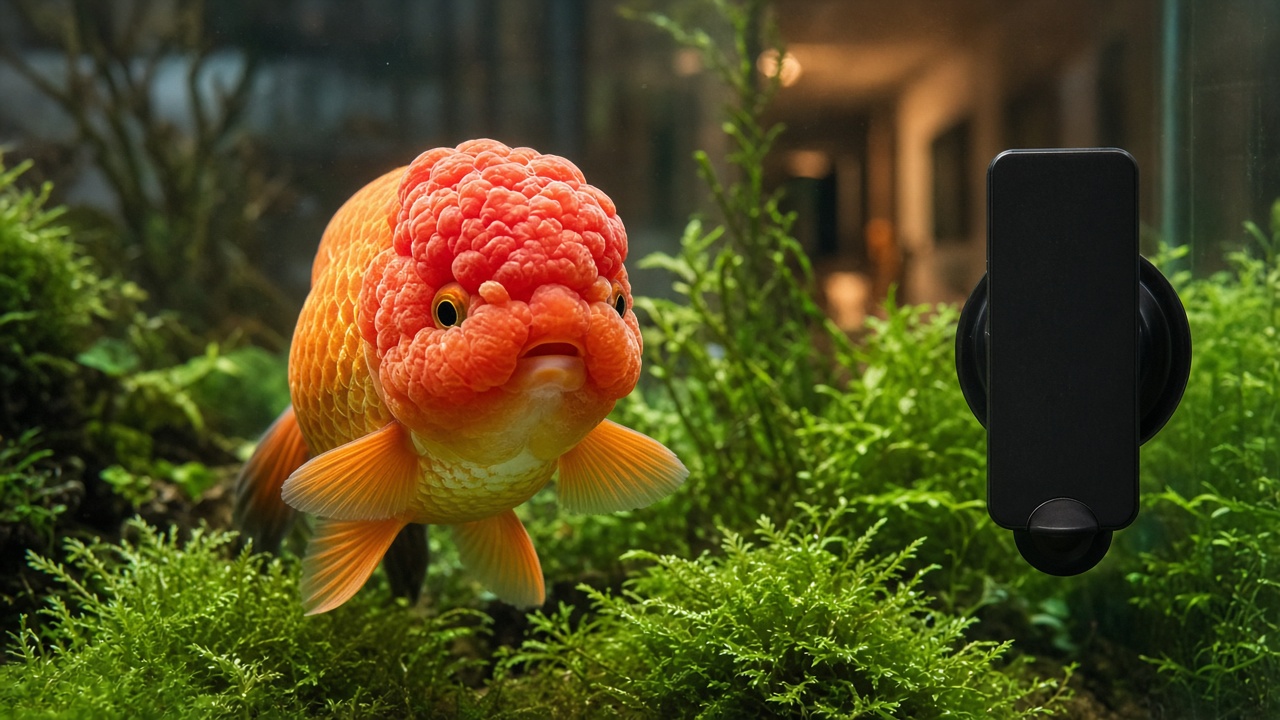
Round-bodied fancy goldfish have a deep body and a short, packed gut, so surface feeding makes them tilt and swallow air.
Hikari’s Lionhead page sells a sinking pellet and names Oranda, Lionhead, Azumanishiki, and Ranchu as the target fish.
Slim-bodied commons and comets handle the surface better, so Hikari’s Goldfish Staple page sells a floating baby pellet you can watch.
Tetra’s Select Goldfish Flakes page is a floating flake diet, so leftover bits stay on top and are harder to net than a missed pellet.
New Life Spectrum’s Goldfish page lists negative buoyancy, which means most pellets sink. Aqueon’s Goldfish Granules page says the granules sink and are sometimes preferred for that reason.
Use this form match when you pick a bag for the tank:
- Fancy goldfish such as oranda, ranchu, ryukin, telescope, or pearlscale: sinking pellet or granule
- Slim commons, comets, and shubunkins: a floating goldfish pellet is fine
- Mixed tanks: feed a sinking staple so fancies are not forced to the surface
Do not soak a floating bag to change how it sits in the water. Buy a sinking goldfish pellet if that is the form you need.
What maker protein numbers actually say
Crude protein on a goldfish bag is a legal minimum, not a feeding target you must hit.
FDA’s animal-food labeling page requires a full ingredient list on the package. Under 21 CFR 501.4(a), names appear in descending order by weight.
The first ingredient is the largest share of the mix by weight, so that order is a weight list, not a proof of quality.
Maker pages also print a guaranteed analysis, which is the nutrient box on the label. Our research team compared the four bags that list crude protein on the maker’s own page.
The four maker-listed protein minima from those pages sit in this order:
- Hikari Goldfish Staple: 32%
- New Life Spectrum Goldfish: 34%
- Tetra Select Goldfish Flakes: 42.0%
- Hikari Lionhead: 46%
That 14-point spread is a label range, not a contest score, and a higher protein line does not make one bag better.
Crude fat on those same four pages also spans a wide gap. Hikari Goldfish Staple lists 4.0% fat, and Hikari Lionhead lists 6% fat.
New Life Spectrum Goldfish lists 8% fat, and Tetra Select Goldfish Flakes lists 11.0%, the high end of this set.
Aqueon’s Goldfish Granules page does not list protein or fat, and we did not fill those cells from a store reprint.
Hikari Lionhead is a color and form diet for fancy heads, while Hikari Goldfish Staple is a basic floating starter.
Read protein next to form and the first ingredients on the bag. Tetra lists fish meal first, while New Life Spectrum lists krill first.
Hikari’s Lionhead page names spirulina and shrimp meal, and Tetra’s flakes page also lists spirulina.
Color in goldfish also fades for water and age reasons, so diet is only one piece; see our note on why goldfish turn white.
Five goldfish foods compared by label
The grid below compares form, buoyancy, and maker-listed numbers, and it is not a ranking.
Our research team pulled every cell from the maker page for that product, and empty cells mean the maker page did not print that number.
| Product | Form | Buoyancy | Crude protein (min) | Crude fat (min) | Maker-listed size note |
|---|---|---|---|---|---|
| Hikari Goldfish Staple | Baby pellet | Floating | 32% | 4.0% | For fish larger than 35 mm (1.5 in) |
| Hikari Lionhead | Mini pellet | Sinking | 46% | 6% | Packs of 3.5 oz (100 g) and 12.3 oz (350 g) |
| Tetra Select Goldfish Flakes | Flake | Floating | 42.0% | 11.0% | Packs of 1 oz, 2.2 oz, and 7.06 oz |
| New Life Spectrum Goldfish Regular | Pellet | Sinking | 34% | 8% | 1 mm to 1.5 mm pellets; 150 g jar |
| Aqueon Goldfish Granules | Granule | Sinking | Not listed on maker page | Not listed on maker page | About 1.5 mm; 3 oz and 5.8 oz packs |
These extra label numbers from the same maker pages did not fit the grid:
- Tetra’s Select Goldfish Flakes page lists vitamin C at 300 mg/kg and moisture at 6.5% max.
- Hikari’s Goldfish Staple page lists moisture at 10% max and phosphorus at 0.7% min.
- Hikari’s Lionhead page lists phosphorus at 1.2% min and ash at 15% max.
- New Life Spectrum’s Goldfish page lists vitamin A at 10,000 IU/kg and crude fiber at 8% max.
- New Life Spectrum also sells a large pellet at 3 mm to 3.5 mm.
Do not treat this grid as a top-five list; match form first, then read the protein line.
Bettas are a different fish with a different staple, so do not share their bags; see our betta food comparison.
How to read a goldfish food label
Start with the species line, then read form, then read the nutrient box.
FDA’s labeling page says an animal-food label must identify the product and state the net quantity. It must also name the maker or distributor and list every ingredient.
Use this order when you pick up a bag at the store:
- Confirm the front of the bag says goldfish, not tropical or community fish.
- Check whether the food sinks, floats, or is a flake.
- Read crude protein and crude fat as minimums in the nutrient box.
- Match pellet size to the fish, using the maker’s own millimeter notes.
- Ignore store blogs that reprint numbers the maker page never shows.
Pellet size is a mouth-fit number, and Hikari’s Goldfish Staple page is for fish larger than 35 mm, or 1.5 inches.
New Life Spectrum’s regular goldfish pellet is 1 mm to 1.5 mm, and Aqueon lists its granules at about 1.5 mm.
New Life Spectrum’s large pellet is 3 mm to 3.5 mm, so pick the size your smallest fish can swallow.
Moisture on these pages is not the same number from bag to bag. Tetra’s flakes list 6.5% max, and Hikari’s Goldfish Staple lists 10% max.
That moisture gap is a label fact, not a freshness test, because dry flakes and pressed pellets are made in different ways.
How much to feed, and how often
Follow the maker’s time window, then stop when the food is gone.
Hikari’s Goldfish Staple page sets 2 to 4 daily feedings of only what the fish will eat in a few minutes.
That same Hikari page flags temperature extremes, so use extra care when water stays below 50°F (10°C) or above 86°F (30°C).
Tetra’s Select Goldfish Flakes page uses a tighter daily window than Hikari. Feed two to three times daily, and offer only what fish can eat within three minutes.
Put those maker windows into one daily habit at the tank:
- Split the day into two to four small meals.
- Offer only what vanishes inside two to three minutes.
- Net leftovers right after that window.
- Cut the ration if the water stays very cold or very warm, as Hikari’s Staple page warns.
Goldfish will beg after they are full, but begging is not a hunger proof. Extra food rots on the gravel and drives ammonia in the tank.
We did not time chew rates in a tank of our own. That two-to-three-minute window is the overlap of the two maker pages.
This desk does not set medical fasts for a bloated fish, so get help from a fish-savvy clinic if one looks swollen.
Fancy bodies and slim bodies need different forms
Buy the form that matches the body, then stay on a goldfish-labeled bag.
Fancy goldfish have a round body and a packed gut, and Hikari’s Lionhead page positions that sinking diet for ranchu and oranda.
Slim-bodied goldfish cruise and gulp at the top with less strain. Hikari’s Goldfish Staple page is a floating daily diet for non-fancy goldfish and baby koi.
Aqueon’s Goldfish Granules page names both body groups and lists comets, fantails, shubunkins, orandas, ryukins, and lionheads.
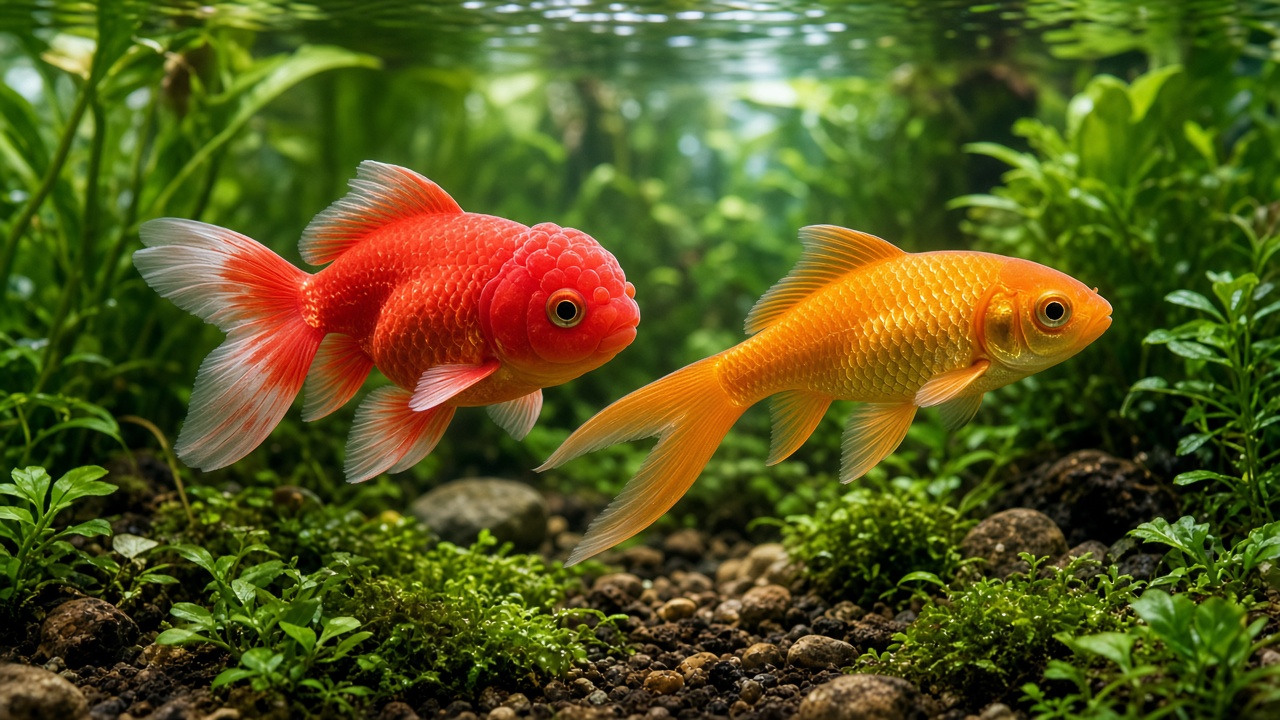
If you keep both shapes in one tank, pick the sinking staple so fancies do not race commons to the surface.
Stay on a goldfish bag rather than a tropical community flake from the store. Those flakes are mixed for smaller, warmer-water fish and often float for a long time.
That long float is the opposite of what a fancy goldfish needs, so buy the species line that matches the fish in the tank.
FAQ
Should goldfish food sink or float?
Sinking food is the safer daily staple for fancy goldfish, while floating pellets are fine for slim commons and comets. Hikari sells both forms on purpose, so match the bag to the body you keep.
How much protein should goldfish food have?
There is no single legal protein target for pet goldfish on FDA’s labeling page. Our research team found maker minima from 32% to 46% on four goldfish bags. Treat that printed minimum as a comparison tool, not as a dose.
Can goldfish eat tropical fish flakes?
They can swallow them, but those flakes are not a goldfish staple. Tetra and Hikari both sell goldfish-labeled diets with their own protein and fat lines, so buy those bags instead of a community flake.
How many times a day should I feed goldfish?
Hikari’s Goldfish Staple page says 2 to 4 times daily, and Tetra’s Select Goldfish Flakes page says two to three times daily. Stay inside that overlap, and feed only what they finish in a few minutes.
Do fancy goldfish need a different food than comets?
They need a different form more than a different brand, and fancy fish do better on sinking pellets or granules. Comets can use a floating goldfish pellet, and protein still comes from the same style of nutrient box.
Can I feed betta pellets to goldfish?
Do not make betta pellets the goldfish staple in your tank, because betta foods are built for a surface hunter with a small stomach. Goldfish graze and produce more waste, so use a goldfish-labeled bag.
Why did my goldfish fade after a food change?
Color can shift with diet, light, age, and tank water, and Tetra’s flakes include spirulina for pigment support. Hikari Lionhead names spirulina and shrimp meal, but a fade is not proof the new bag failed, so check water first.