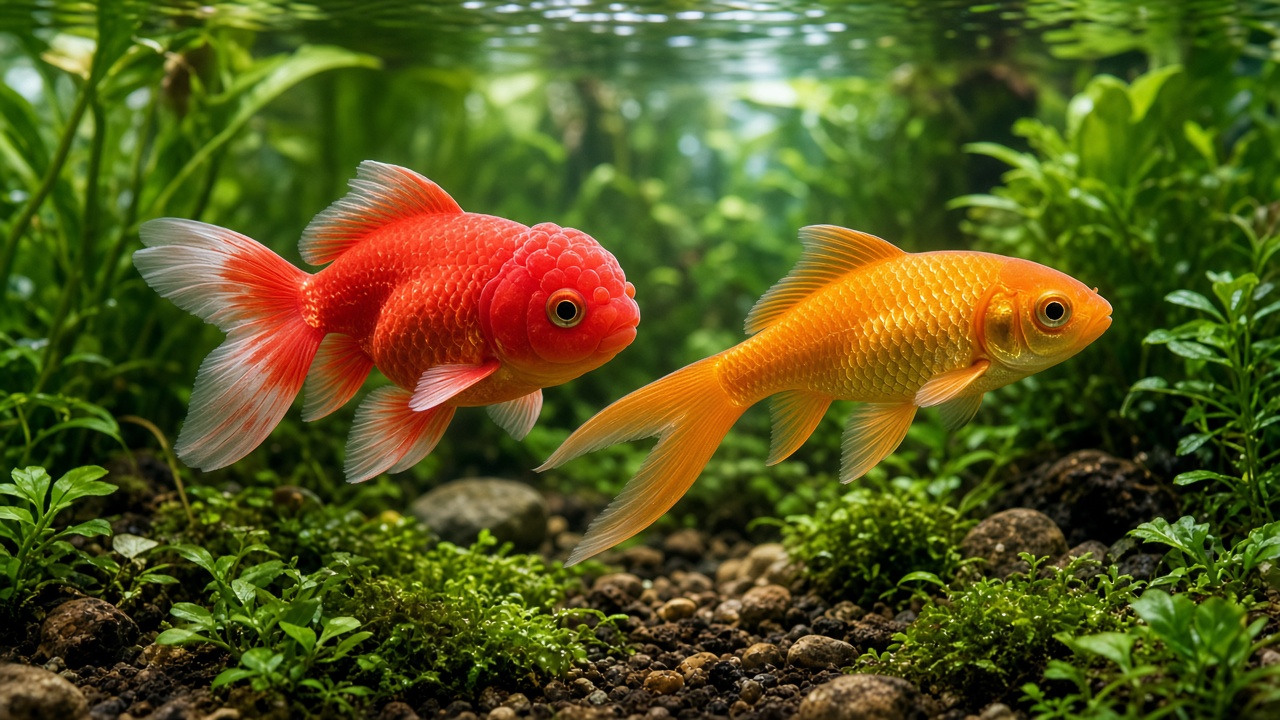
Quick answer: Pick the body plan first, not the color on the fish. Single-tail goldfish need long swimming room and should live only with other single-tails. Fancy goldfish have round bodies and should live only with other fancies.
Common, comet, and shubunkin goldfish are single-tail types; oranda, ryukin, and ranchu are fancy types. This page is a retail body-plan comparison from a home-aquarium research desk, and we did not rank varieties, run feeding trials, or visit hatcheries.
We cover a named goldfish type only when it is sold for home tanks and fits one of those two body plans. We skip koi, wild carp, and show-only strains that have no US retail listing.
For gear, we include only foods whose maker pages name goldfish and list a package size, pellet size, or guaranteed analysis. Our research team compared those published specs and did not keep these fish in house tanks for this page.
How the WaterPuppy Body-Plan Rule sorts goldfish types
The useful split for home buyers is body plan, not a color chart.
All goldfish on this page belong to one species, which the Ornamental Aquatic Trade Association care sheet names Carassius auratus. Color can change over months, but tail count and body depth do not.
We use a five-step WaterPuppy Body-Plan Rule when we sort a fish:
- Count the tail. One lobe means single-tail. A split or paired tail means fancy.
- Read the body. A slim, long body tracks with single-tail types. A short, deep body tracks with fancy types.
- Size the tank for the adult fish, not for the store juvenile.
- Match food form to the way that fish actually swims.
- Keep the two body plans in separate tanks at all times.
A calico comet stays under this rule, and a ranchu stays. A koi does not stay, and a feeder minnow does not stay.
OATA’s care sheet says goldfish were first kept in bowls in China in the third century and reached Europe in the 1700s. Those dates explain the long breeding history, but they do not change the two-plan split.
Single-tail goldfish you will see for sale
Single-tail goldfish are the slim, fast swimmers you will see in the pond-fish aisle.
Three named types show up in US retail again and again:
- Common goldfish, with a short single tail and a long body
- Comet goldfish, with a longer single tail and the same slim build
- Shubunkin goldfish, with a single tail and a calico color pattern
These fish use the full length of a tank and chase food at the surface, and they also grow large. OATA’s care sheet says goldfish have grown to 40 cm or more, while a tank adult more often reaches up to 25 cm.
That is about 16 inches in the high reports and about 10 inches as a common tank adult. A slim fish near 10 inches is not a bowl pet.
OATA’s compatibility note is blunt: it is not advised to keep comet goldfish with fancy goldfish. Comets swim faster, often take the food first, and may nip slower fancy fins.
If you want a single-tail, plan a long tank now or a pond later. OATA says a non-fancy goldfish can move to an outdoor ornamental pond, while fancy types need a different housing plan.
Aqueon’s Goldfish Granules page lists Comets and Shubunkins by name and also lists many fancy forms on the same food. That is a diet label, not a mixing rule.
Fancy goldfish you will see for sale
Fancy goldfish are the short, round fish with paired tails that turn slowly in indoor tanks.
These are the named fancy types that pass our retail rule:
- Fantail, the plain split-tail starter
- Ryukin, with a high back and a short body
- Oranda, with a fleshy hood on the head
- Ranchu and lionhead, hooded fish with no tall dorsal fin
- Telescope and moor, with protruding eyes
- Bubble eye, celestial eye, and pearlscale, the extreme forms
Aqueon’s Goldfish Granules page names 11 goldfish forms, from Comets to Pearlscales, and our research team counted those names on that maker page. Small koi also appear on that list, and koi still fail our selection rule.
Fancy fish turn slowly and often feed lower in the water, so a sinking granule or pellet matches that habit. A floating pellet can make a round fish gulp air at the surface.
Extreme eye and hood forms need smooth décor, because sharp rock can tear tissue. That is a setup choice, not a ranking of types.
Do not mix these fish with commons or comets, because OATA’s care sheet already flags that mismatch. A fast single-tail will win every feeding race in a shared tank.
Space and water numbers that change the setup
Tank volume is a type decision for both body plans, not a décor decision.
OATA’s care sheet sets a hard floor for an adult goldfish:
- At least 100 litres for one adult, about 26 US gallons
- An extra 50 litres for each added adult, about 13 US gallons
- A filter in every tank, with no size exception
That litre rule does not shrink for a fancy body, because a round fish still makes waste and a slim fish still needs swim length. If you cannot meet the 100-litre floor, wait and do not buy the fish yet.
OATA also lists water targets for goldfish:
- Temperature between 4 and 25°C, about 39 to 77°F
- pH from 6.0 to 8.0
- Ammonia at zero mg per litre
- Nitrite at zero mg per litre
- Nitrate no more than 20 mg per litre above tap-water nitrate
- Hardness from 5 to 19°dH
OATA calls for a water test once a week and a 25% water change at least once every week. Treat new tap water before it goes into the tank.
OATA says goldfish can live 6 to 8 years in an aquarium and also notes reports of 20 years or more. Short life is often a small-tank story, not a type story.
A heater is not required unless the room is very cold, but OATA still warns against temperature swings. Keep the tank off drafts, heat vents, and direct sun.
Food form by body plan, with five current products
Food form should follow the WaterPuppy Body-Plan Rule, not a color label on the bag.
Single-tail fish can take flakes or floating pellets, and you can see what they eat. Fancy fish do better on food that sinks, because they do not need to race the surface.
OATA says to use a goldfish flake or pellet, not a generic tropical flake. Feed only what they can eat in a few minutes, once a day. Maker pages sometimes list more feedings, so follow the label on the can you bought.
Our research team compared listed crude-protein minimums on two maker pages. Tetra’s Select Goldfish Flakes list 42.0%, and Omega One’s Large Sinking Goldfish Pellets list 35%. That 7-point gap is a spec spread, not a rank.
| Product | Form | Float or sink | Maker-listed analysis or size | Maker-named use |
|---|---|---|---|---|
| Tetra Select Goldfish Flakes | Flake | Surface flake | 42.0% min crude protein; 11.0% min fat; 1 oz, 2.2 oz, 7.06 oz | Goldfish and small pond fish |
| Hikari Goldfish Gold | Baby pellet | Floating | 3.5 oz (100 g) and 10.5 oz (300 g) | Goldfish and baby koi |
| Aqueon Goldfish Granules | Granule | Sinks | About 1.5 mm; 3 oz and 5.8 oz packs | Common goldfish, fancy orandas, and 11 named forms |
| Aqueon Nutrinsect Goldfish Pellets | Pellet | Sinks | 1.76 oz pack; feed what they finish in 2 minutes | Daily goldfish diet |
| Omega One Large Sinking Goldfish Pellets | Pellet | Sinking | 35% min crude protein; 10% min fat; 3.8 oz and 7.5 oz | Daily diet for all goldfish |
Tetra’s page for Select Goldfish Flakes also lists 2.0% max crude fiber and 6.5% max moisture. It says to feed two to three times daily, only what fish finish in three minutes.
Aqueon’s Nutrinsect Goldfish Pellets page says to feed two to three times a day in amounts they finish in two minutes. It also says to remove leftover food about five minutes after feeding.
Hikari’s Goldfish Gold page calls the diet a floating, color-enhancing daily pellet and lists carotene as the color additive. Use it for fish that feed at the surface, and skip it as the only food for a heavy fancy if that fish gulps air.
Aqueon’s Goldfish Granules page lists a 1.5 mm granule and a 2.6 by 2.6 by 3.2 inch pack. The granule sinks, which matches fantails, orandas, and other short-bodied types on that same page.
Omega One’s Large Sinking Goldfish Pellets page lists 3% max crude fiber, 8.5% max moisture, and 8% max ash. The sinking form fits the fancy side of the comparison table.
Pick one staple that matches the body plan, then stay with that form. Do not chase a ranked “best food” list, because none of these pages ranks the other brands.
Color shifts and who can share the tank
Color is a poor way to name a goldfish type, because pigment can move while the body plan stays put.
A young goldfish can look bronze, then turn orange, and a black moor can fade while a white patch spreads. Those shifts do not move a comet into the fancy group.
If a fish is darkening, start with water tests, not a new variety name. Our note on why a goldfish turns black walks through common causes, and if pale patches spread, use our note on why goldfish turn white.
Both pages stay on color and do not reclassify the fish. Tank mates follow the same body-plan split. Single-tails need room and peers that can keep up, and fancies need slow company with no fin nippers.
OATA says goldfish can live alone or with others, and it still warns against comet-and-fancy mixes. For other species, use our page on what fish can live with goldfish after you lock the body plan.
OATA also gives a breeding note if you keep both sexes. It lists a 2:1 male-to-female ratio and says spawning is more likely near 20°C, about 68°F. Eggs hatch within three days, and adults eat eggs, so move the mop or plants if you want fry.
FAQ
How many types of goldfish are there?
There is one species and two body plans that matter for a home tank. Named strains run far past the 11 forms on Aqueon’s Goldfish Granules page. Most extra names are color or hood variants of the same fancy plan.
Can fancy and single-tail goldfish live together?
No, because OATA’s care sheet says comet goldfish should not be kept with fancy goldfish. Comets are faster, take food first, and may nip fins. Keep the two plans in separate tanks.
How big a tank does one adult goldfish need?
OATA’s care sheet says at least 100 litres for one adult, which is about 26 US gallons. Add 50 litres, about 13 gallons, for each extra adult. The same floor applies to a fancy adult and a single-tail adult.
How often should I feed each type?
OATA says to feed once a day, only what they eat in a few minutes. Tetra’s Select Goldfish Flakes page says two to three times daily, within three minutes. Aqueon’s Nutrinsect Goldfish Pellets page says two to three times daily, within two minutes, and fancy fish should get a sinking form.
Do goldfish need a heater?
OATA says a heater is not required unless the room is very cold, and its listed range is 4 to 25°C. Avoid drafts and heat vents, because sudden swings stress both body plans. A thermometer matters more than a heater in a stable room.
How long do these types live?
OATA reports many aquarium goldfish living 6 to 8 years and also notes reports of 20 years or more. Fancy fish do not get a shorter number on that sheet. Poor water and tiny tanks cut life for both plans.
Are koi a type of goldfish?
No, because koi fail our selection rule as a different carp form sold as pond fish. Aqueon’s Goldfish Granules page mentions small koi as a use case. That still does not make koi a goldfish type.