Quick answer: Feed freshwater puffers meaty frozen or live foods once a day. Add snails or shell-on cockles so their teeth wear down. Do not make flakes the main diet.
OATA says freshwater puffers are carnivores and are unlikely to eat prepared feeds. This page is a label-and-care-sheet comparison of packaged meaty foods and hard-shelled prey. We did not run feeding trials, keep a puffer colony, or review grocery seafood that lacks an aquarium-feed label.
OATA’s freshwater puffer care sheet set the feeding rhythm and prey types we used. Our research team analyzed four maker pages that still list protein and moisture, then compared those published specs.
How we chose the foods on this page
A food is on this page only if a maker lists protein and moisture, or OATA names it for beak wear.
A packaged item enters the table only when both points below are true.
- The maker still lists the product on an official HTML page.
- That page publishes crude protein and moisture in a guaranteed analysis.
Live snails and shell-on cockles enter the prose because OATA names them as foods that grind teeth. We left out marine puffer diets and flake-first community staples. We also left out grocery seafood without an aquarium-feed label, and any brand whose maker page we could not open.
None of the four maker pages we opened use the word “puffer.” The Waterpuppy 2026 Freshwater Puffer Label Audit counted four foods and zero puffer formulas.
What freshwater puffers actually eat
Freshwater puffers eat meaty prey, and hard shells are the tool that wears their teeth.
OATA states that these fish are carnivorous and are unlikely to feed on prepared feeds. It tells keepers to use a meaty diet of frozen live foods instead of flakes or other dry staples.
For smaller species, OATA lists these prey types:
- Daphnia
- Bloodworm
- Brine shrimp
For larger species, OATA lists cockle, mussels, and shrimp. It singles out cockle in the shell, because that food helps wear teeth as the fish break the shell. If a fish will not take frozen food, OATA says to tempt it with live artemia, daphnia, or river shrimp.
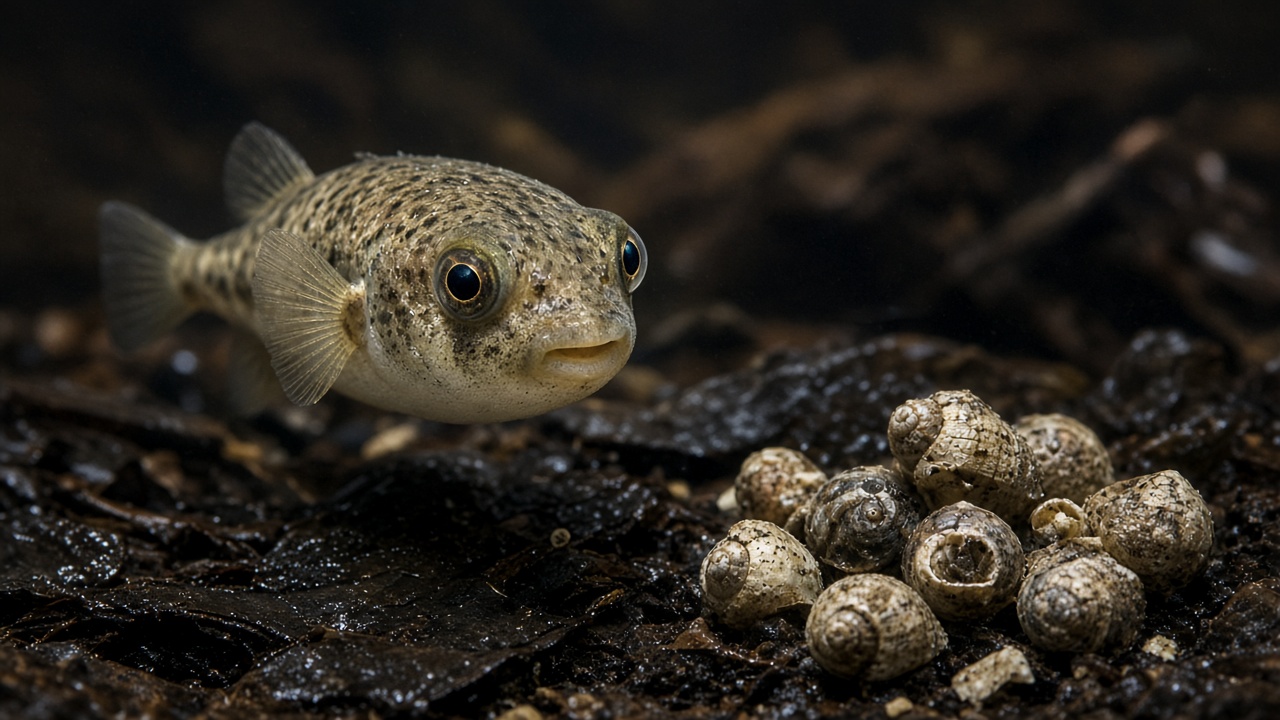
OATA also states that puffer teeth grow throughout life and need a diet with shellfish in their shells. Snails do that job for small puffers. Soft worms feed the fish, but they do not file a beak.
OATA lists the pygmy puffer at 2 cm and the mbu puffer at 60 cm, so prey must match that spread.
Frozen bloodworms: what the labels list
Frozen bloodworm cubes look low in protein because the cube is mostly water.
San Francisco Bay Brand’s Frozen Bloodworms page lists cubes at 3.5% minimum crude protein and 93.5% maximum moisture. Flat packs on the same page stay at 3.5% protein, with moisture listed at 94.5% maximum. That page also lists 0.3% minimum fat and 0.1% minimum phosphorus.
Hikari Sales USA’s page for Bio-Pure Frozen Blood Worms lists 3.5% minimum crude protein and 95% maximum moisture. The same page lists four pack sizes:
- 1.58 oz (40 g) mini cube pack
- 3.5 oz (100 g) 32-count cube pack
- 8 oz (227 g) flat pack
- 16 oz (454 g) flat pack
Omega Sea’s Frozen Bloodworms Pod Pouch page lists 6.3% minimum crude protein and 91.2% maximum moisture.
Those as-fed protein numbers look tiny next to a dry pellet, but the cube is wet. At the 93.5% moisture cap on San Francisco Bay Brand cubes, 3.5% protein equals about 54% on a dry-matter basis.
Hikari Tropical Sinking Carnivore Pellets list 47% minimum protein and 10% maximum moisture. That is about 52% protein on a dry-matter basis at that cap.
Wet cubes and dry pellets land in a similar dry-matter protein band.
Packaged foods compared by label, not by rank
The table below compares maker-listed attributes only and is not a ranking.
| Product | Form | Crude protein (min) | Moisture (max) | Maker feed note | Listed pack sizes |
|---|---|---|---|---|---|
| Hikari Bio-Pure Frozen Blood Worms | Frozen cubes or flat pack | 3.5% | 95% | No timed window on the nutrition block we used | 1.58 oz, 3.5 oz (32 cubes), 8 oz, 16 oz |
| San Francisco Bay Brand Frozen Bloodworms | Frozen cubes or flat pack | 3.5% | 93.5% cubes; 94.5% flat | What fish eat in 3 minutes | 1.75 oz (36 mini-cubes) through 2 lb (216 cubes) |
| Omega One Frozen Bloodworms Pod Pouch | Frozen pods | 6.3% | 91.2% | Ingredients listed; no timed window | Pod pouch on the maker page |
| Hikari Tropical Sinking Carnivore Pellets | Sinking dry pellet | 47% | 10% | 2 to 3 times daily, a few minutes | 2.61 oz (74 g) |
Hikari’s sinking-pellet page lists 8.0% minimum crude fat and 1.0% minimum phosphorus. It names cats, sharks, bichirs, and eels, and it does not name puffers.
AAFCO’s Calorie Content page says specialty pet foods include tank pets such as aquarium fish. It says about half of U.S. states have adopted some version of those rules.
AAFCO’s published crude-protein floors on that page are for dogs, not fish. Growth and reproduction diets list 22.0% dry-matter protein, and adult maintenance lists 18.0%. There is no matching ornamental-fish profile on that page.
Pellets can still help a large puffer that will eat them. They do not replace snails, and they do not replace OATA’s once-a-day meaty rule.
Bettas often take a daily pellet, but freshwater puffers usually do not. If you already keep a betta, see our best food for betta fish page. That plan is pellet-first, and this one is not.
How often to feed, and how much
OATA’s rule is one meaty feeding a day, limited to what the fish eats in a few minutes.
- Feed once a day.
- Offer only what the fish finishes in a few minutes.
- Remove leftovers so waste does not sit.
- Add hard-shelled prey on a regular cycle, not as a rare treat.
San Francisco Bay Brand’s Frozen Bloodworms page says to feed what can be consumed in three minutes, then remove uneaten food. It also says not to microwave cubes or thaw them in hot water.
Hikari’s sinking-pellet page says to feed two to three times daily. That is a pellet schedule for bottom carnivores, not OATA’s puffer schedule.
If a puffer takes a pellet, keep the daily total small. Do not stack three pellet meals on top of a full frozen meal.
OATA warns that leftover meaty food breaks down and releases toxic waste. Its water targets for this group are strict:
- Ammonia: 0 mg per liter
- Nitrite: 0 mg per liter
- Nitrate: no more than 20 mg per liter above tap-water levels
- Temperature: 22–27°C (72–81°F)
- pH: 6.5–8.0
OATA also asks for a weekly 25% water change and a weekly test. Meaty diets make that schedule non-optional, because a puffer that eats snails and worms is a messy eater.
If you miss a day, do not dump two days of worms in one lump. See our note on how long fish can go without food, then resume the normal once-a-day meal.
Prey size follows the fish
A 2 cm pygmy and a 60 cm mbu do not share one menu.
OATA says a small group of pygmy puffers can live in an aquarium as small as 80 liters. It says those pygmies should be kept in groups of at least five.
It says a mbu needs a much larger tank, at least 240 cm long. Feed the mouth in front of you, not a generic “puffer” icon.
Use this split:
- Pygmy and other small freshwater puffers: bloodworm cubes, daphnia, brine shrimp, and small live snails.
- Mid-size freshwater puffers: larger snails, frozen shrimp pieces, and shell-on cockle if the fish can crack it.
- Giant species such as mbu: mussels, cockle, and shrimp, as OATA lists for larger fish.
OATA says some “freshwater” puffers need brackish water as they mature. Low-end specific gravity goes up to 1.005, and medium sits between 1.005 and 1.015. High-end runs from 1.015 to about 1.026.
Food does not fix a salinity mismatch. Confirm the species before you buy a case of cubes.
Most freshwater puffers should live in a species-only tank. OATA says they nip fins, eat smaller fish, and can be highly aggressive, which makes them a poor match for goldfish. If you came here from a mixed-tank plan, read what fish can live with goldfish and keep puffers off that list.
OATA allows one community exception it names: green spotted puffers with archerfish, monos, and scats in brackish water. That is not a goldfish tank.
Keep the beak working
Soft frozen food feeds the fish. Hard-shelled prey files the teeth.
OATA’s biology section is plain: teeth grow for life, and the diet must include shellfish in their shells so the beak wears down. For a pea-sized puffer, that usually means live snails bred in a spare tub. For a large puffer, that means cockle or similar shell-on meat.
A simple week can look like this:
- Five days: thawed bloodworm cubes, sized to a few minutes of eating.
- Two days: live snails or shell-on cockle, matched to the fish’s mouth.
- Every day: siphon crumbs after the meal.
Do not thaw cubes in hot water. San Francisco Bay Brand’s page says heat breaks down nutrients in frozen fish food. Drop a cube, or thaw a sliver in tank water, then feed.
If the beak looks long, or the fish cannot close its mouth, stop guessing at home tools. That is a clinical problem. This desk does not treat it.
FAQ
Can freshwater puffer fish eat flake food?
OATA says freshwater puffers are carnivorous and are unlikely to feed on prepared feeds, and flakes are a prepared feed. Some large puffers will mouth a meaty pellet, but that does not make flakes a staple. Use frozen or live meat as the daily food, and keep any dry item as a backup only if the fish actually eats it.
How often should I feed a pea puffer?
OATA’s group rule is once a day, and only what the fish eats in a few minutes. San Francisco Bay Brand’s cube page tightens the leftover window to three minutes.
A pygmy puffer is 2 cm on OATA’s sheet, so use the smallest cubes or a snipped sliver. Do not copy the two-to-three-times pellet schedule from Hikari’s sinking carnivore page.
Do puffers need live snails?
They need hard-shelled prey. OATA says teeth grow throughout life and must be ground down by shellfish in their shells.
Small puffers use snails for that job, and large puffers can use cockle in the shell. Soft bloodworms do not replace that grind.
Are frozen bloodworms enough by themselves?
No. They are a meaty staple, not a full plan. Hikari Bio-Pure Frozen Blood Worms list 3.5% as-fed protein, and San Francisco Bay Brand lists the same figure. Omega One’s pod pouch lists 6.3% protein and 91.2% moisture, and none of those labels replace a shell.
Can I keep a freshwater puffer with goldfish?
OATA says most puffer fish should live in single-species tanks because they nip fins and may eat smaller fish. Goldfish are a poor match. The one community case OATA names is a brackish green spotted puffer with archerfish, monos, and scats, and that is not a goldfish tank.
What if my puffer skips a meal?
Skip the extra cube the next day. OATA already limits the meal to a few minutes and warns that leftover meat fouls the water.
Check ammonia and nitrite, which OATA lists as zero. For a longer gap, use our how long can fish go without food page, and do not double the portion.
Why don’t bag labels say “puffer food”?
The four maker pages in our 2026 label audit do not name puffers. Hikari’s sinking pellet page names other carnivores, and the frozen-worm pages name tropical and community fish.
AAFCO’s Calorie Content page treats aquarium fish as specialty pets. It publishes dog protein floors of 18.0% and 22.0% dry matter, not a fish profile. You match the prey to the species instead of waiting for a puffer logo on the bag.