Quick answer: Lift one decoration at a time. Scrub it in old tank water with a tank-only brush. Use a 1-to-10 unscented bleach soak only on hard plastic, then rinse and add dechlorinator before it returns.
Clean decorations with tank water and a brush; use a 1-to-10 bleach soak only on hard plastic. This page is a research-desk protocol for removable freshwater ornaments.
Our research team analyzed published care pages from Aqueon, Seachem, and the CDC.
Aqueon’s page on artificial plants states a 1-part-bleach-to-10-parts-water soak. The CDC’s bleach page states 5 tablespoons of unscented bleach per gallon for household disinfection. That Aqueon mix uses about five times as much bleach per gallon as the CDC recipe.
The Lift-Out Rule: what this guide covers
This guide covers only ornaments you can lift out of a running freshwater tank with one hand.
If you cannot lift the piece without breaking silicone or moving a rock pile, it stays out of this article. That is our selection rule for every scenario below.
We include hard plastic plants and caves sold for freshwater tanks. We also include smooth ceramic or glass ornaments with no cloth parts. Sealed resin pieces that do not soak up water are in scope too.
We exclude silk plants, driftwood, lava rock, sand, gravel, live rock, and glued hardscape. Those skipped items hold chemicals in pores and disturb the tank when you pry them free.
A planted tank can skip most plastic cleaning, so see our guide to low-maintenance plants for beginners.
Start with tank water and a dedicated brush
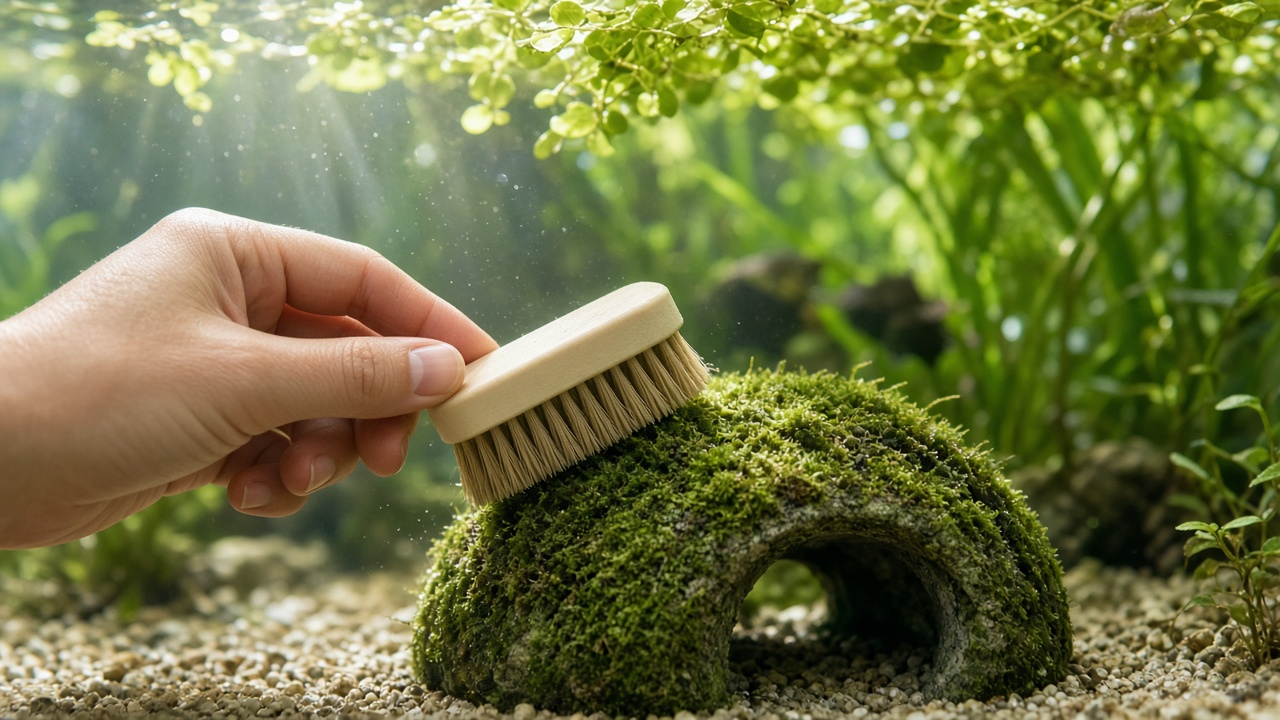
Old tank water plus a soft brush is the default clean for routine algae.
Skip vinegar and bleach until a brush fails. Aqueon’s plant-care page tells readers to use a soft brush or sponge under warm water before any stronger mix.
Set up a tank-only station:
- One plastic bucket that never sees dish soap
- One soft brush or sponge that never sees the kitchen sink
- A towel you do not mind staining
- A second bucket for the later rinse
Follow these steps:
- Unplug heaters and filters if your hands will be near cords.
- Lift one ornament and leave the rest in place.
- Hold it over the tank-only bucket, not the kitchen sink.
- Pour old tank water over it, or dip it in that bucket.
- Scrub slime and film with the soft brush.
- Return the piece if it looks clean and has no chemical smell.
Aqueon’s plant-care page also says to skip dish soap and ammonia. Residue from those products can move back into the tank.
Pull one piece at a time so the slimy bacterial layer stays on the other ornaments and in the filter. Most of the useful bacteria sit in the filter media, not on a plastic cave. Our Top Fin EF-S filter guide walks through that media stack.
Use vinegar for white crust, not for a sick-tank reset
White, chalky crust is mineral scale, so vinegar is for that crust and not for a disease cleanup.
Heinz’s product page for Distilled White Vinegar with 5% Acidity lists that 5% figure in the product name. Use that food-grade white vinegar, not a scented cleaner. Heinz does not publish an ornament soak time, so the 5% acidity is the only maker number in this step.
Use vinegar this way:
- Apply Heinz Distilled White Vinegar at the labeled 5% acidity to the crust
- Work only on hard pieces that do not soak up liquid
- Stop when the crust softens, then scrub with the tank-only brush
- Rinse under running tap water until you cannot smell vinegar
- Finish with a dechlorinator soak, same as after bleach
Do not mix vinegar and bleach. The CDC’s bleach page says never to mix household bleach with other cleaners. That mix can release dangerous vapors.
Skip vinegar on painted details that already flake, and skip it on porous rock and wood. Those materials soak up acid and then leak it later. Vinegar does not replace bleach when heavy algae still holds after a brush.
Use a 1-to-10 bleach soak only on hard plastic
Bleach is a last step for stubborn algae on hard plastic, not a weekly habit.
Aqueon’s page on artificial aquarium plants states the working mix. Soak plants in 1 part bleach to 10 parts water. Cap that soak at 4 to 6 hours, then move the plants into water with a dechlorinator.
The CDC’s bleach page, dated April 24, 2024, adds the bottle rules. Use regular unscented household bleach. Most household bleach contains 5% to 9% sodium hypochlorite.
Skip splashless or laundry bleach if the label sits outside that range or hides the percent.
If you only need a short wet-time, the CDC states this fallback mix:
- 5 tablespoons (1/3 cup) of bleach per gallon of room-temperature water
- Or 4 teaspoons of bleach per quart of room-temperature water
- Keep the surface wet for at least 1 minute
- Mix a fresh batch daily; a solution older than 24 hours is weaker
Aqueon’s 1-to-10 soak is much stronger than the CDC’s 5-tablespoon household mix. Use the weaker CDC mix for a short wet-time on smooth plastic. Use Aqueon’s 1-to-10 mix only after a brush and a vinegar pass fail.
| Published mix | Ratio or dose | Named source |
|---|---|---|
| Household disinfection | 5 tablespoons bleach per gallon | CDC bleach page |
| Artificial-plant soak | 1 part bleach to 10 parts water | Aqueon plant-care page |
| Post-bleach conditioner | 5 mL per 50 US gallons | Seachem Prime page |
Run a bleach soak like this:
- Confirm the piece is hard plastic or smooth ceramic. Stop if it soaks up water.
- Wear gloves, open a window, and keep kids and pets away from the bucket.
- Mix unscented bleach in the 5% to 9% range with room-temperature water.
- Submerge the piece and do not leave it overnight.
- Scrub loosened algae with the tank-only brush.
- Dump the bleach water in a sink, not back into the tank.
- Rinse under running tap water until you cannot smell bleach.
The CDC also says to clean visible dirt before you disinfect, which is why the brush step comes first.
Neutralize chlorine before the piece goes back
A tap rinse is not enough, because tap water can still hold chlorine or chloramine.
The CDC’s drinking-water page treats chlorine or chloramine up to 4 mg/L (4 ppm) as safe for people to drink. The same page says not to keep fish in water that still contains those disinfectants. Even low levels can make fish, turtles, and frogs sick.
U.S. utilities first used chlorine in tap water in 1908 and chloramine in 1929, per that CDC page. You can remove chlorine by letting water sit out for a few days, but you cannot remove chloramine that way.
After a bleach or tap rinse, soak the ornament in treated water. Seachem’s Prime page states the dose as 1 capful (5 mL) for each 50 US gallons (200 L) of new water. Each cap thread is about 1 mL.
For a small bucket, measure by the thread, not by a full cap. Aqueon’s Water Conditioners page states a different label dose: 5 mL (1 teaspoon) per 10 gallons. Pick one conditioner and follow that maker’s page.
Use this neutralize sequence:
- Fill the second bucket with enough tap water to cover the ornament.
- Dose Seachem Prime at 5 mL per 50 US gallons of that bucket volume.
- For a 5-gallon bucket, that is about 0.5 mL, or half a cap thread.
- If your utility uses a heavy chloramine residual, Seachem’s page allows a double dose.
- Soak until you cannot smell bleach, then smell the piece again.
- If bleach remains, change the water and dose again.
- Rinse once more in treated water, then return the ornament.
Seachem’s page also states that Prime can be redosed every 24 to 48 hours. Save the 5-times emergency dose for tank nitrite above 2 ppm, the threshold Seachem names.
What to leave in the tank
Leave porous, glued, and living pieces in place, because pulling them does more harm than algae does.
Do not bleach these items:
- Driftwood and bogwood
- Lava rock, holey rock, and other porous stone
- Gravel and sand beds
- Silk or cloth plants
- Decorations with peeling paint or exposed metal
- Anything you cannot smell-check after a rinse
Aqueon’s plant-care page warns that dish soap, ammonia, and bleach mistakes all leave residue. If a piece is cheap, painted, and already shedding, replace it.
Boiling is not a safe backup for plastic. Heat can warp the piece and loosen dyes.
If algae returns in days, the decor is not the only cause. Check light hours, leftover food, and filter flow. Community filter picks are collected in our Reddit filter-recommendation article.
Put the filter back to work after a decor clean
Cleaning ornaments removes some of the slimy bacterial layer, so the filter is what should keep the tank stable.
Do not bleach filter media in the same bucket. Do not rinse cartridges under hot bleach water. Keep the decor project and the filter project apart.
After the ornament is back:
- Confirm the filter is running and the outflow is moving
- Check that the returned piece does not smell like bleach or vinegar
- Leave the other ornaments in place that day
If you keep pulling every plastic plant in one session, you strip surfaces that still held bacteria. The Lift-Out Rule exists to prevent that.
One cave or one plant cluster is a cleaning job. A full decor tear-down is a reset this page does not cover.
Live plants cut how often you need a bleach bucket. Our beginner planted-tank list is the swap path if you are tired of scrubbing fake leaves.
FAQ
Can I use dish soap if I rinse the decoration for a long time?
No, Aqueon’s plant-care page tells readers to avoid dish soap and ammonia on artificial plants. Those products can leave a film that moves back into the tank, so use old tank water and a dedicated brush instead.
How long can aquarium decorations sit in bleach?
Aqueon’s plant-care page caps a 1-to-10 bleach soak at 4 to 6 hours. The CDC’s bleach page states a 1-minute wet-time for its weaker household mix.
Does a tap-water rinse remove bleach by itself?
Not reliably, because the CDC’s drinking-water page states that tap water may still hold chlorine or chloramine up to 4 mg/L. That page also says fish should not live in water that still contains those disinfectants. Use a conditioner dose from Seachem’s Prime page or Aqueon’s Water Conditioners page.
Can I boil plastic ornaments to skip bleach?
Do not boil plastic ornaments, because heat can warp them and loosen color. None of the maker pages in our source set give a boil method for plastic plants.
Should I clean every decoration in one day?
No, lift one piece or one small cluster and leave the rest in the tank. That is the Lift-Out Rule, and it keeps the bacterial layer on the remaining ornaments and in the filter.
How do I remove white crust without bleach?
Use Heinz Distilled White Vinegar at the labeled 5% acidity on hard pieces that do not soak up liquid. Scrub the softened crust, rinse until the vinegar smell is gone, and neutralize the tap rinse with conditioner. Never pour vinegar into a bleach bucket.
When is a bleached ornament safe to put back?
Put it back only when you cannot smell bleach or vinegar on the piece. Seachem’s Prime page doses 5 mL per 50 US gallons of the soak water, while Aqueon’s Water Conditioners page doses 5 mL per 10 gallons. Follow one label.