Quick answer: Keep pea puffers as a group of six in a planted 20-gallon tank. Feed frozen meaty foods, not flakes. Skip mixed community stocking in small tanks.
A group of six pea puffers needs a tank of at least 20 US gallons. This page is a desk brief on published specs, and
A tank enters this guide only if the maker lists 20 gallons and 24 inches of length. We skip desktop kits under that cut, brackish kits, and livestock listings.
That cut is the Waterpuppy group-housing rule, a desk rule rather than a lab trial.
What a pea puffer is
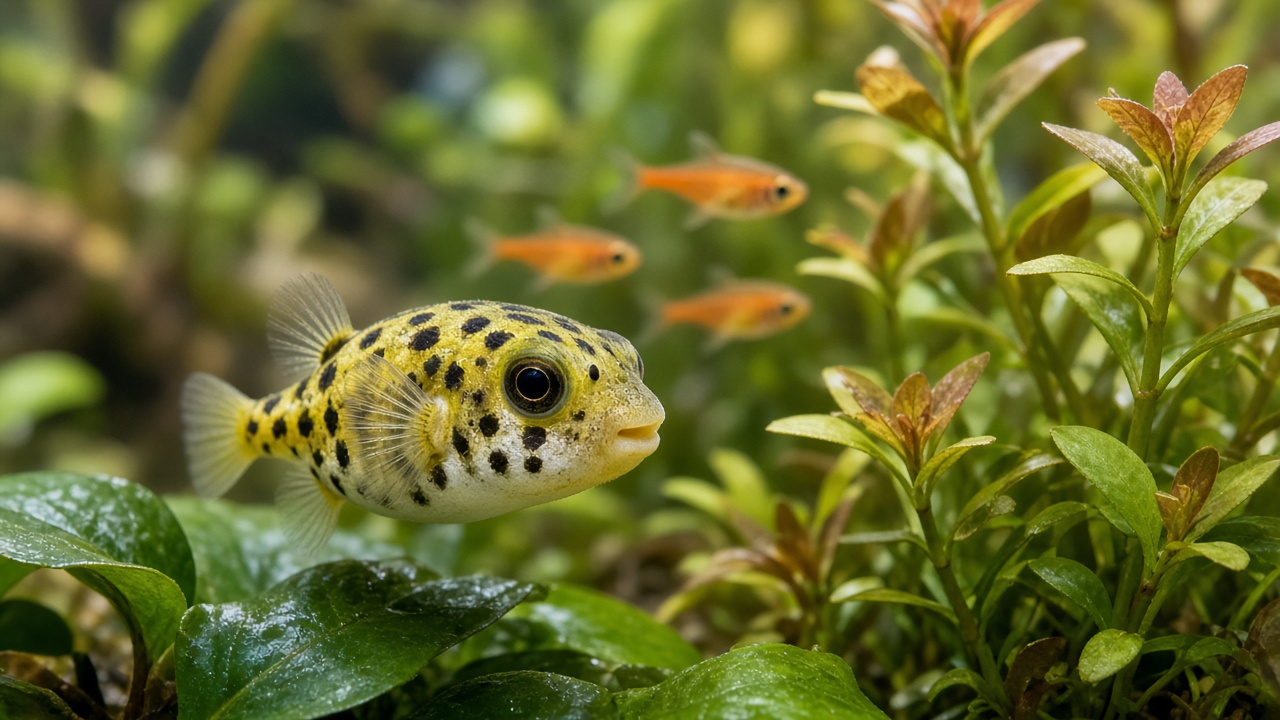
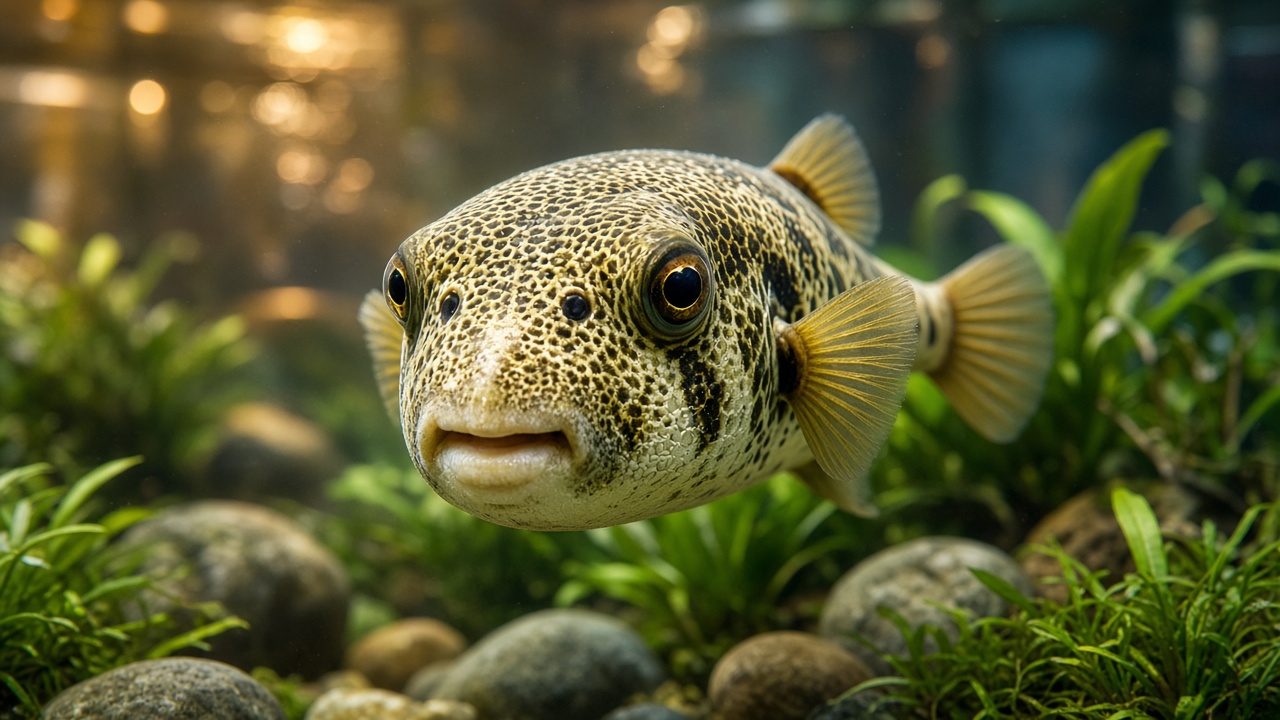
A pea puffer is a tiny freshwater puffer from India, sold as Carinotetraodon travancoricus.
FishBase lists the species as the Malabar pufferfish and gives a maximum length of 3.5 cm TL.
FishBase also places the fish in tropical freshwater and lists 22°C to 28°C as the temperature band. The same page lists a pH range of 7.5 to 8.3.
A 2018 paper in Mitochondrial DNA Part B is hosted by the National Library of Medicine. It repeats the Western Ghats range and names coastal Kerala and southern Karnataka.
That paper reports a complete mitochondrial genome of 16,542 nucleotides. It counts 13 protein-coding genes, 2 rRNA genes, and 22 tRNA genes.
The same paper lists base composition as 28.8% C, 28.5% A, 27.1% T, and 15.6% G. It notes a slight AT bias of 55.6%.
The authors collected their specimen from the Periyar River, India, at 10°10′36″N, 76°9′46″E. They stored it at Zhejiang Ocean University.
FishBase reports the IUCN Red List status as Vulnerable and dates that assessment to 20 September 2010.
The National Library of Medicine paper also calls the species Vulnerable and ties that listing to habitat loss and aquarium-trade harvest.
This is a research-desk species brief, not a diagnosis of a sick fish.
Tank size and footprint
A group of six needs floor space more than a tall cube.
Our research team compared six tanks that are sold now, and only two met both parts of the Waterpuppy group-housing rule.
Those two are the Aqueon 20 Long and the Aqueon 29. Both list a 30.25-inch length.
The other four fail the cut on volume, length, or both. We still list them so the cut is easy to check.
Compare the listed numbers:
| Product | Listed volume | Length (in) | Width (in) | Height (in) | Filled weight listed |
|---|---|---|---|---|---|
| Fluval Spec Aquarium Kit 2.6 US Gal | 2.6 US gal / 10 L | 10 | 11.5 | 11.5 | Not listed |
| Fluval Spec Aquarium Kit 5 US Gal | 5 US gal / 19 L | 19.5 | 6.5 | 11.5 | Not listed |
| Fluval Spec Aquarium Kit, Black 16 US Gal | 16 US gal / 60 L | 21.5 | 11.5 | 17 | Not listed |
| Aqueon 15 aquarium | 15 gal | 24.25 | 12.5 | 12.75 | 170 lb |
| Aqueon 20 Long aquarium | 20 gal | 30.25 | 12.5 | 12.75 | 225 lb |
| Aqueon 29 aquarium | 29 gal | 30.25 | 12.5 | 18.75 | 330 lb |
Fluval’s Spec page lists the 5 US Gal kit at 19.5 inches long and 6.5 inches wide, which is a short, skinny box.
The same Fluval page lists the 16 US Gal kit at 16 gallons and 21.5 inches long. That volume misses the 20-gallon cut.
Aqueon’s dimensions chart lists the 20 Long at 30.25 by 12.5 by 12.75 inches. It lists a filled weight of 225 lb.
The same Aqueon chart lists the 29 at 30.25 by 12.5 by 18.75 inches. It lists a filled weight of 330 lb.
Aqueon also lists the 15 at 24.25 inches long and 170 lb filled, so length passes and volume does not.
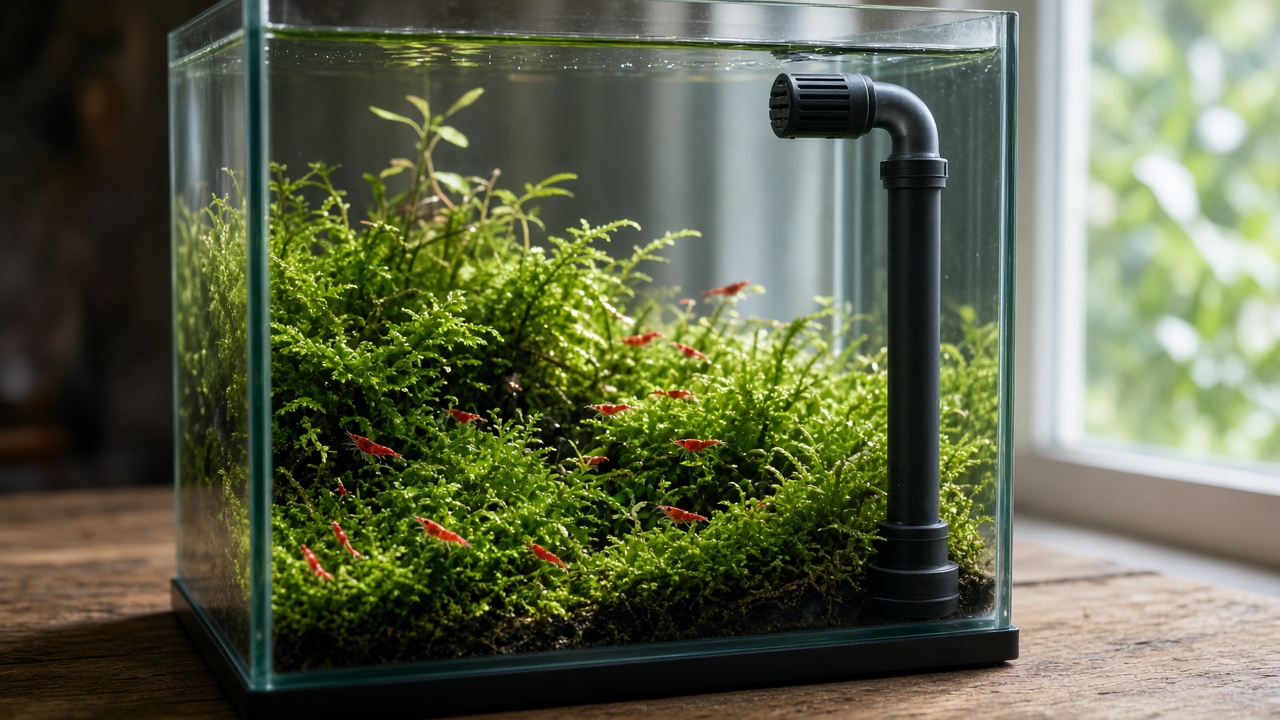
Put plants, wood, and leaf litter in first, and break the sightlines before the fish go in.
Do this when you set the tank:
- Use the Aqueon 20 Long or the Aqueon 29 for a group of six.
- Plant stems in clumps, not one row along the glass.
- Add wood so two fish can lose sight of each other.
- Leave open lanes on the sand for hunting.
- Skip the Fluval Spec 2.6 US Gal and Fluval Spec 5 US Gal for a group.
Aqueon’s chart notes that filled weights can change with substrate and décor. Plan the stand for the listed filled weight, then add margin.
Water, heat, and filtration
Match the FishBase temperature and pH bands, then treat new tap water before it hits the tank.
FishBase lists 22°C to 28°C. Stay inside that published band if your room swings.
FishBase lists pH 7.5 to 8.3, and many US tap lines already sit there. Do not chase a rainforest pH that the species page does not list.
Seachem’s page for Prime lists 1 capful (5 mL) for each 50 US gallons of new water. It also states each cap thread is about 1 mL.
For water changes, scale that listed dose:
- 10 gallons of new water: 1 mL of Prime.
- 20 gallons of new water: 2 mL of Prime.
- 29 gallons of new water: about 3 mL of Prime.
Seachem’s page says Prime may go in the tank, but it is better in the new water first. The same page says a sulfur odor is normal.
The same page says Prime binds ammonia, nitrite, and nitrate for up to 48 hours and can be dosed every 24 to 48 hours.
If ammonia or nitrite is above 2 ppm, Seachem’s page allows up to 5 times the normal dose. That is an emergency label, not a weekly plan.
Use a liquid kit that reads ammonia, nitrite, nitrate, and pH, and test before each large water change.
Keep flow gentle, because FishBase lists the species as a bottom-living freshwater fish.
A sponge filter or a baffled hang-on filter is enough in a planted 20 Long. Point the outflow into glass or plants.
Change a slice of the water on a set day each week, and dose Prime on the new water using the math above.
Diet
Pea puffers hunt small meat and rarely switch to dry flakes on their own.
Hikari Sales USA’s page for Bio-Pure Frozen Blood Worms lists four pack sizes:
- 1.58 oz (40 g) mini cube pack
- 3.5 oz (100 g) 32-count cube pack
- 8 oz (227 g) flat pack
- 16 oz (454 g) flat pack
The same Hikari page lists 3.5% minimum crude protein and 95% maximum moisture, so this is a wet frozen food, not a dry staple.
Use Hikari Bio-Pure Frozen Blood Worms as one meat, not the only meat, and rotate other small frozen items of the same class.
Hikari’s page describes a 3-step sterilization process and “no touch” cubes. Thaw one cube in a cup of tank water, and do not drop a frozen block in the tank.
Feed on this schedule:
- Offer a small thawed portion at a set time each day.
- Stop when the fish slow down.
- Remove leftovers after a few minutes.
- Rest one day if waste builds.
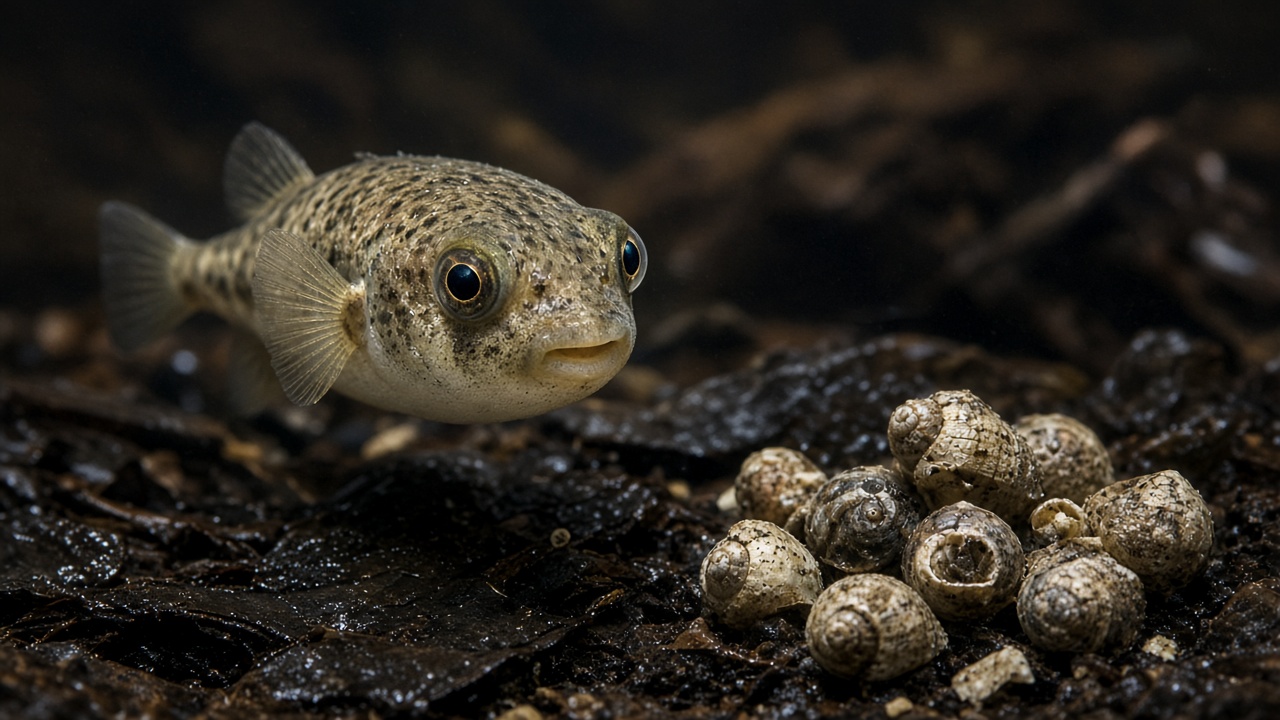
Keep a small snail culture if you can, because soft pond snails give a hunt that cubes cannot copy.
Skip marine shellfish, because pea puffers are a 3.5 cm freshwater fish on FishBase, not a large brackish puffer.
If a fish ignores cubes, try a moving live worm or a crushed snail. Hunger, not a new pellet brand, usually fixes a strike.
Tank mates
A species-only group of six is the default stocking plan.
Pea puffers nip fins and eat shrimp, and that is hunting rather than a mood.
Our research team did not run mixed-stock trials. The Waterpuppy rule still applies: if the tank fails 20 gallons and 24 inches, skip extra species.
If you later move to a larger planted tank, keep these limits:
- No ornamental shrimp.
- No slow long-finned fish.
- No tiny fry you want to keep.
- No snails you want as display animals.
A 20 Long with six pea puffers is already a full social group, and extra fish raise bite risk and waste.
FishBase lists the species as harmless to humans, and that does not make it harmless to tank mates.
If one fish pins another for hours, add plants and wood first. Do not add a “dither” fish to soak up the chase.
Breeding
FishBase states that eggs are deposited and hidden in vegetation, and that is the published breeding note we use.
A planted Aqueon 20 Long or Aqueon 29 gives the plant cover FishBase describes. Dense stems and moss give places to hide eggs.
Keep the group mixed if you hope for eggs, because FishBase does not list a sexing measurement on its species page.
Do not add a “breeding hormone” product, because there is no such listing on the maker pages in this brief.
If eggs appear:
- Leave the parents in a thick plant mass, or move the clutch with the plant.
- Feed the adults well so they hunt food, not every egg.
- Plan live microscopic foods for fry, because cubes are too large.
Most home tanks never see a viable brood, so treat breeding as a bonus rather than a first-year goal.
The National Library of Medicine paper flags wild harvest as a threat. Captive-bred fish, when you can find them, reduce pressure on Kerala and Karnataka stocks.
FAQ
How many pea puffers can go in a 10-gallon tank?
None as a group under the Waterpuppy rule. Fluval’s Spec page lists 5 US Gal and 2.6 US Gal kits, and both sit far below 20 gallons. Keep six fish in an Aqueon 20 Long or larger.
Can one pea puffer live alone?
A single fish can live in a planted tank, but this brief is written for a group of six. Lone fish often stare, hide, or fixate on one corner. If you keep one fish, still give plants and daily hunts.
Do pea puffers eat snails?
Yes. Small soft snails are a natural hunt for a 3.5 cm meat eater. Large snails with thick shells waste water and leave rotting tissue, so use pest bladder snails rather than a prized mystery snail.
What if they refuse pellets?
That is common. Use Hikari Bio-Pure Frozen Blood Worms or another thawed meat. Hikari lists cube packs from 1.58 oz to 16 oz, so you can buy a small pack first.
Can pea puffers live with neon tetras?
Not in the tanks this brief covers. A 20 Long with six puffers is already full, and tetras have long fins that invite nipping.
How often should I change the water?
Change a slice of water on a set day each week. Dose Prime at 5 mL per 50 US gallons of new water, per Seachem’s page. Test ammonia and nitrite after the change if the tank is new.
Where do pea puffers come from?
FishBase lists India, and the National Library of Medicine paper names the Western Ghats, Kerala, and southern Karnataka. That paper also collected a fish from the Periyar River, so ask the seller if the fish were bred in tanks.