Quick answer: Buy an electric pond vacuum with a listed suction hose of 16 feet or more. Match the discharge hose to a nearby garden bed or drain. Pick a dual-chamber or pump-out model if you want continuous work.
Buy a pond vacuum with at least 16 feet of suction hose and 8 feet of discharge hose.
This page is a published-spec comparison written by our research team. We did not drain ponds, run motors, or time sludge jobs.
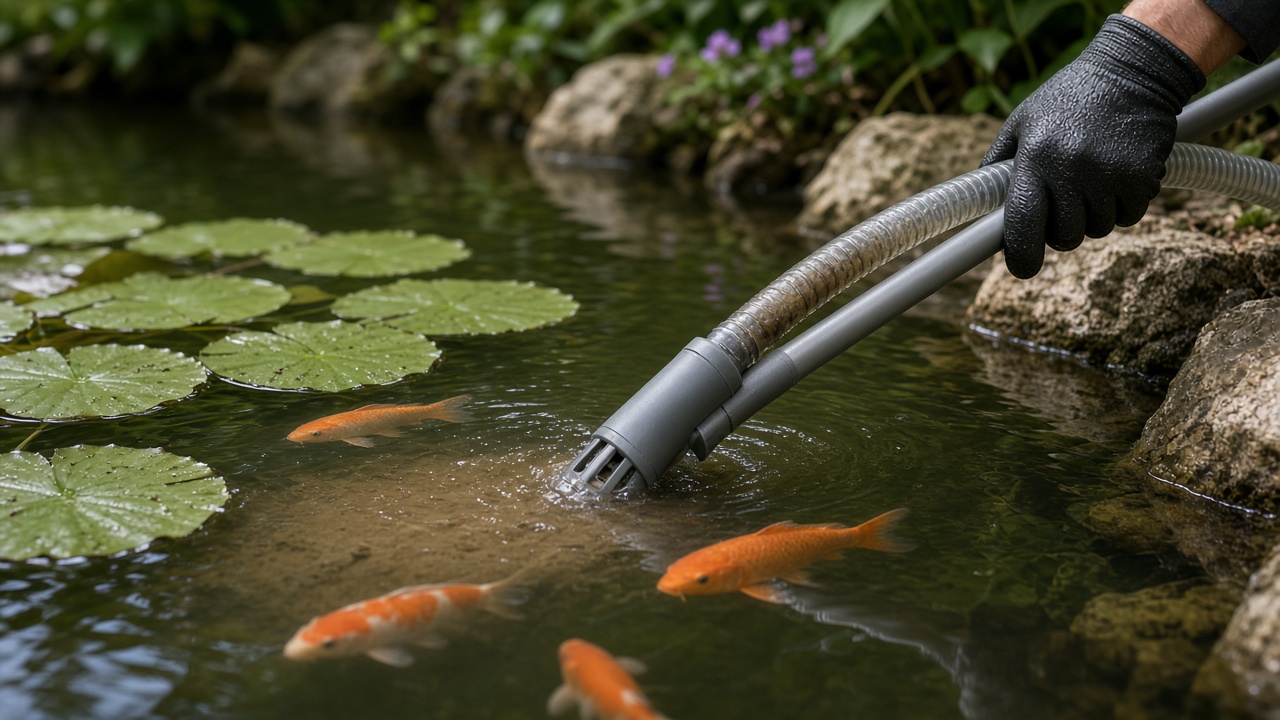
A pond vacuum is a shoreline machine that pulls silt and waste off the liner. It is not a garden-hose siphon, and it is not an indoor gravel vac.
Use the WaterPuppy Reach-Drain-Depth rule when you compare units. Check suction hose length, then discharge hose length, then the maker-listed depth or lift.
What we included, and what we left out
We covered only currently sold electric pond vacuums whose maker pages list watts plus both hose lengths.
Five models met that rule on the pages we compared:
- OASE PondoVac 4
- OASE PondoVac 5
- Matala Pond Vacuum II
- Matala Pond Vacuum II-Plus
- Matala Power-Cyclone Pond Vacuum
We left out hose-siphon vacs with no motor and cordless bag cleaners that omit hose specs. We also left out sludge bacteria treatments and solids cleanout pumps.
This is a research desk page, not a field trial of live ponds. Indoor tanks still need a smaller gravel vacuum for small tanks.
Top 7 Pond vacuum
The picks below are the 7 pond vacuums on sale right now, listed with what each suits best and an honest drawback. Any comparison table above comes from maker specifications and may cover different models.
1. The Pond Guy ClearVac Pond Vacuum Cleaner for Outdoor Decorative Ponds
Best for: Large decorative ponds with heavy sludge buildup
We compared the performance specs of this unit against standard cleaners and found it excels in deep-cleaning decorative ponds. Owners report that the motor handles thick sludge effectively without losing suction over long sessions.
Pros: High suction power; Durable construction Cons: Higher price point
2. OASE PondoVac Classic Pond Vacuum Cleaner
Best for: Reliable maintenance for standard garden ponds
The PondoVac Classic is a staple in the industry for a reason. Owners report that while it lacks the continuous suction of high-end dual-chamber models, its consistent performance makes it a dependable choice for routine pond care.
Pros: Proven brand reliability; Efficient single-chamber system Cons: Requires manual discharge pauses
3. Spollowe Garden Pond Vacuum Cleaner
Best for: Budget-conscious owners needing decent suction
When looking at value-tier options, we compared the Spollowe to entry-level competitors. Owners report that it provides surprising suction for the price, though it is best suited for lighter debris rather than heavy muck.
Pros: Affordable price; Simple assembly Cons: Plastic components feel less robust
4. PoolMr Handheld Pool Vacuum for Above Ground Pool & Hot Tub Vacuum
Best for: Targeted cleaning in hot tubs and spas
This handheld model is designed specifically for tight spaces where a full-sized pond vacuum would be overkill. Owners report it is perfect for spot-cleaning debris in hot tubs, though it isn't meant for large pond floors.
Pros: Compact size; Easy to maneuver Cons: Limited battery life
5. API POND-ZYME SLUDGE DESTROYER (1 Pound) Pond Cleaner with Natural
Best for: Biological sludge removal without mechanical vacuuming
While not a mechanical vacuum, this treatment is a popular alternative for those looking to break down organic matter. We compared its biological approach to physical suction, and owners report it is an excellent supplement for maintaining water clarity.
Pros: Easy application; Safe for fish and plants Cons: Requires time to see results
6. 4 in 1 Cordless Rechargeable Small Pool Vacuum spa hot tub
Best for: Quick cordless spot cleaning for small features
The 4-in-1 cordless design offers great versatility for small water features. Owners report that the convenience of being untethered outweighs the need for frequent emptying of the debris chamber.
Pros: No tangled hoses; Lightweight design Cons: Small debris canister capacity
7. Rechargeable Pool & Spa Hot Tub Vacuum Cleaner
Best for: Portable debris removal for shallow water areas
This unit serves as a convenient tool for light maintenance tasks. We compared its utility to larger vacuums, and owners report it works best as a secondary tool for quick cleanups rather than heavy-duty pond restoration.
Pros: Rechargeable battery; Simple operation Cons: Weak suction on heavy debris
Comparison: Pond vacuum at a Glance
| Product | Best for | Approx. price | Where to buy |
|---|---|---|---|
| The Pond Guy ClearVac Pond Vacuum Cleaner for Outdoor Decorative Ponds | Large decorative ponds with heavy sludge buildup | $429.99 | Check price |
| OASE PondoVac Classic Pond Vacuum Cleaner | Reliable maintenance for standard garden ponds | $327.99 | Check price |
| Spollowe Garden Pond Vacuum Cleaner | Budget-conscious owners needing decent suction | $189.99 | Check price |
| PoolMr Handheld Pool Vacuum for Above Ground Pool & Hot Tub Vacuum | Targeted cleaning in hot tubs and spas | $69.99 | Check price |
| API POND-ZYME SLUDGE DESTROYER (1 Pound) Pond Cleaner with Natural | Biological sludge removal without mechanical vacuuming | $19.04 | Check price |
| 4 in 1 Cordless Rechargeable Small Pool Vacuum spa hot tub | Quick cordless spot cleaning for small features | $62.99 | Check price |
| Rechargeable Pool & Spa Hot Tub Vacuum Cleaner | Portable debris removal for shallow water areas | $69.98 | Check price |
Want to browse every option? See the full range of pond vacuum on Amazon →
How a pond vacuum moves sludge
A pond vacuum stays on land, and only the wand and suction hose enter the water.
Most units fill a tank and then send that load out a discharge hose. The dump step is the part most buyers forget to plan.
The five maker pages describe three empty-cycle types:
- Intermittent fill-and-drain, where the motor pauses while the tank empties
- Dual-chamber, where one chamber fills while the other empties
- Pump-out, where a second motor pushes waste water out under pressure
OASE’s PondoVac 4 page describes a two-chamber system that fills and empties at the same time. OASE’s PondoVac 5 page describes a suction turbine paired with a separate feed pump.
Matala’s Pond Vacuum Series page lists an auto-filling and draining cycle for the II line. Matala’s Power-Cyclone page lists two motors and continuous-duty use.
Gravity-drain units need the discharge hose lower than the outlet. Pump-out units can send waste uphill, which changes where you can dump sludge.
Specs side by side
Our research team compared the five maker pages and did not rank the units.
| Model | Listed motor watts | Suction hose | Discharge hose | Maker-listed depth or lift | Empty cycle |
|---|---|---|---|---|---|
| OASE PondoVac 4 | 1700 W | 5.00 m | 2.50 m | 2.40 m max suction | Dual chamber |
| OASE PondoVac 5 | 2400 W total; 900 W pump | 5.00 m | 8.00 m | 2.50 m max suction | Integrated pump-out |
| Matala Pond Vacuum II | 1400 W | 16.4 ft | 8.2 ft | 5 ft above pond surface | Drain 25–30 seconds |
| Matala Pond Vacuum II-Plus | 1400 W | 16.4 ft | 8.2 ft | 5 ft above pond surface | Drain 30–35 seconds |
| Matala Power-Cyclone | 1200 W vacuum; 700 W pump at 110–120 V | 26.2 ft | 32.8 ft | Discharge listed to any elevation | Two-motor continuous |
OASE’s PondoVac 4 page lists a 5000 l/h max flow rate. OASE’s PondoVac 5 page lists 8000 l/h and 60% more delivery capacity than the PondoVac 4.
That 8000 l/h figure is about 2,110 gallons per hour. Matala’s Power-Cyclone page lists a 3700 GPH exhaust-pump flow.
Matala’s Pond Vacuum II page lists a 5.3 gallon (20 L) tank. The II-Plus listing on the same page is 6.6 gallons (25 L), and the Power-Cyclone page lists 13.2 gallons (50 L).
Those tank numbers matter on intermittent units, because a smaller tank means more drain pauses.
Two of the five units list a separate discharge pump. Those are the OASE PondoVac 5 at 900 W and the Matala Power-Cyclone at 700 W on 110–120 V.
Hose reach: suction versus discharge
Suction hose length sets how far you can stand from the work spot, and discharge hose length sets where the sludge can go.
OASE lists a 5.00 m suction hose on both the PondoVac 4 and the PondoVac 5. That listed length is about 16.4 feet.
Matala lists 16.4 feet on the Pond Vacuum II and II-Plus. Matala lists 26.2 feet on the Power-Cyclone.
Our research team’s spread on suction hose was 16.4 feet to 26.2 feet. That is a 9.8-foot gap between the shortest and longest listed suction hose.
Discharge hoses vary more on those same pages:
- OASE PondoVac 4: 2.50 m, about 8.2 feet
- Matala Pond Vacuum II and II-Plus: 8.2 feet
- OASE PondoVac 5: 8.00 m, about 26.2 feet
- Matala Power-Cyclone: 32.8 feet
That discharge spread is 8.2 feet to 32.8 feet. The longest listed discharge hose is four times the shortest.
If the drain point sits across a patio, 8.2 feet will fall short. If the flower bed sits next to the pond, 8.2 feet can be enough.
OASE also lists an optional 10 m floating hose set (38 mm) for the PondoVac 5. That kit is an add-on, not the stock suction hose.
Walk the pond edge with a tape before you buy. Measure the farthest sludge pocket, then measure the path to the dump spot.
Suction depth and sludge thickness
A maker-listed max depth is a limit, not a promise of strong pull at that depth.
OASE lists a 2.40 m max suction depth on the PondoVac 4, which is about 7.9 feet. OASE lists 2.50 m on the PondoVac 5, which is about 8.2 feet.
The same PondoVac 5 page names a 1700 W suction motor and 2400 W total power consumption. Those two watt figures describe the suction motor and the whole machine.
Matala’s Pond Vacuum Series page does not list a max pond depth. It lists a 5 ft / 1.5 m lift above the pond surface, which is a different measurement.
That lift number describes how high the unit can sit above the water. It does not tell you how deep the wand can work.
The Pond Vacuum II page also lists five extension tubes at 5.9 feet total. Short tubes help on shallow shelves, while long stacks get heavy and can kink flow.
Thick sludge clogs nozzles faster than thin silt. A wide nozzle covers more liner, and a narrow nozzle fits rock gaps.
A vacuum is for pockets of muck, not a full rebuild. A full reset still needs nets, buckets, and a plan. That planning step is the same idea as a careful fish tank setup.
Match the vacuum to the pond
Match cycle type and hose reach to pond size, not to motor watts alone.
Use this list:
- Small liner pond with sludge near the edge: an intermittent 1400 W unit with a 16.4-foot suction hose can be enough.
- Medium pond and long work sessions: a dual-chamber unit avoids stop-and-wait dumps.
- Deep end near 7 to 8 feet: use a unit whose maker lists a max suction depth at or above that mark.
- Dump spot uphill or far from the bank: use a pump-out unit with a long discharge hose.
Matala lists 1400 W on the Pond Vacuum II and II-Plus. The listed difference is tank size and drain time, not hose length.
The II lists 25–30 seconds to drain, and the II-Plus lists 30–35 seconds. The Pro on that page lists 9.5 gallons and a 40–45 second drain. We kept it out of the table because the hose lengths do not change.
OASE lists 1700 W on the PondoVac 4 and 2400 W total on the PondoVac 5. Watts are a power-draw figure, not a score.
Matala lists a 16.4-foot power cord on the Pond Vacuum II. OASE lists a 4.00 m cord on the PondoVac 4 and a 7.50 m cord on the PondoVac 5.
Matala lists a 32.2-foot cord on the Power-Cyclone. Short cords force extension cords, so keep the body of the vacuum on dry ground.
Indoor keepers who also clean a fish tank already know this waste rule. Pull waste out, and do not blast it back into the water.
How to run a session without wrecking the water
Work in short passes, dump sludge off-pond, and keep the machine on dry land.
Follow this order:
- Skim floating leaves first so they do not clog the wand.
- Set the vacuum at the waterline, on firm ground.
- Lay the discharge hose flat to a bed or drain.
- Start at the shallow shelf, then move toward deeper sludge.
- Pause if the hose sucks gravel or liner.
- Empty or check the debris bag before it packs solid.
- Unplug before you open the tank.
OASE’s PondoVac 5 page says larger particles stay in a pre-filter bag. It also says the fine outlet sack is for particles larger than 1 mm and is not suitable for pond silt.
Plan to dump silt on soil, not back into the pond. Matala’s Power-Cyclone page says dirty water is pumped out to waste, so do not loop that hose back to the pond.
Work on a cool, calm day, because stirring sludge can cloud the water for hours. Keep fish in the pond, and do not chase them with the wand.
If you keep koi or goldfish, watch for stress after a big stir. This desk does not treat fish, so call a fish-health professional if they gasp or stop eating.
Store hoses unkinked and rinse the nozzles after each session. Dry the tank so trapped sludge does not sour.
FAQ
Do I need a pond vacuum, or will a hose siphon work?
A hose siphon can move some water and loose silt, but it has no motor and no listed suction depth. It also needs a downhill dump. A pond vacuum is the tool when sludge is thick or the dump spot is not downhill.
How long should the suction hose be?
Our research team’s five maker pages listed 16.4 feet or 26.2 feet. Sixteen feet covers many backyard ponds from one firm bank. Measure your farthest pocket, and look at the 26.2-foot Matala Power-Cyclone hose if that pocket sits farther out.
Can I put the sludge on the garden?
OASE’s PondoVac 4 page says waste water can go on a flower bed or to a sewer. Keep it off vegetable beds if the pond holds fish waste or treated water. Local drain rules still apply.
Why does the vacuum keep stopping?
Intermittent units stop to drain, and Matala lists 25–30 seconds on the Pond Vacuum II. Dual-chamber and pump-out units are built to keep suction going. Check for kinks before you blame the motor.
Will a pond vacuum replace a full clean-out?
No. A vacuum lifts pockets of sludge, and it does not reset a collapsed liner or a failed filter. Use it for maintenance, and plan a full clean-out when plants, rocks, and water all need a reset.
What size circuit do these motors need?
OASE lists 1700 W on the PondoVac 4 and 2400 W total on the PondoVac 5. Matala lists 1400 W on the Pond Vacuum II line and 1200 W plus 700 W on the Power-Cyclone at 110–120 V. Plug into a grounded outdoor outlet with GFCI protection, and do not daisy-chain light-duty cords.
Can I use a pond vacuum in a small indoor tank?
No. These machines are built for outdoor ponds. Indoor tanks need a smaller gravel vac and a bucket, so use the pond unit only at the pond.