Quick answer: Keep African dwarf frog water warm and steady in the low- to mid-70s °F. Use an adjustable heater and a separate thermometer. Avoid cold rooms, AC drafts, and wild day-night swings.
Keep African dwarf frog water about 68–77°F with an adjustable heater and a separate thermometer.
This page is a home-aquarium temperature guide for Hymenochirus frogs. Our research team compared lab housing ranges and heater maker sheets. We did not log room temperatures in a test apartment. We did not bench-calibrate heaters against a lab standard. We did not heat-shock frogs for data.
Selection rule: We include published Hymenochirus boettgeri housing temperatures and heater models with clear watt and accuracy specs. We exclude unheated bowl advice and “room temperature is always fine” claims for cool houses. We also skip fever-heat “cures” with no published protocol.
The published temperature band for daily care
Tropical frogs need warmth you can measure, not guess.
An open protocols.io housing protocol lists a constant water temperature ranging from 20°C to 25°C. That band is about 68°F to 77°F.
A University of Michigan Virulence (2023) husbandry report held recirculating and standard systems at 25°C ± 0.5°C. That setpoint sits at about 77°F with a tight control window.
Rabb and Rabb’s 1963 study maintained aquaria across 19°C to 30°C while observing breeding behavior. They also noted sunlight and daily temperature swings could bring males into calling condition.
Home takeaway: aim near 72–77°F for ordinary care. Hold the needle steady. Treat short breeding swings as special cases, not the daily default.
Write both Celsius and Fahrenheit on your log if your heater uses one scale and your stick thermometer uses the other. Mixed scales cause many “mystery” errors.
Quick conversions for stickers and kits:
- 20°C equals 68°F
- 22°C equals about 72°F
- 25°C equals 77°F
- 30°C equals 86°F
Why steady heat beats “sometimes warm”
Frogs cannot move to a warmer room on their own. The heater is their climate.
Cold water slows appetite and movement. Hot spikes stress soft-skinned amphibians and speed waste problems. Oxygen also falls as water warms, so a blast of heat can create breathing stress even when frogs can reach the surface.
The Virulence group changed temperatures slowly when they used heat treatment in quarantine. They raised water from 20°C to 30°C over 10 days, held 10 days at 30°C, then lowered to 25°C over 5 days. That ramp is a lab protocol. It is not a casual home dial twist.
Daily habits that keep heat honest:
- Set the heater once for your target band
- Confirm with a thermometer in another corner
- Recheck after every water change
- Recheck when seasons and AC schedules change
- Fix drafts before you chase tiny dial clicks
Heater sizing, placement, and accuracy
Match watts to water volume, then verify with a second thermometer.
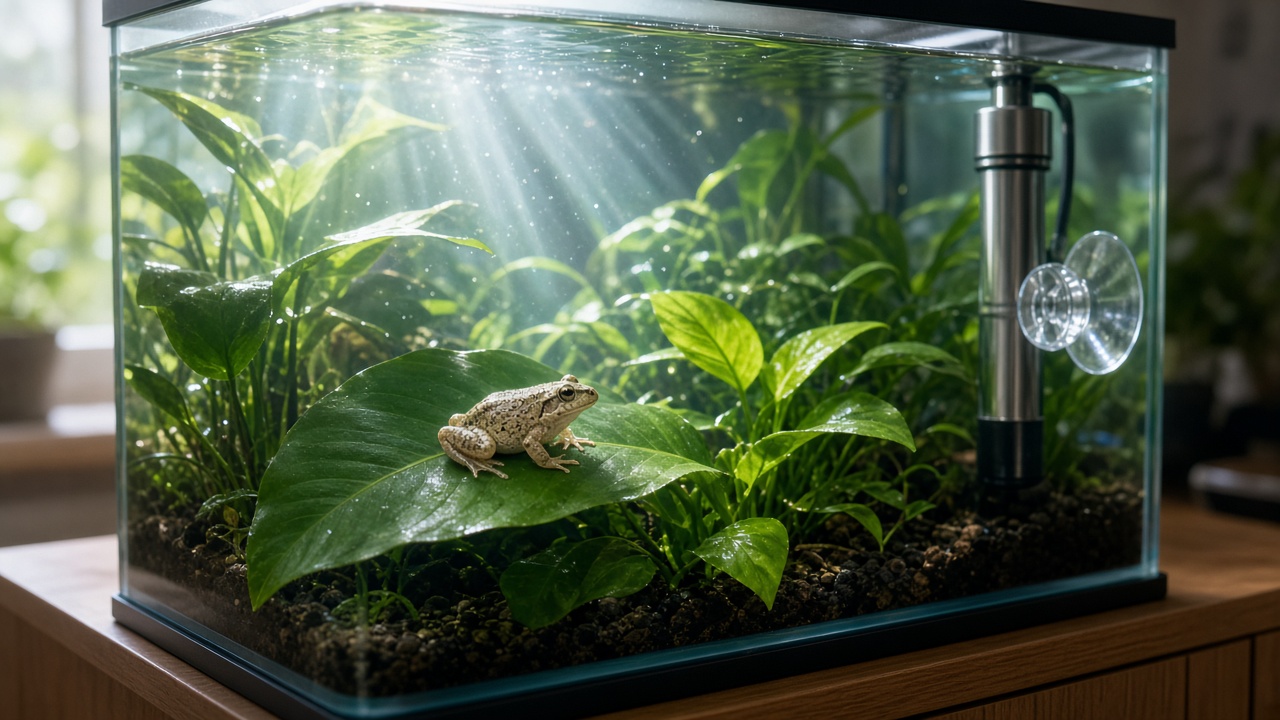
EHEIM’s thermocontrol 75 page lists 75 watts for aquariums of about 60 to 100 liters. The adjustable range is 18°C to 34°C. Control accuracy is listed at ±0.5°C. Cable length is about 170 centimeters. The heater is fully submersible and includes dry-run shut-off.
Aqueon’s Critical Dimensions sheet helps you judge water mass. The 10 Leader lists 111 pounds filled. The 20 Long lists 225 pounds filled. Larger water masses hold heat longer, but cool rooms still need a correctly sized heater.
Placement tips:
- Sit the heater where gentle filter flow passes the tube
- Keep thick sand from burying the sensor
- Use a drip loop on the cord
- Never run a heater dry during a deep drain
- Add a second thermometer at the far end of the tank
If one corner runs hot and the other runs cool, move the heater or soften the filter return so heat mixes.
Lids, depth, and heat loss
Open tops cool faster. Tight lids hold warmth and stop escapes.
The Virulence notes keep at least 1 centimeter between the lid and the water surface so adults can gulp air. That small gap still lets some heat leave. In winter, improve room climate or step up wattage carefully. Do not jump straight toward 86°F for comfort.
Shallow water changes temperature faster than deep water. Rabb and Rabb’s shallow 10-centimeter study depth warmed and cooled quicker than a full deep box. Watch small tanks more closely during cold nights and hot afternoons.
Mark a normal water line with tape. Evaporation drops the line, changes heater coverage, and lengthens the climb to air. Top off with conditioned water matched to tank temperature.
Reading frog behavior against the thermometer
Lethargy in a cool tank often tracks the thermometer first.
Gasping at the surface can mean heat plus low oxygen. Add gentle surface movement without a blast. Check the heater before you assume disease.
If frogs hug the heater tube, the tank may be too cold overall. If they avoid one corner, that corner may be too hot. Move or baffle the heater before you rearrange the whole aquascape.
Keep copper medications out of shared water. Soft amphibian skin is sensitive. Temperature fixes do not replace toxin caution.
After a big water change, watch for a sudden chill. Match new water within a degree or two of the tank reading before you pour.
Seasonal room problems and simple fixes
Summer AC swings and winter night setbacks both hit small tanks.
Move the aquarium away from vents when you can. Insulate the back of an open stand with a foam sheet if nights run cold. In heat waves, reduce room light, float a sealed frozen water bottle only as a short bridge, and aim to restore the 20–25°C band as soon as you can.
Do not stack heaters. Two large heaters in a small tank can overshoot. One correctly sized unit plus a thermometer is cleaner. A controller outlet can help in extreme rooms, but it does not replace a working in-tank thermometer. Read the display at frog height, not only at the heater clip.
If your heater’s maker range is 60–100 liters, do not ask it to hold a much larger box in a cold garage. Upsize the heater or move the tank.
Keep spare batteries for digital thermometers. A dead display during a cold snap leaves you flying blind. Stick-on strip thermometers drift; use them only as a backup clue.
Log morning and evening readings for one week when you first set up. That short log shows whether night setbacks are real in your room. Fix the room pattern before you blame the frogs.
Attribute table for temperature planning
| Cue | Published number | Publisher |
|---|---|---|
| Daily housing range | 20–25°C (68–77°F) | protocols.io housing protocol |
| Lab system setpoint | 25°C ± 0.5°C | Virulence 2023 husbandry |
| Study observation span | 19–30°C | Rabb & Rabb 1963 |
| Heat-treatment ramp | 20→30°C over 10 days; 10 days hold; 5 days down | Virulence 2023 |
| EHEIM thermocontrol 75 | 75 W; 18–34°C; ±0.5°C; ~170 cm cord | EHEIM product page |
| Aqueon 10 Leader filled weight | 111 lb | Aqueon Critical Dimensions |
| Aqueon 20 Long filled weight | 225 lb | Aqueon Critical Dimensions |
| Lid air gap | ≥1 cm | Virulence housing notes |
Water changes without temperature shock
Large water changes can undo a perfect heater setting in minutes.
Match new water to the tank reading before you pour. A swing of several degrees feels small in a bucket and large to a frog. Condition for chlorine and chloramine first, then adjust temperature second.
When the Virulence team performed water changes in standard tanks, they adjusted reverse-osmosis water for conductivity and temperature before use. Their target conductivity was 900 ± 100 microsiemens per centimeter with Instant Ocean at 0.5 grams per liter. Home keepers using tap water still need temperature matching even when they skip salt mixes.
Siphon slowly. Refill slowly. Watch the heater lamp after the refill. Many heaters need a few minutes to catch up. Do not stack hot water from the tap into a cool tank to “save time.”
If frogs go still after a change, check the thermometer before you assume illness. Cold shock is common and fixable with better matching next week.
FAQ
What temperature should African dwarf frog water be?
Protocols.io lists 20°C to 25°C. The Michigan protocol held systems near 25°C ± 0.5°C. Most homes do well in the low- to mid-70s °F with a steady heater and a second thermometer. Write the target on a tape label on the stand so guests do not twist the dial.
Do I need a heater if my house feels warm?
Often yes. Night setbacks and air conditioning still chill small tanks. A heater with ±0.5°C class control, like the EHEIM thermocontrol 75 rating, holds a floor when rooms swing.
Can the water be too hot?
Yes. Rabb and Rabb explored up to 30°C in study conditions, but daily care should stay nearer 20–25°C. Hot water also holds less oxygen, so frogs may gasp even with a short climb to air. If summer rooms push past 77°F, cool the room before you accept a new “normal.”
Where should I put the thermometer?
Place it opposite the heater, mid-tank. Confirm both ends after the heater cycles. Trust the thermometer more than the dial art on the heater.
How fast can I change temperature?
Change slowly. The lab heat-treatment ramp used days, not minutes. For ordinary moves, nudge about one degree at a time and recheck appetite and activity.
Does tank size change heater choice?
Yes. More water needs more watts. Use the maker’s volume range. Aqueon’s filled weights show how heavy even “small” tanks become when full, which hints at heat mass too.
Why do my frogs sit on the heater?
The tank may be cooler than the dial suggests. Verify with a second thermometer. Raise the true tank temperature into the 20–25°C band, then watch whether resting spreads out again. Also check for a strong filter jet that pushes them into the warm corner by force.