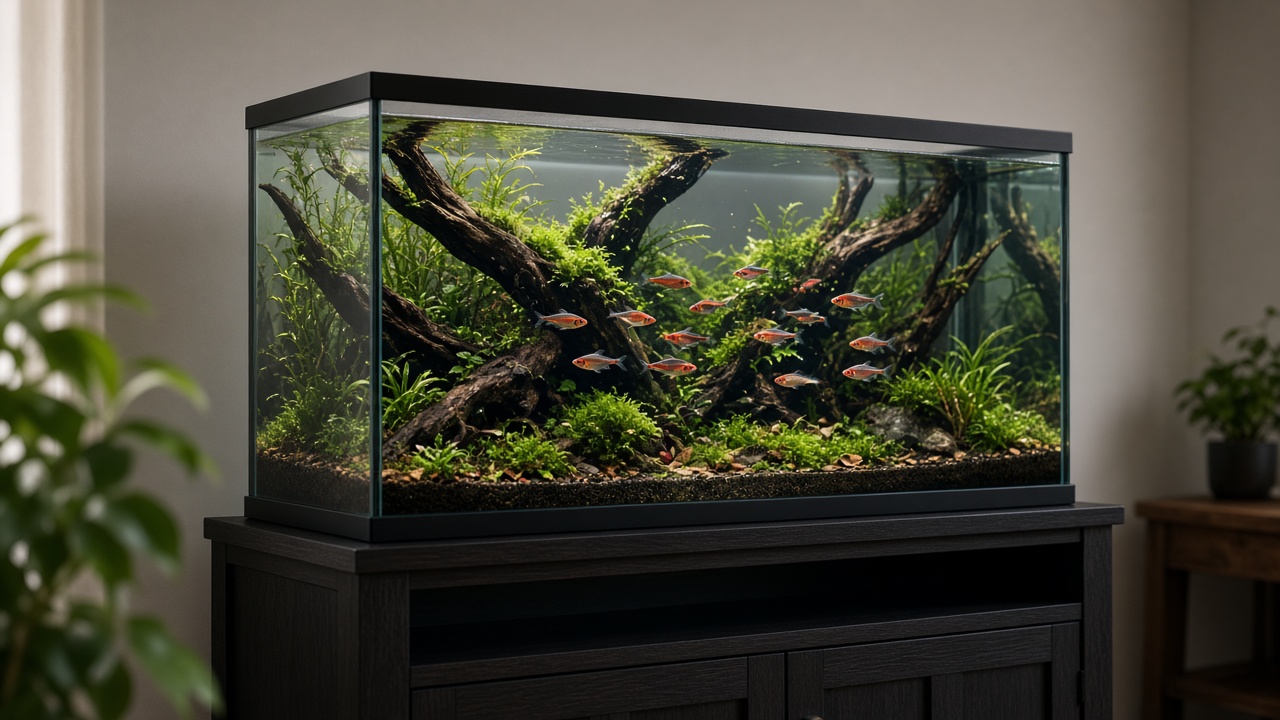
Quick answer: Buy inert aquarium stone for most community and planted tanks, and use limestone or aragonite rock only when you want harder water. Rinse every piece and seat heavy stone on substrate, not bare glass.
Inert aquarium stone will not raise hardness; limestone and aragonite rock will.
This page is a published-spec comparison of five currently sold aquarium rock kits. We did not collect yard stone, run soak trials, or inspect wild river rock.
Which rocks this article covers
Only kits with a maker-listed size and a material or chemistry line made this article.
That rule is our Maker-Spec Gate, so garden stone, collected river rock, and painted resin ornaments stay out.
Our research team analyzed five maker pages that still sell rock for aquariums in 2026. We compared only those published specs and did not rank the kits.
The five kits are:
- Fluval Aquascaper Natural Rock & Sand Décor Set, Nano, Black Basalt Canyon
- Hygger CO2 Dragon Stone Rock, model HC007
- WIO Dragon Stone Kit
- WIO Ryuoh Stone Kit
- CaribSea LifeRock Original
If a stone type has no current maker page with those fields, it is named only as a geology class. It is not sold as a pick here.
Top 7 Rocks for fish tank
The picks below are the 7 rocks for fish tank on sale right now, listed with what each suits best and an honest drawback. Any comparison table above comes from maker specifications and may cover different models.
1. GloFish Aquarium Gravel
Best for: brightly colored community tanks
We compared GloFish Gravel with other budget options and found it delivers consistent color that many owners say brightens community setups. It’s inexpensive and easy to rinse, though some report occasional staining on delicate species.
Pros: Vibrant hues add visual pop; Affordable small‑bag size Cons: May stain light‑colored fish
2. OUPENG Pebbles Polished Gravel
3. Marina Decorative Gravel
4. GloFish Aquarium Sand 5 Pounds
5. Virekm River Rocks
6. Aqua Natural Aquarium Substrate
7. Ameliade Aquarium Artificial Plants & Rock Cave Betta Fish Tank Decor
Comparison: Rocks for fish tank at a Glance
| Product | Best for | Approx. price | Where to buy |
|---|---|---|---|
| GloFish Aquarium Gravel | brightly colored community tanks | $8.97 | Check price |
| OUPENG Pebbles Polished Gravel | $9.99 | Check price | |
| Marina Decorative Gravel | $3.99 | Check price | |
| GloFish Aquarium Sand 5 Pounds | $6.71 | Check price | |
| Virekm River Rocks | $7.11 | Check price | |
| Aqua Natural Aquarium Substrate | $12.76 | Check price | |
| Ameliade Aquarium Artificial Plants & Rock Cave Betta Fish Tank Decor | $7.88 | Check price |
Want to browse every option? See the full range of rocks for fish tank on Amazon →
The chemistry split that decides safety
The first filter is simple: does the stone add calcium and magnesium, or does it sit still?
The USGS Water Science School defines hardness as dissolved calcium and magnesium. Its page classifies water this way:
- Soft: 0 to 60 mg/L as calcium carbonate
- Moderately hard: 61 to 120 mg/L
- Hard: 121 to 180 mg/L
- Very hard: more than 180 mg/L
A USGS National Water-Quality Assessment study assessed about 2,100 domestic wells across the United States. Hard water was common where carbonate rock feeds the aquifer. The same mineral story plays out in a glass box.
Inert stone does not feed that rise, and clay-sedimentary dragon stone belongs here when the maker says so.
Calcareous stone does feed that rise, so limestone, marble, coral rock, and aragonite belong here.
The USGS Water Science School page notes that vinegar, an acid, helps dissolve mineral particles. A fizz on dry stone is a home clue for carbonate, not a lab assay.
Our research team compared the five maker pages. Only the WIO Dragon Stone Kit page states the stone will not affect pH or hardness.
The WIO Ryuoh Stone Kit page states the opposite: it is natural limestone and may raise pH and hardness over time.
CaribSea’s marine-substrates page states LifeRock is 97 percent calcium carbonate, which is aragonite rock, not an inert community stone.
Hygger’s HC007 page lists size and tank volume and does not publish a hardness number.
Fluval’s Aquascaper page calls the kit 100 percent natural, pre-washed, and non-toxic, and it does not publish a hardness number.
Treat missing chemistry as unknown and do not guess.
Five currently sold rock kits, compared
The table below uses only attributes each maker lists on its own product page.
| Product | Maker-listed material | Pack size | Piece size | Maker chemistry line | Maker tank cue |
|---|---|---|---|---|---|
| Fluval Aquascaper Natural Rock & Sand Décor Set, Nano, Black Basalt Canyon | Natural stone and sand kit sourced from Spain | 24 lb / 11 kg kit; stone set 11 lb / 5 kg | Not listed as piece height | 100% natural, pre-washed, non-toxic | Freshwater aquascape kit |
| Hygger CO2 Dragon Stone Rock (HC007) | Natural dragon stone | 3 kg, 6 kg, or 9 kg | 4–8 in (10.2–20.3 cm) | Safe for aquatics; no hardness figure | Tanks 10 gal / 38 L and up |
| WIO Dragon Stone Kit | Natural clay-sedimentary stone | Nano 3 kg; Box 6 kg; Mega 12 kg | Mix 3–16 cm (Nano) to 3–25 cm (Mega) | Inert; will not affect pH or hardness | Nano ≤45 cm; Box ≤60 cm; Mega ≤90 cm |
| WIO Ryuoh Stone Kit | Natural limestone (calcareous) | Nano 5 kg; Box 11 kg; Mega 21 kg | Mix 3–16 cm (Nano) to 3–25 cm (Mega) | May raise pH and hardness over time | Nano ≤45 cm; Box ≤60 cm; Mega ≤90 cm |
| CaribSea LifeRock Original | Aragonite rock | 10 lb, 20 lb, or 40 lb boxes | Not listed as piece height on this SKU | 97% calcium carbonate; 50% void space | Marine hardscape; no curing required |
Comparing published specs, WIO’s two Mega boxes target the same ≤90 cm tank class. Dragon Mega is 12 kg, while Ryuoh Mega is 21 kg.
Limestone is the heavier kit, and that gap is density, not a quality score.
Hygger’s HC007 page lists three bag weights: 3 kg, 6 kg, and 9 kg. Each stone is 4–8 inches tall, or 10.2–20.3 cm. The page sets the floor at 10 gallons, or 38 liters.
Fluval’s Nano Black Basalt Canyon page lists a 24 lb / 11 kg kit, and the stone set inside is 11 lb / 5 kg. Detailing stones are 0.55 lb / 0.25 kg, and the same page says the materials are sourced from Spain.
CaribSea’s LifeRock line also includes Dreamscapes kits, and that same page lists sizes for 5–15 gallon, 15–25 gallon, and 40–60 gallon tanks.
The assortment box lists a minimum of 40 pounds of rock, and CaribSea suggests one box for every 40 to 60 gallons.
CaribSea’s page also states LifeRock has about 50 percent void space. That pore space is a marine filtration claim, not a soft-water planted-tank reason.
WIO’s Dragon Stone Kit page lists typical main stones by box size. Nano is about 12–15 cm, Box is 15–20 cm, and Mega is 17–25 cm.
Use the table to match chemistry first, then match pack weight to tank length.
Match the rock to the tank, not the photo
Pick stone for the water you keep, not for the photo you saved.
Community tanks and most planted tanks need inert stone, and soft-water fish and shrimp need the same rule.
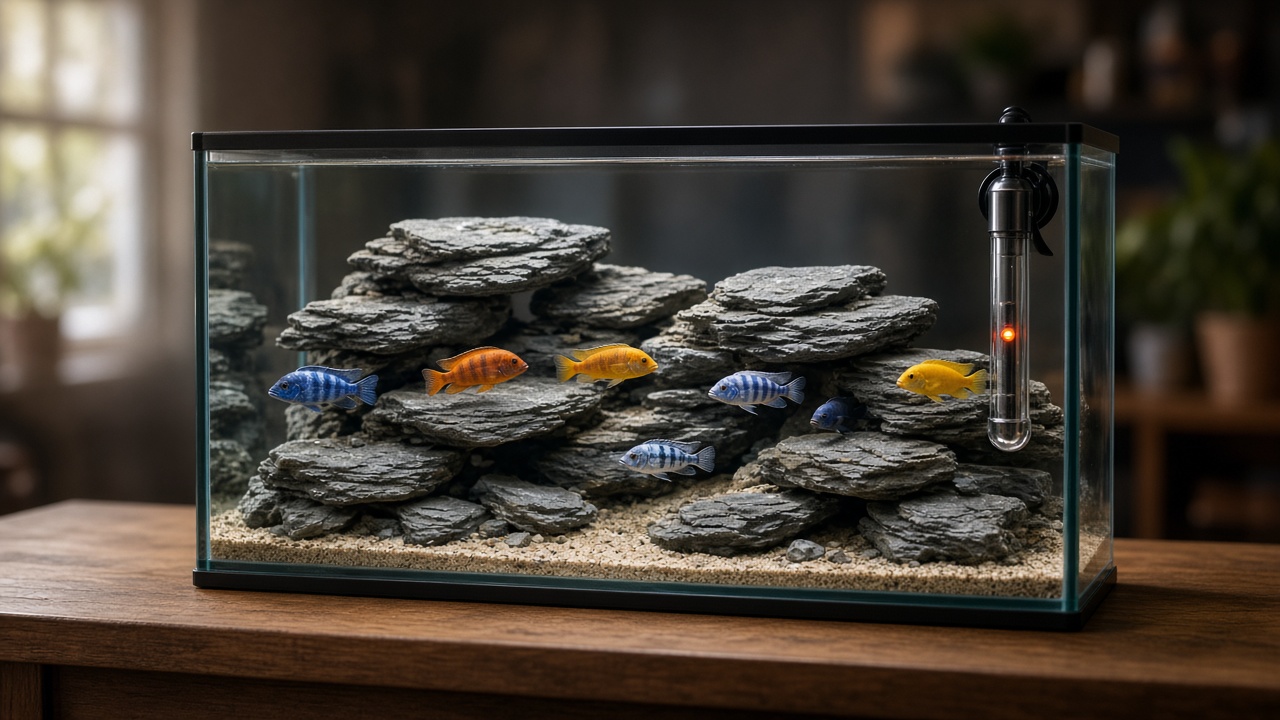
Hard-water livebearers and African cichlids can use calcareous rock on purpose, and that is a choice, not a default.
Use this match list:
- Inert clay-sedimentary stone, such as the WIO Dragon Stone Kit, for community and planted tanks
- Dragon stone bags with no hardness line, such as Hygger HC007, only after you accept the gap
- Natural basalt-style kits, such as Fluval’s Black Basalt Canyon set, when you want a full hardscape kit and will track water after fill
- Limestone kits, such as the WIO Ryuoh Stone Kit, for Iwagumi looks when you accept a hardness rise
- Aragonite rock, such as CaribSea LifeRock Original, for marine systems or other hard-water plans
Seat rock on a planted base. Our best substrate for planted aquarium guide covers soils and sands that hold that weight.
If the tank holds a betta, keep edges blunt and add soft cover from our best live plants for betta fish list.
Rock is not the only hide. Silk leaves and caves in our best decorations for betta fish guide do the same job with less weight.
Do not mix one inert pile with one limestone pile and call the tank stable, because the limestone still dissolves.
How to rinse, place, and stack rock
Rinse first, place second, and stack last, and do not skip the rinse because a box says pre-washed.
Maker pages still ask for a rinse. The WIO Dragon Stone Kit page says a quick rinse is optional to clear transit dust. The WIO Ryuoh page also calls for a brief rinse.
Hygger’s page does not replace a rinse. Fluval’s page says the kit is pre-washed, so still rinse the stone set.
Follow this order:
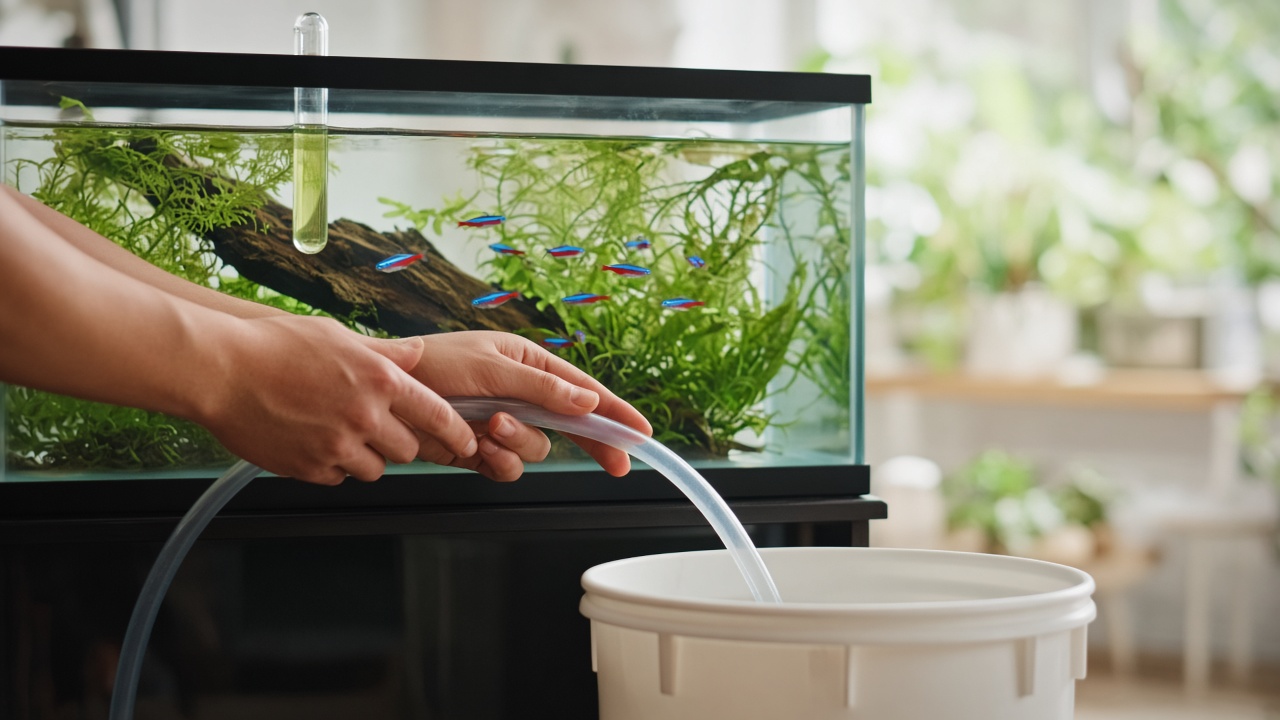
- Rinse each piece under running tap water until the runoff looks clear.
- Scrub pores with a clean brush. Use no soap.
- Set a substrate pad on the glass before the first heavy stone.
- Seat the largest stone first. Echo its angle with smaller pieces.
- Keep a finger-width gap between stone and glass for algae wipes.
- Fill slowly over a plate so you do not undercut the stack.
WIO’s Dragon and Ryuoh pages both say a light haze can clear within hours after fill. That haze is dust, not a chemistry pass.
After fill, test pH and hardness on day one and again after a few water changes. Compare those readings to the USGS bands above. A climb from the soft band into the hard band is a real change.
If you used limestone or LifeRock, plan for that climb. If you used a kit with no chemistry line, treat the first month as a watch window.
Do not brace a stack with household glue, and use only aquarium-labeled adhesives if a maker calls for a bond.
Never leave a teetering peak, because a fallen stone can crack glass or pin a fish.
What to leave out of a fish tank
Skip any stone that cannot pass the Maker-Spec Gate and the chemistry split.
Leave these out of a community tank:
- Yard rock, driveway gravel, and landscaping stone with no aquarium label
- Limestone, marble, and coral rock when you want soft water
- Metallic veins, fool’s-gold sparkle, and painted garden ornaments
- Concrete chunks, brick, and unsealed cement
- Shells and crushed coral in a freshwater betta tank
- Sharp shards that can cut fins or puncture bags
CaribSea’s South Seas rock is sold on the same marine page for marine, reef, and African cichlid aquariums. That is a hard-water product family, not a soft-water community pick.
LifeRock Dreamscapes copy on CaribSea’s page says the kits are safe for all marine fish and invertebrates, so read that as a marine claim.
If you only know a stone as “pretty gray rock,” do not buy it for a fish tank.
A named kit with a chemistry line is the safer start, and unknown stone is the common failure.
FAQ
Can I use rocks from my yard in a fish tank?
No, not as a default. Yard stone has no maker chemistry line and may carry pesticides, metals, or carbonates.
Our Maker-Spec Gate keeps that stone out of this article, so buy a labeled aquarium kit instead.
Will Ryuoh or other limestone raise hardness?
Yes, it can, and the WIO Ryuoh Stone Kit page states the stone is calcareous limestone and may raise pH and hardness over time.
The same page tells you to watch pH and kH. That rise can push water out of the USGS soft band of 0 to 60 mg/L as calcium carbonate.
Is dragon stone safe for shrimp and planted tanks?
WIO’s Dragon Stone Kit page states the stone is inert and will not affect pH or hardness. It also lists fish, shrimp, and plants as suitable.
Hygger’s HC007 page says the stone is safe for aquatics and sized for tanks 10 gallons and up. It does not publish a hardness figure, so treat that bag as unknown until you measure.
How much rock do I need for a 10-gallon tank?
Hygger’s HC007 page sets 10 gallons, or 38 liters, as the smallest listed use. WIO’s Dragon Nano box is 3 kg for tanks up to 45 cm.
Fluval’s Nano Black Basalt Canyon kit is 24 lb / 11 kg with an 11 lb / 5 kg stone set. Start with the smallest listed pack for that length, and add stone only if the stack stays stable.
Does CaribSea LifeRock belong in a freshwater community tank?
Not as a first pick. CaribSea’s page states LifeRock is 97 percent calcium carbonate with about 50 percent void space.
That composition matches marine aragonite rock. Use it when you want that mineral load, and skip it when you want the USGS soft-water band to stay put.
Do I need to boil new aquarium rocks?
No maker page in this set lists a boil step as required. Fluval calls the kit pre-washed. WIO calls its kits pre-washed with an optional rinse.
A hot boil can crack porous stone and splash debris, so rinse and brush instead, then measure water after the tank is filled.
Can stacked rocks hurt fish?
Yes, if a piece shifts or has a knife edge, so seat the heaviest stone on substrate, not bare glass.
Leave swim-through gaps that a fish can exit. For bettas, pair blunt stone with soft plants and the hides in our decorations guide. A pretty stack that pins a fish is a failed scape.