Quick answer: Keep one Chinese algae eater only if you can give it a long tank that meets the Seriously Fish 80-gallon figure. It’s a territorial adult, not a cleanup fish for a community tank. Feed a mixed sinking diet and skip look-alike bottom fish.
A Chinese algae eater reaches 11 inches standard length and is not a community cleaner.
This page is a care brief from published species records and maker food labels. We did not keep a colony, run feeding trials, or score store tanks.
Selection rule: A housing plan enters only if it meets the 150 × 45 centimeter base on the Seriously Fish profile. A food enters the table only if its maker page lists protein, fat, and moisture.
We call that filter the Published-Label Rule, so live foods, unsigned store wafers, and any small “community cleaner” plan stay out.
Adult size and how long the fish lives
Plan for an 11-inch fish, not the small juvenile that shops sell in a bag.
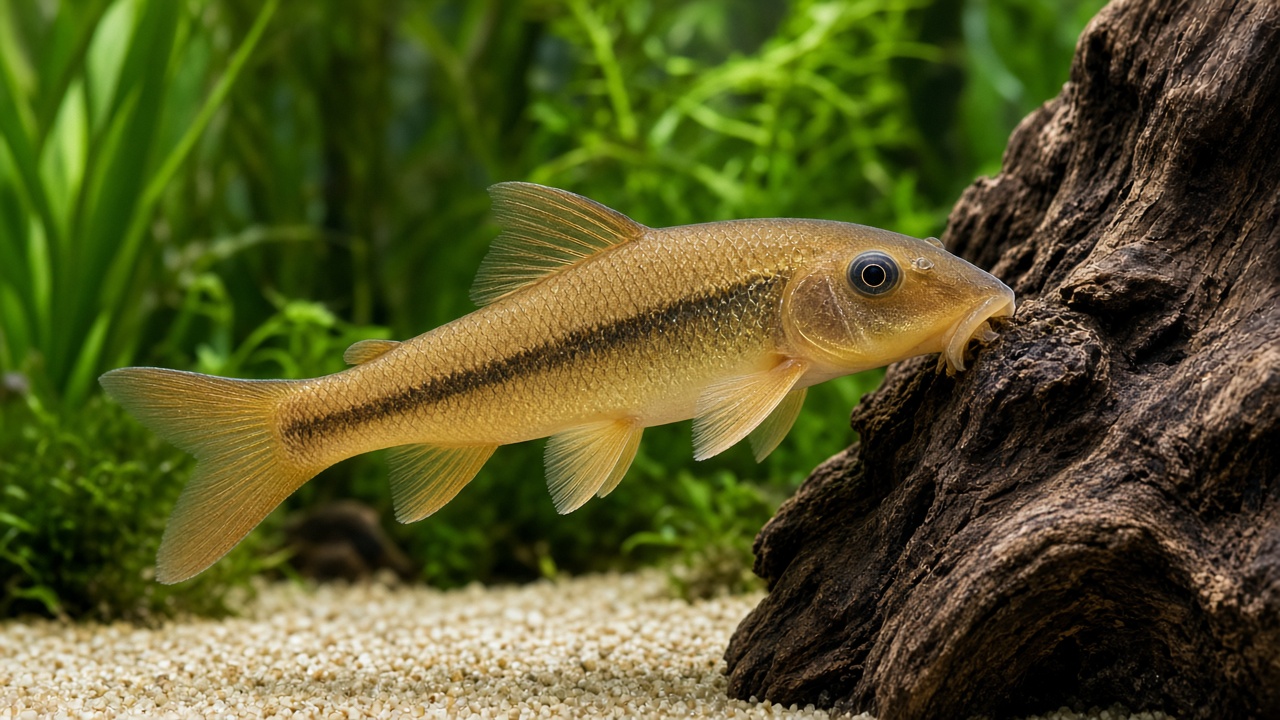
Seriously Fish lists Gyrinocheilus aymonieri at 280 millimeters standard length, or 11 inches. Standard length is the body from the snout to the last scale, not the tail tip.
That 11-inch figure is the number we use for tank planning. Store fish are farmed juveniles, so the bag size is a start point, not the adult size.
Seriously Fish also states that potential age can exceed 15 years, so this is a long pet. It’s not a short cleanup tool you replace next season.
The same profile notes that the trade names “Chinese” and “Indian” algae eater are misleading. The fish does not occur naturally in China or India.
Wild range on that page is the Mae Klong, Chao Phraya, Mekong, and Dong Nai basins. All fish in shops are farmed, and wild examples are not currently traded.
Seriously Fish says mature females look thicker-bodied than males, but young fish cannot be sexed by eye. Adult males in spawning condition grow tubercles on the snout.
The profile also says the species has not been bred in home aquaria, and farms produce the trade stock with hormones.
Temperament as the fish grows
Young fish hide most of the day, and adults later claim space and may rasp other fish.
Seriously Fish says small specimens hide much of the time and become more territorial as they grow. The worst of that aggression is aimed at similar-looking bottom fish.
The profile names Crossocheilus, Epalzeorhynchos, and Garra species as poor matches, because those fish share the same body shape and the same floor.
Bottom fish take the next hit after those look-alikes. The same page says the eater may attach to the flanks of larger tank mates and feed on body mucus.
That latch is a feeding act, not play, so if you see a sucker stuck to another fish, move one of them out.
Add this fish last if you keep a mixed tank. Seriously Fish says a last add helps stop it from owning the whole box.
A group is not a small-tank fix for that aggression. The profile says buy at least half a dozen so a pecking order can form, and only in a very large tank.
One adult in a long tank is the plan this page uses, and we do not map a six-fish group into a typical home community.
Tank size and layout
The smallest footprint we accept is 60 by 18 inches of floor, not a tall cube.
Seriously Fish sets the smallest base at 150 × 45 centimeters, or 60 × 18 inches. The same line lists about 304 liters, or about 80 US gallons.
That footprint is larger than the small starter tanks that sell this fish. Length matters more than height, because the fish patrols the floor and the glass.
Build a flowing-stream look, not a still display bowl.
- Use mixed rock, gravel, and some larger, water-worn boulders.
- Add driftwood roots or branches for cover.
- Attach tough plants such as Microsorum, Bolbitis, or Anubias to decor.
- Keep oxygen high and water moving at a moderate pace.
Seriously Fish says the species is intolerant of organic-waste buildup. Bright light can grow the biofilm the fish will graze, but that film is not a full diet.
Don’t count on plants as the only food, because adults still need offered meals, which the diet section covers.
The same profile notes a spiracle on each gill cover that lets the fish breathe while the mouth stays clamped to a rock. That mouth is a hold-fast, so glass and tank mates can both get rasped.
Tank mates that can work, and those that cannot
Skip look-alikes, skip most catfish, and keep upper-water fish fast and robust.
Seriously Fish says this species is largely unsuitable for a general community tank. It doesn’t say the fish must live alone if the tank is long and the neighbors are chosen with care.
Use this match list from that profile.
- Avoid Crossocheilus, Epalzeorhynchos, and Garra species.
- Avoid other bottom cichlids and most catfish.
- Avoid any fish the eater can pin and rasp.
- For the upper levels, choose robust, active cyprinids or characids.
- Add the algae eater last.
Slow, tall-bodied fish such as angelfish and discus are a poor fit. They present a large flank and cannot dart away from a rasping mouth.
Goldfish are also a poor fit in this setup. They are slow, they carry a thick slime coat, and they already struggle in warm water.
Don’t add this fish to the species on our best algae eaters list just to pile on cleaners. Siamese algae eaters and Garra look too similar and share the floor.
If you want a crew that stays small and peaceful, leave this species off the list. Use that algae-eater page, or our 2026 algae-eating fish guide, instead.
Diet and currently sold sinking foods
Adults need offered food, because tank algae will not cover a growing fish.
Seriously Fish describes the wild diet as aufwuchs: algae, small crustaceans, and insect larvae. In the tank, the same page calls for live or frozen bloodworm, Daphnia, and Artemia, plus flakes, granules, and fresh plant matter.
It also names shelled peas, cucumber, blanched zucchini, spinach, and chopped fruit. Those items are add-ons, not the only meals an adult should get.
Our research team analyzed five maker pages that met the Published-Label Rule. Crude protein on those labels ran from 24% to 47%.
Crude fat on the same five labels ran from 3% to 9%. Moisture sat at a 10% maximum on every label we compared.
| Product | Form | Protein (min) | Fat (min) | Maker feed window |
|---|---|---|---|---|
| Hikari Tropical Algae Wafers | Sinking disc | 33% | 4.0% | Eat within 2 hours |
| Hikari Tropical Mini Algae Wafers | Smaller sinking disc | 33% | 4.0% | Eat within 1 hour |
| Hikari Tropical Sinking Wafers | Soft sinking disc | 36% | 9.0% | Eat within 20 minutes |
| Hikari Tropical Sinking Carnivore Pellets | Sinking pellet | 47% | 8.0% | 2 to 3 feeds a day |
| Omega One Super Veggie Green Nori Seaweed | Dried sheet | 24% | 3% | No time listed |
Hikari’s Algae Wafers page lists 33% protein, 4.0% fat, 3.0% fiber, 10% moisture, 17% ash, and 0.8% phosphorus. Pack sizes on that page are 0.7 ounce, 1.41 ounce, 2.89 ounce, and 8.8 ounce.
Hikari’s Mini Algae Wafers page lists the same 33% protein and 4.0% fat, with pack sizes of 0.77 ounce and 3.0 ounce. The feed window on that page is one hour, not two.
Hikari’s Sinking Wafers page lists 36% protein, 9.0% fat, 4.0% fiber, and 16% ash. That page tells you to remove leftover food after 20 minutes.
Hikari’s Sinking Carnivore Pellets page lists 47% protein, 8.0% fat, and 1.0% phosphorus in a 2.61 ounce pack. It says to feed two to three times daily, only what fish finish in a few minutes.
Omega One’s Super Veggie Green Nori page states the sheet is 100% seaweed. The same page lists 24% protein, 3% fat, 3% fiber, and 10% moisture.
Use the veggie discs and the nori sheet as the daily plant share. Use the higher-protein sinking wafer or carnivore pellet as the animal-protein share for an adult.
Don’t leave wafers in overnight past the maker window. Leftover food is waste, and this species already wants clean, moving water.
Water conditions from the species record
Hold the tank in the mid-70s Fahrenheit, with a mid pH and moderate hardness.
Seriously Fish lists a care band of 22–26°C, or 72–79°F. The same profile notes a wider short-term range of 16–32°C, or 60–90°F.
It says not to hold the fish at either extreme for general care. A heater belongs in the plan so room swings do not hit those ends.
Other published numbers from that page are simple.
- pH: 6.0–8.0
- Hardness: 2–20 dGH
- Flow: moderate, with high dissolved oxygen
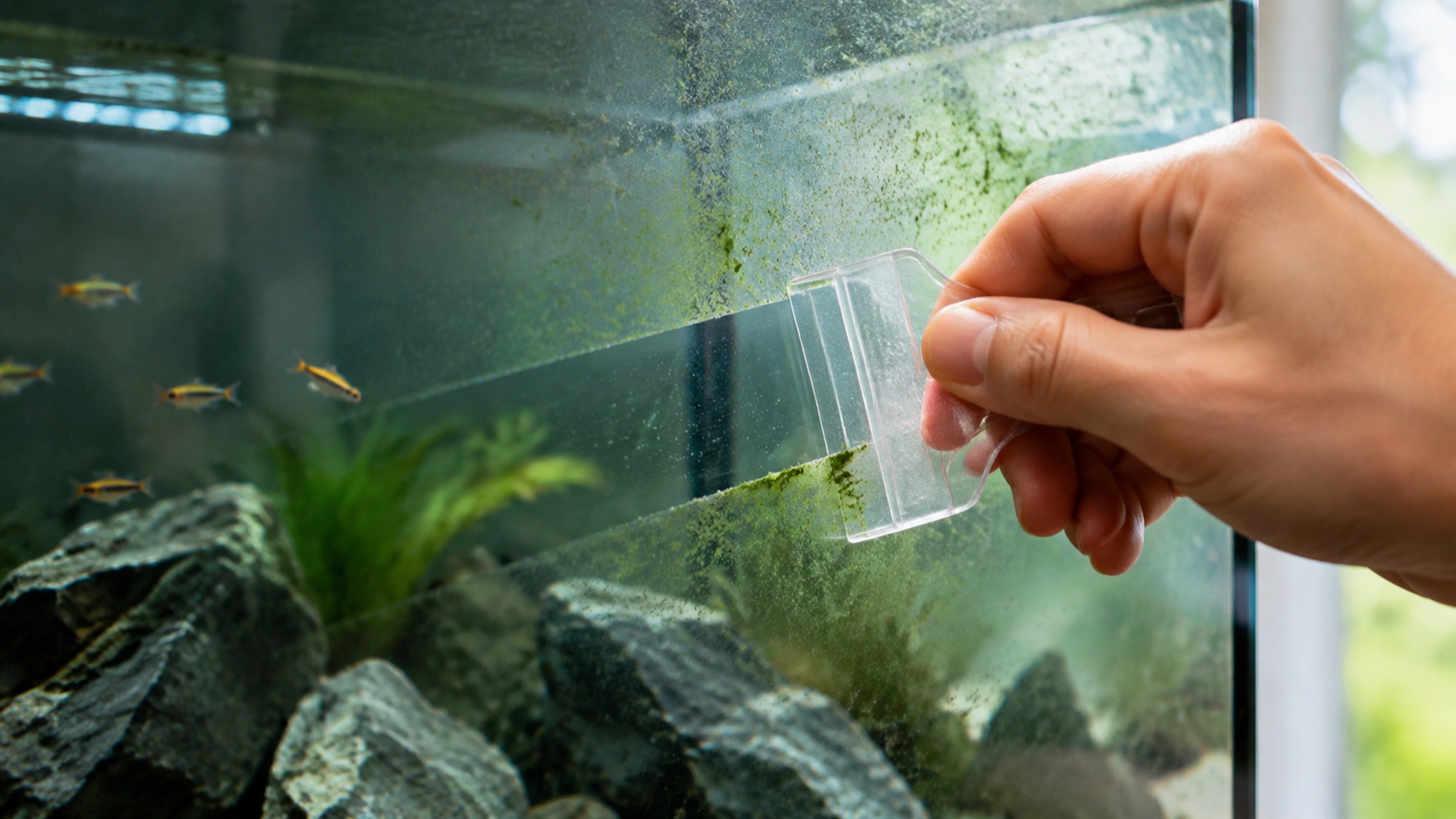
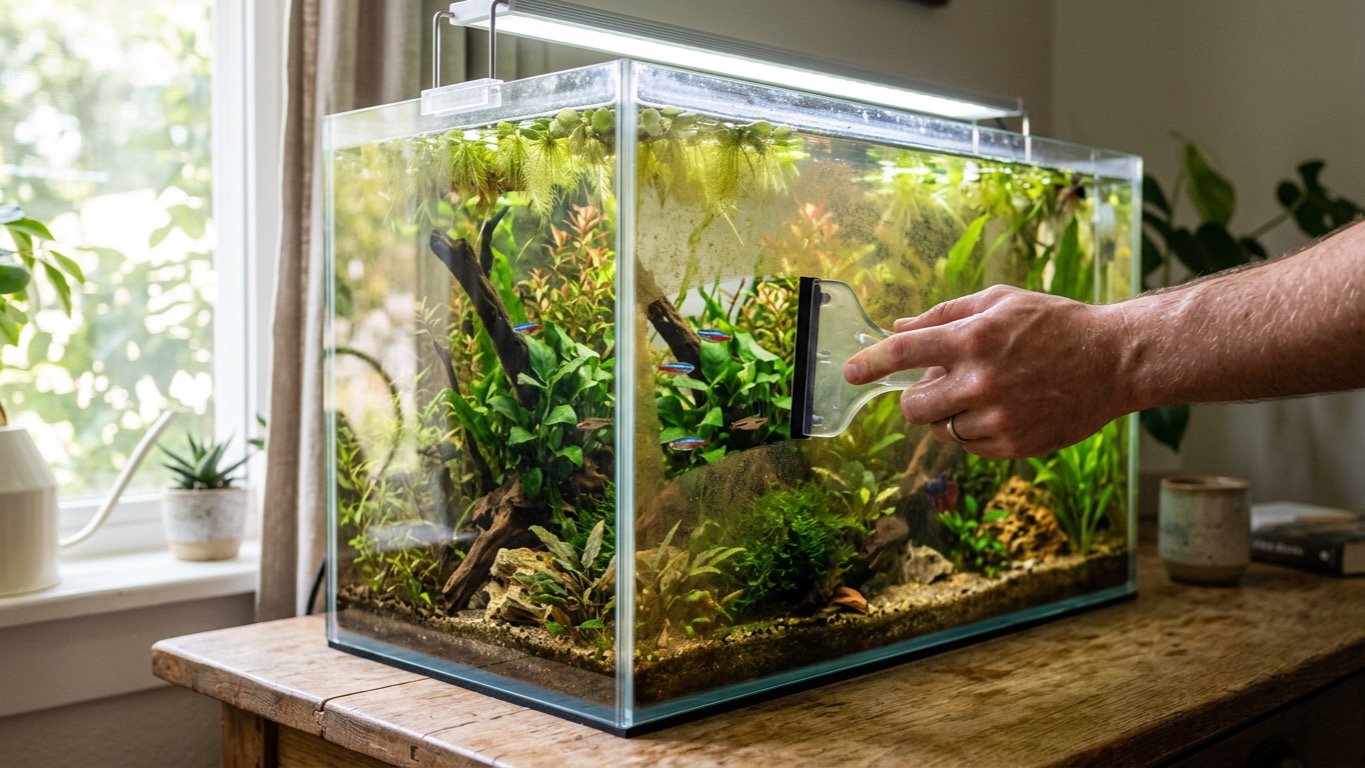
Brown film on new glass is often diatoms, not a reason to buy this fish. See our page on brown algae in a fish tank for the wipe-and-cut steps.
When to pick a different algae eater
If you need glass cleaning in a community tank, pick a different animal.
This species fails the usual shop pitch on size and mood. It grows to 11 inches, lives more than 15 years, and turns territorial.
Use another page when your goal is algae control, not this fish.
- Want a mixed crew that stays small? Read best algae eaters.
- Want fish-only options by tank role? Read best algae-eating fish for 2026.
- Want a brown wipe-off film gone? Fix silica first on the brown algae page.
Keep a Chinese algae eater only when you already want that species. Don’t buy it as a shortcut for a dirty starter tank.
FAQ
How big does a Chinese algae eater get?
Seriously Fish lists 280 millimeters standard length, which is 11 inches. That is the body without the tail fin. Plan the tank around that number, not the juvenile in the bag.
How large should the tank be?
Seriously Fish sets the smallest base at 150 × 45 centimeters, or 60 × 18 inches. That footprint holds about 80 US gallons. A tall, short tank of the same gallons is a weaker match because this fish needs floor length.
Can I keep two Chinese algae eaters together?
Seriously Fish says a group can spread aggression, but only at half a dozen or more. Fewer fish let strong fish pin weak ones. This page keeps one adult in a long tank and does not cover a six-fish project.
Will it eat all the algae in my tank?
No, young fish graze biofilm, but adults still need offered plant and animal foods. Seriously Fish lists bloodworm, Daphnia, Artemia, wafers, and vegetables as regular meals, so algae on glass is a snack, not a ration.
What should I feed an adult?
Rotate a veggie disc, a higher-protein sinking food, and a seaweed sheet. Comparing published specs, protein on our five labels ran from 24% to 47%. Hikari Algae Wafers list a two-hour eat window, and Hikari Sinking Wafers list 20 minutes, so pull leftovers after those times.
Can it live with shrimp, snails, or corydoras?
Seriously Fish warns against most catfish and other bottom fish. Corydoras sit on that floor and cannot outrun a rasping adult. Shrimp and snails were not listed as safe tank mates on that profile, so skip that mix.
Is this the same fish as a Siamese algae eater?
No, a Chinese algae eater is Gyrinocheilus aymonieri, and a Siamese algae eater is a Crossocheilus species. Seriously Fish names Crossocheilus as a fish this species attacks. Buy the names from a label, not from the words “algae eater” on a tank sticker.