Quick answer: Feed a goldfish-labeled pellet each day, then add boiled peas or lettuce a few times a week. Keep freeze-dried worms as treats, and skip bread.
Goldfish eat omnivore pellets plus plants and small invertebrates, not bread or leftover dinner. This page is a home-tank feeding map;
What this page covers, and what it leaves out
We cover home-tank goldfish menus only, not farm ponds or bait-shop feeder diets.
Our research team used one selection rule for every food on this page. A food is in only if a maker page listed it for goldfish, or a university page named it as goldfish food.
That rule is the Staple-Treat-Never split:
- Staples: dry foods a maker labels for goldfish, used as the daily meal.
- Treats: plants or invertebrates named on those pages, used a few times a week.
- Never-feeds: leftover human food and bags not labeled for goldfish.
We left out pond-farm rations, feeder-fish mill diets, tropical cichlid foods, ranked brand lists, and price tiers.
The FDA’s pet-food page says the agency does not recommend one product over another. This page stays a menu map and is not a shopping list.
What wild goldfish actually eat
Wild goldfish eat plants, algae, and small animals from the bottom of still water.
Oregon Sea Grant at Oregon State University calls goldfish omnivores. Their page lists aquatic plants, algae, small invertebrates, and commercial pellets.
The University of Michigan BioKIDS page matches that mix. In the wild, goldfish eat plants, mosquito larvae, small crustaceans, zooplankton, and detritus, which is dead plant and animal matter on the bottom.
Goldfish crush food with teeth in their throats, not with mouth teeth, so a tank menu should look like a small omnivore.
Oregon Sea Grant notes more than 1,000 years of breeding in China and more than 125 breeds. Adults on that page typically run from a few centimeters to over 30 centimeters (12 inches).
Some fish reach 40 centimeters (16 inches) or more. BioKIDS lists a high length of 41.0 centimeters and a high mass of 3.0 kilograms.
A larger fish still eats the same kinds of food and just needs a larger pellet. BioKIDS notes that goldfish enjoy eating live plants in the tank, and Oregon Sea Grant warns that overfeeding leads to obesity.
Daily staples: pellets labeled for goldfish
A goldfish-labeled pellet is the daily staple, and a tropical flake is not the same food.
BioKIDS says captive goldfish are commonly fed dried flake or pellet food, and Oregon Sea Grant also lists commercial pellets.
The FDA’s pet-food page says animal foods must be safe, made under sanitary conditions, free of harmful substances, and truthfully labeled. Ingredients must be listed from most to least, by weight.
Our research team compared published specs on two Hikari goldfish pages and did not score the brand. We used the numbers as a printed-panel example.
Hikari’s Goldfish Staple page lists this guaranteed analysis:
- Crude protein: minimum 32%
- Crude fat: minimum 4.0%
- Crude fiber: maximum 3.0%
- Moisture: maximum 10%
- Ash: maximum 12%
- Phosphorus: minimum 0.7%
Hikari’s Sinking Goldfish Excel page lists a different print:
- Crude protein: minimum 40%
- Crude fat: minimum 6.0%
- Crude fiber: maximum 2.0%
- Moisture: maximum 10%
- Ash: maximum 15%
- Phosphorus: minimum 1.2%
Comparing those published specs shows an 8-point protein gap and a 2-point fat gap. Phosphorus rises from 0.7% on Staple to 1.2% on Excel, and both bags cap moisture at 10%.
Hikari’s Goldfish Staple page says the food has extra plant matter and names alfalfa, kale, and mulukhiya. It also says no artificial colors or flavors are added.
That page calls the baby pellet a fit for goldfish larger than 35 millimeters, or 1.5 inches. Hikari’s Sinking Goldfish Excel page fits most goldfish above 3 centimeters, or 1.2 inches.
Hikari’s goldfish pellet-size guide lists both baby formulas at 1.7 to 2.0 millimeters. The same guide lists a Staple mini pellet at 3.5 to 4.0 millimeters.
Larger fish can eat a smaller pellet with ease, but smaller fish can struggle with a pellet that is too large.
Hikari Goldfish Staple pack sizes on the maker page are:
- 1.05 ounces (30 grams)
- 3.5 ounces (100 grams)
- 10.5 ounces (300 grams)
Sinking Goldfish Excel is listed at 3.8 ounces (110 grams).
Pick one goldfish-labeled staple and use it every day, then switch form if your fish cannot reach the surface.
Treats that stay treats
Peas, lettuce, and freeze-dried invertebrates are extras, and they are not the whole diet.
BioKIDS names the captive supplements in plain terms:
- Freeze-dried Tubifex worms
- Mosquito larva
- Bloodworms
- Daphnia
- Brine shrimp
- Boiled peas and lettuce
Oregon Sea Grant’s wild list already includes plants, algae, and small invertebrates. Treats copy that mix without dumping a whole bag of worms.
Use this treat cadence:
- Boiled peas or lettuce a few times a week, not every meal.
- Freeze-dried daphnia, brine shrimp, or bloodworms in a pinch, not a pile.
- Live plants as grazing, with a plan to replace them.
Hikari’s Goldfish Staple page says the formula needs no supplemental feeding. That is a maker claim for that bag, not a ban on peas. We still treat plants and invertebrates as extras.
Prep the plant treats BioKIDS names:
- Boil peas until soft, then slip off the skins.
- Mash or split each pea so the fish can swallow it.
- Tear lettuce into small pieces and rinse it.
- Pull uneaten pieces after the meal.
Hikari’s pellet-size guide lists freeze-dried daphnia, brine shrimp, bloodworms, Tubifex, and ocean plankton in 12-gram packs. A treat should be gone in a few minutes.
How much to feed, and how often
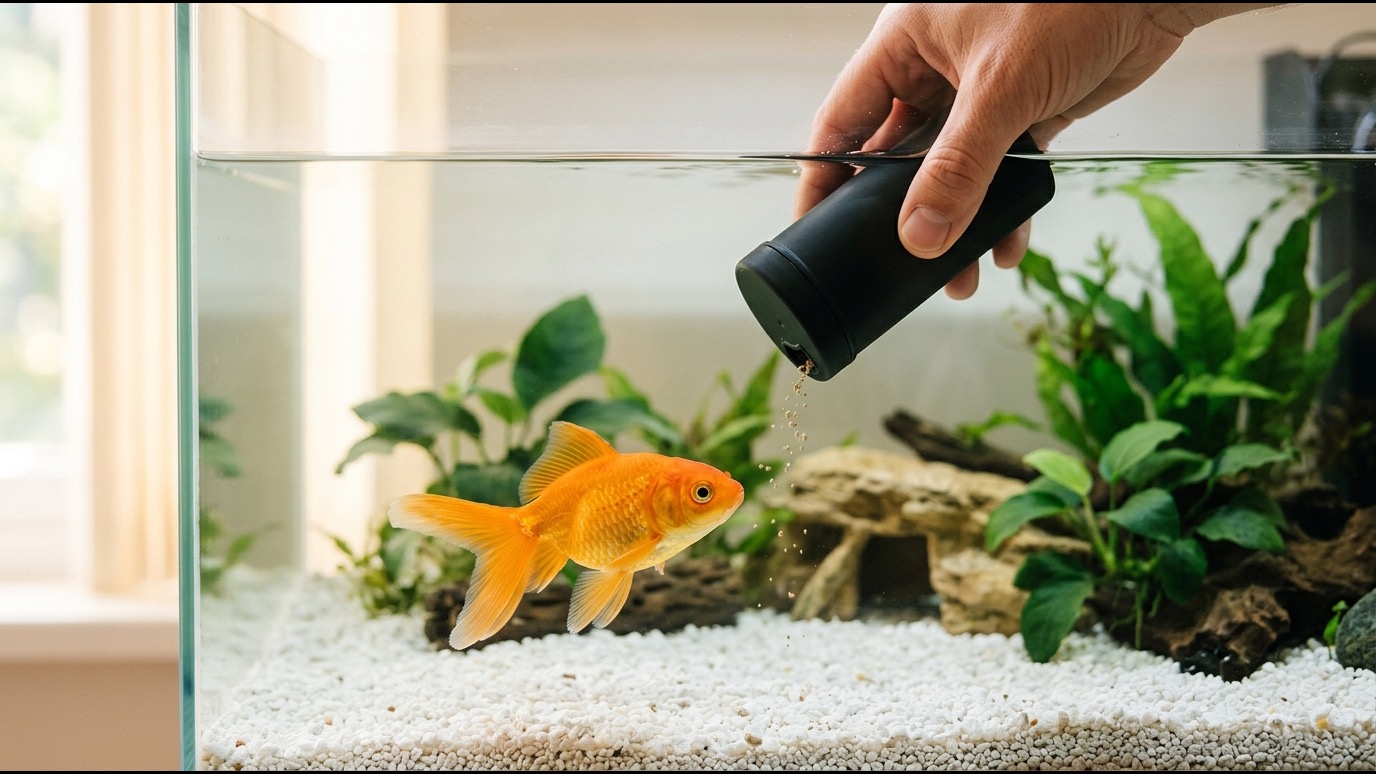
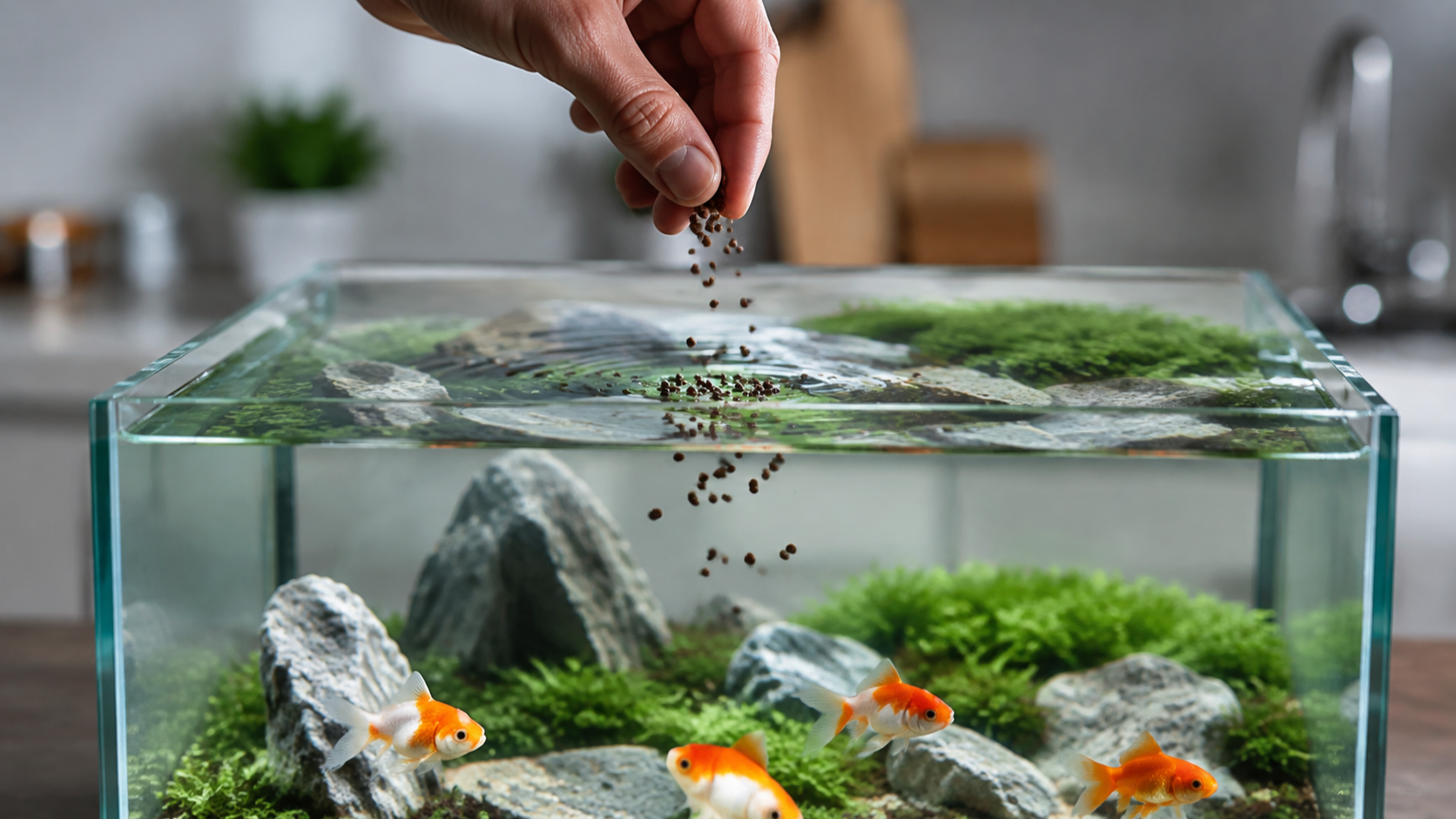
Feed small amounts two to four times a day, then remove every leftover piece.
Hikari’s Goldfish Staple page says to feed 2 to 4 times daily and to offer only what the pet will eat within a few minutes. Always remove uneaten food after that window.
Hikari’s Sinking Goldfish Excel page says to feed up to 4 times daily and not exceed what the fish will eat in a few minutes. More frequent, smaller feedings are best.
Use that as a clock, not a scoop size:
- Offer a small pinch, then watch.
- Stop when the fish slow down, even if food remains.
- Lift leftovers after a few minutes.
- Repeat 2 to 4 times in a day if the fish stay active.
Both Hikari pages add a temperature brake. Below 50°F (10°C) or above 86°F (30°C), they warn against over-feeding. Excel’s page says to cut the amount if activity drops at those marks.
BioKIDS lists a typical captive pH range of 6.5 to 8.5 and survival from freezing to 30 degrees Celsius. Those are water facts, not feeding doses.
A cold or heat-stressed fish will not process a full summer ration, so cut the meal when the fish stop hunting.
Oregon Sea Grant says a balanced diet supports health and longevity, and that overfeeding leads to obesity and other health problems. BioKIDS says a goldfish tank is hard to keep clean, and extra food becomes extra waste.
Hikari Goldfish Staple retail packs start at 30 grams, and that small bag can still overfeed one tank.
Never-feeds and leftover human food
Skip unlabeled human leftovers, because they are not formulated or labeled as goldfish food.
The never-feed list is short on purpose, and we only exclude what our sources support.
The FDA’s pet-food page cites the Federal Food, Drug, and Cosmetic Act. Animal foods must be safe, sanitary, free of harmful substances, and truthfully labeled. FDA rules also require product identity, net quantity, maker name and place, and an ingredient list by weight.
Bread, crackers, chips, and last night’s dinner fail that test. They are not labeled as goldfish food and have no goldfish guaranteed analysis.
Keep this never-feed list:
- Bread, crackers, cereal, and other table starch.
- Leftover meat, dairy, or seasoned dinner scraps.
- Any bag labeled only for dogs, cats, or tropical carnivores.
- Moldy, damp, or unmarked dry food.
- Food left in the tank after the meal window.
The FDA page notes that many state labeling rules follow an AAFCO model. That note is a labeling model, not a goldfish nutrient profile.
Hikari’s feeding notes already treat leftover pellets as a problem, so remove them and do not add more food on top of yesterday’s waste.
If a food is not on a goldfish maker page we read, it stays off this menu. The same rule applies to foods missing from the BioKIDS and Oregon Sea Grant diet lists.
Fancy goldfish and color-linked diet notes
Fancy body shapes still eat the same omnivore mix; pellet form may change.
Oregon Sea Grant names comet, fantail, oranda, and ryukin as common varieties. BioKIDS says there are over a hundred varieties. The diet type does not flip with the tail.
Hikari’s size guide lists a Lionhead pellet at 2.0 to 2.3 millimeters, with a length of 2.5 to 2.8 millimeters. It lists an Oranda Gold pellet at 2.5 to 2.8 millimeters, and those are still goldfish foods.
Hikari’s Sinking Goldfish Excel page is a sinking food, and Hikari’s Goldfish Staple page is a floating baby pellet. A fish that struggles at the surface can use a sinking goldfish pellet.
Color is a separate question from the daily menu. Oregon Sea Grant says rich tank colors often shift to copper or brassy green in wild fish.
Diet can play a role, but pale skin is not always a food miss. If color fades, read why goldfish turn white before you change bags.
Oregon Sea Grant says some goldfish reach 10 years or more in well-kept aquaria. BioKIDS says 10 years is a more likely aquarium average, with 25 years as a pond maximum and one report of 43 years.
FAQ
These answers stay inside the same maker pages and university lists used above.
Can goldfish live on flakes alone?
BioKIDS says captive goldfish are commonly fed dried flake or pellet food. A goldfish-labeled flake can serve as a staple if the fish eat it before it dissolves. Both university pages still describe an omnivore, so keep plants and invertebrates on the treat list.
How many times a day should I feed a goldfish?
Hikari’s Goldfish Staple page says 2 to 4 times daily, in an amount eaten within a few minutes. Hikari’s Sinking Goldfish Excel page says up to 4 times daily, with smaller feedings preferred. Use the low end on cool, quiet days.
Are peas a meal or a treat?
BioKIDS lists boiled peas as a vegetation supplement, not as the only food. Keep peas on the treat side of the Staple-Treat-Never split. Boil them, remove the skins, and offer a few pieces.
Do goldfish need live worms?
Goldfish do not need live worms on the pages we read. BioKIDS lists freeze-dried Tubifex, mosquito larva, bloodworms, daphnia, and brine shrimp as good supplements. Oregon Sea Grant lists small invertebrates in the wild diet, and freeze-dried forms cover that slot.
What should I never feed a goldfish?
Never feed bread, crackers, or leftover human dinner, because those items are not labeled as animal food for goldfish. The FDA’s pet-food page requires animal foods to be truthfully labeled, with ingredients listed by weight. Also skip bags meant for dogs, cats, or tropical carnivores.
Can I use tropical fish food in a pinch?
Do not make tropical food the plan. The FDA page requires truthful labeling and an ingredient list by weight, and a tropical carnivore bag is labeled for a different animal. Buy a goldfish-labeled staple before the current bag runs out.
Why did my goldfish go pale after I changed food?
Color can shift for many reasons, and a new bag is only one possible cause. Oregon Sea Grant notes that tank colors often dull toward copper or brassy green in wild fish. Check the fade pattern on why goldfish turn white before you blame the menu.