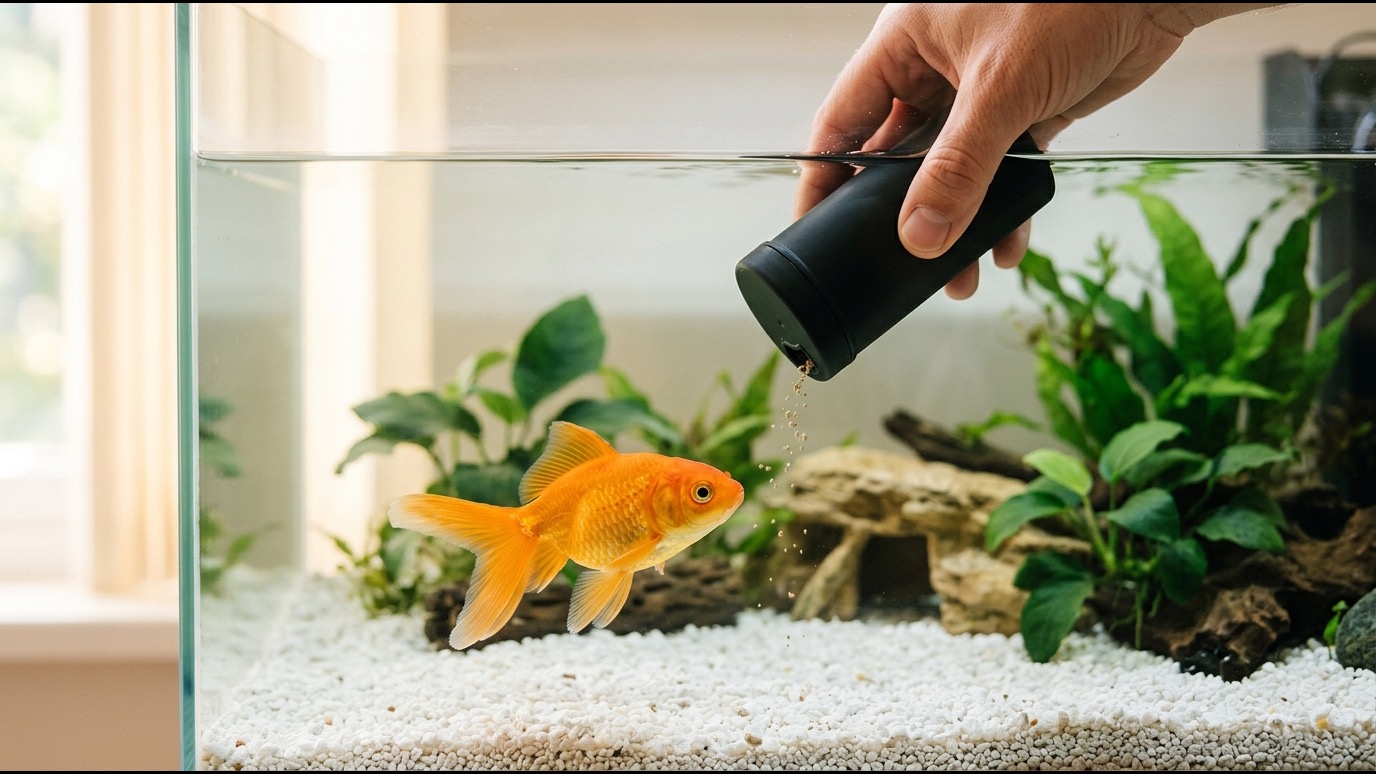
Quick answer: Test ammonia first. If the kit reads above 0 ppm, change water and keep testing until it reads zero. Black patches that appear after a spike are healing skin, not a new goldfish type.
New black patches plus any ammonia reading above 0 ppm mean the fish is healing a chemical burn. This page is a research brief that compares published tank-test rules with published water-quality numbers.
How we chose what this page covers
A cause stays on this page only if a keeper can sort it with a liquid ammonia test and a one-day watch.
That selection rule is the Waterpuppy 0-ppm Gate, and it decides what we keep.
Our research team analyzed six published pages for this brief: API Fishcare’s ammonia kit page, Aqueon’s goldfish care guide, and Seachem’s Prime page. We also read the EPA CADDIS ammonia page, the August 22, 2013 Federal Register notice, and one USGS black-spot paper page.
We left out show-bench color standards, microscope diagnoses, and full pond-fluke life cycles as the main story. Those cases need tools most living rooms do not have, and they do not change the first test.
Test ammonia before you name the color
Any reading above 0 ppm on a liquid kit is the first cause to treat.
API Fishcare’s ammonia kit page says fish release ammonia from gills, urine, and solid waste. Uneaten food and decaying matter add more ammonia to the same water.
The same page calls ammonia the number one killer of freshwater fish, because small amounts stress fish and large amounts kill them.
API’s page says the kit reads ammonia from 0 to 8 ppm. In a new tank, use it several times a week for 4 to 6 weeks. After that, use it weekly, or any time a problem shows.
API’s instructions put the test in a short list.
- Fill a clean tube with 5 mL of tank water.
- Add 8 drops from bottle 1.
- Add 8 drops from bottle 2.
- Cap the tube and shake it hard for 5 seconds.
- Wait 5 minutes, then match the color to the card.
- Do not pour the used sample back into the tank.
Treat any color above the 0 ppm chip as a live problem, and change water without waiting for a darker chip.
The EPA’s August 22, 2013 Federal Register notice is a stream rule, not a home-tank rule. At pH 7.0 and 20°C, the acute one-hour number is 17 mg/L total ammonia nitrogen. The chronic 30-day number is 1.9 mg/L.
At pH 7, that chronic range runs from 0.99 mg/L at 30°C to 4.4 mg/L at 0°C. Those numbers protect wild water bodies, not one goldfish in a closed box.
The Waterpuppy 0-ppm Gate keeps the home target at API’s 0 ppm line. A closed tank has no flow to dilute waste, and a stream does.
Compare API liquid ammonia test kits on Amazon →
What black patches mean after a spike
New black patches after a spike are healing skin, and the fish still needs clean water.
The EPA CADDIS ammonia page says unionized ammonia moves across gill membranes. The ionized form does not pass as easily, so pH changes the risk.
The same EPA page says toxicity rises as pH rises. Temperature also changes how hard total ammonia hits aquatic life.
EPA’s effect list for high ammonia in fish is concrete.
- Faster breathing and weaker oxygen use.
- Jumpy or off-balance swimming.
- Extra mucus and gill-tissue change.
- Slower growth, and in hard cases, mass death.
Black color after that insult is not a new variety. It is damaged skin laying down dark pigment while it heals.
The fish can still crash if ammonia stays up, so the dark patch is a record of harm rather than a clean bill. Those signs sit with ammonia on EPA’s list, and they can sit with other water faults too. The liquid ammonia test still goes first on every case.
The opposite fade, a goldfish going pale, uses the same pigment cells, and we cover it in why goldfish turn white.
When black color is genetics, not a burn
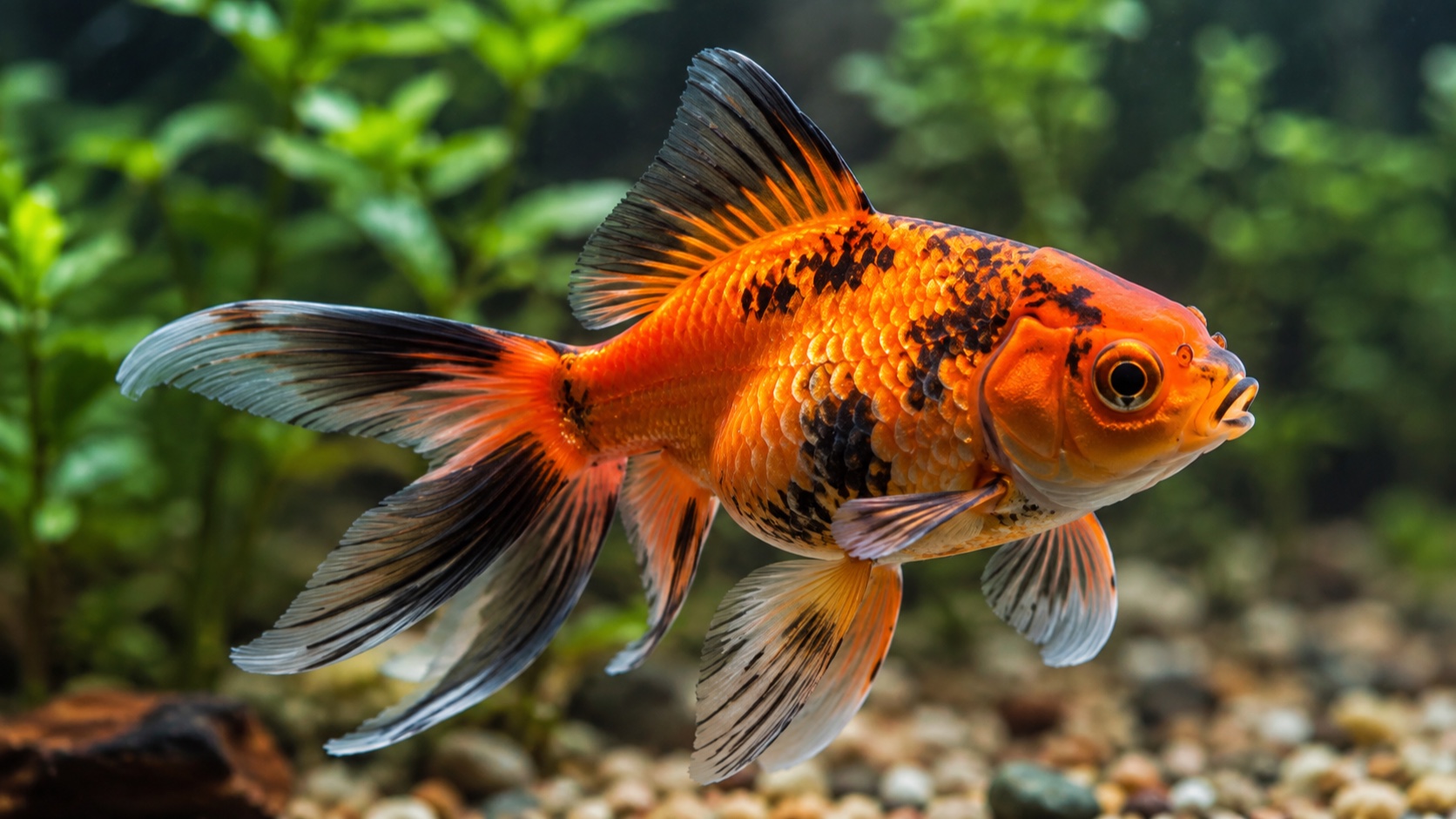
Slow darkening with a 0 ppm reading is usually genetics, not a burn.
Aqueon’s Goldfish Care Guide says all common fancy types are one species. Commons, comets, shubunkins, orandas, ryukins, and moors sit on that same list.
Aqueon says people have kept goldfish for over 1,000 years, and with proper care they can live over 20 years.
A young feeder-type fish can throw black wash as it grows over weeks or months. The fish still eats, and the ammonia card stays on 0 ppm.
A black moor is already a dark fish, so more black on that body is often the planned color, not a burn.
Use this three-row sort as an attribute grid, not a rank list.
| What you see | How fast it showed | Liquid ammonia test | Usual reading |
|---|---|---|---|
| Patchy black on body or fins | Hours to a few days | Above 0 ppm | Healing burn |
| Slow dark wash as the fish grows | Weeks to months | 0 ppm | Genetics |
| Tiny pin dots on a pond fish | Slow, many small dots | 0 ppm | Encysted parasite |
If the test is 0 ppm and the fish is bright and eating, do not chase a burn protocol. Keep the weekly test, and keep the water-change clock.
Tank size and water-change clocks that keep ammonia at zero
Aqueon’s published gallons and change clocks are the main way to hold that reading at zero.
Aqueon’s care guide says goldfish should never live in bowls, small tanks, or any unfiltered box. They grow large and make a lot of waste.
Aqueon splits adult space by body type on that same page.
- Give each adult common, comet, or shubunkin at least 20 gallons.
- Give each adult fancy goldfish at least 10 gallons.
- Size the filter a bit large for the waste load.
Those gallons are Aqueon’s published floor, not a contest ranking. A tight tank fails the 0 ppm gate first.
Aqueon’s water clock is also a number, not a guess.
- Change 10% of the water each week, or
- Change 25% every 2 weeks.
- Treat new tap water before it goes in. Aqueon names Aqueon Water Conditioner on that page.
Temperature and pH sit on the same care guide.
- Fancy goldfish: 68°F to 74°F.
- Comets and shubunkins: 60°F to 70°F.
- Ideal pH band: 7.0 to 8.4.
- Fast swings in heat or chemistry can kill.
The EPA CADDIS page matches the pH warning in a different way. Higher pH shifts more ammonia into the unionized form, and that form crosses gills.
Aqueon’s feed clock cuts the waste that becomes ammonia.
- Feed only what the fish finish in 2 to 3 minutes.
- Feed once or twice a day.
Leftover food is an ammonia source on API’s page, so a short meal is a water-quality tool.
What to do in the first 24 hours
The first day is water, conditioner, and retests, not a medicine hunt.
Do the first-day jobs in this order, and write down each reading.
- Run the API liquid ammonia test and write the ppm.
- If the card is above 0 ppm, siphon out dirty water and leftover food.
- Use Aqueon’s 10% weekly clock for a small swap. Go larger only if the reading is high and treated water is ready.
- Dose Seachem Prime on the new water, or on the whole tank if you add water by hose.
- Retest the same day, then again the next morning.
Seachem’s Prime page sets the dose in milliliters, not guesses.
- Use 1 capful, which is 5 mL, for each 50 U.S. gallons of new water.
- Each cap thread is about 1 mL.
- If you dose the tank itself, base the amount on full tank volume.
- A sulfur smell is normal on that page.
Seachem’s FAQ adds an emergency gate when ammonia or nitrite climbs.
- If ammonia or nitrite is above 2 ppm, the page allows up to 5 times the normal dose.
- Prime can be dosed every 24 to 48 hours.
- The bind holds those compounds for up to 48 hours.
- If the water is above 86°F and chlorine or ammonia is low, use a half dose.
API’s kit tops out at 8 ppm, so a 2 ppm reading is already well above the home 0 ppm gate.
Prime binds ammonia, and it does not replace a water change. Seachem’s page says the bound waste is still there for filter bacteria.
Keep the filter running, and do not wash the media in tap water. That rinse can wipe the bacteria that eat ammonia.
If the fish stops eating and cannot stay upright, stop guessing at home. Take a fresh water sample and the fish to a clinician who treats fish.
When tiny black dots are not a burn
Tiny pin dots on pond fish can be encysted parasites, and that case is rare indoors.
The USGS page on Uvulifer in Wyoming fish calls black spot a common wild-fish syndrome. Staff sampled Muddy Creek in 2003 or 2004.
Every species in that set had at least some fish with gross signs. Bluehead suckers and flannelmouth suckers had 100% infection.
The same USGS page says suckers carried more cysts than the chubs. Chubs are cyprinids, and goldfish are cyprinids too.
That paper is a creek study, not a bowl study, so it sets a limit rather than a home diagnosis.
Indoor tanks rarely host the snail-and-bird loop those worms need. Smeared new patches plus a high ammonia card stay a burn case first.
Use a parasite cause only after three checks.
- The ammonia card reads 0 ppm.
- The marks are many tiny dots, not smears.
- The fish lives with snails, outdoor water, or wild birds.
If those three fail, stay on the 0-ppm Gate. Change water, retest, and do not start a pond-parasite plan over a new-tank spike.
FAQ
These questions cover the checks keepers ask after they already have an ammonia reading.
Is a goldfish turning black dying?
Color alone does not answer that, and API’s page says any ammonia above 0 ppm can harm fish. A fish that still eats while patches darken is often healing, but a gasping fish needs water work now.
Can the black patches go away?
Some healing patches fade over weeks once the card stays at 0 ppm, while genetic darkening usually stays. Aqueon’s care guide does not give a fade clock, so treat fade as a hope, not a promise.
Why did only the fins turn black?
Fins are thin and meet the water on both sides. EPA’s CADDIS page flags gill and tissue harm from unionized ammonia, and fin edges often show the same burn first. Test the water before you blame a fin-only disease.
Does a black moor turning blacker count as a burn?
Not if the ammonia card is 0 ppm and the change is slow. Aqueon lists moors with the other fancy types as one species. Fast new smears plus a reading above 0 ppm still follow the burn path.
How often should I retest after a water change?
API’s page says to test several times a week for 4 to 6 weeks in a new tank, then weekly. After a spike, add a same-day test and a next-morning test. Seachem’s page says Prime can be redosed every 24 to 48 hours if the waste is still there.
Is black spot disease the usual reason indoor goldfish turn black?
No, the USGS Wyoming page found 100% infection in two wild sucker species in one creek, and that is a snail-and-bird cycle. A glass tank with a high ammonia card is still a chemistry case.
My goldfish went pale, then grew black patches. Which page applies?
Pale-first cases often start as stress or pigment loss. New black smears after that still need an ammonia test. Use this page for the dark patches, and use our brief on why goldfish turn white for the fade.