Quick answer: Choose nerite snails when you want algae grazing without a baby boom. Choose mystery snails when you want a larger scavenger in a lidded tank. Skip apple snails.
Nerite snails are the fish-tank pick for algae; mystery snails fit a 5-gallon scavenger role.
This page is a desk comparison of four current U.S. listings and one U.S. Geological Survey fact sheet.
Which snails this page covers, and which it leaves out
A snail listing enters this page only if a U.S. seller publishes adult size, a temperature band, and a freshwater breeding outcome.
That is our Published-Spec Rule, so assassin snails, trumpet snails, and any Pomacea sold as apple snails stay out. Our research team compared four Aquatic Arts product pages plus Aquarium Co-Op’s mystery-snail care guide.
We used those published numbers only and skipped hobby-forum stocking ratios. The four listings are Aquatic Arts Midnight Black Nerite Snail, the Nerite Snail Combo Pack (Tiger plus Zebra), Golden Mystery Snails, and Assorted Ramshorn Snails.
Algae work versus leftover-food work
Nerites are the glass-and-hardscape grazers on this page, while mystery snails and ramshorns take more leftover food.
Aquatic Arts’ Midnight Black Nerite Snail page calls that species an effective algae eater in a mature tank. The Combo Pack page says Tiger and Zebra nerites clean algae off glass, plants, and décor. It also says they do not eat plants.
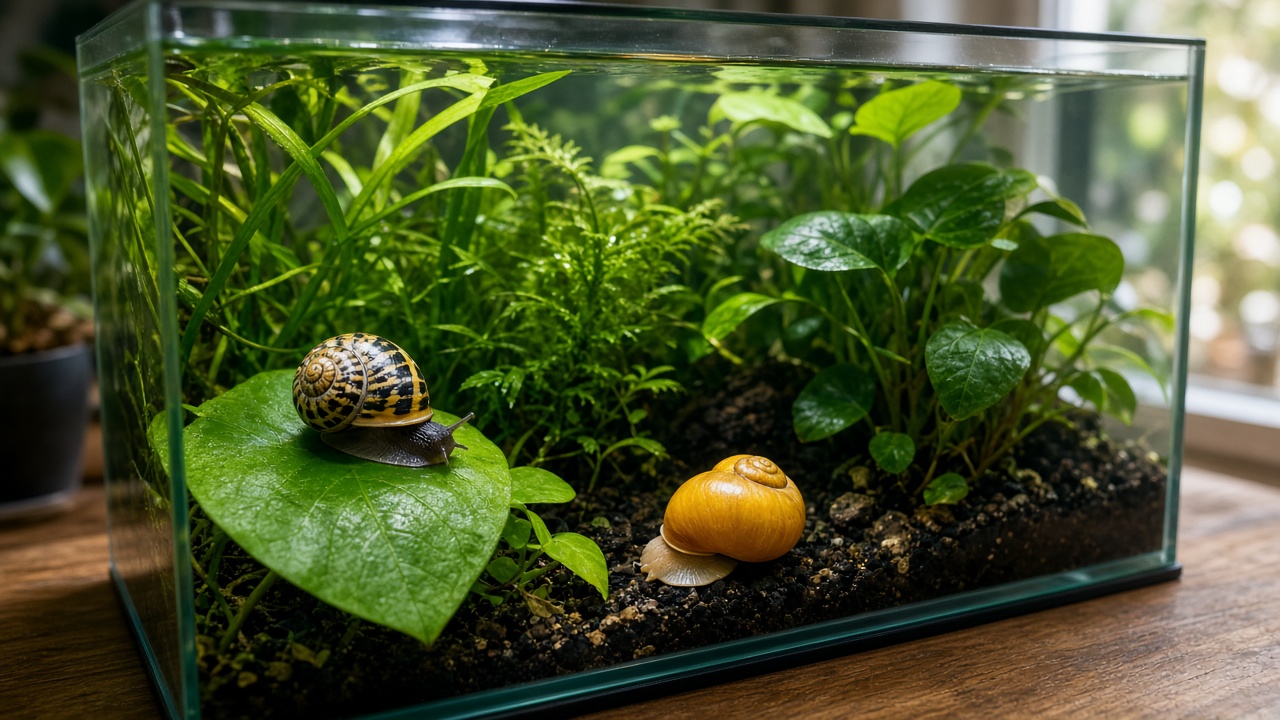
Mystery snails sit in a different job. Aquarium Co-Op’s mystery-snail care guide calls them scavengers of leftover fish food, dead animals, and dead leaves. It also notes many keepers find them less focused on algae than nerites.
Aquatic Arts’ Golden Mystery Snails page still lists algae, hair algae, and substrate cleanup. Treat that listing as a scavenger that also grazes.
Ramshorns sit closer to leftover food. Aquatic Arts’ Assorted Ramshorn Snails page says they eat algae, waste, and leftover pellets or fish food, so extra fish food feeds a ramshorn boom.
Buy against that split:
- Want glass film and hair algae, few babies: start with a nerite listing.
- Want a large, visible scavenger: start with Golden Mystery Snails.
- Want a small cleaner and accept babies: start with Assorted Ramshorn Snails.
Breeding: eggs that hatch, eggs that do not
Freshwater hatching is the one breeding fact that changes which snail you should buy.
Aquatic Arts’ Midnight Black Nerite Snail page states the fry need brackish or marine water. It also says the species will not proliferate in a freshwater tank.
The Nerite Snail Combo Pack page says those nerites need salt water to reproduce, so they will not overpopulate a freshwater tank. You may still see white nerite eggs on glass, but those two listings say they do not finish in freshwater.
Mystery snails do hatch in a home tank if you leave them air space. Aquarium Co-Op’s guide says they will not reproduce under water, because females lay eggs above the water line.
Use Aquarium Co-Op’s lid numbers as a yes-or-no lever:
- To block clutches, keep the water line within 1.5 inches (4 cm) of the top.
- To invite clutches, drop the water line at least 3–4 inches (8–10 cm).
- Remove any clutch on the lid before it hatches.
Aquarium Co-Op also publishes clutch size. Younger females may lay 50–100 eggs, and bigger females can lay hundreds.
Hatch time is 1–4 weeks, depending on temperature. Buy one mystery snail if you want zero pairing, because Aquarium Co-Op says each snail has a single sex and cannot change sex.
Ramshorns are the opposite bet. Aquatic Arts’ Assorted Ramshorn Snails page says they reproduce very quickly, and population tracks leftover food.
Cut feeding if the colony climbs, and see our ramshorn snail care guide for daily habits.
Tank size and water numbers from seller pages
Seller pages do not share one gallon rule, so keep each number next to its maker.
Our research team lined up the four listings. Published adult size starts at 1.2 inches on the Midnight Black Nerite page. Golden Mystery Snails list 2.5–3+ inches.
Use the maker’s own tank and water band:
- Midnight Black Nerite Snail: 5-gallon minimum; 71.6°–87.8°F; pH 6.5–8.0; KH 2–12 dKH.
- Nerite Snail Combo Pack: 2 gallons per snail; 65°–85°F; pH 6.5–8.0; KH 5–12 dKH.
- Golden Mystery Snails: 2.5 gallons per snail; 68°–84°F; pH 7.6–8.4; KH 2–15 dKH.
- Assorted Ramshorn Snails: no gallon minimum listed; 60°–80°F; pH 7.0 and up.
Aquarium Co-Op’s mystery-snail guide is tighter than the Golden Mystery listing. It lists 70–78°F, pH of at least 7.2, and GH above 150 ppm (or 8 degrees).
It also says one or two mystery snails can live in a 5-gallon tank with a tight lid. That 5-gallon note and Aquatic Arts’ 2.5-gallons-per-snail note can both be true.
One snail in 5 gallons meets both floors, and four snails in 5 gallons meet neither.
Aquarium Co-Op lists mystery snails around 2 inches (5 cm), while Aquatic Arts lists Golden Mystery adults at 2.5–3+ inches. Assorted Ramshorn Snails ship at 1/4–1 inch, and that page says Planorbarius corneus often reaches about 1–1.5 inches.
Shell minerals matter more than décor color. Aquarium Co-Op says mystery snails cannot live in soft water, and pits or divots on the shell are the check.
Aquatic Arts’ Midnight Black Nerite page says lifespan is generally longer in alkaline water over 7.0 pH. A stable heater helps you stay inside those bands; see our filter and heater in one guide.
Four current listings compared by published specs
This table is an attribute grid, not a ranking. Each cell comes from that product’s maker page, except the mystery-snail hatch note.
| Product | Adult size (maker) | Min tank (maker) | Temperature (maker) | Freshwater hatch |
|---|---|---|---|---|
| Aquatic Arts Midnight Black Nerite Snail | 1.2 inches (3 cm) | 5 gallons | 71.6°–87.8°F | No; fry need brackish or marine water |
| Aquatic Arts Nerite Snail Combo Pack (Tiger + Zebra) | 1–1.5 inches (2.5–3.8 cm) | 2 gallons per snail | 65°–85°F | No; maker says salt water is required |
| Aquatic Arts Golden Mystery Snails | 2.5–3+ inches (5–7.6+ cm) | 2.5 gallons per snail | 68°–84°F | Yes, above water; Aquarium Co-Op lists 50–100 eggs on young females |
| Aquatic Arts Assorted Ramshorn Snails | About 1–1.5 inches; sold at 1/4–1 inch | Not listed | 60°–80°F | Yes; maker says they reproduce very quickly |
Purchase size is smaller than adult size. Aquatic Arts lists Midnight Black Nerites and the Combo Pack at 0.5–1 inch on arrival. Golden Mystery Snails arrive at 0.25–1.5 inches.
A well-fed young mystery snail can double in weeks to months, per Aquatic Arts. Use the adult gallon number on day one.
Lifespan is not listed on every page. Aquarium Co-Op gives mystery snails 1–2 years, and Aquatic Arts gives the Midnight Black Nerite “upwards of 4 years.”
Two legal notes sit on the Aquatic Arts pages we read. The maker cannot ship these invertebrates to Maine, and the Golden Mystery Snails page states mystery snails are illegal to own or possess in Georgia.
Apple snails, copper, and other hard stops
Do not buy a channeled apple snail for a home fish tank.
The U.S. Geological Survey’s channeled applesnail fact sheet describes Pomacea canaliculata as a large freshwater snail about 100 mm tall. That is about 4 inches, not the 2-inch mystery snail on Aquarium Co-Op’s page.
The same USGS fact sheet lists 3–4 shell whorls and bright pink egg clutches that can number over 200. Females can store viable sperm for up to 140 days.
USGS also names aquarium use as one pathway that moved this species. It is established in parts of the western United States and Hawaii.
Aquatic Arts’ Golden Mystery Snails page says those mystery snails are not apple snails, even though the shells can look similar. It also says apple snails are illegal to own in the United States.
If a seller uses “golden apple snail” as the trade name, walk away. USGS lists “golden applesnail” as another name for P. canaliculata.
Copper is the other hard stop for every listing we used. Aquatic Arts repeats copper sensitivity on the Combo Pack, Golden Mystery, and Assorted Ramshorn pages. Aquarium Co-Op says to remove mystery snails before salt or copper-based treatments.
Other tank-mate stops from Aquarium Co-Op:
- No puffers, certain loaches, or turtles.
- Avoid fish that nip long antennae.
Mystery snails can uproot new plants in loose substrate. Aquarium Co-Op records duckweed as the main healthy-plant exception.
Adding snails after the tank has cycled
Add snails only after the tank has finished its nitrogen cycle.
A new tank still swings in ammonia and nitrite, and snails add waste even though they eat leftover film. Wait until the cycle is done. Our how long to cycle a fish tank guide covers that window.
Nerites also need food that is already growing. Aquatic Arts’ Midnight Black Nerite page says the snail needs little extra food in a tank that already has algae or biofilm. A bare new tank can leave it short.
A simple add-in order:
- Confirm the cycle is done and the lid fits.
- Match temperature and pH to the listing you bought.
- Float the bag, then add tank water slowly.
- Keep copper medications out of the water.
- Offer blanched zucchini, kale, spinach, or cucumber if the glass is clean.
Those vegetables appear on both nerite listings and the Golden Mystery page, so remove leftovers the next day.
If a mystery snail sits still, wait before you discard it. Aquarium Co-Op says to pick it up after 24–48 hours with no movement, and an overpowering stench means it has died.
FAQ
How many snails can I put in a 10-gallon tank?
Use the maker’s gallon line, not a blended hobby ratio. Aquatic Arts’ Combo Pack lists 2 gallons per nerite, so five Combo Pack snails would meet that floor in 10 gallons. Golden Mystery Snails list 2.5 gallons per snail, so four adults would meet that floor.
Do nerite snails breed in a freshwater fish tank?
No, not to a hatching finish, on the two nerite pages we used. Aquatic Arts’ Midnight Black Nerite page says fry need brackish or marine water. The Combo Pack page says the snails require salt water to reproduce. You can still get white eggs on glass.
Will mystery snails eat my live plants?
Aquarium Co-Op says they usually nibble melted or sick leaves, not healthy plants, and names duckweed as the main exception. Aquatic Arts’ Golden Mystery page states they are safe with plants. Watch new plants in loose sand, because a large foot can uproot them.
What tank size does one mystery snail need?
Aquatic Arts lists 2.5 gallons per Golden Mystery Snail. Aquarium Co-Op says one or two mystery snails can live in a 5-gallon tank with a tight lid. A 5-gallon tank with one snail meets both published floors.
Will ramshorn snails take over the tank?
They can, if leftover food stays high. Aquatic Arts’ Assorted Ramshorn Snails page says they reproduce very quickly in almost any conditions. Cut feeding first, and remove extra wafers.
Can I add snails while the tank is still cycling?
Wait, because snails add bioload even when they graze. Aquatic Arts’ Midnight Black Nerite page also prefers a mature tank with algae or biofilm already present. Finish the cycle first, then add the snail.
Why is my mystery snail floating?
Aquarium Co-Op says mystery snails have gills and lungs. Holding air in the lungs makes them float, and releasing the air makes them drop. Check smell only after 24–48 hours with no movement.