Quick answer: Keep one horned nerite in a cycled, lidded tank with visible algae and hard water. Add a small wafer only when the glass looks clean. Skip copper products and skip any plan to hatch the white eggs.
A horned nerite is a 1/4- to 1/2-inch Clithon grazer that cannot hatch young in freshwater.
This page is a spec-comparison care brief from the Waterpuppy research desk.
The Waterpuppy Spec Pass is our selection rule for this article. A product or care scenario enters only if a maker page lists a quoteable number.
That number can be adult size, tank gallons, hardness, protein percent, a dose, or a wafer diameter. We left out brackish hatchery steps, copper treatments, and foods with no published analysis or size.
Our research team analyzed published specs from five maker pages.
What a horned nerite snail is
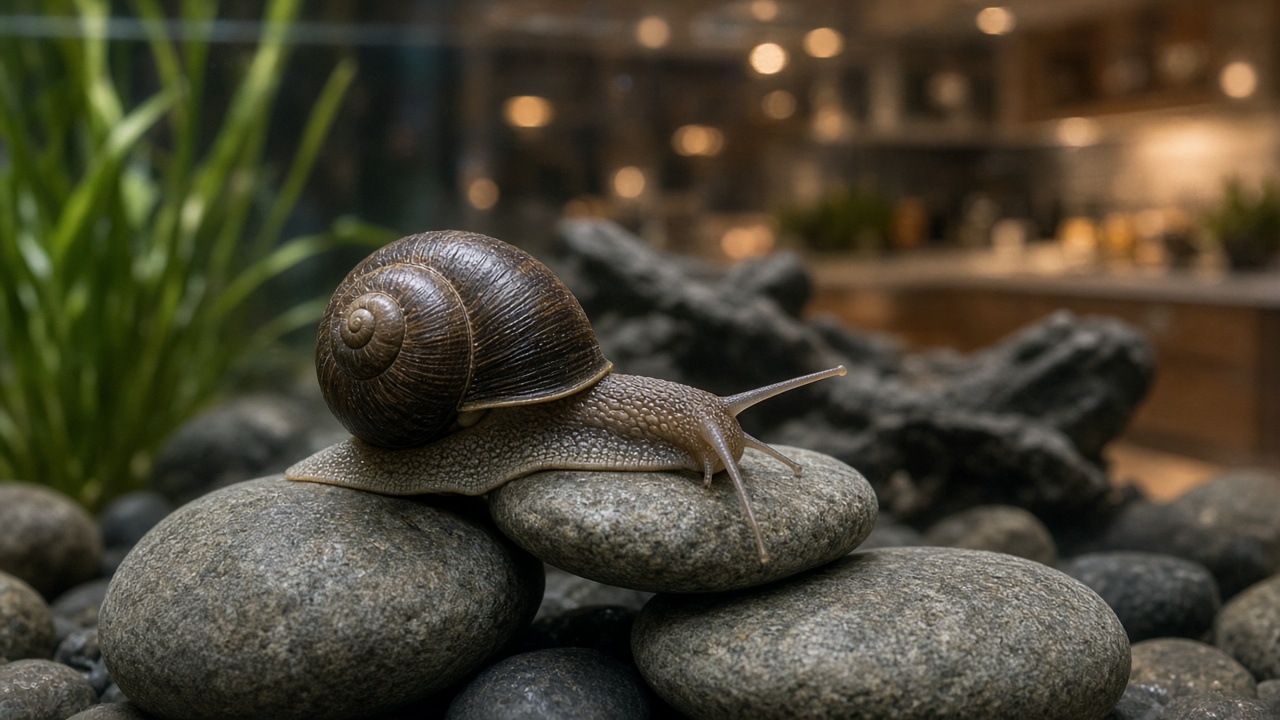
A horned nerite is a tiny, peaceful grazer sold for algae work, not as a breeding pet.
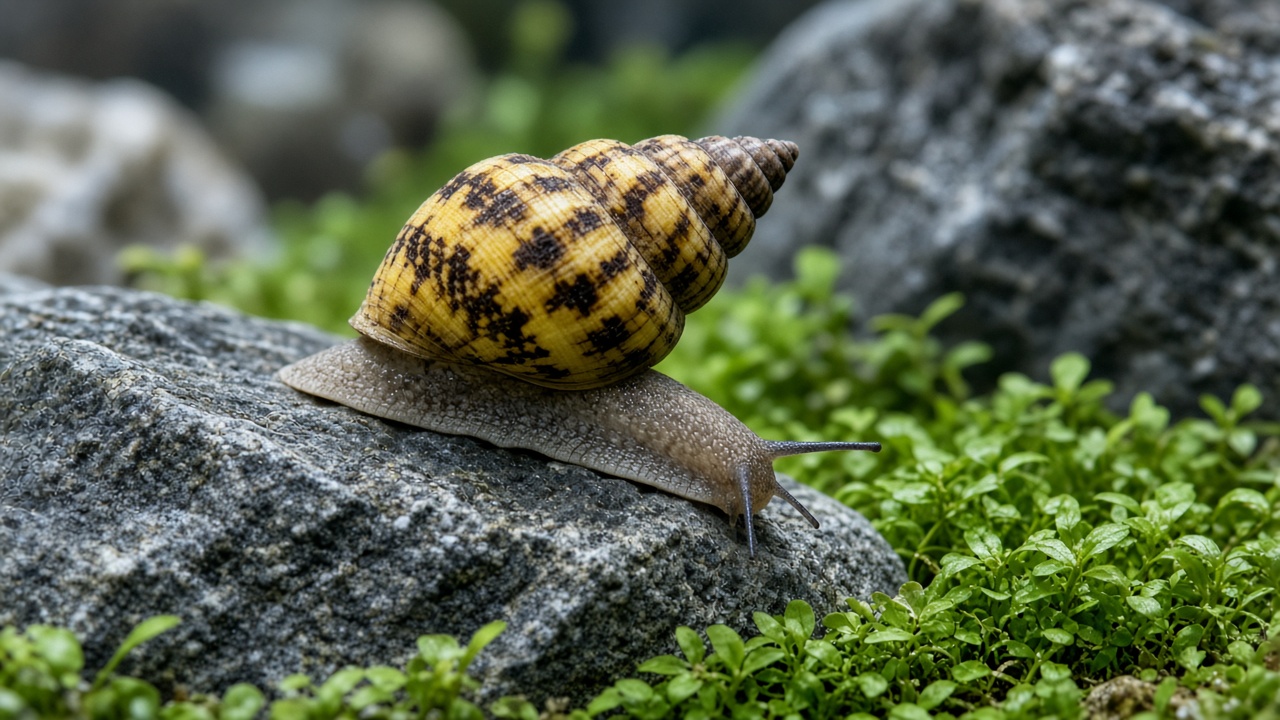
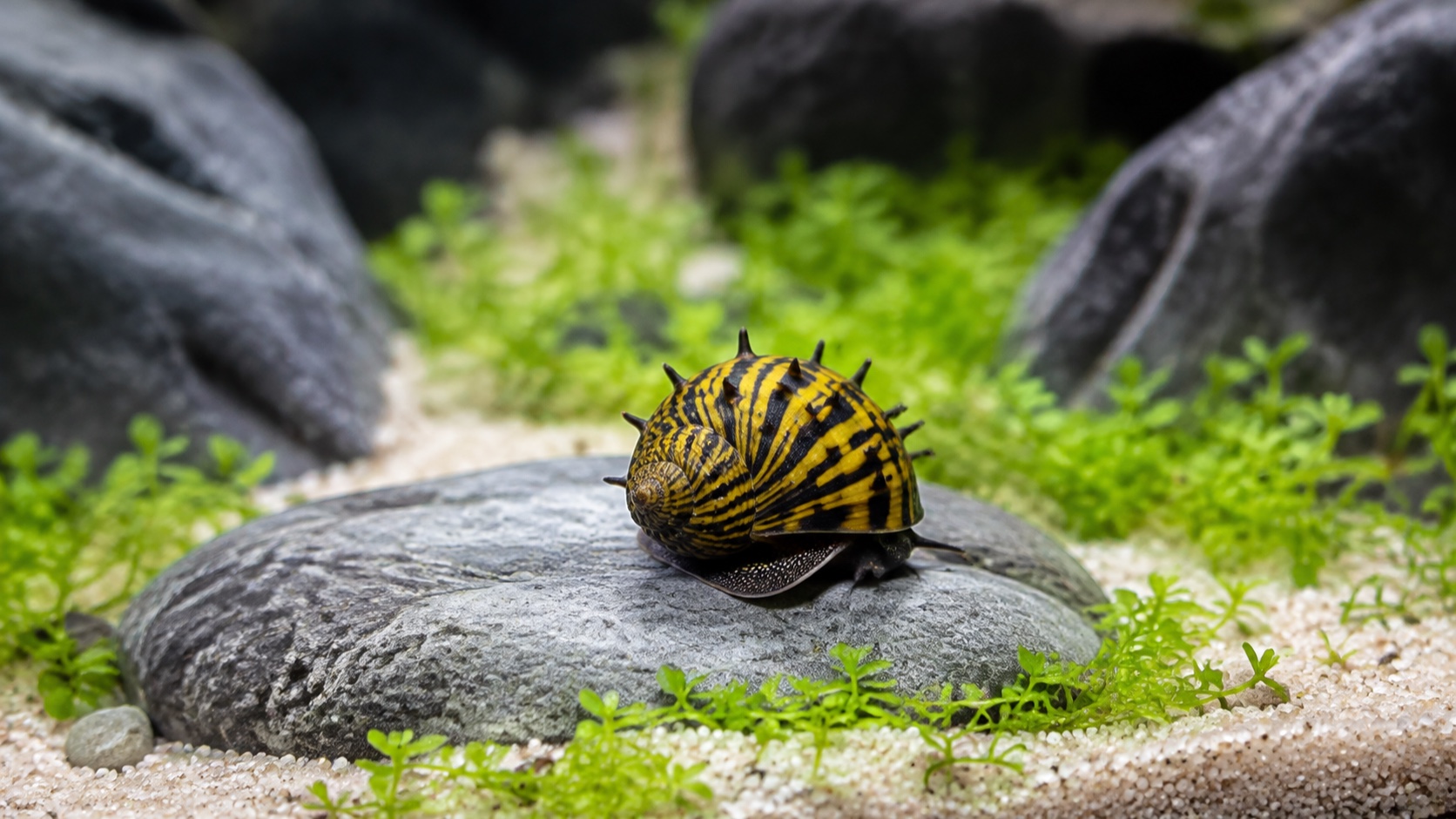
Aquatic Arts’ product page for Zebra Thorn/Horn Nerite Snails lists the animals as Clithon corona/diadema. The shells show a yellow and black spiral plus small front spikes that look like short horns.
Aquatic Arts lists the origin as the Indo-Pacific and calls the snails peaceful and solitary.
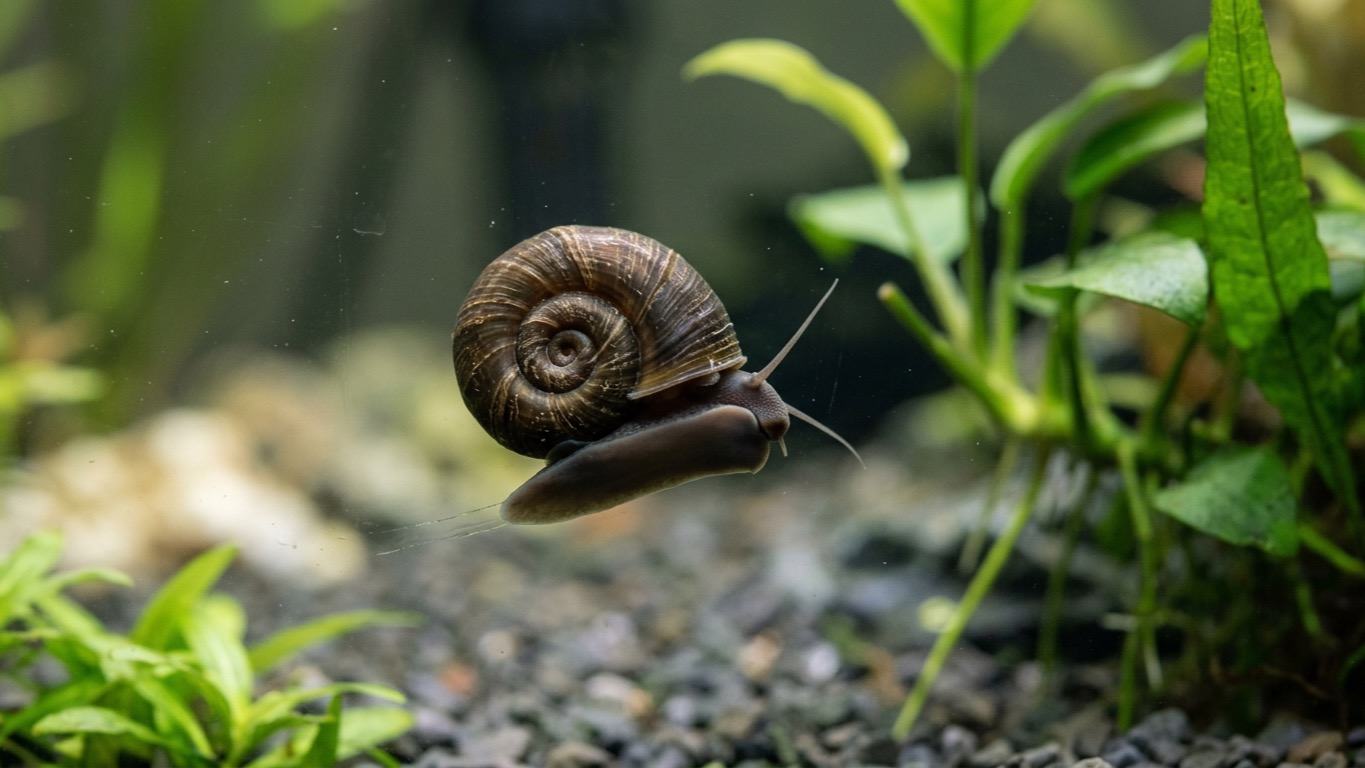
They are not a mystery snail and not a ramshorn. A ramshorn snail can multiply in freshwater, while a horned nerite cannot.
Aquatic Arts states that these nerites require salt water to reproduce. The listing says they will never overpopulate a freshwater aquarium, which is why most keepers pick them.
Size, tank volume, and water numbers
Use the seller’s listed adult size and the 2-gallon-per-snail floor, then match the listed pH and KH band.
Aquatic Arts lists average adult size as 1/4 to 1/2 inch (0.64 to 1.3 cm). Average purchase size is listed as 1/4 inch (0.64 cm), and new arrivals are often pea-sized.
Aquatic Arts lists a minimum tank size of 2 gallons per snail. That figure is a volume floor, not an algae guarantee, because a clean new tank can starve a grazer.
Keep the listed water band if you can measure it.
- Temperature: 65° to 85°F (18° to 29°C), from Aquatic Arts
- pH: 7.4 to 8.2, from Aquatic Arts
- KH: 5 to 12 dKH, from Aquatic Arts
A room that stays inside 65° to 85°F may not need a heater, but a room that drops below 65°F does.
Soft, mineral-poor water is a shell risk. Aquatic Arts says snails need calcium for shell health and warns that copper in tap water is a separate hazard.
Seachem’s Equilibrium page is built for mineral-poor or RO water. Add 16 g (1 tablespoon) per 80 L (20 US gallons) to raise GH by 1 meq/L (3 dH).
Mix that dose in 1 L (1 qt) of water first. Seachem says any haze should clear in 15 to 30 minutes.
Seachem’s guaranteed analysis for Equilibrium lists these amounts per 1 g:
- Soluble potash (K2O): 23.0%
- Calcium (Ca): 8.06%
- Magnesium (Mg): 2.41%
Jar sizes on that page are 300 g, 600 g, and 4 kg. Seachem says the listed dose is based on DI or RO water, and you should not use it when replacing evaporated water.
API’s General & Carbonate Hardness Test Kit page says to test GH and KH weekly. The kit includes GH and KH bottles plus two capped test tubes.
API says low KH can allow rapid pH shifts. If you start from RO water at 0 dH, one Seachem dose raises GH by 3 dH.
Aquatic Arts’ listed KH band starts at 5 dKH. GH and KH are not the same test, so measure both before you add more powder.
Algae they eat and when to add food
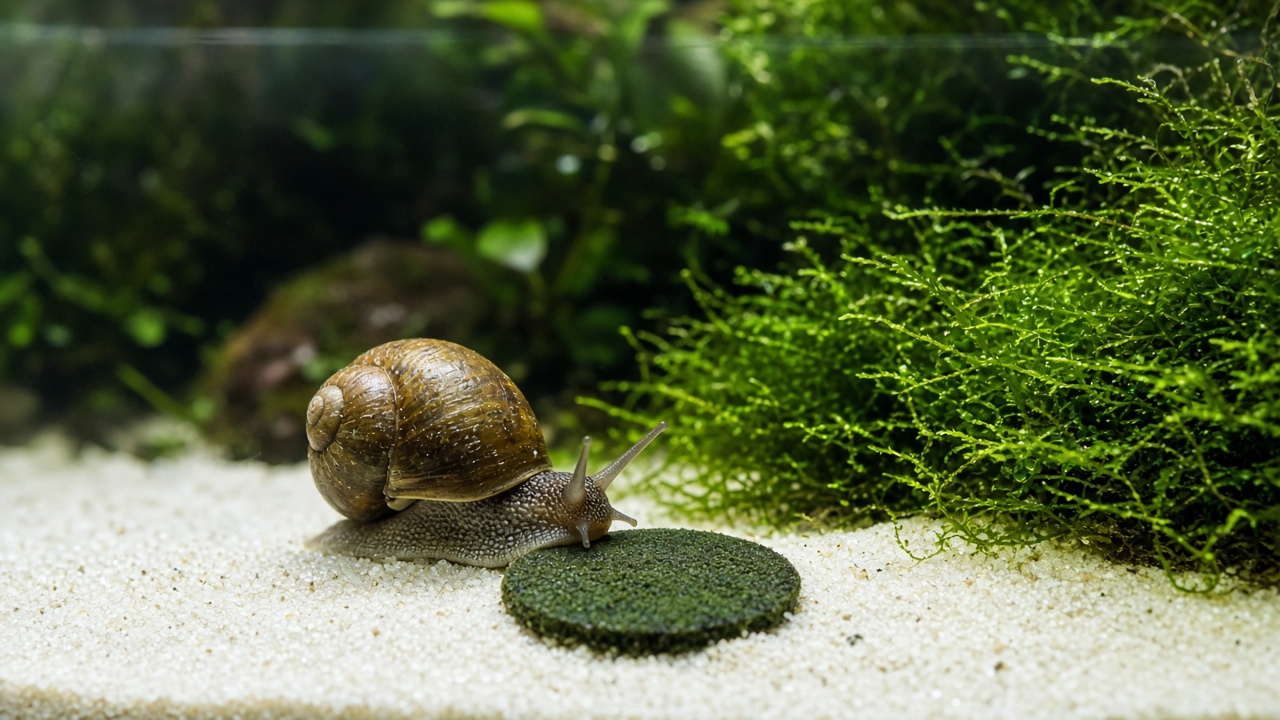
Leave them on an established film first, then add a wafer only after the glass looks too clean to graze.
Aquatic Arts says nerites can subsist on algae if enough is present. The listing says they clean algae off glass, plants, and decorations, and that they eat hair algae.
That work is grazing, not a full tank reset. If brown film keeps returning, see our note on brown algae in a fish tank.
Aquatic Arts says you can add algae wafers or blanched vegetables when algae runs low. It names zucchini, kale, spinach, and cucumber.
Our research team compared three sinking foods that passed the Spec Pass. Two share the same protein and fat numbers, and one lists a diameter.
Hikari’s page for Tropical Mini Algae Wafers lists this analysis:
- Crude protein: min. 33%
- Crude fat: min. 4.0%
- Crude fiber: max. 3.0%
- Phosphorus: min. 0.8%
Hikari lists Mini bags of 0.77 oz (22 g) and 3.0 oz (85 g). The same page says the diet is great for snails and crustaceans.
Feed no more than what animals finish within one hour, then remove leftovers. Hikari’s page for Tropical Algae Wafers lists the same 33% protein and 4.0% fat floor.
Bag sizes on that page are 20 g, 40 g, 82 g, and 250 g. The leftover window is 2 hours, which is twice the Mini window.
Aqueon’s page for Algae Rounds does not list a protein percent. It does list a size: the rounds are approximately 17 mm in diameter.
Aqueon names spirulina and kelp and says to break rounds if needed. The package dimensions are 4.7 in × 1 in × 6.3 in.
Comparing those published specs, only Aqueon of the three foods states a millimeter size. Both Hikari wafers match at 33% protein and 4.0% fat, but only the Mini page names snails.
Aquatic Arts says to avoid any food, medication, or plant fertilizer that contains copper in any form. The listing says copper is toxic to invertebrates, so check the ingredient list first.
White eggs that will not hatch
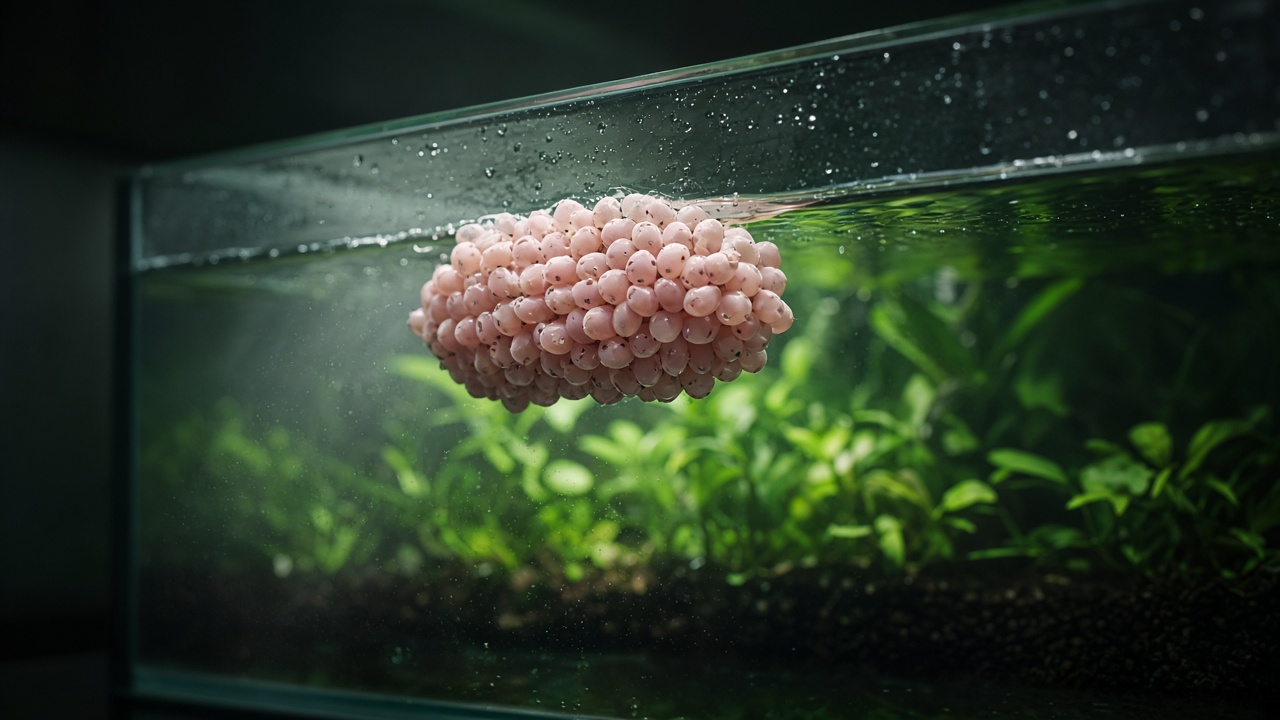
Females can still glue hard white eggs on glass and wood. Those eggs do not become snails in freshwater.
Aquatic Arts states that these nerites require salt water to reproduce. The listing says they will never overpopulate a freshwater tank.
That is a cycle limit, not an egg ban. You may still see small, hard, pale spots on glass, rocks, and wood, and they are a look issue, not a baby boom.
If you want more snails, buy more snails. Do not add salt to a freshwater community just to chase a hatch.
Tank mates that stay peaceful
Pick tank mates that will not eat, nip, or crush a 1/2-inch snail.
Aquatic Arts says these snails are totally safe with any fish, shrimp, or plants. The same page calls them completely peaceful and solitary, and says they will not engage with tank mates.
That “safe with any fish” line is the seller’s claim, and it does not cover every fish mouth. A 1/2-inch snail is snack-sized for a large cichlid or a loach that eats snails.
A small, lidded community is the usual fit, with shrimp, small tetras, and a calm betta.
For the fish side of that pairing, use our best betta fish tank mates guide. Skip tank mates that turn over rock piles, skip snail-eating fish, and skip copper treatments while the snail is in the tank.
Aquatic Arts’ floor is 2 gallons per snail. Extra snails in a spotless tank will sit still and fade.
Products that passed the Spec Pass
We compared five currently sold products whose maker pages list a form plus a number.
The table is an attribute sheet, not a ranking.
| Product | Maker-listed form | Maker-listed number | Maker-stated use |
|---|---|---|---|
| Hikari Tropical Mini Algae Wafers | Sinking disc; 22 g or 85 g bags | Min. 33% crude protein; min. 4.0% crude fat; 1-hour leftover window | Algae eaters; Hikari also names snails |
| Hikari Tropical Algae Wafers | Sinking disc; 20 g, 40 g, 82 g, or 250 g bags | Min. 33% crude protein; min. 4.0% crude fat; 2-hour leftover window | Plecos and other algae eaters |
| Aqueon Algae Rounds | Sinking round, about 17 mm across | Package 4.7 in × 1 in × 6.3 in | Bottom dwellers, including dwarf shrimp |
| Seachem Equilibrium | Mineral powder; 300 g, 600 g, or 4 kg | 16 g per 80 L raises GH by 3 dH; 8.06% calcium | RO or mineral-poor water |
| API General & Carbonate Hardness Test Kit | Liquid GH and KH bottles plus two tubes | Weekly GH and KH checks | Match water to the animal’s habitat |
How to use that sheet in a real tank:
- Test GH and KH with the API kit before you add minerals.
- If you use RO water, dose Seachem Equilibrium from the 16 g per 80 L rule.
- Recheck GH after the 15- to 30-minute clear time Seachem lists.
- Feed Hikari Tropical Mini Algae Wafers first when algae is thin.
- Break an Aqueon Algae Round if 17 mm is larger than the snail.
- Pull uneaten food at the maker’s listed hour mark.
Hikari’s Mini page names snails and uses the shorter leftover window.
Lids, copper, and problems
Aquatic Arts says the water line should not sit too high, because these snails climb above the water line. A rimless open top is a walk-off risk, so use a fitted lid.
The same listing says nerites do not tolerate high nitrate, but it does not list a nitrate number. Use your own test kit and keep the tank cycled before the snail goes in.
Aquatic Arts says copper is toxic to invertebrates, and many fish foods, medications, and plant fertilizers contain copper or copper sulfate.
If copper is named on a label, skip that bottle. A still snail may be above the water line or closed on glass, so look for the trapdoor and the foot first.
Pitted or thin shells point back to minerals and pH. Stay inside Aquatic Arts’ pH band of 7.4 to 8.2, and use Seachem’s calcium number only as a GH tool.
FAQ
How big do horned nerite snails get?
Aquatic Arts lists average adult size as 1/4 to 1/2 inch (0.64 to 1.3 cm). Average purchase size is listed as 1/4 inch (0.64 cm), and new snails often arrive pea-sized.
Do horned nerite snail eggs hatch in a freshwater tank?
No. Aquatic Arts states that these nerites require salt water to reproduce and will never overpopulate a freshwater aquarium.
Females can still leave hard white eggs on glass and wood. Those eggs are a look issue, not a hatch.
How many horned nerites can I keep?
Aquatic Arts lists a minimum of 2 gallons per snail. That is a space floor, and algae supply is the second limit.
What should I feed a horned nerite snail?
Start with the tank’s own algae. Aquatic Arts says they can subsist on algae if enough is present.
When the glass looks clean, add a small wafer or blanched zucchini, kale, spinach, or cucumber. Hikari’s Mini Algae Wafers page lists minimum 33% protein and a one-hour leftover window.
Can horned nerites live with a betta?
Aquatic Arts calls these snails completely peaceful and safe with any fish or shrimp. A calm betta that ignores the glass is the usual match.
A betta that attacks the bottom is a poor match. Use our betta tank-mates page for the fish side.
Do I need a heater for a horned nerite?
Aquatic Arts lists 65° to 85°F (18° to 29°C). A steady room in that band can skip a heater, but a room that falls below 65°F cannot.
Why is my horned nerite on the glass above the water?
Aquatic Arts says these snails tend to climb past the water line. Lower the water a little, use a tight lid, and check for copper or a tank that is too clean to graze.