Quick answer: Keep a black molly in a heated tank at least 60 cm long. Use hard, alkaline water and feed both plant matter and protein each day. Plan for live young about every 28 days if you mix sexes.
A black molly needs a tank at least 60 cm long, water at 18–28°C, and pH 7.5–8.2.
This page is a research-desk brief on tank length, water, food labels, and breeding numbers.
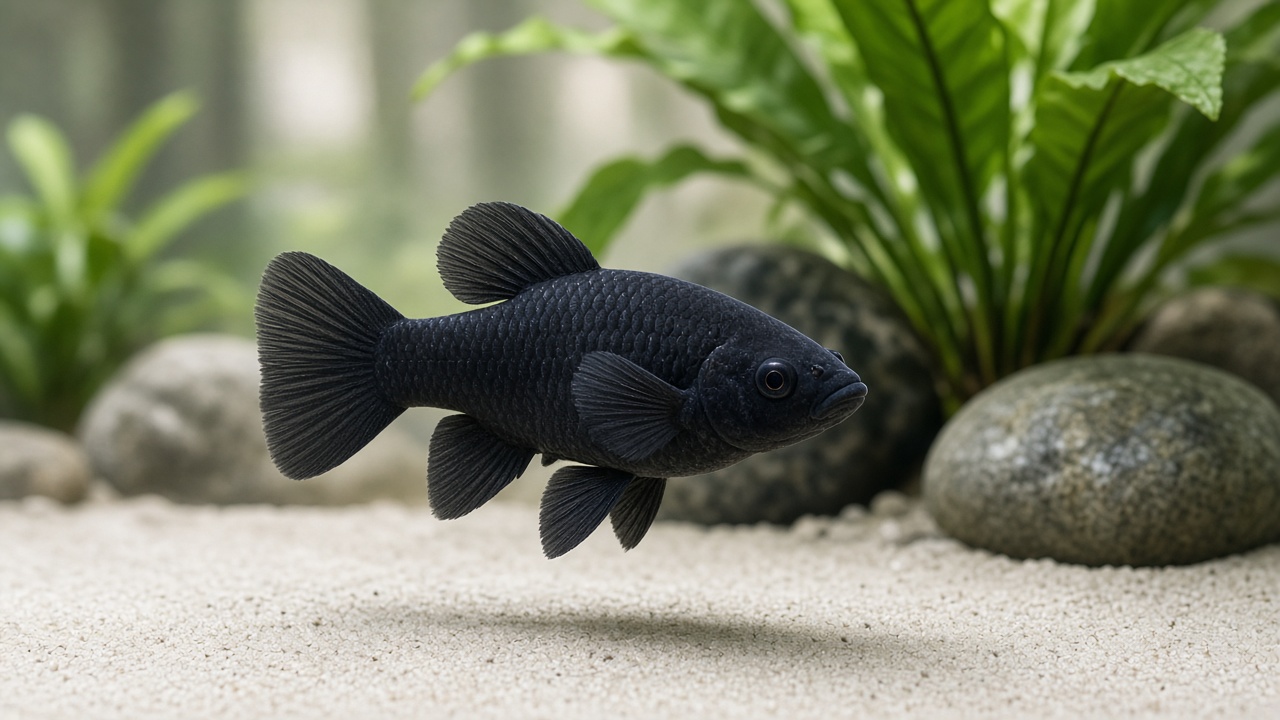
People who type “black moly” mean the black molly, a farmed dark strain of Poecilia sphenops on FishBase.
How we chose what this page covers
A product or setup enters this article only if a named page already prints a number we can quote.
Our research team compared published specs from maker pages and from FishBase, and ”
Here is the selection rule we used:
- A food is in only if the maker’s current page lists crude protein, fat, fiber, and moisture.
- A conditioner is in only if the maker’s page states a dose per water volume.
- We exclude aquarium salt, medications, and any kit shorter than 60 cm.
- We exclude any food whose maker page omits those four nutrient lines.
- We exclude sex-ratio charts, because FishBase does not print one.
That rule is why five current products appear below. Tetra TetraMin Flakes and Omega One Super Color Flakes print full nutrient lines.
New Life Spectrum Regular Pellet and Hikari Tropical Algae Wafers do the same. Seachem Prime prints a dose, and salt mixes never appear.
Tank length and adult size
FishBase’s species page sets the smallest aquarium length at 60 cm, which is about 24 inches.
Do not start with a gallon slogan; measure the long glass wall first, then buy the tank.
FishBase also prints the size of the fish itself, so the length rule has a body to match:
- Maximum length is 7.5 cm standard length, about 3.0 inches.
- Common length is 4.0 cm total length, about 1.6 inches.
- Length at first maturity is 3.5 cm, about 1.4 inches.
A 7.5 cm adult still needs room to turn, so a 60 cm tank is a length floor, not a crowd target.
Our research team includes only tanks that meet that 60 cm figure and leaves out any boxed kit listed under that length.
FishBase maps the wild range from Mexico to Colombia, and the black shop fish is a selected color form, not a second species.
FishBase notes that keepers often confuse this fish with Poecilia mexicana. Check the label on the bag, then keep one livebearer species per tank if you want clean lines.
FishBase reports the IUCN Red List status as Least Concern, assessed on 22 March 2018 in the record we read.
Heat, pH, and hardness
Stay inside FishBase’s printed water ranges for heat, pH, and hardness on this page.
FishBase lists these numbers:
- Temperature: 18–28°C, which is 64–82°F
- pH: 7.5–8.2
- Hardness: dH 11–30
- Habitat type: freshwater and brackish
Soft, acid water sits outside that pH band, so do not chase a “neutral 7.0” target for this species.
FishBase lists both freshwater and brackish use, which is a range, not an order to add salt.
This desk does not publish a salt recipe and did not add a salt product to the comparison table.
Heat still matters on the cool end, because 18°C is the low FishBase bound, not a slogan for a cold room.
If your room drops at night, use a heater that can hold a steady point inside 18–28°C.
Diet and four current foods
FishBase says adults eat worms, crustaceans, insects, and plant matter. The same page says the aquarium fish also eats green algae and accepts dried food.
That is an omnivore list, so a flake-only bowl covers protein and misses the plant half.
Our research team compared four foods whose maker pages print a full nutrient line. Across those labels, listed crude protein runs from 33.0% to 46%, a 13-point spread.
| Product | Maker-listed form | Crude protein | Crude fat | Crude fiber | Moisture or dose |
|---|---|---|---|---|---|
| Tetra TetraMin Flakes | Flake staple | 46% | 11% | 2% | 7% moisture |
| Omega One Super Color Flakes | Flake | 42% min | 12% min | 2% max | 8.5% max moisture |
| New Life Spectrum Regular Pellet | Sinking pellet, 1–1.5 mm | 37% min | 8% min | 7% max | 10% max moisture |
| Hikari Tropical Algae Wafers | Sinking wafer | 33.0% min | 4.0% min | 3.0% max | 10.0% max moisture |
| Seachem Prime | Liquid conditioner | Not a food | Not a food | Not a food | 5 mL per 50 US gallons |
Tetra’s TetraMin Flakes page lists crude protein at 46%, crude fat at 11%, vitamin D3 at 1848 IU/kg, and citric acid at 293 mg/kg.
Tetra lists pack sizes from 100 ml (20 g) up to 10 L (2.1 kg). The page calls the flakes a complete daily food for freshwater ornamental fish.
Omega One’s Super Color Flakes page lists 42% minimum crude protein and 12% minimum crude fat. It lists 8% maximum ash and packs from 0.42 oz to 5 lb.
New Life Spectrum’s Regular Pellet page lists 37% minimum crude protein and 8% minimum crude fat. Regular pellets are 1–1.5 mm, and the maker page says most pellets sink.
That same New Life Spectrum page lists vitamin A at 10,000 IU/kg and ascorbic acid at 600 IU/kg. First ingredients on the page are krill, squid, and whole wheat flour.
Hikari’s Algae Wafers page lists 33.0% minimum crude protein and 4.0% minimum crude fat. Pack sizes on that page run from 0.70 oz (20 g) to 2.2 lb (1 kg).
The Hikari page names fish meal first, then wheat flour and dried seaweed meal, and lists vitamin A at 8,700 IU/kg.
Use one mid-water staple plus a vegetable wafer to match FishBase’s mix of animals and plants.
Do not treat the table as a rank; it is an attribute sheet from maker pages, not a scorecard.
This desk does not print a daily pinch count, so follow the feeding line on the can you bought.
Water changes and conditioner math
New tap water needs a conditioner before it meets the fish, and Seachem’s Prime page is the dose we quote.
Seachem’s Prime page states these figures:
- Use 1 capful (5 mL) for each 200 L (50 US gallons) of new water.
- Each cap thread is about 1 mL.
- A double dose may be used for high chloramine.
- Up to 5 times the normal dose may be used to detoxify nitrite in an emergency.
- If water is above 30°C (86°F) and chlorine is low, use a half dose.
- The binder holds ammonia, nitrite, and nitrate for up to 48 hours.
- Prime may be redosed every 24–48 hours.
- Bottle sizes run from 50 mL to 4 L.
Our research team did the volume math from that 5 mL per 50-gallon line:
- 1 US gallon of new water needs 0.1 mL.
- A 5-gallon water change needs 0.5 mL.
- A 10-gallon water change needs 1.0 mL.
Prime is not a food; it sits in the table so the dose stays visible next to the foods.
FishBase does not print a weekly change percent, so we do not invent a “25% every Sunday” rule.
Match Prime to the gallons you add, not to the full tank, unless you pour it straight in. Seachem’s page says a direct tank dose should use the aquarium’s whole volume.
Breeding numbers from FishBase
FishBase states that females produce 20 to 150 young after 28 days of gestation.
That 28-day figure is the number this desk uses, and we do not replace it with a longer rumor.
If you keep both sexes, treat fry as likely, because FishBase also notes several spawnings per year.
The same FishBase record lists a doubling time under 15 months next to a fecundity range of 20–150 young.
FishBase does not print a male-to-female ratio, and we do not invent one for this page.
FishBase does not print a fry-food brand, so we do not add a sixth product for that gap.
If you do not want young, keep one sex only and confirm sex before you buy.
Adult size at maturity is 3.5 cm on the FishBase page, and a fish that small can already carry young.
The same page lists a trophic level of 3.0, which matches an insect-and-plant eater, not a leaf-only grazer.
What this desk left out
We left out salt mixes, medications, and any kit shorter than FishBase’s 60 cm floor.
We also left out sailfin mollies sold as a different species, because this page covers the black form of Poecilia sphenops only.
FAQ
Do black mollies need salt?
No. FishBase lists both freshwater and brackish water for Poecilia sphenops, so salt is optional, not required.
This desk does not publish a salt dose and excluded salt products from the table under our selection rule.
Hardness still matters even in freshwater, so stay inside FishBase’s dH range of 11–30.
How big does a black molly get?
FishBase lists a maximum of 7.5 cm standard length, and the common length on that page is 4.0 cm total length.
Plan the tank for the 7.5 cm figure, because shop photos often show younger, smaller fish.
A fish can already be mature at 3.5 cm, so store size is not the size you should plan for.
What tank size does a black molly need?
FishBase’s minimum aquarium size is 60 cm long, about 24 inches.
Our research team uses that length as the cutoff and does not convert it into a ranked gallon chart.
A short nano tank fails that rule even if the box says “tropical kit,” so measure the long side before you buy.
How often do black mollies have babies?
FishBase says females produce 20 to 150 young after 28 days of gestation.
Mixed-sex tanks can repeat that cycle, and FishBase notes more than one spawning per year plus a doubling time under 15 months.
If you want no fry, do not house males with females.
What should I feed a black molly?
FishBase says adults eat worms, crustaceans, insects, and plant matter. Dried food and green algae are also listed for aquarium fish.
Pair a listed flake or pellet with Hikari Tropical Algae Wafers for the plant half. Tetra TetraMin Flakes list 46% protein, while Hikari’s wafers list 33.0% protein in a sinking disc.
New Life Spectrum Regular Pellets list 37% protein and a 1–1.5 mm sinking size. Use that pellet if your fish feed lower in the water.
What pH do black mollies need?
FishBase lists pH 7.5–8.2, and that band is alkaline, not acid.
Do not force pH 6.5 to match a soft-water community, because that value sits outside the FishBase range.
Keep hardness with pH, because FishBase’s dH band of 11–30 is part of the same water box.
Can I keep one black molly alone?
FishBase does not list a minimum group size, but this desk still keeps the 60 cm length rule for a single fish.
A lone fish still needs the same heat, pH, and hardness numbers, plus both plant matter and protein in the diet.