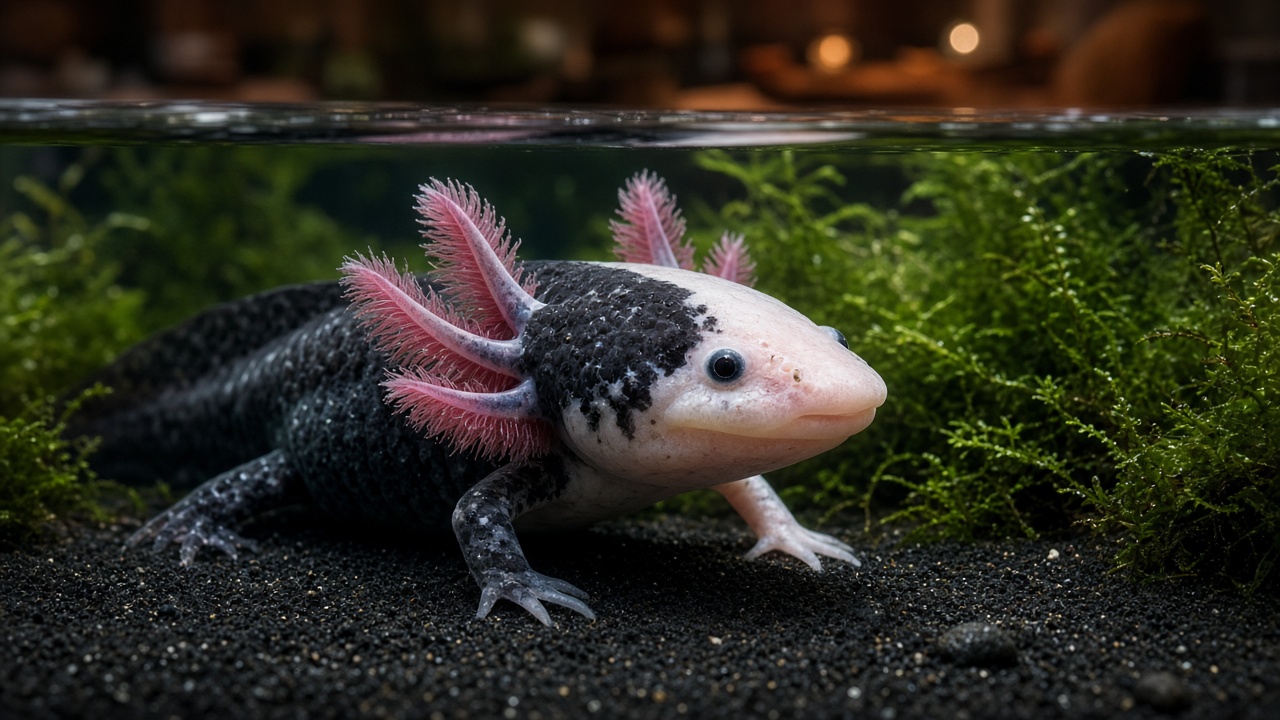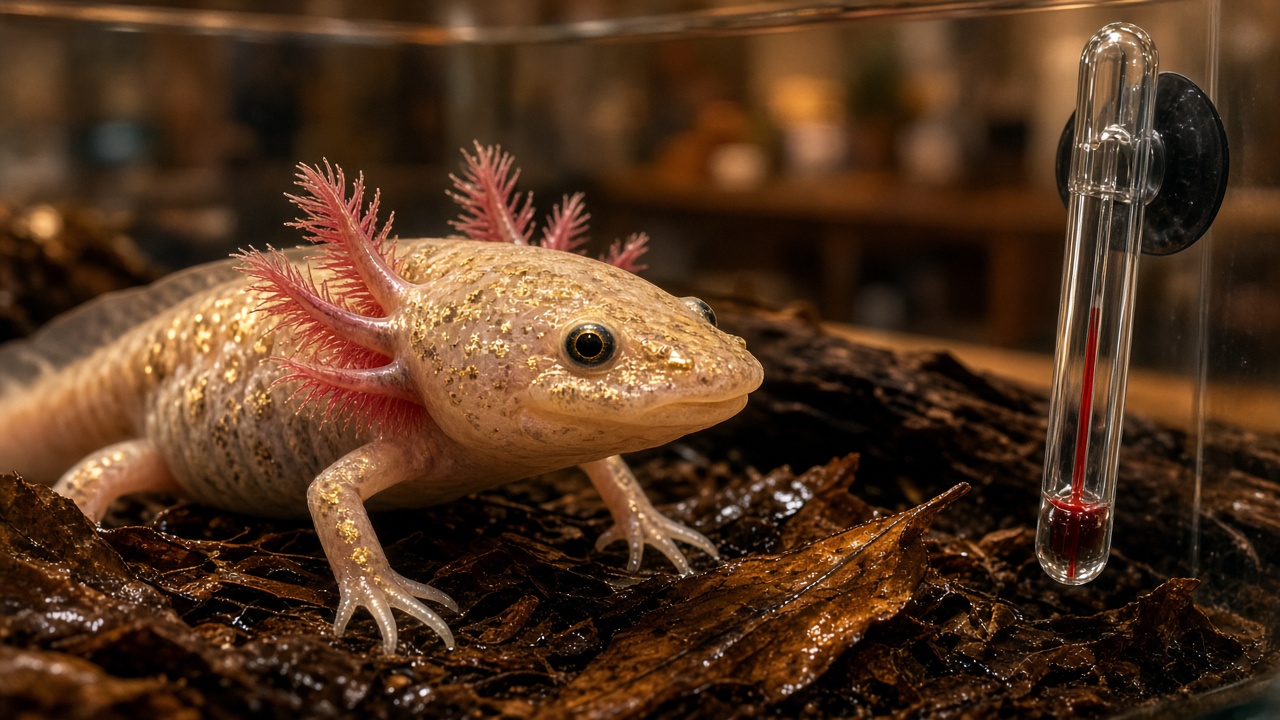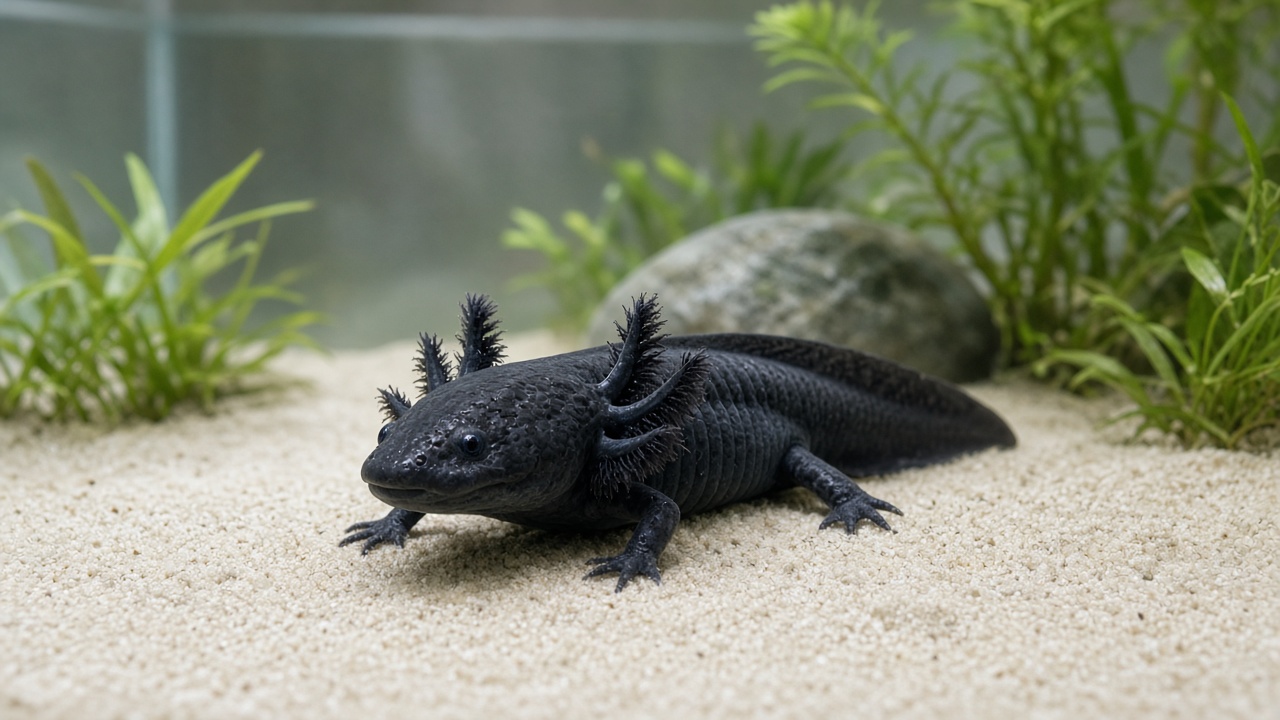
Quick answer: A black axolotl is a melanoid color morph of the Mexican salamander, not a new species. Keep it in cool, treated water with a cycled tank and a sinking meat diet. Skip tropical heaters.
A black axolotl is a melanoid Ambystoma mexicanum that lacks iridophores and needs 60–65°F water, not a tropical tank. This Waterpuppy brief compares published specs our research team analyzed; we did not house melanoids, run spawn trials, or scrape shop prices.
Selection rule: we cover captive melanoid care, published Ltk genetics, and freshwater gear we can map to colony limits. We skip wild-canal restoration, fluorescent lab lines, and tropical kits used as sold.
What a black axolotl is
A black axolotl is a color morph, not a different species.
The 2023 Genes paper by Kabangu and colleagues describes melanoid as a Mendelian variant. It has many melanophores, fewer xanthophores, and no iridophores.
The Waterpuppy Desk Three-Cell Rule is our check for the word black. Gold sparkle or a shiny eye ring means the animal is not a classic melanoid.
The same paper notes that the 1863 Paris import included 33 axolotls, and all but one were olive-green wild type. A melanoid can look charcoal, slate, or near-ink, and lighting changes the read.
Dark skin can hide redness and fungus, so watch closer at feeding time. The Genes paper ties the look to pigment-cell fate, not extra toughness.
Melanoid genetics: the Ltk rule
The published cause is a pigment-cell gene, not a care shortcut.
The 2023 Genes paper maps melanoid to leukocyte tyrosine kinase, or Ltk, on chromosome 14q.
The authors compared pooled RNA from 16 melanoid and 16 wild-type siblings. A later linkage set used 48 melanoid and 48 wild-type offspring, and wild-type Ltk crispants looked like melanoid animals.
That is why we use Ltk, not a pet-shop color name, as the genetic label. The paper treats melanoid as a natural variant from 1960s lab crosses of Mexican stock.
Breeding math stays Mendelian if both parents are true melanoids.
- Two melanoids should produce melanoid young
- A melanoid crossed to a non-carrier should produce none that look melanoid
We did not run those crosses; we are reporting the paper’s Mendelian framing, not a spawn log.
The same paper reared animals in Axolotl Rearing Water at 17–18°C, then moved larvae into 9 L boxes after they reached 5 cm.
Published rearing-water recipe from that paper:
- 1.75 g NaCl per liter
- 100 mg MgSO4 per liter
- 50 mg CaCl2 per liter
- 25 mg KCl per liter
- NaHCO3 buffer to pH 7.3–7.5
That recipe is a lab standard, not a home mandate. Home keepers still need hardness and a stable pH. The Ambystoma Genetic Stock Center’s husbandry guide says not to use extremely soft or distilled water.
Water, tank, and temperature
Cool, hard, treated water matters more than the black color.
The Ambystoma Genetic Stock Center’s husbandry guide keeps axolotls at 15–18°C (60–65°F). It says they should never stay above about 22°C (72°F).
That ceiling is why we reject tropical kits. Aqueon’s page for Rectangle LED Kits states the included preset heater holds 78°F, which sits above the Stock Center’s 72°F limit. Leave that heater unused if you buy the kit for a melanoid.
The same husbandry guide keeps pH between about 6.5 and 8. At the high end, it says to watch ammonia because toxicity rises. The Genes paper’s rearing water sat at pH 7.3–7.5.
Stocking numbers from the same guide:
- Two adults as a rule of thumb in a 10-gallon aquarium
- About 1/2 gallon (2 liters) of water per animal in their bowl system, if changes are frequent
- Slow flow only, because rapid current is listed as stressful
- No pea-sized gravel, because animals ingest it
A 10-gallon footprint is a colony rule of thumb, and larger volume is easier to keep stable at home. For a full build list, use our axolotl tank setup page.
This brief only covers what the melanoid morph changes about that build: darker skin, with the same cool-water limits.
Cycle the tank before the animal arrives. Seachem’s page for Prime lists 5 mL per 50 US gallons of new water. Each cap thread is about 1 mL.
Prime doses we pulled from that page:
- 1 mL for a 10-gallon change, on the 5 mL per 50 gallon rule
- Dose new water first; tank dosing is allowed but listed as second choice
- Repeat every 24–48 hours if needed
- Up to 5 times the normal dose in a nitrite emergency
- A sulfur odor is listed as normal
API’s page for the Freshwater Master Test Kit says the kit measures ammonia, pH, high-range pH, nitrite, and nitrate. It ships with four test tubes, a holding tray, and a laminated color card, and the page says to test weekly.
Treat any ammonia or nitrite reading above zero as a husbandry problem, not a color problem.
The husbandry guide says never to house animals in direct sun and reports about 14 hours of light a day in its breeding rooms. A tight lid helps, because young animals can jump.
Feeding a melanoid
A melanoid eats like any other captive axolotl.
The Ambystoma Genetic Stock Center’s husbandry guide starts larvae on newly hatched brine shrimp. At about 1 1/2 inches (4 cm), it adds 1/8 inch (3 mm) soft-moist salmon pellets.
At about 6 inches (15 cm), the same guide switches to 3/16 inch (5 mm) pellets. When animals are about one year old, it feeds three or four times per week. It caps a feeding at no more than five pellets.
Home keepers often use a sinking carnivore pellet when colony salmon pellets are not on the shelf. Hikari’s UK page for Sinking Carnivore Pellets lists a 74 g pack and a minimum 47% protein figure.
That Hikari page says to feed two to three times daily the amount the animals will finish in a few minutes. That schedule is written for fish, so a year-old axolotl should stay closer to the Stock Center’s three or four feedings a week.
Remove uneaten pellets, because the husbandry guide says leftover food fouls water fast. The same guide also lists earthworms and aquarium-bred feeders, and it warns that bait-shop minnows often carry parasites.
Always change water before a pellet feeding if you keep animals in bowls, and siphon waste after meals in a filtered tank.
Gear compared from maker pages
We compared products a first melanoid tank actually uses, not a ranked “best of” list.
The Waterpuppy Desk Spec Check kept a product only when its maker page listed a freshwater dose, size, or kit spec. That spec had to map to Stock Center limits.
| Product | Maker | Listed role | Maker-listed spec | Listed form |
|---|---|---|---|---|
| Prime | Seachem | Fresh and saltwater conditioner | 5 mL per 50 US gallons of new water | Bottles from 50 mL to 4 L |
| Freshwater Master Test Kit | API | Freshwater ammonia, nitrite, nitrate, and pH tests | Four tubes; weekly testing | Kit with laminated color card |
| Sinking Carnivore Pellets | Hikari | Sinking diet for bottom-feeding carnivores | Minimum 47% protein; 74 g pack on the UK page | 74 g sinking pellets |
| Rectangle LED Kit (20 High) | Aqueon | Boxed glass kit with hood, filter, and heater | 20 High size option; preset 78°F heater | Kit with five-stage filter |
How those specs map to a melanoid tank:
- Use Seachem Prime on new tap water at 5 mL per 50 gallons
- Use the API kit weekly for ammonia, nitrite, nitrate, and pH
- Offer Hikari pellets only as a sinking meat backup, then match Stock Center meal counts
- Use the Aqueon 20 High box for the glass and hood, and leave the 78°F heater unplugged
Aqueon’s page also lists a QuietFlow LED PRO filter and an ammonia specialty pad. Slow the outflow, because the Stock Center’s husbandry guide says fast current stresses axolotls.
The 20 High box is a short footprint for two adults if you want extra stability. One adult is the safer read of that kit. We did not measure tanks in our office.
How price is set
We did not publish a live retail price, because we did not scrape shops.
Pet-trade tags move by size, locality, and seller. A true melanoid has no eye ring and no sparkle.
The Ambystoma Genetic Stock Center’s husbandry guide says the colony sends embryos, larvae, and adults to labs and schools. Sex is not clear until about one year.
What usually changes a listed tag, from those published facts:
- Age and length, from larva to a one-year adult
- Confirmed melanoid look versus a dark wild type
- Whether the seller is a lab source or a pet shop
- Local laws on amphibian sales
If a listing says “black” but shows glitter or a gold eye ring, treat it as a wild-type or mixed animal. Ask for a clear photo of the eye, and use the Genes paper’s Three-Cell Rule as the check.
We also did not convert lab shipping fees into a home budget.
Watching health on dark skin
Dark pigment hides early color cues, so you watch behavior and gills.
The husbandry guide says well-kept animals rarely get sick. Stress from poor water or heat opens the door to infection.
Listed first signs are loss of appetite and gill decline; pale gills show sooner than pink skin on a melanoid.
Watch these during the weekly API test:
- Refused pellets for more than one scheduled feeding
- Forward-curled gill filaments that stay clamped
- White cotton patches that show against black skin
- Floating that does not stop after a rest
- Water above the Stock Center’s 72°F ceiling
The husbandry guide names Pseudomonas and Aeromonas as common opportunistic bacteria. It also says young larvae and year-old animals are the most prone to illness. We do not give drug plans here.
If heat is the problem, published guides start with cooler water because too-warm water is listed as dangerous.
Cooling steps that follow those limits:
- Move the tank off sunlit floors
- Drop room heat
- Add a fan or a purpose-built chiller if the room cannot hold 60–65°F
Do not add tropical community fish to help a black axolotl; the animal will eat smaller fish, and goldfish can nip gills.
FAQ
Is a black axolotl a different species?
No. It is a melanoid morph of Ambystoma mexicanum. The 2023 Genes paper treats melanoid as a Mendelian color variant with more melanophores, fewer xanthophores, and no iridophores.
How do I tell a melanoid from a dark wild type?
Look for shine. A melanoid should lack iridophores, so the skin stays matte and the eye lacks a gold ring. A dark wild type still shows sparkle.
What temperature does a black axolotl need?
The Stock Center’s husbandry guide keeps animals at 15–18°C (60–65°F). It says never to keep them above about 22°C (72°F). Do not use a kit heater set to 78°F.
How big a tank does one black axolotl need?
The Stock Center’s husbandry guide uses two adults in a 10-gallon aquarium as a rule of thumb. Its bowl system uses about 1/2 gallon (2 liters) per animal with frequent changes. A larger home tank is easier to keep cool and stable.
What should I feed a melanoid?
Use the Stock Center pellet sizes: 1/8 inch (3 mm) for small juveniles, then 3/16 inch (5 mm) from about 6 inches long. At about one year, it feeds three or four times a week, no more than five pellets. Hikari’s UK page lists Sinking Carnivore Pellets at a minimum 47% protein in a 74 g pack as a sinking backup.
Why are some black axolotls cheap and others costly?
We did not scrape shop tags. Age, confirmed melanoid look, and seller type drive the spread. The Stock Center’s husbandry guide says animals cannot be sexed until about one year.
Do I need a tropical starter kit?
Only for the glass, if the size fits. Aqueon’s Rectangle LED Kit page lists a 20 High size and a preset 78°F heater. That heater conflicts with the Stock Center’s 72°F ceiling.