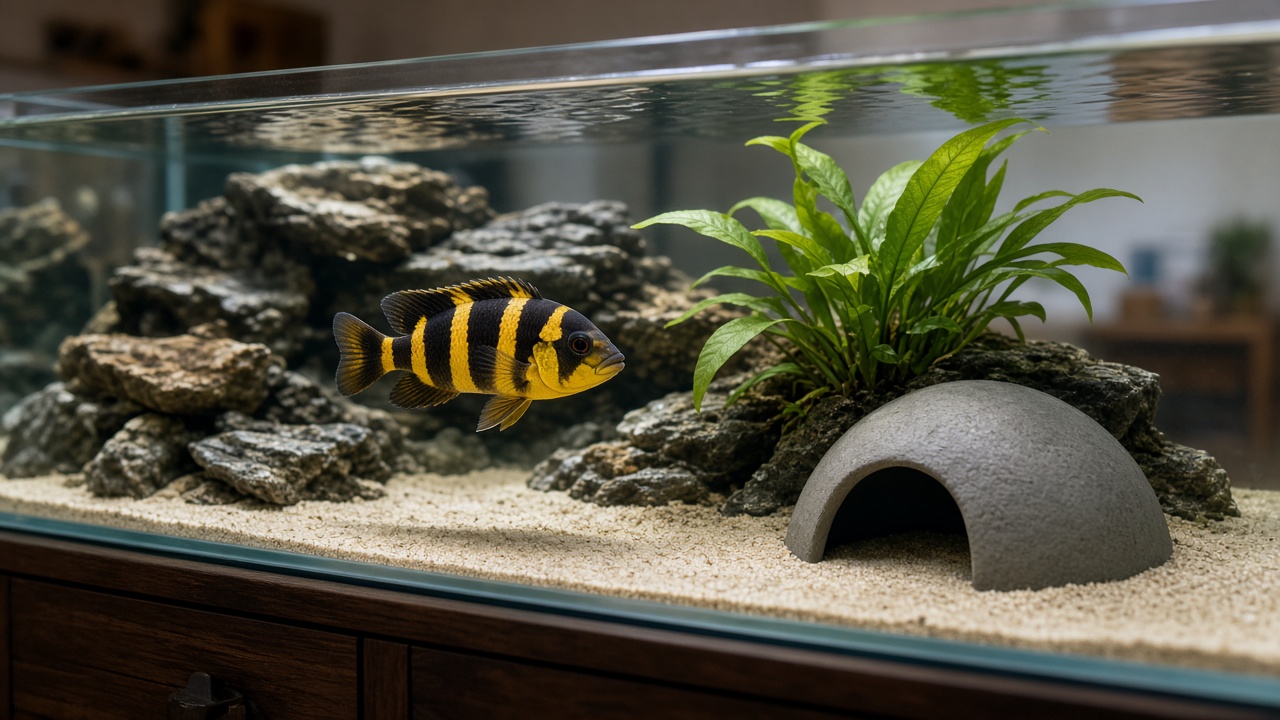
Quick answer: Keep Bolivian rams as a pair on fine sand. Use a tank at least 90 × 45 cm. Hold water at 75–82°F and pH 6.0–7.5, and feed small sinking foods two or three times a day.
A Bolivian ram is Mikrogeophagus altispinosus; keep a pair at 75–82°F in a 90 × 45 cm tank. This page is a care brief built from published species records and maker labels.
We cover adult Mikrogeophagus altispinosus kept as a pair or a small community over sand. We leave out German blue rams, Mikrogeophagus maculicauda, African cichlids, and tanks smaller than the 90 × 45 cm footprint that Seriously Fish lists.
What a Bolivian ram is
The Bolivian ram is Mikrogeophagus altispinosus, a South American dwarf cichlid with two published length figures.
FishBase lists the species as a freshwater cichlid from the Amazon basin in the Guaporé and Mamoré drainages of Brazil and Bolivia. John D. Haseman described the fish in 1911.
Our research team analyzed the two length figures in the records we read. FishBase lists a maximum standard length of 5.6 cm, while Seriously Fish lists 80 mm SL, or 8.0 cm, a 2.4 cm gap.
FishBase also publishes model scores that hobby pages rarely quote. It lists a trophic level of 3.1 plus or minus 0.5 and a fishing vulnerability of 10 of 100.
FishBase reports the IUCN Red List status as Least Concern, with an assessment date of 20 November 2020.
The fish sifts sand for small prey. FishBase says eggs are deposited on stones and covered with sand, then the female cares for them and both parents later defend the larvae.
Males grow a bit larger than females. Seriously Fish says adult males have slightly longer fins and stronger color.
Water, tank size, and a weekly routine
Hold a pair in a 90 × 45 cm tank at 75–82°F and pH 6.0–7.5.
Seriously Fish sets the aquarium base at 90 × 45 cm, or 36 × 18 in. It estimates volume at about 182 liters, or about 48 U.S. gallons, for one fish in a community or a bonded pair.
Published temperature bands do not match: FishBase lists 22°C to 26°C, while Seriously Fish lists 24°C to 28°C, or 75°F to 82°F.
Our research team compared those two ranges, and the overlap is 24°C to 26°C, or about 75°F to 79°F, which should be the daily target.
Seriously Fish lists these water values:
- Temperature: 24–28°C (75–82°F)
- pH: 6.0–7.5
- Hardness: 1–10 dGH
FishBase lists a pH starting at 7.0 and a dH starting at 10, but those fields are open-ended and are not a full hobby range.
Seriously Fish says filtration should not be strong. It recommends regular water changes of 10–15%, warns against very large changes, and says this species should never go into a new, uncycled tank.
A simple weekly plan looks like this:
- Test ammonia, nitrite, nitrate, and pH before you change water.
- Remove 10–15% of the water, as Seriously Fish recommends.
- Treat the new water with a conditioner at the maker’s listed dose.
- Match temperature before you pour.
- Feed after the tank settles, not during the change.
Seachem’s page for Prime states a dose of 1 capful (5 mL) for each 200 L, or 50 U.S. gallons, of new water. Each cap thread is about 1 mL, so a 10-gallon change takes 1 mL of Prime.
Seachem says a sulfur odor is normal and allows a double dose for high chloramine. In a nitrite emergency, it allows up to five times the normal dose.
Seriously Fish notes a condition like head-and-lateral-line pits when water quality falls, which is a reason to keep changes steady.
Diet that reaches the sand
Feed small sinking foods two or three times a day, not floating flakes alone.
Seriously Fish describes the species as a sand-sifter. The fish take mouthfuls of substrate and spit the waste out through the gills and mouth.
Seriously Fish says to offer live or frozen items such as bloodworm, Artemia, Daphnia, and grindal worm. Add small sinking dried foods as well. Wild-caught fish may refuse dry food at first, but tank-bred fish usually take it.
Comparing published specs on two staple foods shows a clear protein gap. Fluval’s page for Bug Bites Cichlid Granules (S-M) lists a minimum of 40.0% crude protein. Hikari’s page for Tropical Micro Wafers lists a minimum of 44% crude protein, a 4-point gap on the label.
Fluval’s page also lists these facts for Bug Bites Cichlid Granules (S-M):
- Tub size: 45 g (1.6 oz)
- Granule size: 1.4–2.0 mm, slow sinking
- Black soldier fly larvae as the first ingredient, up to 40%
- Crude fat: 12.5% minimum
- Feed what the fish eat in two minutes, two or three times daily
Hikari’s page for Tropical Micro Wafers lists these facts:
- Sizes: 0.70 oz (20 g) and 1.58 oz (45 g)
- Crude protein: 44% minimum
- Crude fat: 8% minimum
- Phosphorus: 1% minimum
- Feed two to three times daily, only what fish eat in a few minutes
Hikari names cichlids as users of Micro Wafers. Fluval frames Bug Bites Cichlid Granules as a cichlid formula.
A practical feeding plan looks like this:
- Offer a small sinking food in the morning.
- Offer a frozen or live item in the evening, two or three days a week.
- Stop when food sits uneaten past the two-minute window on the Fluval label.
- Remove leftovers so ammonia does not rise.
Do not rely on large floating pellets, because they stay at the surface and Bolivian rams feed on the sand.
Tank mates that leave the bottom open
Share the tank with calm midwater fish, not other bottom cichlids.
Seriously Fish does not treat this species as a general community fish, because it needs clean water and is a poor competitor. That does not mean it must live alone.
Seriously Fish recommends peaceful open-water characids or similar schooling fish, which help shy rams feel less exposed. It also allows peaceful bottom dwellers such as Corydoras.
Avoid these matches:
- Large, fast, or aggressive feeders
- Most other cichlids
- Fish that need harder water than 10 dGH
- Other sand-sifting cichlids in a small tank
Seriously Fish says the species is fairly social. A mixed-sex group of 6–8 or more can work in a tank 120 cm long, or 47 in.
In a small tank, males fight more over territory, so a bonded pair is the default for a 90 × 45 cm tank. Add a group only when the tank is longer than 120 cm.
Keep the décor simple. Seriously Fish calls for a soft, sandy substrate, because gravel can block feeding, damage gill filaments, or get swallowed.
Add wood, a flat stone, and plants that attach to wood, such as Anubias or Java fern, for shade and cover.
Breeding on stone, then pits
Pairs spawn on a stone, then move fry into sand pits.
Seriously Fish says both parents guard eggs on a hard surface, and there is no special trigger beyond good food and clean water.
Start with a group of young fish if you cannot sex adults, and let pairs form on their own.
Spawn steps from Seriously Fish look like this:
- The pair claims a flat rock, wood, a broad leaf, or the glass.
- The female lays one or more rows of eggs.
- The male fertilizes each row.
- They repeat until the clutch is done.
Seriously Fish lists incubation at 2–3 days. Fry then stay mostly still for another 5–8 days and do not need extra food in that window.
Parents move hatched fry into a pit in the sand and often shift them between pits each day.
Once fry swim, Seriously Fish says to offer microworm and Artemia nauplii. New pairs may eat the first brood, but later broods often survive.
If the pair lives in a community, move the eggs or the tank mates if you want a large raise.
FishBase matches the sand-cover detail: eggs go on stones and get covered with sand, the female tends them, and both parents later defend the larvae.
Do not raise heat past 28°C just to force a spawn; stay inside 24–28°C and keep the 10–15% water-change rhythm.
Gear compared by published specs
We compared only current products whose makers publish the specs we cite.
This is a label chart, not a ranked list: our research team compared published specs and did not run tank trials.
We included two small foods, one conditioner with a printed dose, and two CaribSea sands whose grain size fits a sifter. We left out heaters, filters, and test kits whose maker pages
| Product | Maker | Format | Maker-listed spec | Stated use |
|---|---|---|---|---|
| Bug Bites Cichlid Granules (S-M) | Fluval | Slow-sinking 1.4–2.0 mm granules, 45 g tub | 40.0% min crude protein; 12.5% min fat | Daily cichlid diet |
| Tropical Micro Wafers | Hikari | Wafers in 20 g and 45 g packs | 44% min crude protein; 8% min fat | Small and medium tropicals, including cichlids |
| Prime | Seachem | Liquid in 50 mL to 4 L bottles | 5 mL per 50 U.S. gallons (200 L) of new water | Removes chlorine and chloramine |
| Super Naturals Aquascapes Crystal River | CaribSea | Sand in 5, 10, 20, and 40 lb bags | Typical grain 0.5–1.0 mm; 95 lb per cubic foot | Fine, fish-friendly sand bed |
| Super Naturals Aquascapes Moonlight Sand | CaribSea | Sand in 5, 10, 20, and 40 lb bags | Typical grain 0.25–0.75 mm; 95 lb per cubic foot | Finer sand bed |
CaribSea’s freshwater substrates page lists Crystal River at 0.5–1.0 mm and Moonlight Sand at 0.25–0.75 mm. Both list an average density of 95 pounds per cubic foot.
Both sit in the Super Naturals Aquascapes line, which uses smooth grains and no paints or dyes. Pick Crystal River for a slightly coarser sift, or Moonlight Sand for a finer bed.
Fluval’s 1.4–2.0 mm granules drop to the sand. Hikari’s Micro Wafers float, then sink, so midwater tank mates can eat too.
Dose Seachem Prime on the new water, not by guess. A 48-gallon fill takes about 5 mL. Measure 1 mL per 10 gallons of new water.
FAQ
How big do Bolivian rams get?
FishBase lists a maximum standard length of 5.6 cm, and Seriously Fish lists 80 mm SL, or 8.0 cm. Plan tank space for the 8.0 cm hobby length.
What tank size does a pair need?
Seriously Fish lists a base of 90 × 45 cm for one fish in a community or for a pair. That is about 182 liters, or 48 U.S. gallons. A group of 6–8 needs a tank at least 120 cm long.
What temperature should I use?
Seriously Fish lists 24–28°C (75–82°F), and FishBase lists 22–26°C, so hold the daily setpoint in the 24–26°C overlap.
What should I feed them?
Use a small sinking staple and add frozen or live foods. Fluval’s Bug Bites Cichlid Granules list 40.0% minimum protein and a two-minute feed window. Hikari’s Tropical Micro Wafers list 44% minimum protein and two to three feedings a day.
Can they live with other cichlids?
Seriously Fish says to avoid most other cichlids and fish that need harder water. Peaceful tetras and Corydoras are the safer match.
How do they breed?
They lay eggs on a hard surface. Seriously Fish lists a 2–3 day hatch, then 5–8 days before fry swim. Feed newly free-swimming fry microworm or Artemia nauplii.
Are they a beginner cichlid?
Seriously Fish rates the species as moderate. It still needs a cycled tank, sand, and steady 10–15% water changes. It is a poor competitor, not a fish for an empty starter kit.