Quick answer: Keep one adult severum in a tank at least 64 US gallons, with a floor at least 48 by 18 inches. Feed a daily cichlid pellet plus plant matter, and keep only tank mates too large to swallow.
An adult Heros efasciatus needs a tank at least 48 by 18 by 18 inches. This page is a published-spec desk brief from Waterpuppy. We did not keep a colony, run filter trials, or open clinic records.
Our selection rule is the Waterpuppy 64-Gallon Desk Rule, and we cover only the common trade severum, Heros efasciatus. We include only tanks that meet that 48-by-18-inch floor, plus daily pellets whose maker pages list crude protein. We leave out Heros severus and African rift cichlids, plus nano tanks and any food with no guaranteed analysis.
What a trade severum actually is
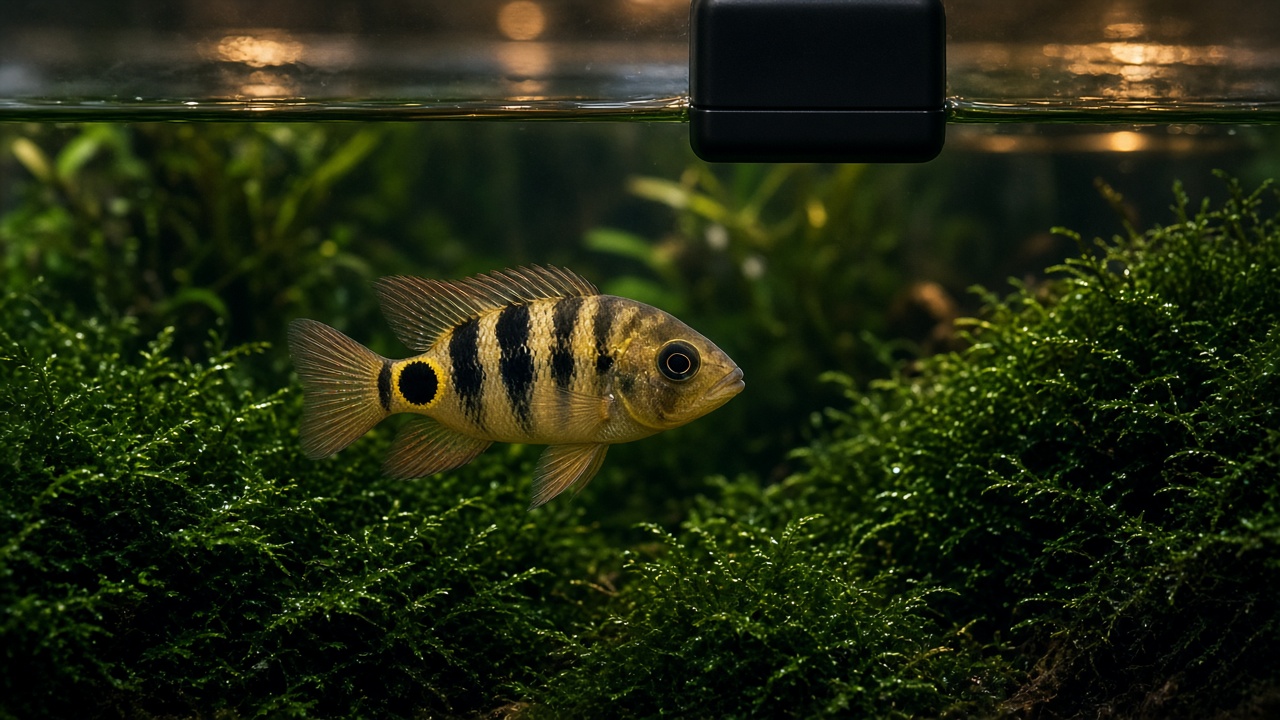
The fish sold as a severum is usually Heros efasciatus, a large Amazon cichlid.
Seriously Fish’s species profile names the fish Heros efasciatus and lists a standard length of 300 mm, or 12 inches. It also notes the common green form and the gold form sold in shops.
FishBase’s summary page lists a shorter wild maximum of 17.0 cm standard length and a published weight of 268.20 g. Those two published lengths do not match, and our research team did not resolve the gap with new measurements.
Treat 12 inches as the hobby planning size, and treat the FishBase figure as a wild-catch record, not a tank target.
Seriously Fish places the species in the Amazon main channel, the rio Solimões, and the rio Xingu. FishBase lists tributaries of the Ucayali and Amazon in Peru, plus the Solimões-Amazon River in Brazil.
Slow rivers, floodplain lakes, and wooded banks are the stated habitat. Seriously Fish says the fish is most abundant in deeper, calm water with submerged tree roots.
This is not a dwarf cichlid, an Oscar, or a rift-lake mbuna. Seriously Fish says males grow larger and may show gill-cover marks, a nuchal hump, and longer unpaired fins.
Tank size that meets the published floor
Volume alone is not the rule, because the tank must also be at least 18 inches wide.
Seriously Fish says the fish is not suitable under 120 by 45 by 45 cm, which is 48 by 18 by 18 inches. The listed volume is about 243 liters, or 64 US gallons.
A long, narrow box can hold 55 gallons and still miss the width. The published floor is a footprint, not a marketing gallon number.
For one adult, use this floor:
- Length: at least 48 inches
- Width: at least 18 inches
- Height: at least 18 inches
- Volume: at least 64 US gallons
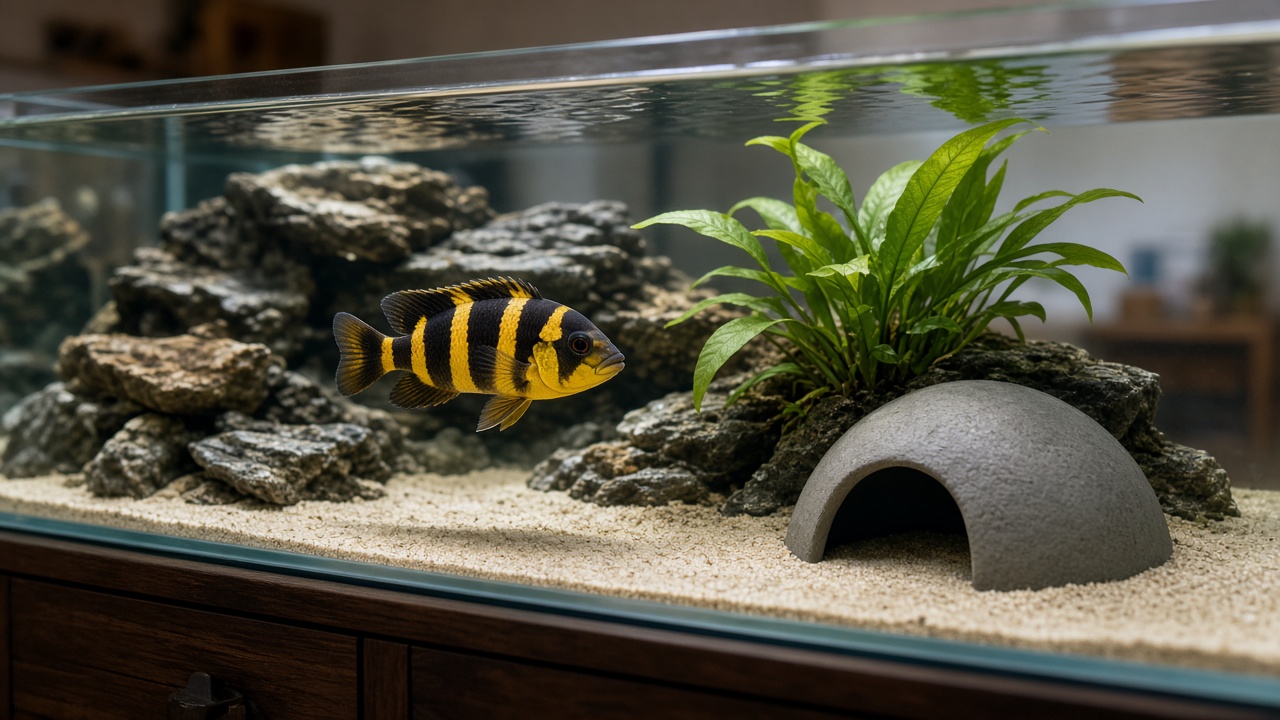
Step up from 64 gallons if you want a pair or extra tank mates. Seriously Fish describes a simple wood-and-sand layout with river sand, driftwood, and dim light.
It says plants are not a feature of the wild water, and it allows dried, stripped beech if you cannot find shaped driftwood. It also says some fish grow a nasty streak when kept alone, and company of their own kind is the stated check on that.
A rogue fish is still possible, so watch the first weeks after a new fish goes in.
Water numbers you can actually cite
Hold temperature in the low-to-mid 70s to low 80s Fahrenheit, and keep pH acid to neutral.
Seriously Fish lists these ranges:
- Temperature: 72–84°F (22.2–28.9°C)
- pH: 5.5–7.0
- Hardness: 1–8 dGH
FishBase lists a warmer band of 24–32°C and a pH start of 7.0. Those two pages do not agree, so a home tank should stay inside the overlap.
That overlap is about 75–84°F with pH held steady near 6.5 to 7.0. Do not swing pH every week to chase a wild-river story.
Seriously Fish allows a small peat bag in the filter to stain the water like weak tea. Use dim light with that setup, and do not chase a number you cannot measure.
Seachem’s Prime page states a dose of 1 capful (5 mL) per 200 liters (50 US gallons) of new water. Each cap thread is about 1 mL, so dose the new water rather than a guess.
For a 25 percent change in a 75-gallon tank, the new water is about 19 gallons. That is roughly 2 mL, or two cap threads on the Seachem bottle.
Seachem lists bottle sizes from 50 mL to 4 L and says the product is non-acidic and will not change pH.
Seachem also states these limits:
- A double dose is allowed for high chloramine
- Up to 5 times the normal dose may be used for nitrite in an emergency
- Use a half dose if temperature is above 86°F and chlorine or ammonia is low
- The product may be dosed every 24–48 hours
- The bind lasts up to 48 hours
Do not skip the conditioner, because tap chlorine and chloramine are not optional problems.
Diet and the pellets we compared
Use a daily cichlid pellet plus plant matter, not a meat-only menu.
Seriously Fish calls the fish an unfussy omnivore and lists good dried food, plus bloodworm, chopped earthworms, and prawns. It also asks for plant matter such as shelled peas, blanched spinach, and spirulina foods.
Our research team compared published guaranteed analyses. We did not feed the bags to fish.
Hikari’s Cichlid Gold page lists two protein floors, with the Baby pellet at a minimum of 32% crude protein. The Mini, Medium, and Large pellets list a minimum of 40% crude protein.
All four Hikari sizes list a minimum of 4% crude fat and a maximum of 10% moisture. Baby ash is listed at a maximum of 12%, while Mini, Medium, and Large ash is listed at a maximum of 15%.
Hikari also splits phosphorus, with Baby at a minimum of 0.7% and Mini, Medium, and Large at a minimum of 1.0%. Hikari lists 2 oz (57 g) and 8.8 oz (250 g) bags for each pellet size. Item numbers run from 04111 for Baby through 04428 for Large.
New Life Spectrum’s Cichlid page lists a minimum of 37% crude protein and 8% crude fat. Moisture is listed at a maximum of 10%, and fiber is listed at a maximum of 7%.
The regular New Life Spectrum pellet is listed at 1 mm to 1.5 mm and sinks. Jar and bag sizes on that page are 80 g, 150 g, 300 g, 600 g, and 2,200 g.
Hikari’s feeding line is simple: feed two to three times daily, give only what fish finish in a few minutes, and remove leftovers.
| Product | Form | Min. crude protein | Min. crude fat | Max. moisture |
|---|---|---|---|---|
| Hikari Cichlid Gold Baby | Floating pellet | 32% | 4% | 10% |
| Hikari Cichlid Gold Mini | Floating pellet | 40% | 4% | 10% |
| Hikari Cichlid Gold Medium | Floating pellet | 40% | 4% | 10% |
| Hikari Cichlid Gold Large | Floating pellet | 40% | 4% | 10% |
| New Life Spectrum Cichlid | Sinking pellet | 37% | 8% | 10% |
Across those five listed diets, published minimum protein runs from 32% to 40%. That 8-point spread is the desk finding.
Use Baby only while the fish still takes a small pellet, then step up to Mini, Medium, or Large as the mouth grows.
New Life Spectrum also lists vitamin A at 10,000 IU/kg and vitamin D at 3,500 IU/kg. It lists vitamin E at 400 IU/kg and ascorbic acid at 600 IU/kg.
A daily plate looks like this:
- Morning: a few pellets the fish can swallow whole
- Evening: the same pellet, or a plant item
- Two or three days a week: a thawed invertebrate, not a raw mammal meat
Skip beef heart as a staple, because Seriously Fish does not list it.
Tank mates that fit the mouth rule
If it fits in an adult severum’s mouth, it is food, not a roommate.
Seriously Fish says the fish is fairly mild except when spawning and calls it a fit for a community of large, peaceful fish. It warns against any fish small enough to eat and prefers other South American fish.
It also says a single fish can turn mean, and keeping conspecifics is the stated way to cut that risk.
Use this pass/fail rule:
- Pass: similar-size South American cichlids, large characins, and armored catfish too big to swallow
- Fail: neon tetras, guppies, shrimp, and any fish that fits in the mouth
- Fail: heavy-jawed cichlids that claim the same rock and start fights
Do not mix a pair in a 64-gallon box. Add length and width before you add a mate, and watch spawning because both parents guard the site.
Breeding notes from the species profile
Seriously Fish says to buy a group of young fish and grow them on if you want a pair.
A pair should form from that group, and eggs go on a flat stone or a similar patch. Both parents guard the eggs until they hatch.
Seriously Fish says both parents then mouthbrood the fry. The fry are fairly large and can take brine shrimp and powdered food.
Move small dither fish out before spawning starts. A 64-gallon floor is for one adult, not a working nursery.
Lifespan, and the weekly work
Neither primary species page we read lists a lifespan in years.
Seriously Fish’s Heros efasciatus profile has no lifespan field. FishBase’s summary page lists length and weight, not a maximum age, so we will not invent a year count.
Plan for a long-lived, large cichlid, and do not buy one for a short-term tank.
Weekly work that does have a source:
- Change about one-quarter of the water
- Dose Seachem Prime at 5 mL per 50 US gallons of new water
- Feed two to three short meals a day, as Hikari directs
- Pull uneaten pellets before they rot
If ammonia or nitrite reads above 2 ppm, Seachem’s Prime page allows up to five times the normal dose. That is an emergency binder, not a filter.
FAQ
How big does a severum get?
Seriously Fish lists 300 mm standard length, or 12 inches. FishBase lists a wild maximum of 17.0 cm standard length and 268.20 g. Plan the tank for the larger hobby figure.
What size tank does one adult need?
Seriously Fish’s floor is 48 by 18 by 18 inches, about 64 US gallons. A 55-gallon tank can still be too narrow if it is under 18 inches wide, so measure the footprint, not only the gallon label.
What should I feed a severum?
Use a daily cichlid pellet with listed protein of 32% to 40%, and add peas, spinach, or a spirulina food. Offer thawed invertebrates a few times a week, and follow Hikari’s two-to-three short feedings a day.
Can severums live with angelfish or tetras?
Seriously Fish allows a large, peaceful South American community and bans fish small enough to eat. Full-size angels may pass in a wide tank, but neon tetras fail the mouth rule.
What water temperature and pH should I use?
Stay inside Seriously Fish’s 72–84°F and pH 5.5–7.0 band. If you also read FishBase’s 24–32°C note, use the overlap near 75–84°F. Hold pH steady near 6.5 to 7.0.
Do I need a pair?
No, one adult can live alone in a 64-gallon-plus tank. Seriously Fish says singles can grow a nasty streak, and a group raised together is the stated way to reduce that.
How long do severums live?
We found no lifespan figure on Seriously Fish or on FishBase’s summary page. Do not treat an unsourced year count as a fact, and budget for years of large-tank care.