Quick answer: Keep one pair of keyhole cichlids in a 20-gallon tank. Feed a labeled sinking cichlid pellet as the daily staple. Skip Malawi haps and other hard-water fish.
A keyhole cichlid is Cleithracara maronii, and FishBase lists a 7.1 cm standard-length maximum. This page is a Waterpuppy research-desk brief on tank size, diet, tank mates, and breeding. We did not run tank trials, spawn fish, or treat sick animals.
Our selection rule is the 20-Gallon Pair Rule. We cover one captive-bred pair of Cleithracara maronii in a freshwater display of 20 gallons or more. We leave out nano tanks under 20 gallons, wild-caught groups, and Malawi hap communities.
What a keyhole cichlid is, and what this page covers
A keyhole cichlid is one South American cichlid species with a published size, not a mix of look-alike fish.
FishBase lists the scientific name as Cleithracara maronii (Steindachner, 1881). The same page names the Maroni River as the type locality.
Standard length is the snout-to-tail-base measure and does not include the tail fin. FishBase’s maximum is 7.1 cm SL for a male or unsexed fish, about 2.8 inches on that scale.
We do not use a larger total-length figure, because FishBase does not publish one here.
This page covers four jobs only:
- Tank volume and filter capacity from maker pages
- Water numbers FishBase publishes
- Diet labels we could read in full
- Breeding counts FishBase publishes
FishBase lists the IUCN Red List Status as Least Concern, assessed on 28 October 2020 (Version 2025-2). That status is a conservation label, not a tank-size rule.
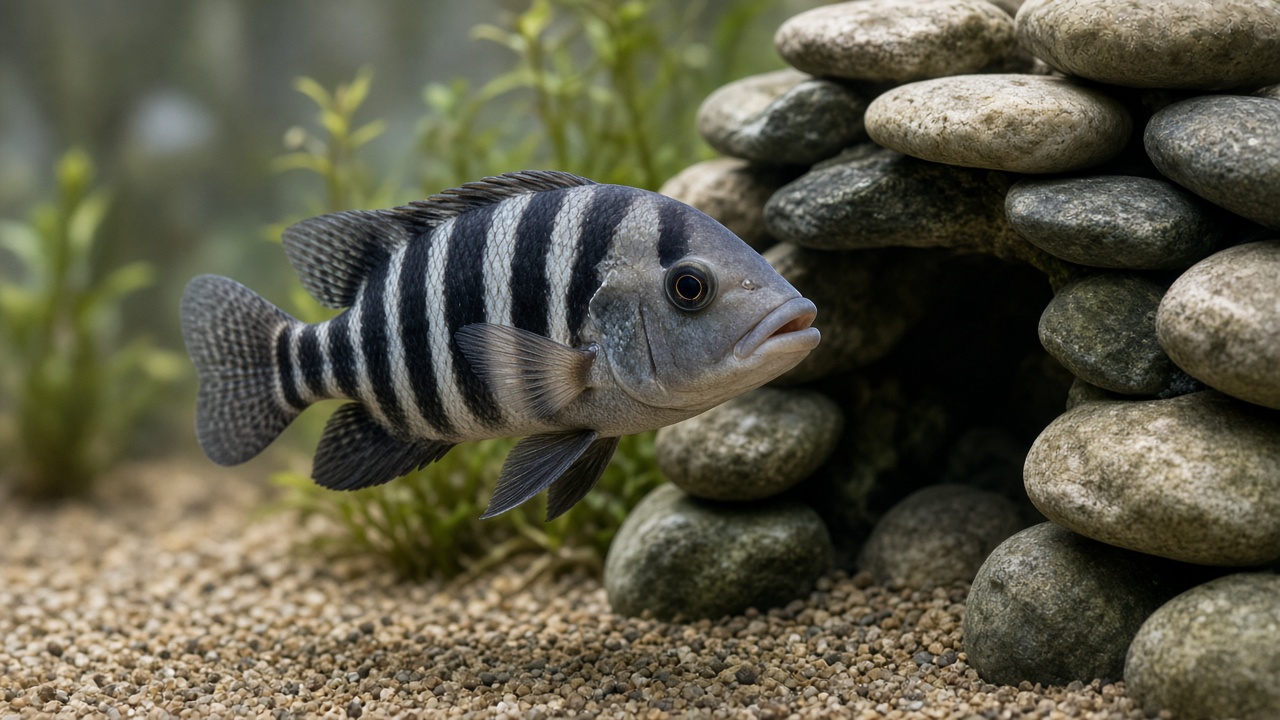
FishBase lists the species as fearful and says it presses against a log and matches the substrate when threatened. Plan cover first, not a bare show tank.
The 20-Gallon Pair Rule
We only write for pair tanks of 20 gallons or more, even when a filter lists a higher ceiling.
FishBase does not publish a gallon minimum. Our research team compared published filter ranges, not tank trials.
Seachem’s Tidal 35 page lists a ceiling of 35 US gallons (130 liters). That ceiling is 35 gallons, and our floor is stricter on purpose.
We use 20 gallons as the smallest pair display we will discuss. A 20-gallon box gives a pair room to hold a wood pile and still leave a swim lane.
Use this volume check:
- One adult pair: 20 gallons
- A pair plus other fish in the same temperature and pH window: start at 20 gallons and add length
- Any plan with extra adult pairs in one 20-gallon box: skip it on this page
Do not scale down for a juvenile, because the rule is for the adult pair you intend to keep.
Seachem’s Tidal 35 page lists a flow rate of 130 US GPH and 6 watts at 120 V / 60 Hz. Comparing those published specs, 130 GPH on a 20-gallon box is 6.5 turnovers an hour.
That flow fits a 20-gallon pair tank and is not a 10-gallon nano plan.
Seachem’s Tidal 35 page also lists a filter volume of 0.2 US gallons (0.7 liters). The unit measures 6 ⅛ by 5 ⅛ by 7 ⅛ inches, with 2 ¾ inches of wall clearance.
Water chemistry we can cite
FishBase publishes the temperature and pH window we use, and we do not invent a blackwater recipe.
Keep the heater in FishBase’s 22°C to 25°C band, about 72°F to 77°F.
FishBase lists pH 6.0 to 8.0. API’s Freshwater Master Test Kit page says a pH of 7.0 is neutral.
Values above 7.0 are alkaline, and values below 7.0 are acidic. Test weekly, then match FishBase’s 6.0 to 8.0 window.
FishBase lists a dH range up to 20 and no low-end hardness number.
Seachem’s Prime page is the conditioner we actually read. Prime removes chlorine and chloramine and binds ammonia, nitrite, and nitrate without changing pH.
Use Seachem’s published dose:
- 1 capful (5 mL) for each 50 US gallons of new water
- Each cap thread is about 1 mL
- For a 20-gallon change, that published rate is 2 mL
- Prime can be dosed every 24 to 48 hours
- The page says the bind lasts up to 48 hours
If temperature is above 30°C (86°F) and chlorine or ammonia is low, Seachem says to use a half dose. That 86°F line sits well above FishBase’s 25°C (77°F) ceiling, so stay in the FishBase band and use the normal Prime dose.
API’s kit page says to test weekly. The kit measures six parameters: ammonia, pH, high-range pH, nitrite, and nitrate, and it ships with four test tubes.
Diet: read the label, then pick a pellet
FishBase says this species feeds on worms, crustaceans, and insects, so the staple should be an animal-forward pellet, not a plant-only flake.
FishBase lists a trophic level of 3.3 ± 0.39 based on food items, which means the fish eats other animals.
We use the Label-First Pellet Check. We do not rank flavors, and we compare published protein, fat, fiber, moisture, and pellet size.
Our research team compared two maker pages, starting with New Life Spectrum’s Cichlid figures:
- Crude protein: 37% minimum
- Crude fat: 8% minimum
- Crude fiber: 7% maximum
- Moisture: 10% maximum
- Regular pellet: 1 mm to 1.5 mm
- Buoyancy: negative, so most pellets sink
Omega One’s page for Cichlid Pellets Small Sinking lists these figures:
- Crude protein: 39.40% minimum
- Crude fat: 13.37% minimum
- Crude fiber: 1.68% maximum
- Moisture: 6.25% maximum
Comparing those two protein minima gives a 2.40-point spread: 37% and 39.40%. Omega One’s 13.37% fat sits 5.37 points above New Life Spectrum’s 8% fat.
A 1 mm to 1.5 mm sinking pellet matches a 7.1 cm SL mouth. Feed only what the pair finishes, because leftover pellets rot and push ammonia up.
Published specs for five products we actually read
Our research team compared maker-published numbers for two pellets, one hang-on filter, one conditioner, and one test kit.
| Product | Type | Maker-published number | Second published number |
|---|---|---|---|
| New Life Spectrum Cichlid | Daily sinking pellet | 37% min crude protein | 1–1.5 mm sinking pellet |
| Omega One Cichlid Pellets Small Sinking | Daily sinking pellet | 39.40% min crude protein | 13.37% min crude fat |
| Seachem Tidal 35 | Hang-on filter | Up to 35 US gal | 130 US GPH / 6 W |
| Seachem Prime | Water conditioner | 5 mL per 50 US gal | Binds up to 48 hours |
| API Freshwater Master Test Kit | Liquid test kit | 6 parameters | 4 test tubes |
A 1 to 1.5 mm New Life Spectrum pellet suits the 7.1 cm SL mouth. Omega One’s small sinking pellet puts 39.40% protein on the sand, where this fish often hunts.
The Tidal 35 row is here because a 20-gallon pair tank needs a filter rated at or above that volume. Seachem’s own ceiling is 35 US gallons.
The Prime row is here because every tap fill needs a published milliliter dose. The API row is here because pH is a number you can measure.
Tank mates that fit this rule
Pair keyhole cichlids with calm fish that share FishBase’s 22°C to 25°C and pH 6.0 to 8.0 window.
FishBase calls the species fearful and also calls both parents clutch tenders. A fast, hard-water tank mate fights that plan.
Do not house this fish with an OB peacock cichlid. That hybrid is kept in hard, alkaline water. FishBase lists keyhole water at pH 6.0 to 8.0 and 22°C to 25°C.
Use this mate filter:
- Yes: other fish that share the FishBase 22°C to 25°C and pH 6.0 to 8.0 window
- Yes: a quiet tank with wood, so the pair can hide the way FishBase describes
- No: Malawi peacocks and other hard-water haps
- No: a second adult pair in the same 20-gallon box
- No: large cichlids that need a pellet bigger than 1.5 mm
We do not name extra community species FishBase does not list. Keep one pair if the tank is 20 gallons.
Breeding numbers FishBase publishes
FishBase says both parents guard eggs and larvae on a hard surface. This page does not add hatch-day counts FishBase does not print.
FishBase says parents tend spawned eggs numbering about 400 on a flat stone. The same page also says the fish produces up to 600 eggs.
Use those two counts as the published range:
- About 400 eggs on a flat stone
- Up to 600 eggs on hard substrate
- Both parents guard eggs and larvae
FishBase lists the reproductive guild as guarders and clutch tenders, with external fertilization. We did not spawn this fish, so we do not add a trigger recipe.
If the pair lays eggs, leave the stone in place and keep the Prime and test routine.
A simple setup sequence
Cycle the tank, set temperature inside FishBase’s band, then add one pair.
Do the work in this order:
- Place a 20-gallon or larger tank on a stand rated for the full weight.
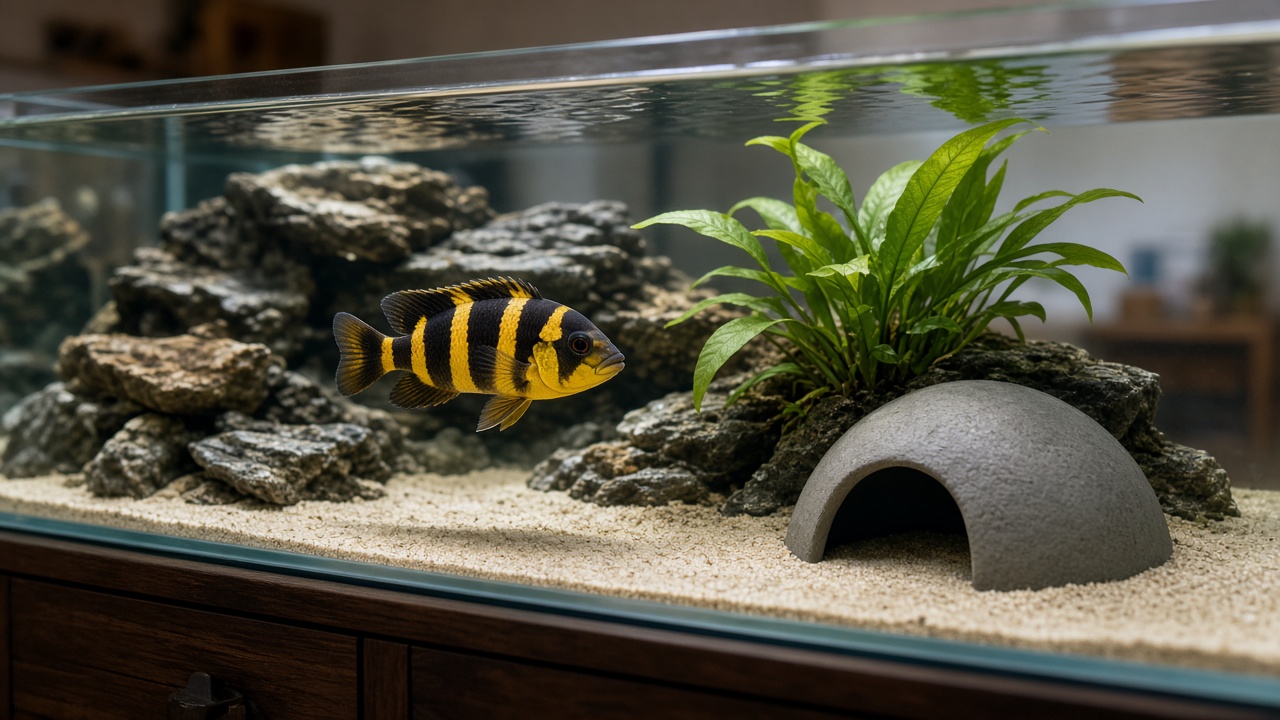
- Add sand and wood piles with one open swim lane, not a bare glass box.
- Install the Seachem Tidal 35 or another filter that publishes a 20-gallon-plus rating.
- Fill, dose Seachem Prime at 5 mL per 50 US gallons, and cycle until ammonia and nitrite read zero.
- Set the heater so water holds 22°C to 25°C (72°F to 77°F).
- Test pH with the API Freshwater Master Test Kit and stay inside 6.0 to 8.0.
- Add the pair after the cycle is done.
- Feed one labeled sinking staple pellet in the 1 mm to 1.5 mm range.
Leave a dark wood pile, because FishBase says this fearful fish pins itself to a log. Change water on a fixed day, and redose Prime only at the published 5 mL per 50 US gallons.
If you skip the cycle, you will chase ammonia instead of color.
FAQ
How big of a tank does a keyhole cichlid need?
Our 20-Gallon Pair Rule says 20 gallons is the smallest tank we will discuss for an adult pair. Seachem’s Tidal 35 page lists a ceiling of 35 US gallons, so a 20-gallon box sits inside that hardware range. A 10-gallon box does not meet our footprint rule.
How big do keyhole cichlids get?
FishBase lists a maximum of 7.1 cm standard length for a male or unsexed fish. That is about 2.8 inches on the snout-to-tail-base scale. We do not convert that figure into a larger total length, because FishBase does not publish one on that page.
What do keyhole cichlids eat?
FishBase says they feed on worms, crustaceans, and insects. Use a daily sinking cichlid pellet whose maker page lists protein we could read. New Life Spectrum Cichlid lists 37% protein and a 1 mm to 1.5 mm pellet. Omega One Cichlid Pellets Small Sinking lists 39.40% protein and 13.37% fat.
Can keyhole cichlids live with Malawi peacocks?
Not under our rule, because those fish do not share the same water plan. FishBase lists keyhole water at 22°C to 25°C and pH 6.0 to 8.0. An OB peacock is kept in hard, alkaline water, so pick one plan.
How many eggs do keyhole cichlids lay?
FishBase says parents tend about 400 eggs on a flat stone. The same page says the fish produces up to 600 eggs on hard substrate. Both parents guard eggs and larvae, and we do not add a hatch-day number FishBase does not print.
What temperature do keyhole cichlids need?
FishBase lists 22°C to 25°C, which is about 72°F to 77°F, so hold a heater in that band. Seachem’s Prime half-dose line of 86°F is an emergency conditioner note, not a target temperature.
Do I need Seachem Prime?
You need chlorine and chloramine removed from tap water. Seachem’s Prime page says to use 5 mL per 50 US gallons of new water, which is 2 mL on a 20-gallon fill. If your water is already treated by another labeled conditioner, read that maker page instead.