Quick answer: Keep one adult flowerhorn in a 75-gallon tank by itself. Feed a labeled cichlid pellet as the daily staple. Skip community fish and breeding pairs.
One adult flowerhorn cichlid belongs in a 75-gallon species-only tank, not a shared community tank. This page is a Waterpuppy research-desk brief on tank size, diet, kok, and aggression. We did not run tank trials, breed flowerhorns, or treat sick fish.
Our selection rule is the Solo 75-Gallon Rule. We cover one adult flowerhorn in a freshwater display of 75 gallons or more, kept alone. We leave out community mixes, breeding pairs, and grow-out tubs.
Our research team compared published filter and heater ranges, not tank trials. Fluval’s FX6 page lists a 400 US gallon capacity.
What a flowerhorn is, and what this page covers
A flowerhorn is a farm-bred hybrid sold for color and a nuchal kok.
It is not a wild fish with one official size chart. Sellers group these fish with New World cichlids because the parent lines come from Central and South America. The fish you buy is tank-bred, and that hybrid status is why we use a hard cutoff.
This page covers four jobs only:
- Tank volume from our Solo 75-Gallon Rule
- Filter and heater capacity from maker pages
- Diet labels we could read in full
- Kok and aggression as husbandry limits, not medical claims
A flowerhorn is also not an OB peacock cichlid. That Malawi hybrid can share a 75-gallon tank with females. A flowerhorn under this rule cannot.
The Solo 75-Gallon Rule
We only write for one adult in a 75-gallon or larger box.
A flowerhorn holds the whole tank, so other fish have no path around it. A short tank removes that path.
Our research team compared published kit ranges, not tank trials. Fluval’s E300 Electronic Heater page lists a capacity up to 100 US gallons.
That ceiling is 100 gallons, and our rule is stricter on purpose. We use 75 gallons as the smallest display we will discuss.
The same Fluval compare table lists the E200 Electronic Heater at up to 65 US gallons. That 65-gallon ceiling sits 10 gallons under our floor, so the E200 is out.
Use this volume check:
- One adult flowerhorn, alone: 75 gallons
- A plan with tank mates: skip it on this page
- A breeding pair: skip it on this page
- A juvenile in a grow-out tub: skip it on this page
Do not scale down for a juvenile. The rule is for the adult fish you intend to keep.
A 75-gallon box gives more footprint than a tall 50-gallon column. Footprint is the number that matters for a fish that patrols walls.
Filter and heater numbers we can cite
A 75-gallon flowerhorn tank needs oversized filtration and a heater rated for 75 gallons.
Fluval’s FX6 page lists these working numbers:
- Aquarium capacity: 400 US gallons
- Pump output (120 V / 60 Hz): 925 US GPH
- Filter circulation (120 V / 60 Hz): 563 US GPH
Comparing those published specs, listed circulation sits 362 US GPH below pump output. That is about 39 percent lower once the canister is treated as a working filter. The 400-gallon ceiling leaves 325 gallons of unused listed room above our floor.
Fluval’s E300 page lists these heat numbers:
- Wattage (120 V / 60 Hz): 300W
- Aquarium capacity: up to 100 US gallons
- Minimum setting: 68°F
- Maximum setting: 93°F
- Step size: 0.5 degrees
We do not invent a flowerhorn Fahrenheit target. No source in our set publishes one for this hybrid. Pick a stable set point inside Fluval’s 68°F to 93°F band, then leave it there.
The E300’s 100-gallon ceiling covers our 75-gallon floor with 25 gallons of listed headroom. Fluval’s E200, at 65 gallons, does not.
We do not state a pH number here. No source in our set publishes one for this hybrid. Test with a kit you already trust, and keep the reading stable.
Diet: read the label, then pick a pellet
University of Florida IFAS treats aquarium foods as specialty pet foods and tells keepers to compare labels.
That is the Label-First Pellet Check. We do not rank flavors. We compare published protein, fat, fiber, moisture, and pellet size.
University of Florida IFAS, in “Interpreting a Fish Food Package Label,” says ornamental aquarium fishes are specialty pet foods. The same page says labels follow FDA rules and AAFCO guidelines. IFAS says those guaranteed analysis values track National Research Council profiles for catfish and salmonids.
University of Florida IFAS gives these typical ranges for production fish feeds:
- Crude protein: 36% to 42%
- Lipid: 6% to 15%
- Crude fiber: 3% to 5%
The same page says tropical aquarium feeds typically list 35% to 50% protein. It says dry pellets often hold about 13% moisture or less, and that fiber above 8% has low feeding value.
IFAS states most feed ingredients average 16% nitrogen. The page uses the factor 6.25 for crude protein.
Our research team compared three maker pages against those IFAS bands. All three protein minima sit inside the 35% to 50% tropical range.
Hikari’s Cichlid Gold page lists Mini, Medium, and Large pellets as follows:
- Crude protein: 40% minimum
- Crude fat: 4% minimum
- Medium pellet size: about 4.8 to 5.3 mm
- Large pellet size: about 7.2 to 8.2 mm
Baby pellets on the same Hikari page drop to a minimum of 32% protein. That is an 8-point drop from the adult spec. Do not treat the baby number as the adult spec.
Hikari’s Cichlid Gold feeding note says to feed two to three times daily. Feed only the amount the fish will finish in a few minutes, then remove leftovers.
NorthFin’s Cichlid Formula page lists these figures:
- Crude protein: 40% minimum
- Crude fat: 5% minimum
- Crude fiber: 5% maximum
- Pellet sizes: 1 mm, 2 mm, and 3 mm, slow sinking
Omega Sea’s page for Omega One Cichlid Pellets Large Sinking lists these figures:
- Crude protein: 42% minimum
- Crude fat: 12% minimum
- Crude fiber: 2.0% maximum
- Moisture: 8.5% maximum
Comparing those three protein minima gives a 2-point spread: 40%, 40%, and 42%. Comparing fat minima gives an 8-point spread: 4%, 5%, and 12%.
Hikari’s 4% fat sits 2 points below the IFAS 6% to 15% production-lipid band. NorthFin’s 5% fat sits 1 point below that same floor. Omega One’s 12% fat sits inside that IFAS lipid band.
All three fiber maxima stay under the IFAS 8% warning line. Omega One’s 8.5% moisture sits under the IFAS 13% dry-pellet line.
A floating 4.8 to 5.3 mm Hikari pellet suits a large adult mouth. A 3 mm NorthFin pellet is the largest size on that maker page. Feed one staple pellet, not five random snacks.
Published specs for five products we actually read
Our research team compared maker-published numbers for three pellets, one canister filter, and one heater.
We picked products that are sold now and that have a full HTML maker page.
| Product | Type | Maker-published number | Second published number |
|---|---|---|---|
| Hikari Cichlid Gold Medium Floating Pellets | Daily floating pellet | 40% min crude protein | 4.8–5.3 mm pellet |
| Northfin Cichlid Formula | Daily slow-sinking pellet | 40% min crude protein | 1 mm, 2 mm, or 3 mm pellet |
| Omega One Cichlid Pellets Large Sinking | Daily sinking pellet | 42% min crude protein | 12% min crude fat |
| Fluval FX6 Canister Filter | Canister filter | 400 US gal rating | 925 US GPH pump / 563 US GPH circulation |
| Fluval E300 Electronic Heater | Submersible heater | 300W / up to 100 US gal | 68–93°F setting range |
The Hikari row is here because a large adult mouth can take a 4.8 to 5.3 mm float. The NorthFin row is here because a 3 mm slow sinker puts 40% protein lower in the water. The Omega One row is here because 42% protein and 12% fat sit inside both IFAS bands.
The Fluval FX6 row is here because a 75-gallon display needs a filter rated at or above that volume. Fluval’s own ceiling is 400 gallons. The E300 row is here because heat is a number you can set.
Kok and aggression under this rule
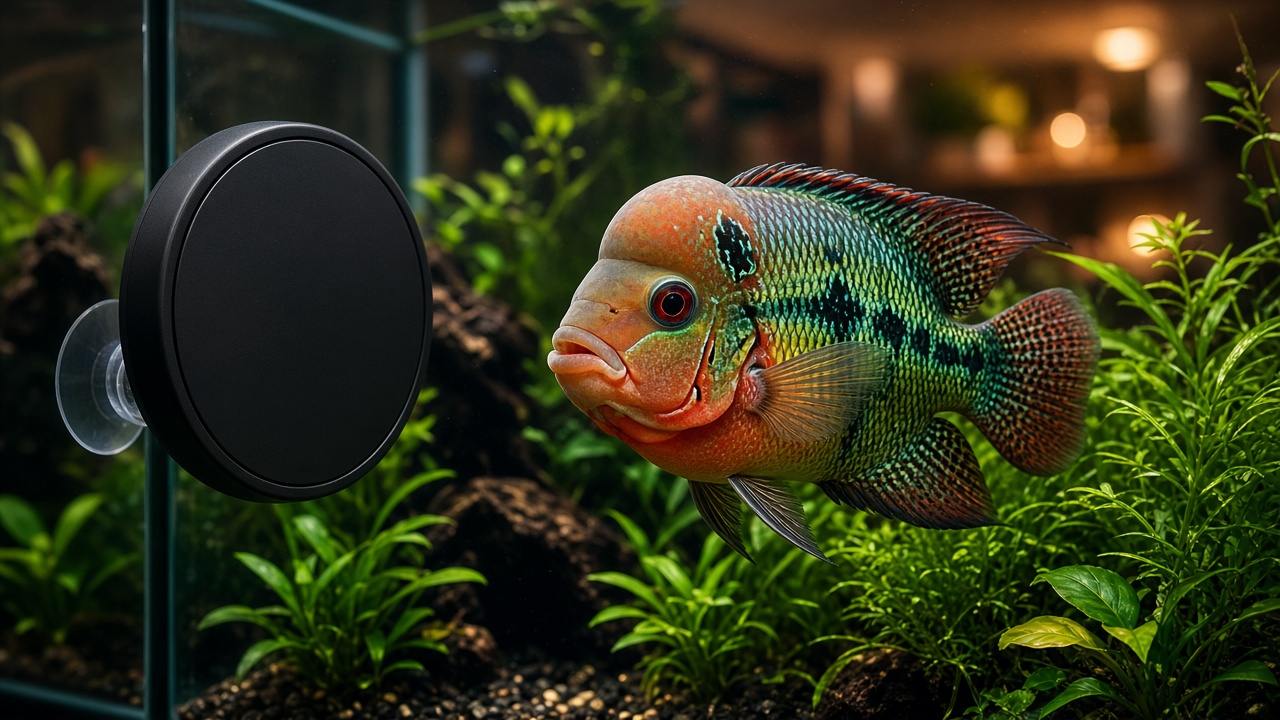
Kok is a nuchal hump on the forehead, and aggression is why this page keeps the fish alone.
We did not measure kok growth, dose kok supplements, or score fights. We only set the husbandry limit that follows from the Solo 75-Gallon Rule.
Use this kok check:
- Yes: a farm-bred adult with a visible head bump in a 75-gallon species-only tank
- No: a claim that one pellet brand grows a kok by a set number of millimeters
Color and kok are farm traits, not a wild-type chart you can copy from a lake paper.
Use this aggression check:
- Yes: one adult, no tank mates, open swim room
- No: tetras, guppies, shrimp, or other small fish
- No: a second flowerhorn in the same 75-gallon box
- No: a “robust community” plan copied from a different cichlid page
An OB peacock can share space with females in 75 gallons. A flowerhorn holds the glass, the sand, and the filter intake. That is why mates fail this rule.
If you already added a second fish, this page does not cover that setup.
A simple setup sequence
Cycle the tank, set a stable heater point, then add one flowerhorn and no other fish.
Do the work in this order:
- Place a 75-gallon or larger tank on a stand rated for the full weight.
- Add a simple hardscape with open swim lanes, not a packed rock wall.
- Install the Fluval FX6 or another filter that publishes a 75-gallon-plus rating.
- Install the Fluval E300, not the E200, because 65 gallons is below our floor.
- Fill, dechlorinate, and cycle until ammonia and nitrite read zero.
- Set the E300 inside Fluval’s 68°F to 93°F band and leave that number alone.
- Add one flowerhorn after the cycle is done.
- Feed one labeled staple pellet and match pellet size to mouth size.
Leave a bright open center, because this fish displays in the open. Change water on a fixed day. If you skip the cycle, you will chase ammonia instead of color.
Hikari’s note is two to three short feedings a day. Stay with small portions the fish finish.
FAQ
How big of a tank does a flowerhorn cichlid need?
Our Solo 75-Gallon Rule says 75 gallons is the smallest tank we will discuss for an adult. Fluval’s FX6 page lists a 400 US gallon capacity. A 50-gallon box can hold a heater, but it fails our footprint rule.
Can I keep a flowerhorn in a 55-gallon tank?
This page does not cover 55-gallon setups. Fluval’s E200 lists a 65-gallon ceiling, and even that sits under our 75-gallon floor. If you already own a 55, plan a move to 75 gallons before the fish is full size.
What do flowerhorn cichlids eat?
Use a daily cichlid pellet whose maker page lists protein in the University of Florida IFAS tropical band of 35% to 50%. Hikari Cichlid Gold Mini, Medium, and Large lists 40% protein. Northfin Cichlid Formula lists 40%, and Omega One Cichlid Pellets Large Sinking lists 42%.
Can flowerhorns live with other fish?
Not under our rule, because one adult holds the whole 75-gallon box. Small community fish have no escape path. A second flowerhorn splits that same box and starts a chase.
What is a flowerhorn kok?
Kok is the nuchal hump on the forehead, and it is a farm trait, not a wild-lake measurement. We did not measure kok height. Do not treat any pellet in our table as a kok-size dose.
Do I need the Fluval FX6 and the Fluval E300?
You need a filter rated at or above 75 gallons, and a heater whose published ceiling covers 75 gallons. Fluval’s FX6 lists 400 gallons and 563 US GPH of circulation. Fluval’s E300 lists 300W and a 100-gallon ceiling.
Is a flowerhorn the same as an OB peacock?
No. A flowerhorn is a New World farm hybrid kept alone under this rule. An OB peacock is a Malawi hybrid that can share a 75-gallon tank with females.