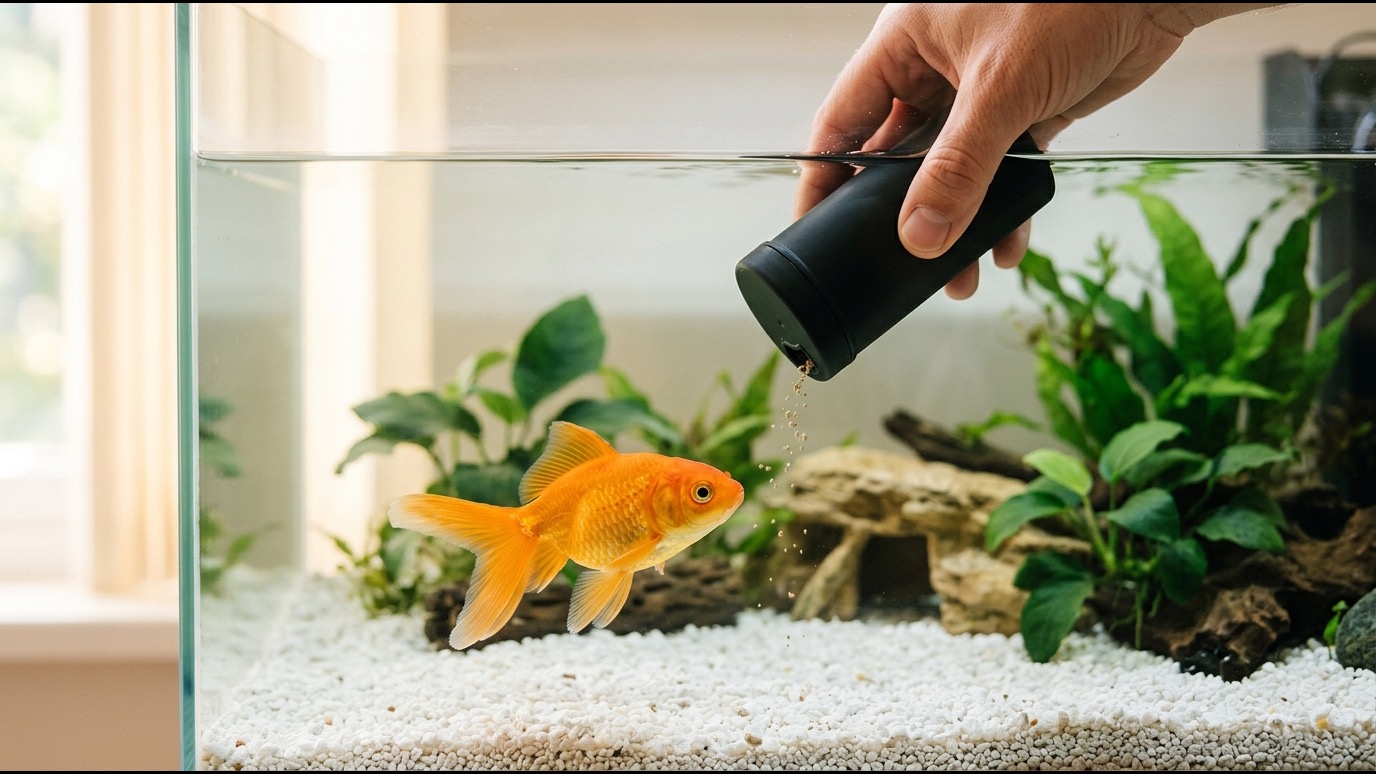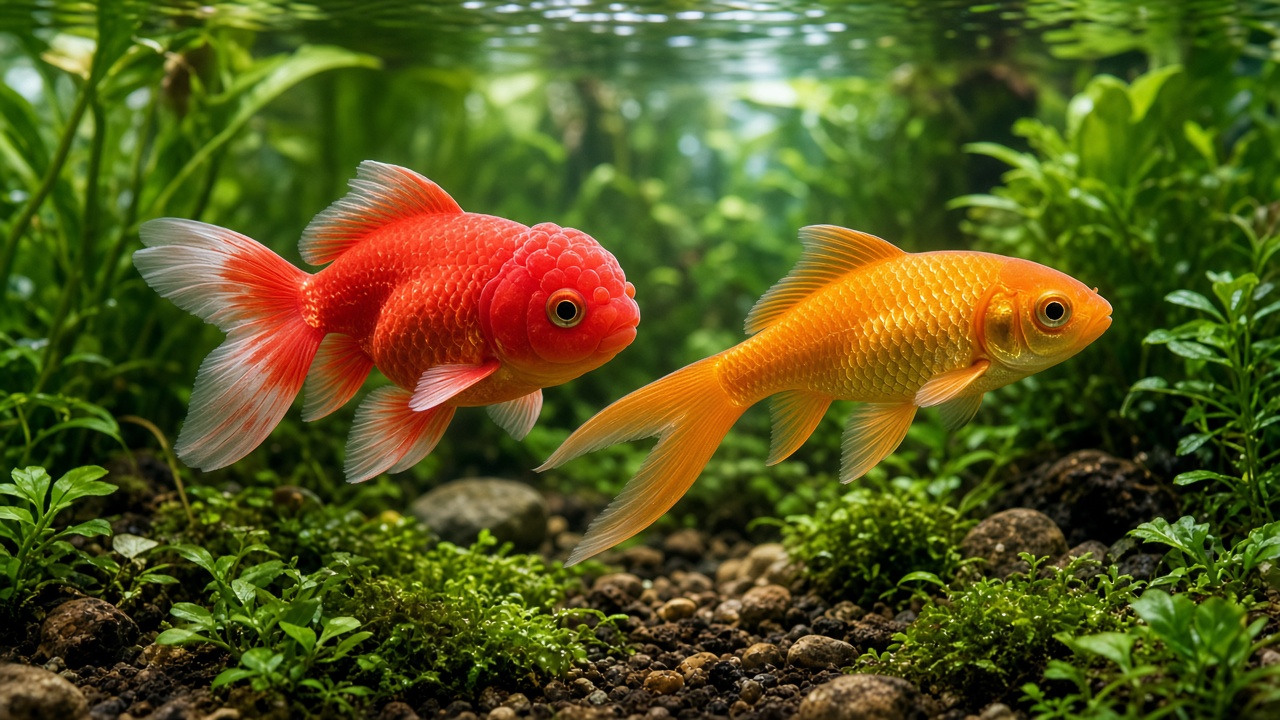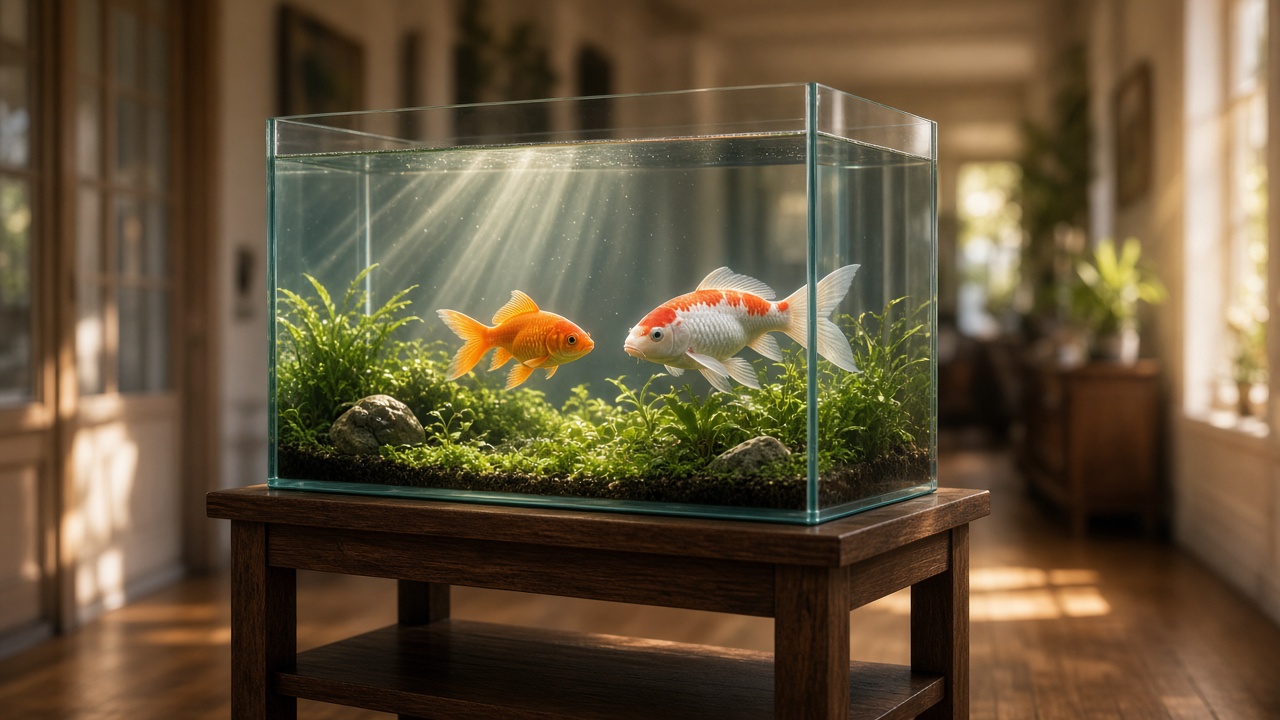
Quick answer: Do not keep a goldfish in a bowl. Use a filtered glass tank of at least 29 US gallons for one adult. A 20-gallon kit is only a short starter for one young fancy fish.
One adult goldfish needs at least 100 liters of filtered tank water, not a bowl.
This page is a housing guide built from published care rules and maker-listed kit specs.
Our selection rule compared only currently sold rectangular glass kits whose maker pages list a volume and a named filter. We left out bowls, hex tanks, and kits with no maker-listed filter.
Why a goldfish bowl fails
A bowl lacks the water volume and the filter that an adult goldfish needs.
The Ornamental Aquatic Trade Association (OATA) says a filter is always essential, and most bowls ship with no filter at all. OATA’s goldfish care sheet also says goldfish can reach 25 cm in tanks, with some reports past 40 cm.
A table bowl cannot hold a fish that long. Waste is the other hard limit, because goldfish dump ammonia into a tiny volume of water.
The Merck Veterinary Manual lists total ammonia nitrogen at 0 mg/L as the freshwater target. It lists toxic un-ionized ammonia at 0 mg/L too.
Merck also states that 0.05 mg/L of un-ionized ammonia is enough to change gill tissue. A bowl gives you almost no room before that line is crossed.
Low oxygen makes the same small volume worse. Merck lists dissolved oxygen above 5 mg/L as the useful floor for most finfish, and fish show stress below that mark.
A bowl has a small surface and no pump, so gas exchange stays weak and the fish then gasp at the top. OATA’s unheated-tank sheet says goldfish are often incorrectly sold for small unheated setups, and that habit does not match the 100-liter adult rule.
The 100-liter adult rule
OATA sets a 100-liter floor for one adult and adds 50 liters for each extra adult.
Those numbers convert to about 26 US gallons for the first adult. Add about 13 US gallons for each extra adult.
OATA also says to buy a tank that can hold the fish when grown. If you start smaller, you must plan a later upgrade.
OATA lists a common tank life of 6 to 8 years and also notes reports of 20 years or more. A bowl plan treats a long-lived fish like a short display.
The same OATA sheet names the fish Carassius auratus and says non-fancy types can move to an outdoor ornamental pond. Commons and comets are pond fish, not bowl fish.
Our research team analyzed listed volumes on the kit pages below. We compared each listed US-gallon figure with OATA’s 100-liter adult floor and call that check the WaterPuppy Kit Volume Check.
Rounded conversions from those listed gallons are:
- 10 US gallons is about 38 liters
- 20 US gallons is about 76 liters
- 29 US gallons is about 110 liters
- 55 US gallons is about 208 liters
Only the last two clear the 100-liter floor. A 20-gallon kit sits about 24 liters short.
Kits that clear the floor, and kits that do not
Only kits at 29 US gallons and up clear OATA’s adult floor in this set.
Aqueon’s Rectangle LED Kits page lists four sizes: 10, 20 High, 29, and 55. Each kit names a QuietFlow LED PRO power filter and a preset heater set to 78 degrees.
Tetra’s Complete LED Aquarium Kit 20 Gal page lists a 20-gallon glass tank that measures 24 inches by 12 inches by 16 inches. The kit names a Tetra Whisper PF 20 Power Filter and a 100-watt heater.
Tetra’s Whisper Power Filter page lists the PF 20 at 105 GPH.
| Kit | Maker-listed volume | Volume in liters | Filter named by maker | Heater on kit page | Clears OATA 100-liter adult floor |
|---|---|---|---|---|---|
| Aqueon Rectangle LED Kit 10 | 10 US gal | 38 L | QuietFlow LED PRO | Preset 78°F | No |
| Aqueon Rectangle LED Kit 20 High | 20 US gal | 76 L | QuietFlow LED PRO | Preset 78°F | No |
| Tetra Complete LED Aquarium Kit 20 Gal | 20 US gal | 76 L | Whisper PF 20 (105 GPH) | 100-watt | No |
| Aqueon Rectangle LED Kit 29 | 29 US gal | 110 L | QuietFlow LED PRO | Preset 78°F | Yes |
| Aqueon Rectangle LED Kit 55 | 55 US gal | 208 L | QuietFlow LED PRO | Preset 78°F | Yes |
The WaterPuppy Kit Volume Check found 2 of these 5 kits above the adult floor. That is 40 percent of the set.
The Aqueon Rectangle LED Kit 29 is the smallest kit in this set that clears 100 liters. The Aqueon Rectangle LED Kit 55 more than doubles that floor.
Use a 20-gallon kit only as a short home for one young fancy fish. Plan the 29-gallon step before the fish fills the 20.
Do not use the Aqueon Rectangle LED Kit 10 for goldfish. It holds about 62 liters less than OATA’s adult floor.
Aqueon’s kit page says gravel and décor are sold separately. Budget those parts on top of the glass box.
Filters, heaters, and water tests
Use the kit filter, and leave the tropical preset heater off for goldfish.
OATA’s goldfish sheet says a filter is always essential, at any tank size. Aqueon’s kit page describes five-stage filtration and an ammonia specialty pad.
Tetra’s 20-gallon kit page names the Whisper PF 20 and a Large Bio-Bag cartridge. Tetra’s Whisper page lists 105 GPH for the PF 20, which is about five turns of a 20-gallon tank in one hour.
Goldfish still need water changes, because a filter does not replace them.
Aqueon’s kit page says the preset heater holds 78 degrees and is for most tropical fish. OATA’s unheated-tank sheet says tropical species need at least 22°C, which is about 72°F.
Goldfish are sold as coldwater fish, so do not run that 78°F preset as a default. Leave the heater unplugged unless your room drops toward freezing.
Merck’s freshwater table is the test card we used:
- Dissolved oxygen: above 5 mg/L
- Total ammonia nitrogen: 0 mg/L
- Toxic un-ionized ammonia: 0 mg/L
- Nitrite: 0 mg/L
- Nitrate: under 20 mg/L
- pH: 6.5 to 9.0
- Total chlorine: 0 mg/L
Merck also notes chlorine harm at 0.02 mg/L and death at 0.04 mg/L. Treat every tap fill before it touches the tank.
Merck says un-ionized ammonia above 1 mg/L, with pH above 8, can kill fish fast. That pairing is “new tank syndrome” on Merck’s hazard table.
Test the water, and do not guess from smell or color.
How to move a goldfish out of a bowl
Cycle a large tank first, then move the fish with matched water.
Buy the Aqueon Rectangle LED Kit 29 or the Aqueon Rectangle LED Kit 55 if you want one adult to stay put. Set the tank on a stand rated for a full glass box.
Run this setup order:
- Wash the glass with water only. Use no soap.
- Place the tank, then add dechlorinated water.
- Hang the named kit filter and start it.
- Leave the preset heater off for goldfish.
- Cycle the tank until ammonia and nitrite read 0 mg/L on a liquid test.
- Match temperature between the bowl and the new tank.
- Net the fish and move it in a bag or bucket of its old water.
- Float the bag, then mix new water in slowly.
- Release the fish and keep the light low for a day.
Keep the first weeks quiet, and change water when tests rise, not on a fixed guess.
If you have a common or comet, treat the 29-gallon kit as a stop, not a forever home. OATA says those non-fancy fish can move to a pond.
Color changes, stress signs, and tankmates
Color shifts often track water quality, and most tropical fish do not belong with goldfish.
Merck lists darkened color as a sign of ammonia trouble. If a fish turns dark after a bowl week, test ammonia first.
See our page on why a goldfish turns black. Black patches can follow ammonia burns or healing scale damage.
Pale or white patches have a different list. See why goldfish turn white. Poor water and sudden temperature swings both show up there.
Merck lists piping at the surface as a low-oxygen or nitrite sign. Brown gills can track nitrite above 0.1 mg/L on Merck’s table.
Watch for these bowl-failure signs:
- Gasping at the surface
- Clamped fins
- Sitting on the bottom
- Fast gill beats
- Cloudy water within a day of feeding
OATA’s goldfish sheet says larger water is more stable, which is why a 55-gallon kit is easier to hold than a 10. If you want company for the fish, read what fish can live with goldfish.
Skip tropical community fish, because they need the heat that goldfish do not.
Do not add a second goldfish until you can add 50 liters. That is OATA’s extra-adult rule, so two adults need about 150 liters, or about 40 US gallons.
FAQ
Can a goldfish live in a bowl if I change the water every day?
No. Daily changes do not add a filter or 100 liters of water, and OATA’s goldfish sheet still requires a filter at every size. Merck’s ammonia target is still 0 mg/L, so a bowl keeps you on a knife edge even with hard work.
Is a 20-gallon tank enough for one goldfish?
It is a short starter for one young fancy fish, not an adult home. Tetra’s Complete LED Aquarium Kit 20 Gal is a real 20-gallon box with a Whisper PF 20. It still sits about 24 liters under OATA’s 100-liter adult floor.
Which kit in this article meets the adult rule?
The Aqueon Rectangle LED Kit 29 and the Aqueon Rectangle LED Kit 55 both clear 100 liters. The 29-gallon kit is about 110 liters, and the 55-gallon kit is about 208 liters. Both include a QuietFlow LED PRO filter on Aqueon’s kit page.
Should I use the heater that comes in the kit?
Not as a goldfish default. Aqueon’s kit page sets that heater at 78°F for tropical fish. OATA’s unheated-tank sheet puts the tropical floor near 22°C, about 72°F, so goldfish do better in a cool room than on that preset.
How many goldfish can go in a 55-gallon tank?
OATA’s math is 100 liters for the first adult and 50 liters for each extra adult. A 55-gallon tank is about 208 liters, which is room for the first adult plus one extra adult, with a small buffer. Do not add a third adult on that sheet’s numbers.
Why does my goldfish gasp at the top of a bowl?
Low oxygen and high waste both drive that behavior. Merck lists piping as a low-oxygen or nitrite sign, and Merck’s useful oxygen floor is above 5 mg/L. A bowl has little surface and no listed pump.
Can I keep a goldfish in a vase or a small desktop tank instead?
No. Those vessels fail the same 100-liter rule, and OATA’s unheated-tank sheet already flags small unheated setups as a common goldfish mistake. Buy a filtered rectangle kit at 29 US gallons or larger.