Quick answer: Test pond water every week and skim floating debris the same day. Backwash or rinse the filter once a month. Change feeding and ice work when the water temperature moves, not when the calendar month changes.
A stocked backyard pond needs a weekly water test and a monthly filter clean.
This page is a lined yard-pond schedule built from maker labels and Penn State Extension figures.
Penn State Extension surveyed 557 pond owners, and aesthetic beauty was the top use at 45 percent. Fishing was second at 21 percent, so both uses need steady water rather than one yearly drain.
How we chose what this schedule covers
We only cover lined backyard ponds under 3,500 gallons that already have a pump and a filter.
That cutoff matches the Aquascape page for the UltraKlean 3500, which lists 3,500 gallons as the average pond size. Larger farm ponds need dam work that this desk does not cover.
Selection rule: a task is in this article if a backyard keeper can do it on a weekly, monthly, or seasonal clock. A product is out if it is a farm-pond chemical, a swim-pond sanitizer, or gear sized above 3,500 gallons.
We also skip indoor aquariums except as a comparison, because a classroom tank and a pond share fish waste. They do not share ice, leaf fall, or outdoor UV clarifiers.
Our research team analyzed published specs from API and Aquascape, then lined those numbers up with Penn State Extension water-quality figures.
Weekly pond tasks
The weekly block is a water test, a debris skim, and a running-gear check.
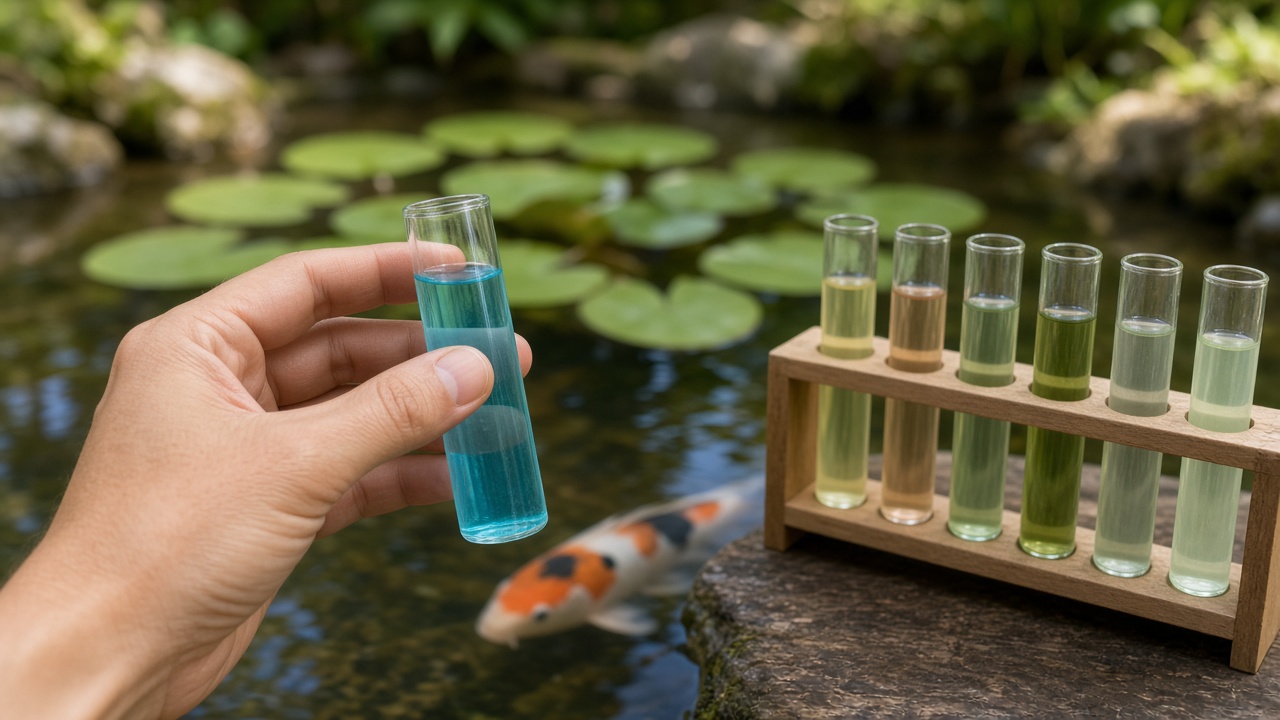
API’s page for the Pond Liquid Master Test Kit says to test weekly and to measure pH, ammonia, nitrite, and phosphate. The same page says the kit holds supplies for over 500 tests.
Do the weekly block in this order:
- Test pH, ammonia, nitrite, and phosphate before you add any treatment.
- Skim leaves, uneaten food, and dead plant bits from the surface.
- Clear any clog on the pump cage and the skimmer basket.
- Confirm the waterfall, fountain, or air stone is still moving water.
- Top off evaporated water only after you treat new tap water.
API’s page for Pond Accu-Clear lists a weekly dose when water stays cloudy. The listed dose is 30 ml, or 2 tablespoons, per 150 US gallons. The same page says to wait 24 hours before a second dose.
Do not shut the pump off at night, because API’s Accu-Clear page says aeration must run at all times. It also warns that hot summer water already holds little oxygen.
Write the four test readings in a notebook so one odd day does not drive a panic dose. Two high weeks in a row means you change feeding and aeration.
Monthly pond tasks
The monthly block is a filter clean plus a closer look at hoses, UV gear, and plants.
Aquascape’s UltraKlean page says the self-cleaning backwash takes less than five minutes and does not require opening the canister. A cleaning light tells you when the media is packed.
Do the monthly block in this order:
- Backwash the pressure filter, or rinse mechanical pads in a bucket of pond water.
- Inspect hose clamps and the pump discharge for kinks, cracks, and leaks.
- Check that the UV clarifier still lights, and replace a dead bulb before summer.
- Trim dead leaves on marginal plants and remove rotting stems from the water.
- Dose sludge bacteria on the maker’s two-week clock if sludge is building.
API’s page for Pond EcoFix Sludge Destroyer lists a start-up dose of 60 ml per 250 US gallons. That start-up dose is 4 tablespoons, given twice a week for two weeks. After that start-up, the same page lists 30 ml per 250 US gallons every two weeks.
Rinse pads in pond water, not tap water, because tap chlorine can knock back the bacteria film you just spent a month growing.
If you keep an indoor tank as well, the monthly filter habit looks familiar. Outdoor pressure canisters are not the same hardware as indoor canister filter picks. The outdoor unit sits in weather and takes UV load that a living-room canister never sees.
Seasonal shifts by water temperature
Use a thermometer, not a calendar month, to change feeding and winter setup.
Penn State Extension says to check temperature and dissolved oxygen when they are likely at their worst. That window is usually July through September.
Spring restart
Wait for the water to climb before you restart heavy feeding. Penn State Extension says largemouth bass spawn when water reaches 60°F, and bluegills spawn later at 67 to 80°F.
Spring start-up list:
- Restart the pump and the filter after a visual check of cords and seals.
- Run the API weekly tests for two weeks in a row before you raise fish food volume.
- Use the EcoFix start-up dose if sludge sat on the liner all winter.
- Add plants only after the filter is moving water again.
Low-maintenance planted-aquarium plants pull nitrate in a tank, and pond plants do the same job outdoors. They do not replace a weekly test.
Summer heat
Penn State Extension says warmwater fish such as bass and bluegill prefer water in the 70s and 80s. The same page says trout grow best at 55 to 60°F and can take only short spells above 75°F.
Summer list:
- Test in the morning, when oxygen is often lowest after a still night.
- Keep the pump and any air stone running overnight.
- Add shade with floating plants or a partial cover over open water.
- Treat new tap water before every top-off.
If you dose a plant killer, Penn State Extension says to treat only one-third of the pond at one time. Wait at least one week between those treatments, because fast plant decay uses oxygen.
Fall leaf control
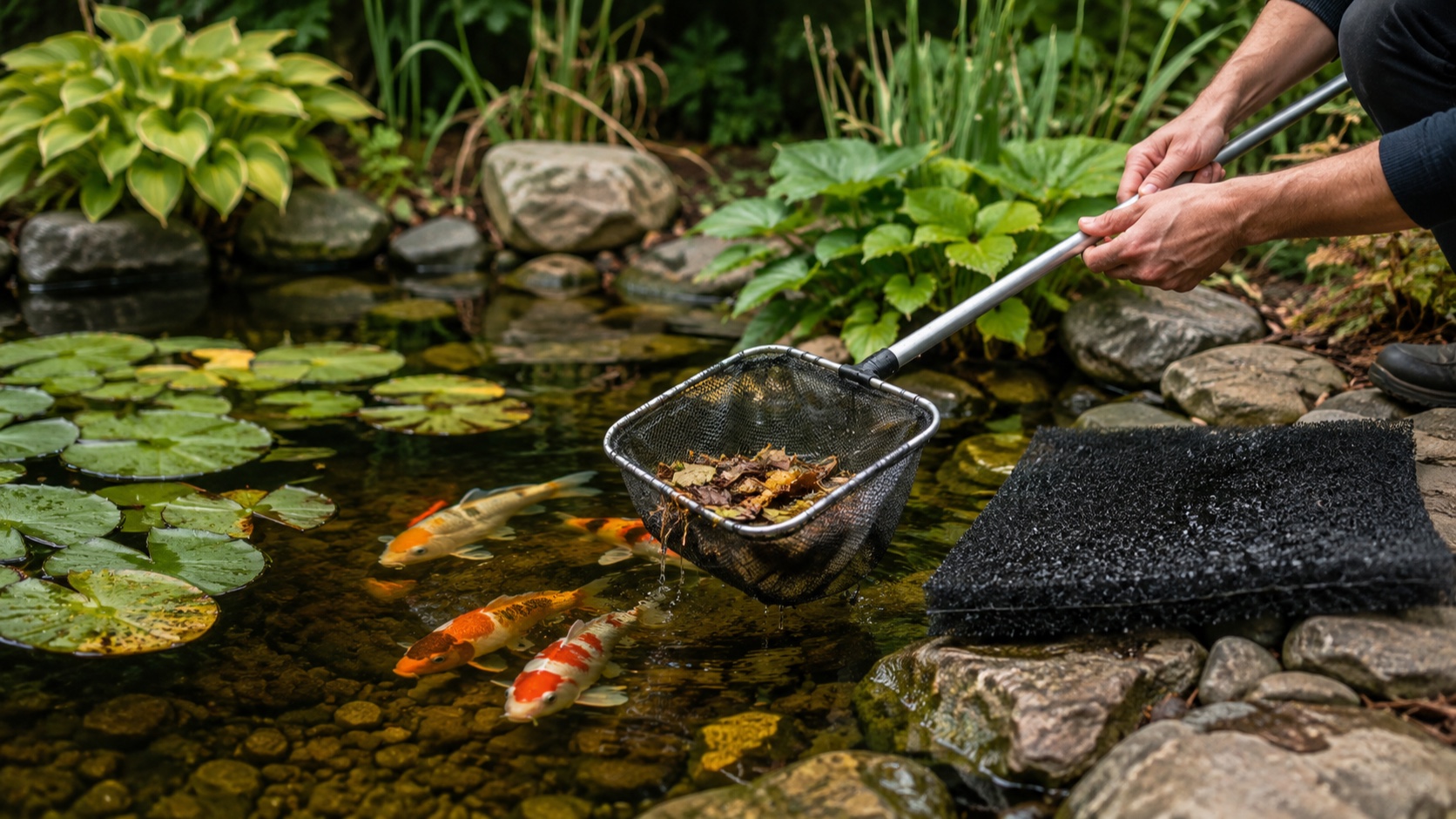
Net the pond before the first heavy leaf drop, because leaves on the liner become sludge that then feeds algae next spring.
Fall list:
- Install a leaf net and empty it after windy days.
- Cut back dying plant stems so they do not sink and rot.
- Reduce feeding as the water cools and leftover pellets stay uneaten.
- Run the EcoFix end-of-season dose listed on the API page.
Winter ice
Leave a hole in the ice so gas can leave the water, and do not smash the whole sheet. The shock can stress fish.
Winter list:
- Stop feeding when leftover food sits on the bottom instead of being eaten.
- Keep an aerator or de-icer opening one small patch of water.
- Leave the biological filter media wet if you pull the pump for frost.
- Stay off thin ice, because this desk does not set a safe-walk thickness.
A classroom fish tank never faces ice, but a backyard pond does. That is why the seasonal block exists.
Water-quality numbers that trigger action
Penn State Extension lists the pH and oxygen numbers that tell you to act.
Use these published figures as action limits, not as a diagnosis:
- Most fish species prefer pH from 6 to 9, per Penn State Extension.
- Trout need a dissolved-oxygen safe minimum of 5 parts per million.
- Warmwater fish need at least 3 parts per million dissolved oxygen.
- A pH under 6 may stunt or shrink a fish population, per the same page.
API’s Pond Liquid Master Test Kit does not measure dissolved oxygen. It measures pH, ammonia, nitrite, and phosphate, so add a separate oxygen check in July through September if you keep trout.
Act on the numbers this way:
- If pH sits outside 6 to 9, stop adding random treatments and retest the next day.
- If ammonia or nitrite reads above zero on two weekly tests, increase aeration and cut feeding.
- If phosphate keeps climbing, skim more debris and check the EcoFix two-week dose.
- If fish gasp at dawn, add air at once and skip any plant-killer dose that week.
This desk compares published numbers and does not treat sick fish.
Gear that matches this schedule
Our research team compared published specs for six currently sold products that fit this routine.
We picked gear that maps onto the weekly, monthly, or seasonal block. We left out farm-pond alum treatments and indoor-only test kits.
Comparing published specs, the Aquascape UltraKlean 2000 lists a 2,700 GPH max flow, and the AquaForce 2700 lists 2,695 GPH. Aquascape’s own UltraKlean 2500 kit pairs those two units, which is why both names appear here.
| Product | Role on this schedule | Maker-listed capacity | Key listed spec | Maker-listed service cue |
|---|---|---|---|---|
| API Pond Liquid Master Test Kit | Weekly water test | Over 500 tests | pH, ammonia, nitrite, phosphate | Test weekly |
| API Pond Accu-Clear | Weekly cloudy-water dose | 30 ml per 150 US gallons | Wait 24 hours before a second dose | Dose weekly |
| API Pond EcoFix Sludge Destroyer | Seasonal start, then every 2 weeks | 60 ml per 250 US gallons at start-up | Then 30 ml per 250 US gallons | Every 2 weeks after start-up |
| Aquascape UltraKlean 2000 | Monthly backwash filter | 2,000 gallons average pond size | 14-watt UV; 2,700 GPH max flow | Backwash in less than 5 minutes |
| Aquascape UltraKlean 3500 | Monthly backwash filter | 3,500 gallons average pond size | 28-watt UV; 5,200 GPH max flow | Same backwash design |
| Aquascape AquaForce 2700 | Weekly pump-cage check | 2,695 GPH max flow | 147 watts; 14-foot max head; 25-foot cord | Handles solids up to 1/4 inch |
Aquascape’s UltraKlean page also lists a UV bulb-saver timer with 6-hour, 12-hour, or 24-hour options. Use that pause when you add bacteria so UV does not hit a fresh dose at once.
The AquaForce 2700 page lists a 14 by 14 by 6.5 inch cage, so check that cage on the weekly walk.
API Accu-Clear bottles are listed in 16-ounce, 32-ounce, 64-ounce, and 1-gallon sizes. EcoFix is listed in 16-ounce, 64-ounce, and 1-gallon sizes. Pick the bottle that matches your gallon math, and keep it out of full sun.
FAQ
How often should I clean a pond filter?
Clean mechanical pads or backwash a pressure filter once a month, or sooner if the maker’s cleaning light turns on. Aquascape’s UltraKlean page says a backwash takes less than five minutes and does not require opening the canister. Rinse pads in pond water so you do not strip the bacteria film.
Do I need a full water change every week?
No weekly full drain belongs on this schedule, because API’s test-kit page asks for a weekly test, not a weekly empty. Top off evaporation with treated tap water. If ammonia or nitrite stays high for two weeks, increase aeration and cut food before you dump a large refill.
What temperature should I use to change feeding?
Use a thermometer in the pond, not the air. Penn State Extension says trout do best at 55 to 60°F and suffer in long spells above 75°F. Warmwater fish prefer the 70s and 80s, so feed less as leftover pellets start to sit.
Can I shut the pump off at night to save power?
No. API’s Accu-Clear page says not to shut off pond pumps and aeration devices at night. Summer water already holds little oxygen, and a still pond at dawn is when fish gasp.
How do I handle green water in summer?
Test first, then keep the pump running and skim debris. Aquascape’s UltraKlean page says the UV bulb targets single-celled algae that make green water. API Accu-Clear clumps dirt and silt, and it is not a stand-in for a working UV bulb.
Is a backyard pond harder than a classroom tank?
A pond adds ice, leaves, and UV gear that a classroom tank never sees. A classroom fish setup still needs the same weekly test habit. The pond just adds the monthly filter walk and the seasonal net.
Do I need a pressure filter or an indoor canister?
A backyard pond needs outdoor-rated filtration with a pump that can move solids. Indoor canister filter picks are built for glass tanks, not leaf load. Comparing published specs, the UltraKlean 2000 is listed for a 2,000-gallon pond.