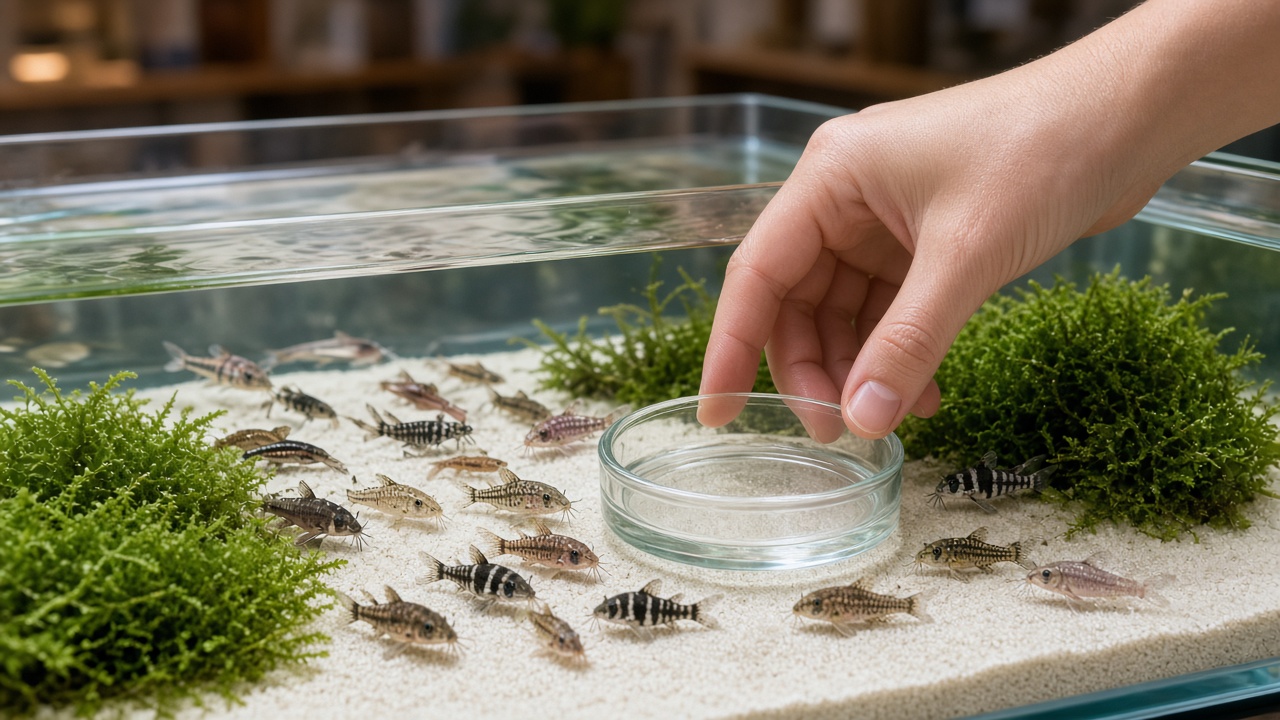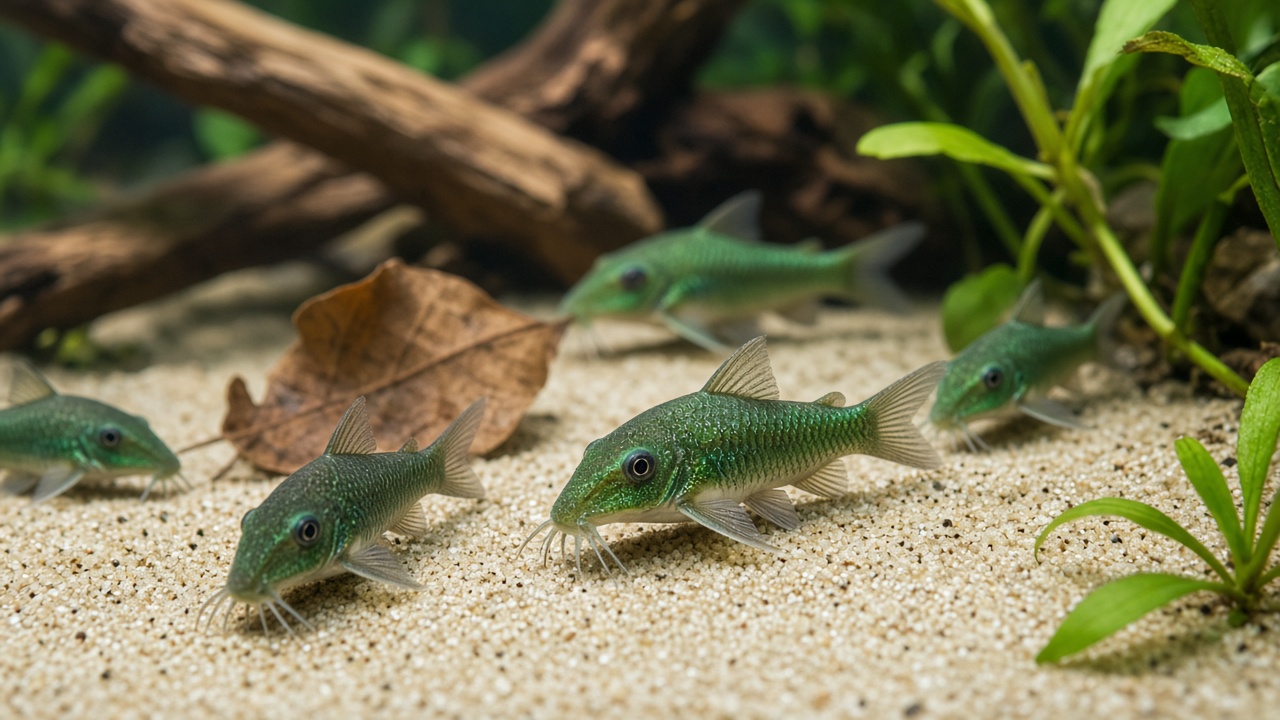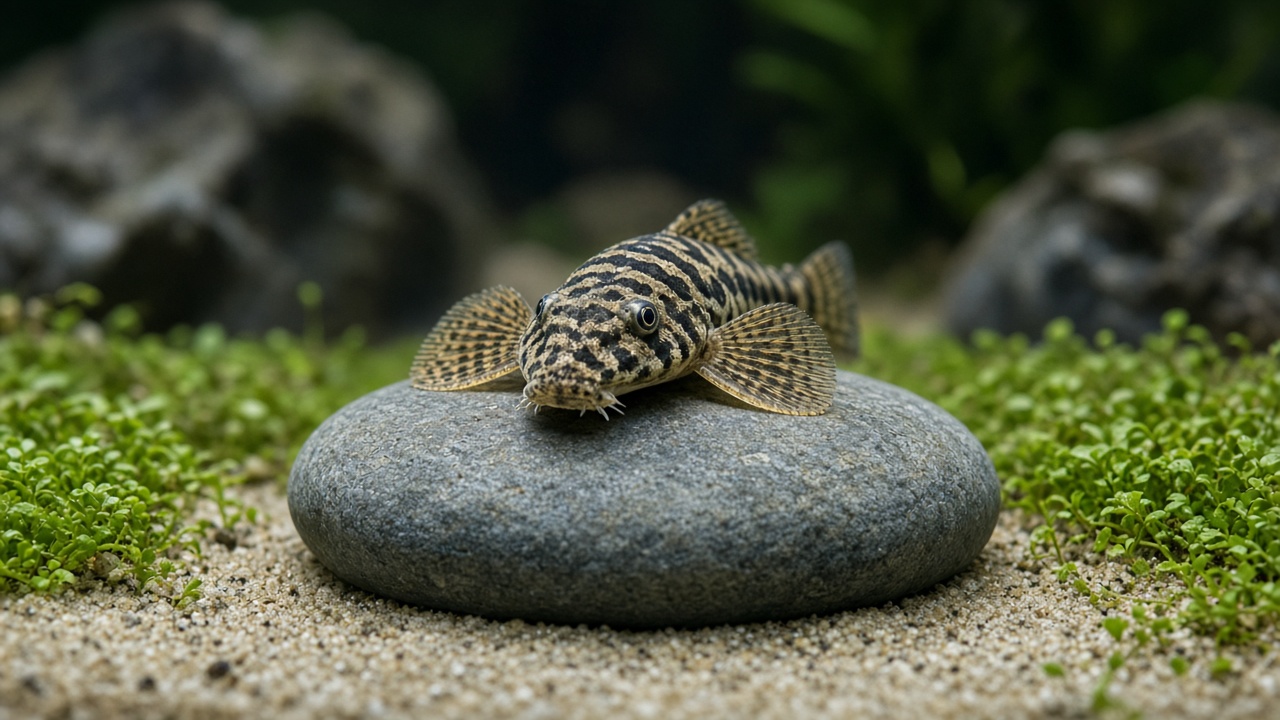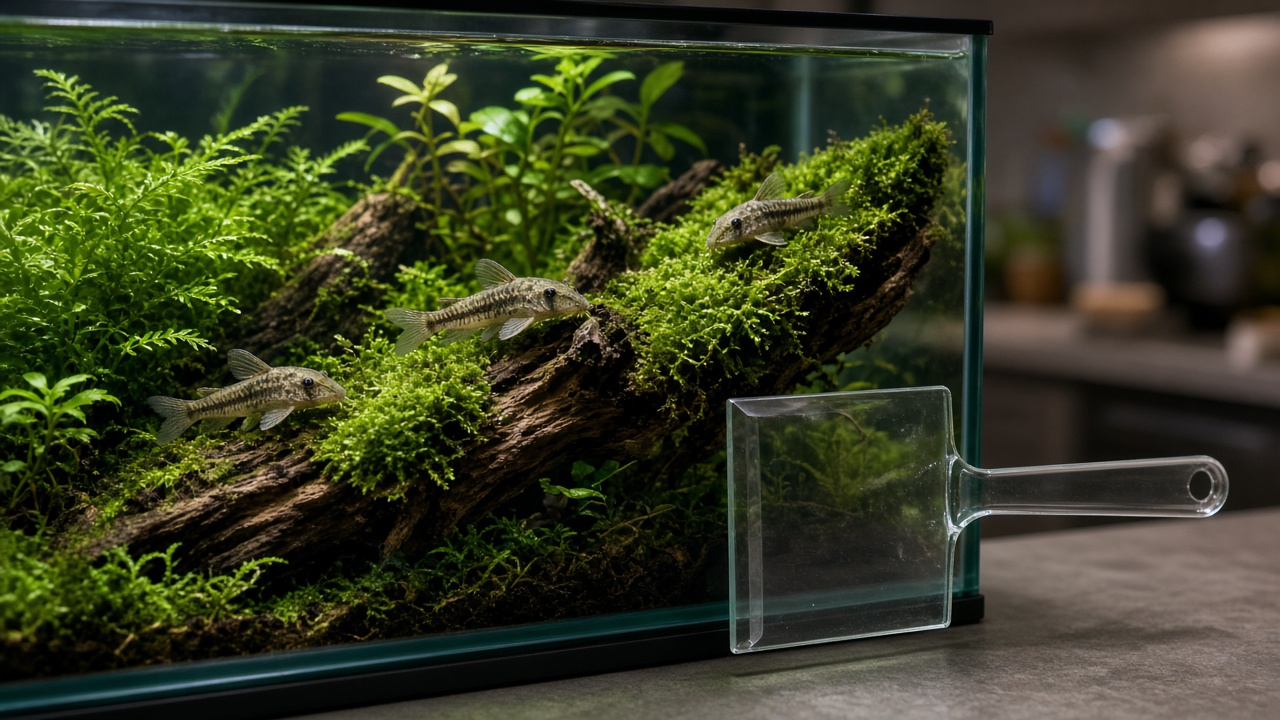
Quick answer: Keep a group of six otocinclus in a planted tank of at least 11 US gallons. Offer soft algae every day, then add a sinking wafer or gel when the film thins. Skip brand-new tanks and skip keeping one fish alone.
Otocinclus catfish need a planted tank of at least 11 US gallons for a group of six. This page is a desk brief that compares maker labels and published species records. We did not stock a colony for this draft, did not run a feeding trial, and did not open clinic files.
What this page includes, and what it leaves out
We included only foods whose maker page lists a guaranteed analysis and names algae, kelp, spirulina, or aufwuchs as a diet target.
That is the selection rule for this brief. A product stayed in if we could open the maker page and copy protein, fat, and form.
A product stayed out if the maker page was missing, and meat-first carnivore diets and tank gear also stayed out.
We left out heaters, filters, test kits, live plants, tank kits, and any “complete diet” line we could not read on the maker’s own page.
Species numbers come from the Seriously Fish profile for Otocinclus macrospilus. Our research team analyzed five current food labels side by side. We did not take tank-size rules from hobby forums.
This brief covers home planted tanks that already grow a thin film on glass, wood, and leaves. It does not cover ponds, quarantine racks, or breeding rooms.
How large they get and what tank they need
Seriously Fish lists Otocinclus macrospilus at 35 mm standard length, which is 1.4 inches.
That length is the body without a stretched tail, and a small body still needs a group and a planted footprint.
Plan the tank around these published limits from the same profile:
- Smallest footprint: 45 by 30 cm, or 18 by 12 inches
- Smallest volume: about 41 liters, written as about 11 US gallons
- Smallest group: six fish
- Adult length: 35 mm standard length
Use 11 gallons as a floor, not a target for extra fish, because a group needs grazing surface more than open water.
A longer tank gives more leaf and wood for film to grow. A tall, narrow tank of the same gallons gives less useful surface.
Do not add otocinclus to a tank that was filled last week. Seriously Fish notes that most shop fish are wild-caught and often arrive underfed.
A mature planted tank already has film on hard surfaces, and a new tank does not. If you want more than six fish, add gallons and plants first.
Water numbers from the species record
Hold temperature, pH, and hardness inside the windows Seriously Fish prints for Otocinclus macrospilus.
Copy these ranges onto your log:
- Temperature: 70 to 79°F (21 to 26°C)
- pH: 5.5 to 7.5
- Hardness: 1 to 12 dGH
Stay inside those bands and do not chase one exact number.
Pick one temperature in the middle of that band and hold it. A swing still stresses small fish that sit on leaves.
Seriously Fish also flags water quality as a common weak point after import, so keep ammonia and nitrite at the kit’s zero mark.
If your kit cannot read those two values, do not add the fish yet. Match new water to the tank before a change, because cold tap water can drop an 11-gallon box in minutes.
Algae diet when the film runs out
Soft algae and the thin film on plants are the main food, and wafers or gels fill the gap when that film is gone.
Seriously Fish says the wild diet is algae and other microorganisms. In a tank, the same profile says the bulk of the diet should be vegetable matter, including fresh slices and dried algae foods.
Otocinclus will rasp glass, wood, and broad leaves. They do not strip every green patch, and tough hair algae often stays put.
When the glass looks clean, the group is out of film, not done eating. That is when a sinking food or a gel slice has to go in.
Use this daily pattern:
- Morning: check the glass and plant leaves for a thin film
- Evening: add a wafer, crisp, or gel piece the group can finish
- After feeding: lift any leftover vegetable slice before it rots
- Weekly: add a blanched zucchini or cucumber slice if the film is thin
Seriously Fish names cucumber, blanched spinach, and zucchini slices as fresh options. It also names algae wafers and spirulina tablets as dried options, and it warns that bloodworm and daphnia should stay rare.
Do not treat an oto as a janitor you never feed, because a group of six can clear a small tank’s film in days.
Prepared foods compared by label
Our research team compared five maker pages, and the protein numbers on those labels run from 33.0% to 43.5%.
That spread is a label fact, not a ranking, and higher protein is not a score for a grazer that rasps surfaces all day.
Hikari Sales USA lists Algae Wafers as a sinking disc for plecostomus and other algae-eating bottom feeders. Extra lines on that page, beyond the table below, are:
- Vitamin A: min. 8,700 IU/kg
- Ascorbic acid: min. 190 mg/kg
- Feeding window: finish within two hours, late in the day
Hikari Sales USA lists Mini Algae Wafers as a smaller disc for smaller algae eaters, snails, and crustaceans. Protein, fat, fiber, moisture, and ash match the standard wafer, and the mini page lists phosphorus as a minimum of 0.8%.
Fluval’s United States page for Bug Bites Algae Crisps states 43.5% crude protein. The first ingredient on that page is wheat flour.
Extra Fluval lines are:
- Vitamin A: min. 25,000 IU/kg
- Ascorbic acid: min. 440 mg/kg
- Feeding window: finish within two minutes, two or three times daily
Repashy Ventures calls Soilent Green an aufwuchs gel premix. The maker page lists spirulina algae as the first ingredient.
Extra Repashy lines are:
- Mix ratio: 1 part powder to 2 to 3 parts water
- Fridge hold: up to two weeks
- Freezer hold: up to six months
- Jerky method: 1/4-inch slices dried at 150°F for a typical 8 to 12 hours
Omega Sea’s page for Omega One Veggie Flakes with Kelp lists a minimum of 33% crude protein and 11% crude fat. The ingredient line starts with salmon and whole herring, with kelp later in the list.
| Product | Form | Crude protein (min.) | Crude fat (min.) | Moisture (max.) | Pack sizes on the maker page |
|---|---|---|---|---|---|
| Hikari Algae Wafers | Sinking disc | 33.0% | 4.0% | 10.0% | 20 g, 40 g, 82 g, 250 g, 1 kg |
| Hikari Mini Algae Wafers | Smaller sinking disc | 33.0% | 4.0% | 10.0% | 22 g, 85 g, 1 kg |
| Fluval Bug Bites Algae Crisps | Crisp | 43.5% | 4% | 7.5% | 40 g, 100 g |
| Repashy Soilent Green | Gel powder | 40% | 8% | 8% | 85 g, 170 g, 340 g, 2 kg |
| Omega One Veggie Flakes with Kelp | Flake | 33% | 11% | 8.5% | 1 oz, 2.2 oz, 5.3 oz |
Read the table as attributes, not as a ranked list. Our comparison of those five labels found only one formula that puts an algae first: Repashy Soilent Green.
Pick a form that sinks and stays put, since flakes can help midwater fish but otocinclus feed on surfaces.
A disc, crisp, or gel smear on wood matches that habit. Match the maker’s own feeding window:
- Hikari Algae Wafers: finish within two hours
- Fluval Bug Bites Algae Crisps: finish within two minutes, two or three times a day
- Repashy Soilent Green: offer as needed after the gel sets
Those times are not the same job: a two-hour wafer is a grazing plate, and a two-minute crisp is a short meal. Use the line printed on the page you bought.
Tank mates that share the same water window
Share the tank only with small, calm fish that also fit 70 to 79°F water.
Seriously Fish calls Otocinclus macrospilus shy, and the profile says vigorous fish will beat them to food.
The same page names small, peaceful characins as a fit. It also names dwarf cichlids such as Apistogramma and smaller Corydoras.
Keep the otocinclus group at six or more, because one or two fish on a bare floor will hide and miss meals.
Skip these pairings:
- Large, fast cichlids that claim the wood
- Night hunters that pick at resting fish
- Other heavy algae eaters that strip the same film
- Any fish that needs water hotter than 79°F as a daily hold
Shrimp can share a planted tank if you still feed the otos, but shrimp will find wafers too.
Put extra gel on wood so the catfish get a share. Do not use otocinclus to clean up after goldfish, because goldfish water and goldfish mouths do not match this species record.
First-week setup from published notes
Add otocinclus only after the tank is planted, cycled, and already showing film on glass or wood.
Seriously Fish says losses after import are common and often tie back to a lack of food. The same profile says many keepers see fewer problems when the fish go into a mature, planted tank.
Use this order:
- Run the tank long enough for a film to show on glass or wood.
- Confirm ammonia and nitrite read zero on your kit.
- Confirm temperature sits between 70 and 79°F.
- Buy six or more fish that already have rounded bellies.
- Float and drip the bag so the temperature change stays slow.
- Turn the lights down for the first evening.
- Place a wafer, crisp, or gel smear after lights-out.
Watch belly shape, not just swimming. A hollow belly after a week means the film was not enough and the extra food is not being eaten.
If midwater fish inhale every wafer, switch to a gel smear on wood. Repashy’s page describes setting gel, then cutting pieces, which keeps food on a surface the otos already use.
Do not add more otocinclus while the first six are still thin; fix food first.
FAQ
These answers repeat the same species numbers and label lines used above.
How many otocinclus should I keep together?
Keep at least six, because Seriously Fish says this species prefers the company of its own kind and sets the group floor at six. A pair will hide more and miss more meals.
What tank size do otocinclus catfish need?
Seriously Fish sets the smallest base at 18 by 12 inches, about 11 US gallons, for Otocinclus macrospilus. That is a floor for a group of six, not a license to add more fish. Extra fish need extra gallons and extra grazing surface.
Do otocinclus eat all kinds of algae?
No. Seriously Fish describes a diet of algae and microorganisms, plus vegetable matter in the tank. Soft film is the usual target, and tough hair algae often remains, so plan on wafers or gel when the glass looks clean.
Can I keep otocinclus with shrimp or tetras?
Yes, if the other animals stay small and calm and share 70 to 79°F water. Seriously Fish names small, peaceful characins as a fit. Feed extra sinking food so shrimp and tetras do not take every piece.
Why do new otocinclus often fail in the first week?
Seriously Fish says most shop fish are wild-caught and can arrive short on food. A new, bare tank has little film. Put the group into a mature planted tank and offer a wafer or gel the first night.
How often should I offer wafers if the tank already has algae?
Feed a small sinking portion every day once the film looks thin. Hikari Sales USA tells you to use no more than the fish will finish in two hours. Fluval’s crisp page tells you to use a two-minute portion two or three times a day.
Are otocinclus a good choice for a brand-new aquarium?
No. Seriously Fish ties early losses to weak food supply and to water that is not yet stable. Wait until plants are in, the kit reads zero ammonia and zero nitrite, and a film is visible, then add a group of six.