Quick answer: Choose a peaceful schooling corydoras or a small bristlenose for most home tanks. Skip the common suckermouth sold as a starter pleco. Match adult size and temper before you buy.
Home aquariums should keep catfish near FishBase’s 7.5 cm bronze corydoras length, not the 25.0 cm suckermouth. This page is a size-and-temperament field guide drawn from published FishBase records and current maker food labels. We did not run tank trials, did not keep these 15 types for this draft, and did not open clinic case files.
Selection rule: a type made this page only if US shops still sell it as a freshwater aquarium catfish. It also had to be a bronze-cory community fish, a common algae-eating loricariid, or a shop staple people buy by mistake.
We left out marine catfish, pond channel cats, and any fish we could not match to a current sinking-food label or a FishBase aquarium-use note.
The 7.5-centimeter rule we used
We sorted types by published adult length and social behavior, not by store nicknames.
FishBase’s bronze corydoras page lists a max length of 7.5 cm SL. That same page says keep them in groups of 5 or more in a tank at least 60 cm long.
FishBase’s suckermouth catfish page lists a max length of 25.0 cm SL and a common length of 28.0 cm TL. Our research team subtracted those two published max-length figures, and the gap is 17.5 cm.
Use this rule when you read a tank card:
- If the adult will stay near the 7.5 cm bronze-cory record, it can share a community floor.
- If the adult is a suckermouth sold as a “common pleco,” plan for the 25.0 cm FishBase length.
- If the fish hunts midwater and swallows tankmates, treat it as a predator.
FishBase lists bronze corydoras as Least Concern, assessed on 7 November 2018, and the suckermouth as Least Concern, assessed on 14 February 2021.
Fifteen freshwater types by size class
This page groups seven small schoolers, five mid-size grazers, and two shop fish that outgrow or out-hunt a community tank.
We name the shop name first, then the scientific name.
Small, peaceful schoolers and glass grazers
These seven types live on the sand or on plant leaves and do not patrol as hunters.
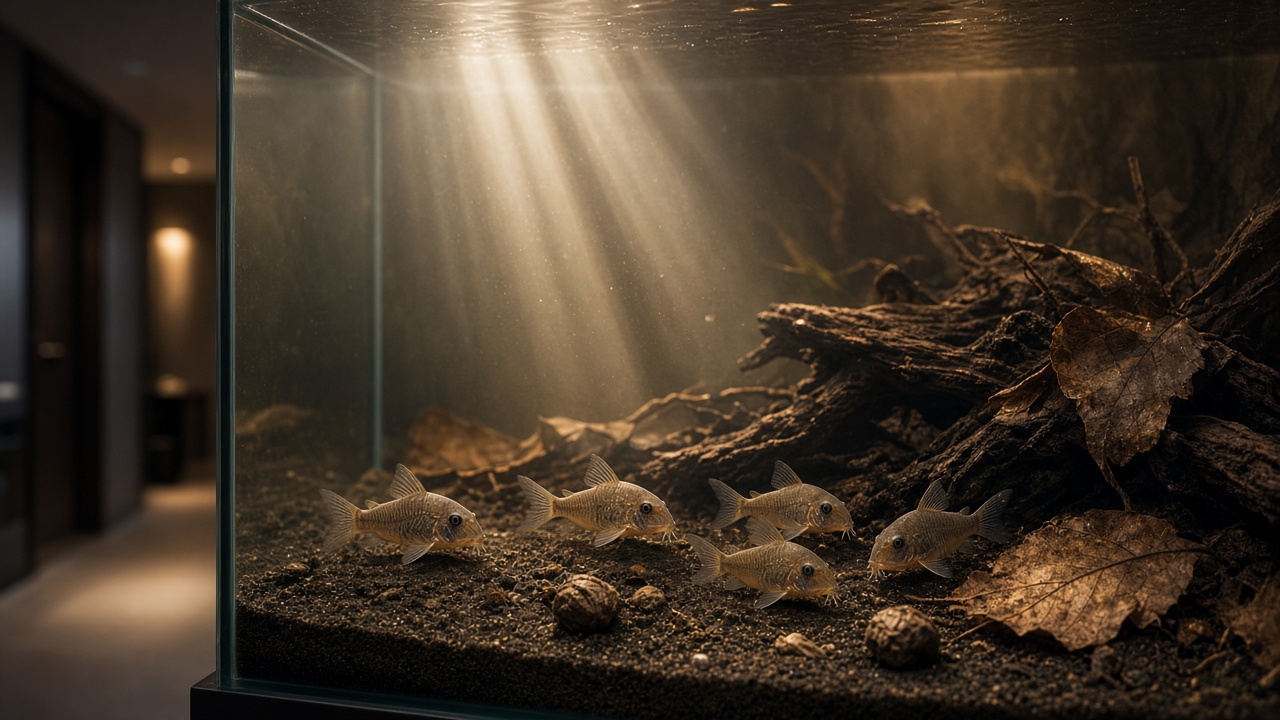
- Bronze corydoras (Corydoras aeneus, listed by FishBase as Osteogaster aenea). This peaceful schooler sifts sand. FishBase lists 7.5 cm SL, pH 6.0–8.0, and 25°C–28°C. FishBase also notes wild schools of 20 to 30 fish and 100–200 eggs per spawn.
- Peppered corydoras (Corydoras paleatus). This peaceful sand-sifter matches the bronze habit, so keep a group rather than a single fish.
- Panda corydoras (Corydoras panda). This short, bold-marked cory is still a schooling bottom fish.
- Pygmy corydoras (Corydoras pygmaeus). This dwarf cory often swims in midwater with a group.
- Sterbai corydoras (Corydoras sterbai). Shops sell this peaceful cory for warmer planted community tanks.
- Three-stripe or julii-type corydoras (Corydoras trilineatus and look-alikes). Shops often mislabel these spotted fish, so keep one pattern in one group.
- Otocinclus (Otocinclus spp.). This tiny suckermouth rasps soft algae and biofilm in an aged, planted tank, not a bare new box.
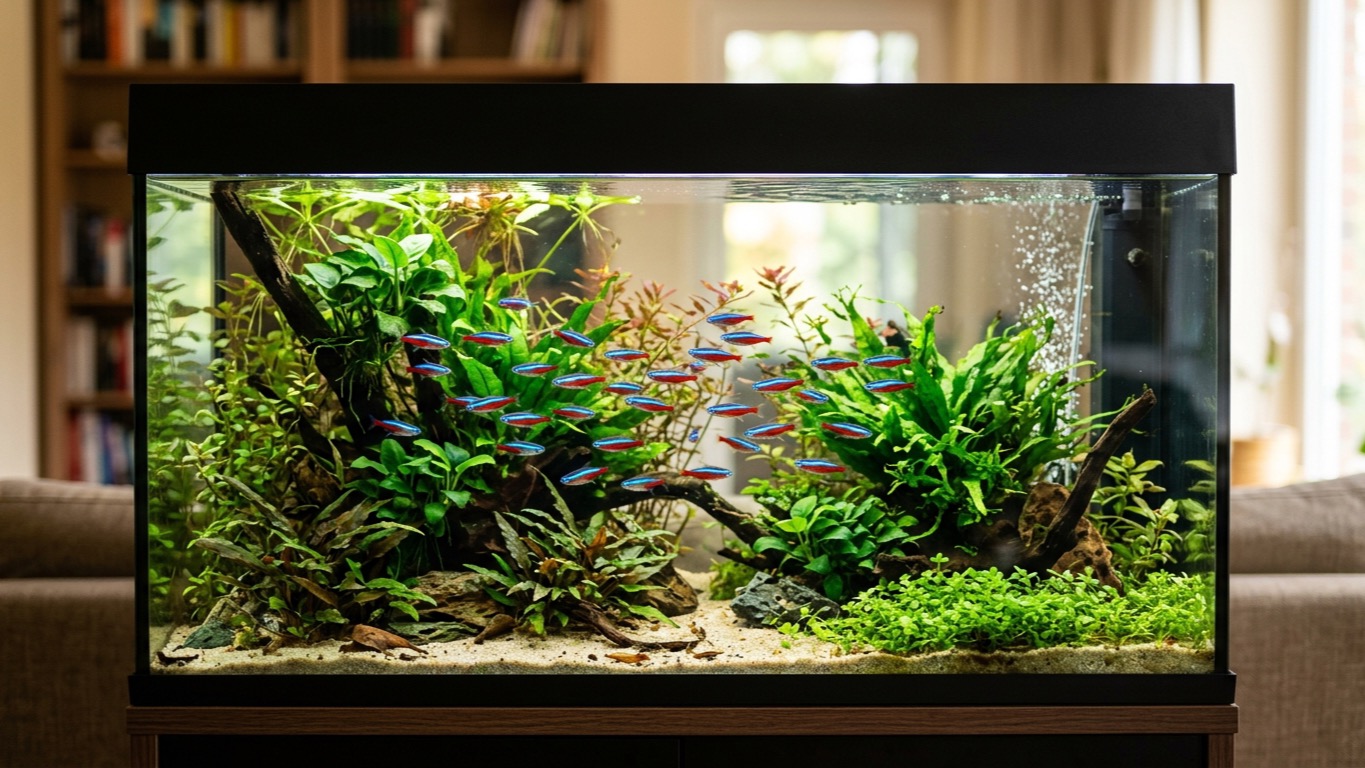
Hikari’s Sinking Wafers page names corydoras catfish as a daily-diet target, which matches this size class. A low-maintenance planted aquarium gives otocinclus biofilm on leaves and gives corydoras shade.
Mid-size grazers that may guard a cave
These five types still suit many home tanks, but they are not free-swimming schoolers.
- Bristlenose pleco (Ancistrus spp.). It stays peaceful with other species, though males may guard a cave. This is the small algae eater shops should sell instead of a common suckermouth.
- Clown pleco (Panaqolus maccus and similar wood-eaters). This shy wood-grazer needs bogwood and will not clean a whole tank.
- Twig catfish (Farlowella spp.). This peaceful, frail fish hangs still on plant stems, so skip it if your tank has rough fish.
- Upside-down catfish (Synodontis nigriventris). It is peaceful to mildly pushy and often rests under leaves, belly up.
- Glass catfish (Kryptopterus vitreolus). This peaceful midwater schooler is not a sand sifter, so keep a group or it hides.
Hikari’s Algae Wafers page names plecostomus and other algae eaters as the daily-diet target. Fluval’s Bug Bites Bottom Feeder page names plecos and ancistrus.
Use those two labels for types 8–10. Do not expect one wafer to feed a glass catfish school.
The two shop fish that break a community tank
- Pictus catfish (Pimelodus pictus). This fast, whiskered hunter will eat fish that fit in its mouth. It needs open swim space, not a small community tank.
- Striped Raphael catfish (Platydoras armatulus). This nocturnal, armored fish is not a tiny cory and fits better with larger, calmer tankmates.
- Common suckermouth / “common pleco” (Hypostomus plecostomus and look-alikes). FishBase lists 25.0 cm SL and a common length of 28.0 cm TL. FishBase also lists pH 6.2–8.2 and 20°C–28°C.
Our research team compared those FishBase length records with the 7.5 cm bronze-cory figure. Types 1–7 sit in the small class, and type 15 sits 17.5 cm longer on the published max-length line.
If a shop card says “pleco” and does not say bristlenose or clown, assume the 25.0 cm FishBase fish.
Sinking foods: what four maker pages list
Label protein and feed time tell you which wafer fits which mouth.
Our research team compared published specs on four foods sold now for bottom fish. Three maker pages list protein at 36%, 33%, and 32%, a spread of 4 percentage points.
Hikari’s Sinking Wafers page lists these guaranteed numbers:
- Crude protein min. 36%
- Crude fat min. 9.0%
- Crude fiber max. 4.0%
- Moisture max. 10%
- Ash max. 16%
- Phosphorus min. 0.8%
That same Hikari page says to feed what fish will finish in 20 minutes, then remove leftovers. Listed packs are 25 g, 50 g, and 110 g.
Hikari’s Algae Wafers page lists a different fat and fiber pair:
- Crude protein min. 33%
- Crude fat min. 4.0%
- Crude fiber max. 3.0%
- Moisture max. 10%
- Ash max. 17%
- Phosphorus min. 0.8%
That page says to feed no more than fish will finish in 2 hours and notes that many bottom feeders eat at night. Listed packs are 20 g, 40 g, 82 g, and 250 g.
Fluval’s Bug Bites Bottom Feeder Granules page lists a sinking granule of 1.4–2.0 mm. The label block on that page lists:
- Protein 32%
- Fat 12%
- Crude fibres 6%
- Crude ash 9%
- Vitamin A 7,500 IU/kg
The composition line lists black soldier fly larvae at 30% and salmon at 22%. Fluval also prints “up to 40%” black soldier fly larvae as the first marketing claim. Feed what fish eat in two minutes, two or three times daily, from the 45 g or 500 g packs.
Tetra’s PRO Cory Wafers page names a sinking 2-in-1 wafer with shrimp and potato protein. It lists product number 77014 and packs of 2.12 oz and 5.29 oz. That maker page does not list a protein or fat percent.
| Product | Form on maker page | Crude protein | Crude fat | Maker feed window | Listed pack sizes |
|---|---|---|---|---|---|
| Hikari Tropical Sinking Wafers | Soft sinking wafer | min. 36% | min. 9.0% | 20 minutes | 25 g, 50 g, 110 g |
| Hikari Tropical Algae Wafers | Sinking disc | min. 33% | min. 4.0% | 2 hours | 20 g, 40 g, 82 g, 250 g |
| Fluval Bug Bites Bottom Feeder Granules | 1.4–2.0 mm granule | 32% | 12% | 2 minutes, 2–3 times daily | 45 g, 500 g |
| Tetra PRO Cory Wafers | Sinking 2-in-1 wafer | Not listed on the maker page | Not listed on the maker page | Not listed on the maker page | 2.12 oz, 5.29 oz |
Match food to mouth with this list:
- Corydoras and other gulp-feeders: Hikari Tropical Sinking Wafers or Tetra PRO Cory Wafers.
- Bristlenose, clown pleco, and other raspers: Hikari Tropical Algae Wafers or Fluval Bug Bites Bottom Feeder Granules.
- Glass catfish: they eat in the water column, so a sand wafer alone will miss them.
Our research team lined up the three published feed windows of 2 minutes, 20 minutes, and 2 hours, a 118-minute spread on the same shelf.
Tank setup: floor space, filters, and pH
Floor space and waste control matter more than decor style for bottom catfish.
FishBase’s bronze corydoras page sets a 60 cm minimum tank length. A tall hex tank can hold the gallons and still fail this length rule.
Corydoras sift sand, and sharp gravel can wear their barbels. Use smooth sand or rounded fine gravel when you set the floor.
Do this when you set the tank:
- Pick a tank at least 60 cm long for a bronze-cory group of 5.
- Leave open sand in the front and put wood and plants along the back.
- Add a cave if you keep a bristlenose male.
- Skip the 25.0 cm suckermouth unless the tank is built for a large loricariid.
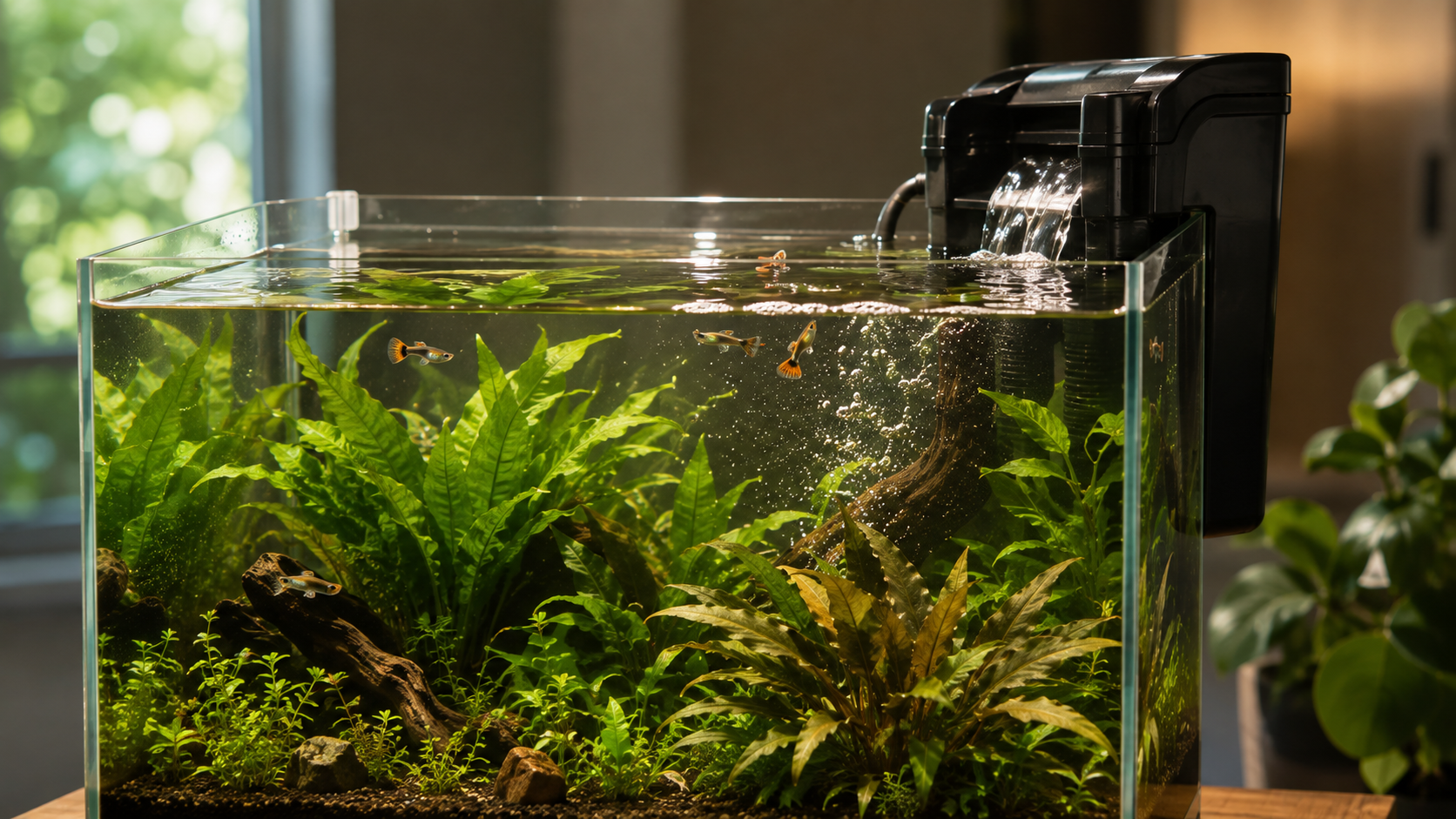
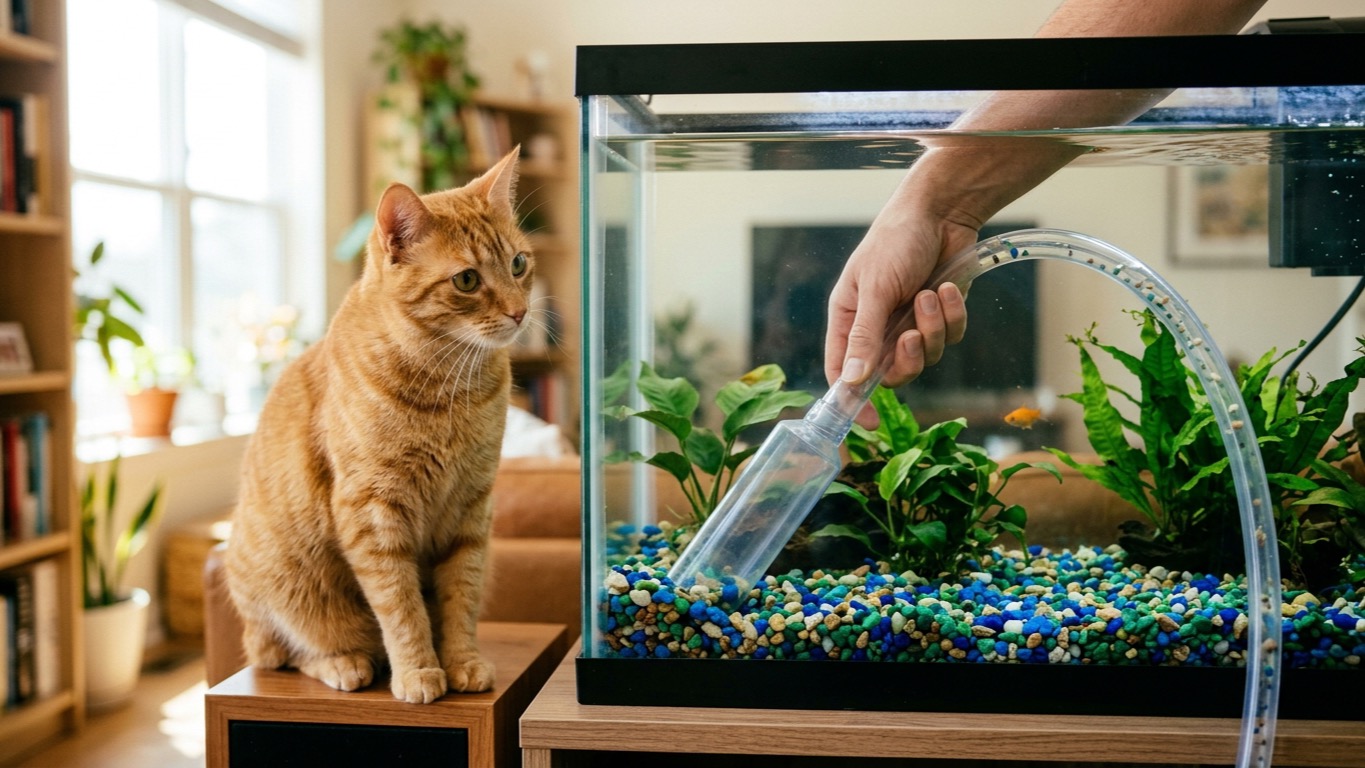
Bottom fish eat on the floor, and leftover wafers rot in the sand. A hang-on filter like the one in our Top Fin aquarium filter EF-S guide pulls waste off the substrate. Rinse media in tank water.
FishBase lists bronze corydoras at pH 6.0–8.0 and the suckermouth at pH 6.2–8.2. Most tap water already sits in those bands.
If your tap water sits below that FishBase band, use our page on how to raise pH in an aquarium. Change water on a schedule instead of chasing a daily pH target.
FishBase notes bronze corydoras can take air 1 to 45 times per hour, so keep the surface moving.
Shop checks before you buy
Buy by adult length and temper, then check the bag before you pay.
For corydoras, count toward FishBase’s group of 5 or more and look for intact barbels.
Do not buy a catfish as a tank cleaner. Types 1–7 eat leftover bits and still need their own wafers. Types 8–10 rasp algae and still need labeled wafers or wood.
Hikari’s Sinking Wafers page says the soft disc is for downward mouths that gulp, which is the corydoras mouth.
FAQ
How many aquarium catfish should I keep?
For bronze corydoras, FishBase says groups of 5 or more and a 60 cm tank. Use that as the floor for other small cory types on this page. Keep otocinclus in a group in a planted tank, and keep one bristlenose unless you have extra caves.
Can I keep a common pleco in a 20-gallon tank?
No, a 20-gallon starter tank is not built for that length. FishBase lists the suckermouth at 25.0 cm SL and a common length of 28.0 cm TL. Buy a bristlenose if you want a small wood-grazing pleco.
What should I feed aquarium catfish?
Use a sinking food the maker names for that mouth. Hikari lists Sinking Wafers for corydoras and Algae Wafers for plecostomus. Fluval lists Bug Bites Bottom Feeder Granules for plecos and ancistrus, and Tetra lists PRO Cory Wafers for omnivorous bottom grazers.
Do aquarium catfish clean the tank by themselves?
No, they eat some leftover food and some soft algae, but they still add waste. You still need water changes and a filter. Plan food for them.
What pH do these catfish need?
FishBase lists bronze corydoras at pH 6.0–8.0 and the suckermouth at pH 6.2–8.2. Stay inside the band for the type you bought. Raise pH only if your tap water sits below that published range.
Are pictus catfish safe with neon tetras?
No, a pictus is an active hunter and will eat fish that fit in its mouth. Keep pictus with larger, fast tankmates in a long tank, or skip the type.
Why did my new otocinclus fade after a week?
Otocinclus needs biofilm in an aged, planted tank, and a new bare tank has little for it to rasp. Use plants and a labeled sinking wafer, and add this type last, not first.