Quick answer: Keep Corydoras julii in a group on a sand floor, in a long tank near 21 US gallons. Feed them their own sinking food every day, and match published temperature and pH ranges from FishBase and Seriously Fish.
Corydoras julii is a 5.2 cm South American catfish that lives in 23 to 26°C freshwater, per FishBase. This page is a desk brief on tank size, school size, diet, and tank mates.
What this page covers
This article covers home community tanks with a sand bed and a group of spotted corys.
Our inclusion rule is simple: we cover published species records and sinking staple foods with a maker guaranteed analysis. We leave out ponds, brackish water, single-fish bowls, flakes, gels, and vacation blocks.
Our research team compared four maker labels side by side. We used FishBase for wild size and water figures, and Seriously Fish for tank base and group size.
We do not rank the foods, and we report only the numbers each maker published.
How to identify Corydoras julii
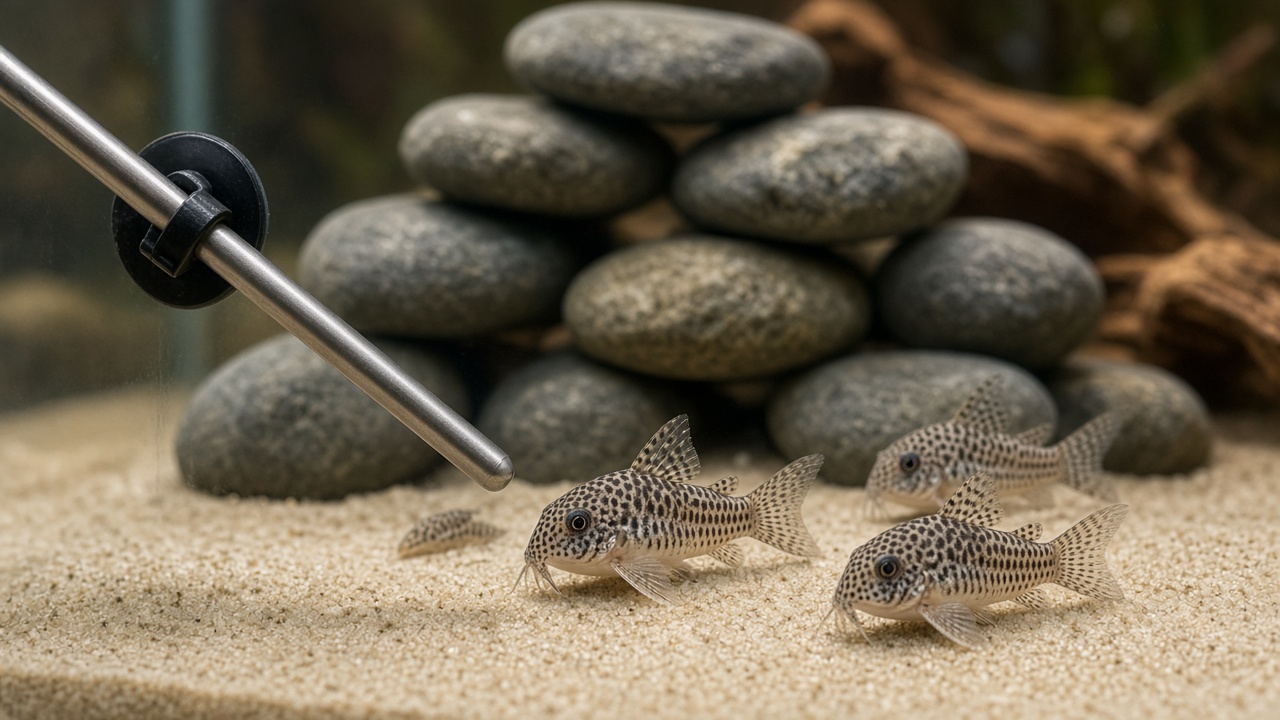
True julii corys have many small, separate spots on the head, per Seriously Fish.
FishBase now lists the species as Hoplisoma julii, while shops still sell it as Corydoras julii, a name Steindachner published in 1906.
FishBase lists a maximum standard length of 5.2 cm. Seriously Fish lists 55 mm standard length, or 2.2 inches.
Seriously Fish places wild fish in coastal rivers south of the Amazon delta. Those records come from Piauí, Maranhão, Pará, and Amapá in northeastern Brazil.
The type locality is a creek into the Rio Parnaíba near Alto Parnaíba, at 9°08′S, 45°56′W. FishBase also lists the lower Amazon and coastal rivers of northeastern Brazil.
Many shop bags labeled julii hold Corydoras trilineatus, and Seriously Fish says that lookalike lives in the upper Amazon, where collection is more common.
Use this check from Seriously Fish:
- True julii: many small, distinct spots on the head
- Corydoras trilineatus: worm-like marks on the head
- Some Corydoras trilineatus also show spots, so locality helps
- Care for both spotted forms is the same on this page
FishBase rates the species Least Concern, and that IUCN line is dated 07 November 2018. The same page lists a fishing vulnerability of 10 of 100, which is a low score on their model.
FishBase also lists high resilience, with a minimum population doubling time under 15 months. It lists the species as highly commercial in the aquarium trade.
Tank size and school
Seriously Fish calls for a tank base of 90 × 30 cm, about 21 US gallons, and a group of four to six fish.
Floor space matters more than height because these fish patrol the sand. A long tank gives them a path, while a tall, narrow tank does not.
Seriously Fish lists these minimums:
- Tank base: 90 × 30 cm, or 36 × 12 in
- Volume: about 81 liters, or about 21 US gallons
- Group: at least four to six fish
A pair will hide, while a group of four to six will forage in the open.
Add midwater fish only after the cory group has the whole floor. A 21-gallon long tank is the floor plan for the corys, so extra fish need extra length, not extra height.
Do not use a bowl or a tank with no open sand.
Water, sand, and air breathing
Match the published ranges, then keep the water stable instead of chasing a single “perfect” number.
FishBase lists this wild and aquarium range:
- Temperature: 23°C to 26°C
- pH: 6.0 to 8.0
- Hardness: 2 to 25 dH
- Habitat: freshwater, bottom-dwelling, tropical
Seriously Fish lists a wider cool end and a tighter hardness band:
- Temperature: 20°C to 26°C, or 68°F to 79°F
- pH: 5.5 to 7.5
- Hardness: 2 to 12 dGH
Stay inside both sets if you can, which means about 23°C to 26°C and pH 6.0 to 7.5.
Seriously Fish asks for fine sand, and rounded gravel is a backup only if you keep it clean. Sharp gravel can scrape the barbels these fish use to find food.
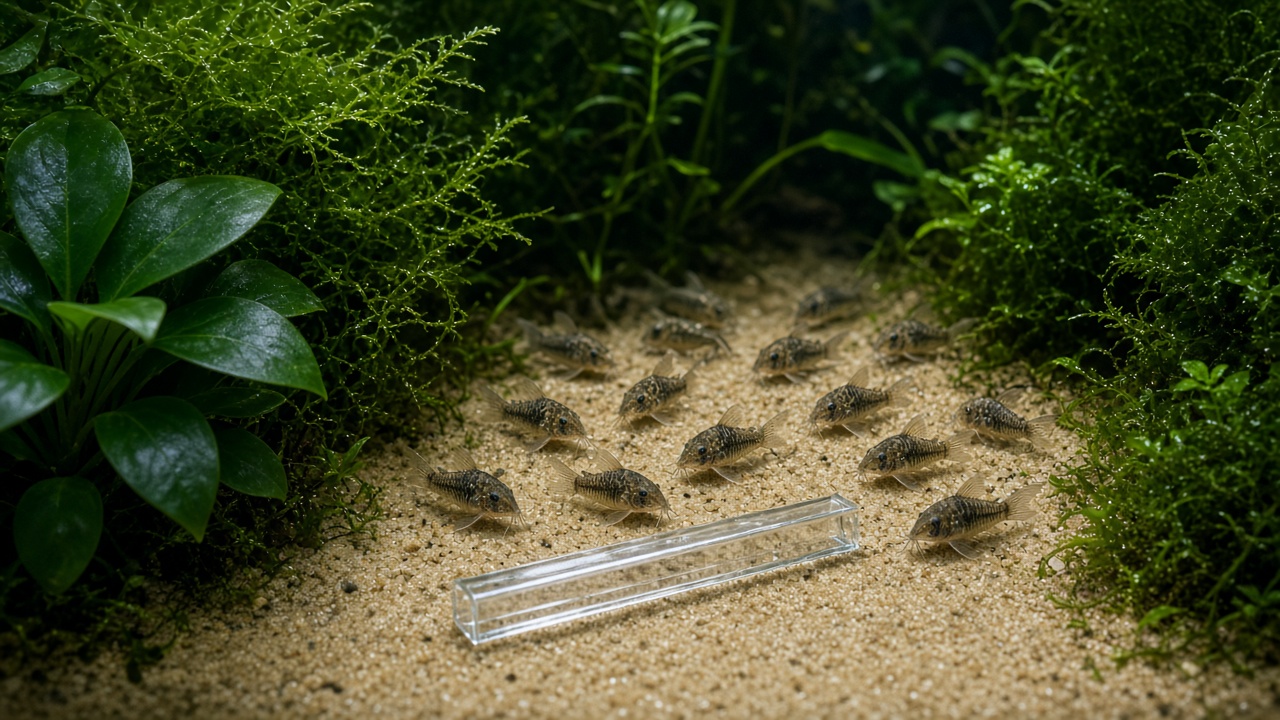
Give them cover such as driftwood, plants, and leaf litter, and leave open sand so the group can walk.
FishBase says the species is a facultative air-breather, so you will see a fish dash up, gulp, and drop back. That gulp can be normal, but you should still keep the water moving and clean.
FishBase lists the species as harmless to people, yet the pectoral spines can still poke skin, so net them with care.
Diet and sinking foods
Julii corys need their own food on the sand and are not a clean-up crew.
FishBase says they eat worms, crustaceans, insects, and plant matter. The trophic level on that page is 3.0, plus or minus 0.35.
Seriously Fish says most corys take sinking dry food plus small live or frozen foods, and they must not live on leftovers.
Our research team compared four currently sold sinking staples. We included a food only if the maker page lists a guaranteed analysis and names corydoras, catfish, or bottom feeders.
We left out flakes, gels, and vacation blocks, and
| Product | Form | Crude protein | Crude fat | Crude fiber | Moisture |
|---|---|---|---|---|---|
| Hikari Tropical Sinking Wafers | Soft disc | min. 36% | min. 9.0% | max. 4.0% | max. 10% |
| Omega One Sinking Catfish Pellets | Pellet | min. 38% | min. 10% | max. 2.0% | max. 8.5% |
| Tetra Cory ShrimpWafers | Wafer | 48.0% | 8.0% | 2.0% | 6.0% |
| Hikari Tropical Micro Wafers | Micro wafer | min. 44% | min. 8% | max. 2% | max. 10% |
Comparing those published specs, listed protein runs from 36% to 48%, and listed fat runs from 8% to 10%.
Hikari’s page for Tropical Sinking Wafers names corydoras catfish and lists these extra figures:
- Ash: max. 16%
- Phosphorus: min. 0.8%
- Packs: 0.88 oz (25 g), 1.76 oz (50 g), and 3.88 oz (110 g)
- Feeding window: eat it all in 20 minutes, then remove leftovers
Omega Sea’s page for Sinking Catfish Pellets names all bottom feeders and lists these extra figures:
- Ash: max. 8%
- Packs: 4.5 oz and 15 lbs
- First ingredients: salmon, whole herring, and whole shrimp
Tetra’s page for Cory ShrimpWafers names Corydoras and lists these extra figures:
- Shrimp in the formula: 10.0%
- Vitamin D3: 1760 IU/kg
- Manganese: 65 mg/kg
- Zinc: 39 mg/kg
- Iron: 25 mg/kg
- Pack: 100 ml / 40 g
Hikari’s page for Tropical Micro Wafers names catfishes and says the wafers float, then sink, so midwater fish can steal them. That label also lists these extra figures:
- Ash: max. 13%
- Phosphorus: min. 1%
- Packs: 0.70 oz (20 g) and 1.58 oz (45 g)
- Feeding: two to three times a day, in a few minutes
Feed sinking staples on the sand after the lights dim, because midwater fish steal food that hangs in the water.
Use this daily plan:
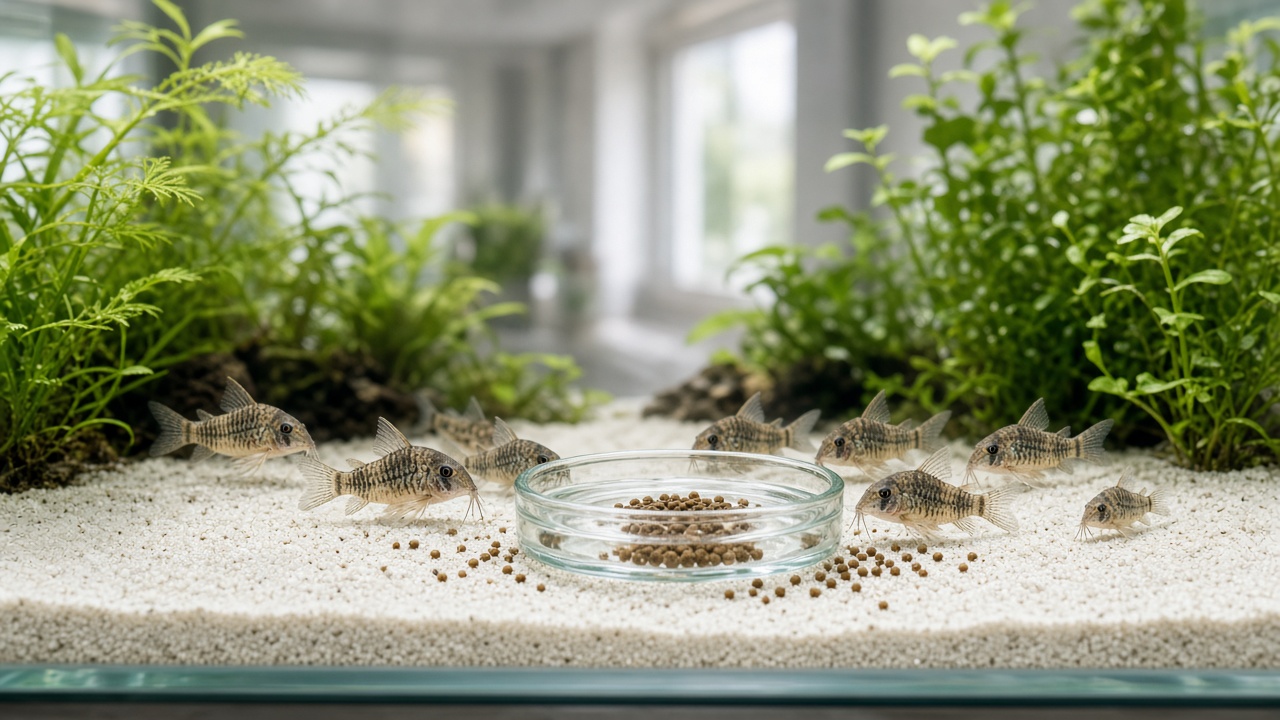
- Drop a sinking staple on open sand, away from the filter outflow.
- Watch the group for the maker’s time window.
- Lift any leftover discs or pellets.
- Add a small frozen worm or crustacean portion on some days.
Break large wafers if one fish hogs the disc, because several small pieces let the whole school eat.
Tank mates
Pick quiet community fish that will not eat a 5.2 cm catfish.
Seriously Fish calls the species peaceful and gregarious, and that page also lists it as a community-tank fish.
Good tank mates share the same published water band, and they should leave the sand to the corys.
Use this include list:
- Small tetras, rasboras, and other calm midwater fish
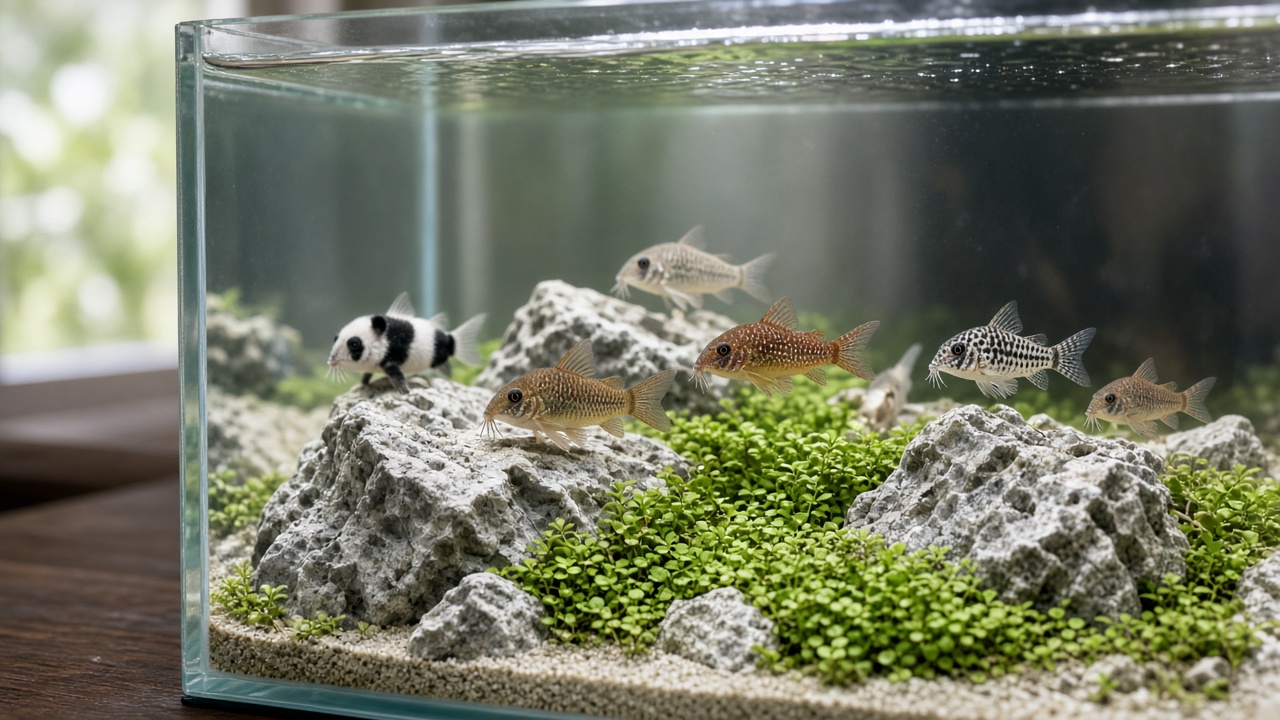
- Other small Corydoras of similar size, if you keep each kind in its own group
- Shrimp and snails that can live in the same pH band
Use this skip list:
- Large cichlids and other fish that can swallow a 5.2 cm body
- Fast, nippy fish that tear barbels or fins
- Fish that need cool water below 20°C
- Fish that need hard, alkaline water above pH 8.0
Do not mix one julii into a school of a different cory. Keep each species in a group of four to six, per Seriously Fish.
Avoid salt treatments and copper mixes unless a fish-health professional directs you. This desk does not give medical advice.
Breeding notes you can actually use
FishBase lists the species as oviparous, with wild spawning in swamps, ponds, or streams.
Seriously Fish gives a home-tank method used for many Corydoras:
- Use two or more males per female if you can
- When females look full of eggs, change 50% to 70% of the water with cooler water
- Raise flow and oxygen
- Repeat that change daily until they spawn
- Eggs often stick to glass, plants, or spawning mops
- Hatch time is normally 3 to 4 days
Move adults or eggs after the spawn, and give fry tiny live foods once the yolk is gone.
This is a published method, not a hatch count from our tanks.
FAQ
Do I have a real Corydoras julii or a three-line cory?
Look at the head first. Seriously Fish says true julii have many small, distinct spots, while Corydoras trilineatus more often shows worm-like marks. Some three-line fish are spotted too, so a collection site helps. Care on this page is the same for both.
What tank size do I need for a school?
Seriously Fish lists a 90 × 30 cm base, about 21 US gallons, for a group of four to six. Choose a long tank, not a tall one, and add length if you also keep midwater fish.
What temperature and pH should I set?
FishBase lists 23°C to 26°C and pH 6.0 to 8.0. Seriously Fish lists 20°C to 26°C and pH 5.5 to 7.5. A stable band near 23°C to 26°C and pH 6.0 to 7.5 sits in both ranges.
Can they live on leftover flake?
No, they cannot live on leftover flake, because Seriously Fish says they must not live on leftovers. FishBase lists worms, crustaceans, insects, and plant matter, so put sinking food on the sand every day.
Why do they dash to the surface?
FishBase lists them as facultative air-breathers, so a quick gulp at the top can be normal. Frequent gasping plus dull color or clamped fins still means you should check ammonia, nitrite, and oxygen.
How many should I buy?
Seriously Fish says keep at least four to six, because one or two fish spend more time hiding. Buy the group in one trip if you can, and match sizes.
Which sinking food should I start with?
Start with a staple the maker names for corydoras or catfish. Hikari Tropical Sinking Wafers list a minimum 36% protein and a 20-minute feed window. Tetra Cory ShrimpWafers list 48.0% protein and 10.0% shrimp. Rotate a second label later if the fish still eat well.