Quick answer: Keep panda corys as a group on smooth sand, and feed a sinking wafer or a 1 mm pellet. Give them a wide floor, not a tall cube. They are small Peruvian armored catfish, not lone tank cleaners.
Corydoras panda is a 1971 Peruvian armored catfish that lives on sand and eats sinking food.
This page is a Waterpuppy desk brief, and We compared maker labels against Eschmeyer’s Catalog of Fishes.
Our research team analyzed three sinking diets and three Super Naturals sands. We used only numbers printed by those makers or by the California Academy of Sciences.
The Sand-School-Sink rule we used
A setup entered this brief only if it met one desk rule. The maker page had to list a sinking food, or a sand grain of 2.0 mm or finer.
We left out heaters, medicines, breeding racks, wild-export claims, and tall nano cubes with almost no floor.
That is the Sand-School-Sink rule: sand for barbels, a school that can mill, and food that sinks.
What a panda cory is
Trade bags still say Corydoras panda, but the catalog now uses a newer genus name.
Eschmeyer’s Catalog of Fishes, updated 13 August 2026, lists current status as Hoplisoma panda. The California Academy of Sciences still records the original name as Corydoras panda Nijssen and Isbrücker, 1971.
The 1971 paper sat in Beaufortia volume 18, number 239, page 186. The type locality is Aquas Amarillas, a tributary of the Río Pachitea in the Río Ucayali system, Huánuco State, Peru.
The holotype is BMNH 1969.7.15.8, and the catalog places the species in Callichthyidae, subfamily Corydoradinae.
It lists the range as the upper Amazon basin in Peru and Ecuador, and it lists habitat as freshwater. So the search term is a trade name for a small armored catfish from Andean-fed rivers.
Tank size is floor space, not height
Stock slowly, then give the school room to turn on the sand.
CaribSea’s FAQ states a start rule of no more than 1 inch of fish per 20 gallons for the first two weeks. After that it lists no more than 1 inch of fish per 5 gallons total.
Use that inch rule as a load cap, then add width because panda corys work the floor. A tall column wastes the open sand they actually use.
CaribSea’s same FAQ gives a substrate load of 1 to 2 pounds per gallon. Its density shortcut for Super Naturals is 100 pounds in the length × width × depth equation.
A practical build looks like this:
- Pick a tank that is long more than it is tall.
- Cap bioload with CaribSea’s inch-per-gallon steps.
- Budget 1 to 2 pounds of sand per gallon of water.
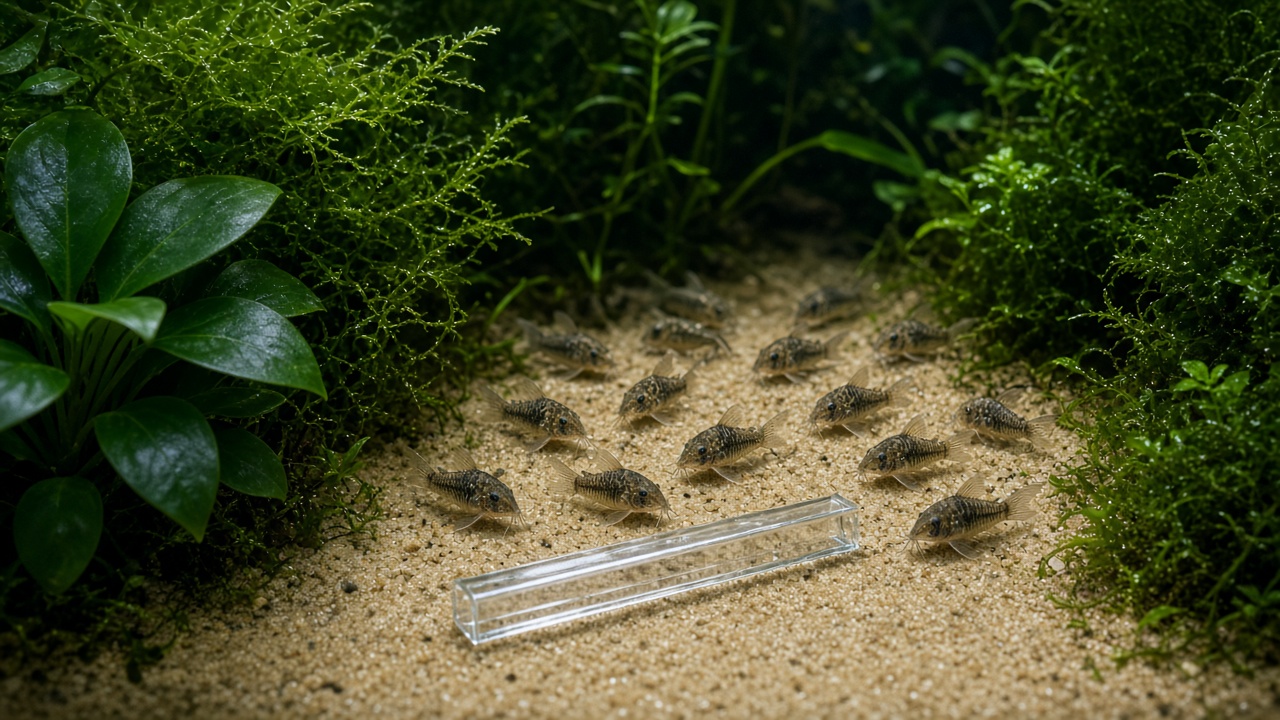
- Leave open sand so the school can turn as a unit.
We do not list one “minimum gallon” figure as if every school fits the same cube, because floor length is the number that matters.
School size we will cover
We write only for groups that can mill together on the sand.
A lone panda cory is a common shop add-on, and it fails the Sand-School-Sink rule. The fish is sold as a social bottom worker, so one fish cannot show that.
This brief covers groups large enough to stay in contact while they sift, and it skips pair-only tanks and “one cleaner fish” tanks.
If you already own a single fish, add more of the same species and do not call a mixed pair a school.
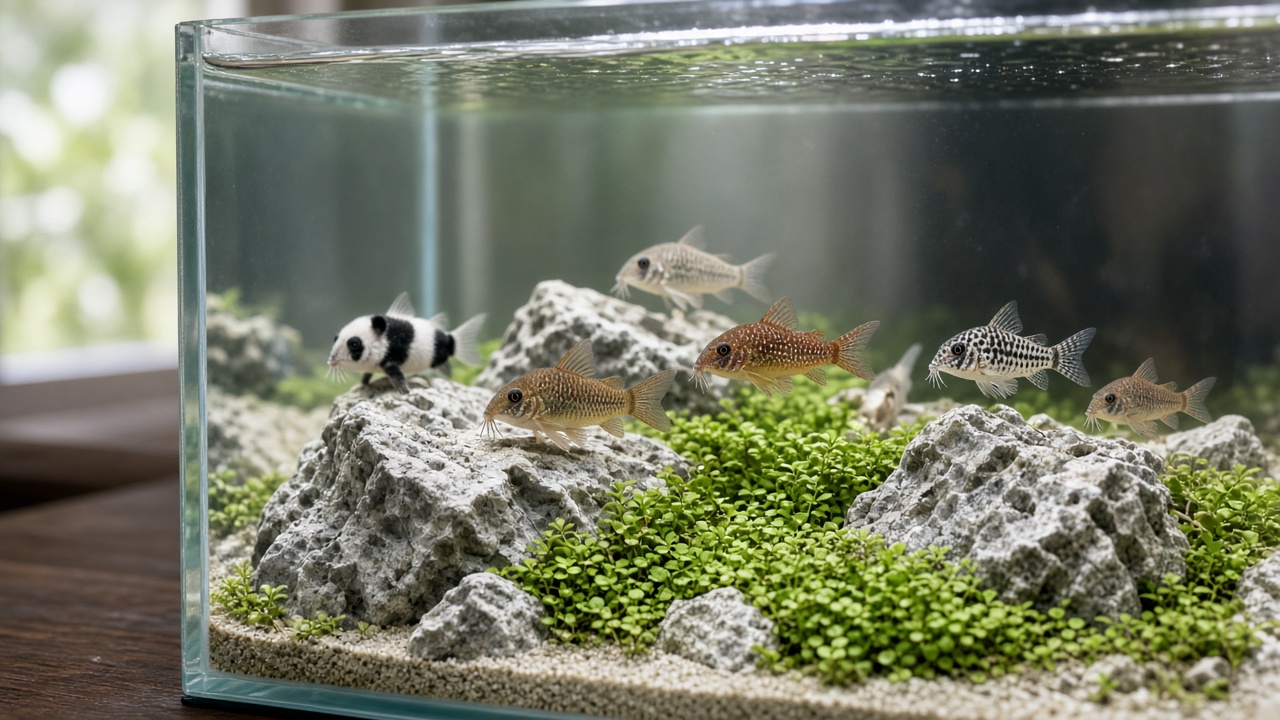
Mixed cory species can share a tank, but they still do not replace a same-species group.
Water to match, and water to skip
This is a freshwater Amazon fish, not a rift-lake fish.
The California Academy of Sciences lists habitat as freshwater in the upper Amazon. That is the only water claim we take from the catalog.
CaribSea’s freshwater line splits in a useful way. African Cichlid Mix products “naturally buffer” for rift-lake tanks, while Super Naturals are the sands it names for corys.
Skip crushed coral and rift-lake mixes if you want this species, because those products are built to hold a harder, more alkaline profile.
CaribSea describes PYROFLORA as support for “soft and mildly acidic water.” That matches a planted, low-buffer tank better than a Malawi mix.
It is not a panda-only recipe, but it is a listed chemistry hint from the maker.
Keep the tank cycled and clean, because barbels drag through waste and dirty sand is a husbandry failure, not a mystery illness.
Sand that will not shred barbels
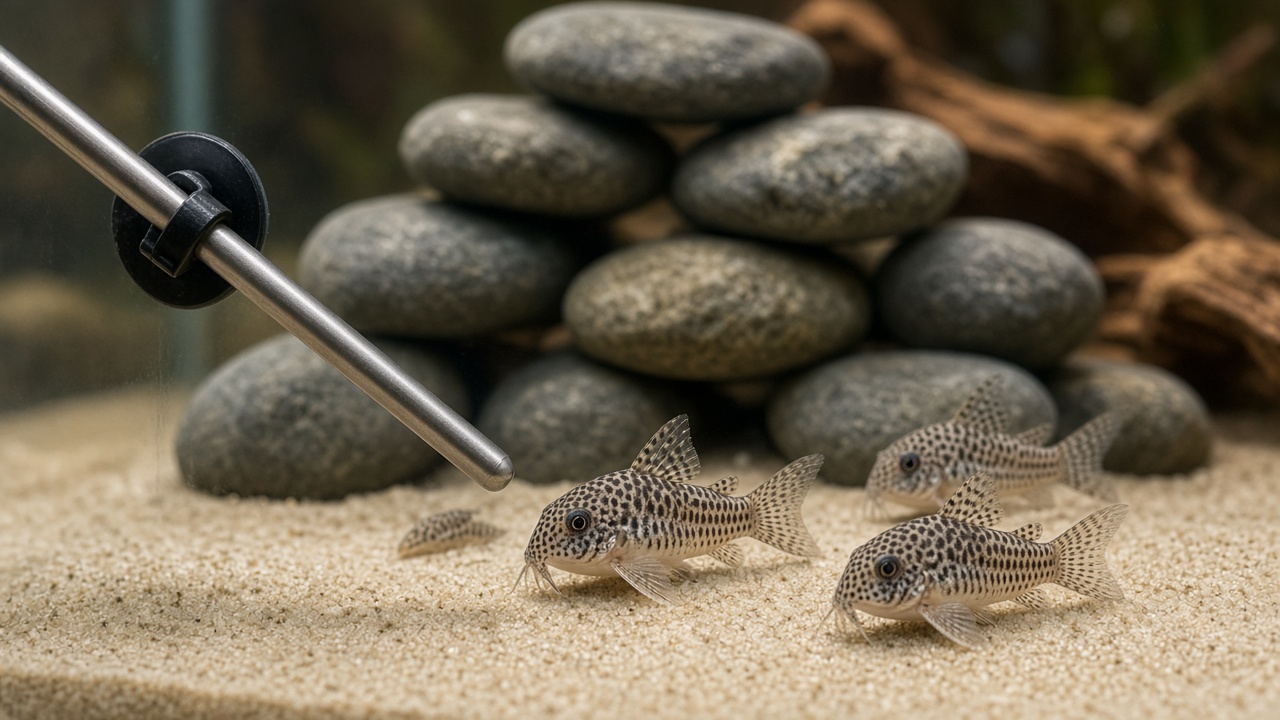
CaribSea names Super Naturals for corys and lists Peace River as its favorite.
Our research team compared three listed grain bands on that line. Moonlight Sand’s listed top grain is 0.75 mm, and Peace River’s listed top grain is 2.0 mm.
That is a 1.25 mm gap on one product family, with Crystal River sitting in the middle at 0.5–1.0 mm.
The Hikari Tropical Sinking Wafers page names Corydoras as a daily-diet target, and CaribSea’s FAQ names Super Naturals, plus Peace River, for corys.
Rinse Super Naturals before they go in, unless the bag is a live-sand style product. CaribSea’s FAQ says a rinsed bed should start to clear in hours and finish in 24 to 48 hours.
Do not cap an old bed with new sand, because CaribSea warns that a cap can start another cycle. Mix in about a cup a day if you only need to thicken the bed.
Diet that actually reaches the floor
Comparing published specs, listed protein on our three sinking foods ran from 36% to 42%.
These are the six products that passed the Sand-School-Sink rule, with attributes taken from the maker pages and not from a ranked list.
| Product | Type | Listed form or grain | Listed protein or density | Packs on the maker page |
|---|---|---|---|---|
| Hikari Tropical Sinking Wafers | Sinking wafer | Soft disc | 36% min. crude protein | 25 g, 50 g, 110 g |
| Omega One Sinking Catfish Pellets | Sinking pellet | Pellet for bottom feeders | 38% min. crude protein | 4.5 oz, 15 lb |
| NorthFin Krill Pro 1 mm | Slow-sinking pellet | 1 mm | 42% min. crude protein | 20 g, 80 g, 250 g, 500 g, 1 kg |
| CaribSea Super Naturals Moonlight Sand | Sand | 0.25–0.75 mm | 95 lb per cubic foot | 5 lb, 10 lb, 20 lb, 40 lb |
| CaribSea Super Naturals Crystal River | Sand | 0.5–1.0 mm | 95 lb per cubic foot | 5 lb, 10 lb, 20 lb, 40 lb |
| CaribSea Super Naturals Peace River | Sand | 1.0–2.0 mm | 93 lb per cubic foot | 5 lb, 10 lb, 20 lb, 40 lb |
Hikari’s Tropical Sinking Wafers page lists these guarantees:
- Crude protein: min. 36%
- Crude fat: min. 9.0%
- Crude fiber: max. 4.0%
- Moisture: max. 10%
- Ash: max. 16%
- Phosphorus: min. 0.8%
Hikari says to feed only what fish will finish in 20 minutes, then remove leftovers. The same page names Corydoras catfish as a daily-diet target.
Packs listed there are 0.88 oz (25 g), 1.76 oz (50 g), and 3.88 oz (110 g).
Omega One’s Sinking Catfish Pellets page lists these guarantees:
- Crude protein: min. 38%
- Crude fat: min. 10%
- Crude fiber: max. 2.0%
- Moisture: max. 8.5%
- Ash: max. 8%
First ingredients are salmon, whole herring, and whole shrimp. Packs listed are 4.5 oz and 15 lb, and Omega One calls them a daily diet for all bottom feeders.
NorthFin’s Krill Pro page lists these guarantees:
- Crude protein: min. 42%
- Crude fat: min. 5%
- Crude fiber: max. 5%
- Pellet sizes: 1 mm, 2 mm, 3 mm, 6 mm
- First ingredient: whole Antarctic krill meal
For panda mouths, the 1 mm size is the match on that page. The 1 mm packs start at 20 g and run to 1 kg.
Our research team compared those three labels. The protein spread is 6 points, and fat spreads from 5% on Krill Pro to 10% on the Omega One pellet.
Fiber is lowest on the Omega One pellet at 2.0% max.
Feed on a simple loop:
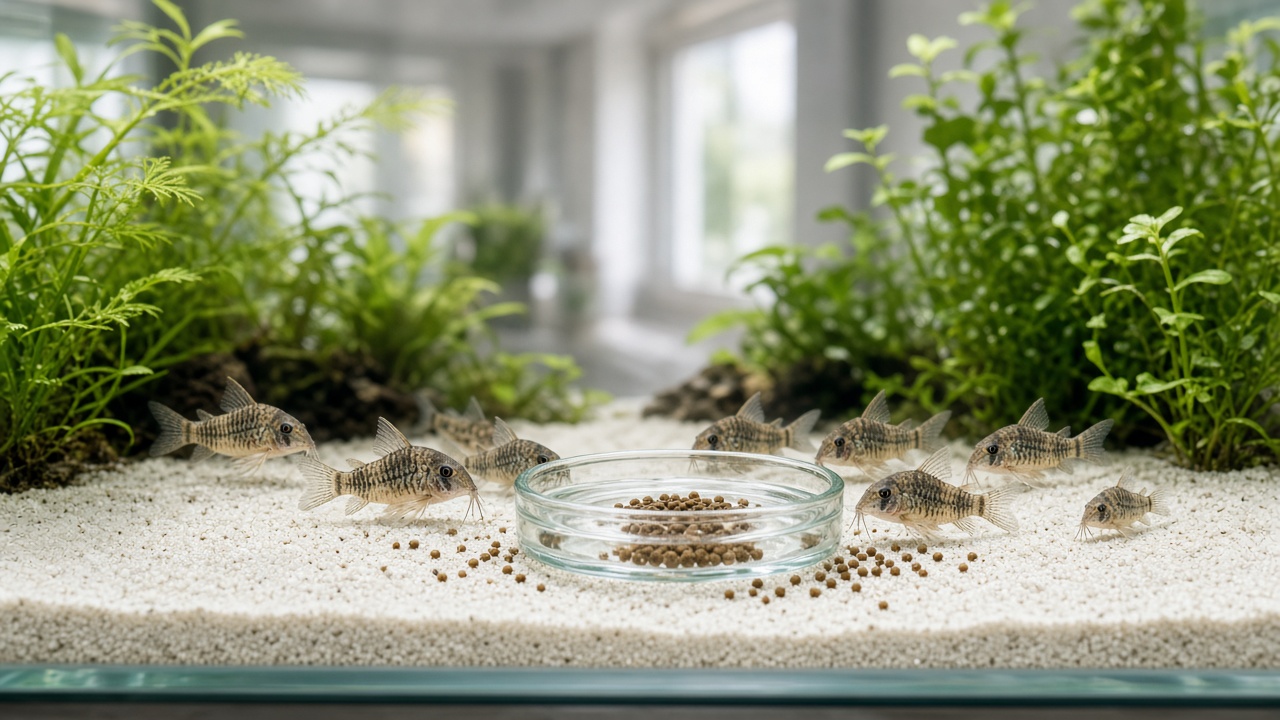
- Drop food on open sand, not into a plant thicket.
- Watch the school finish the pile.
- Stop at Hikari’s 20-minute window if you use that wafer.
- Siphon crumbs so barbels are not grazing rot.
Flakes that stay at the surface are a midwater food, not a panda diet, so use a wafer or a 1 mm slow sinker.
What this brief does not cover
This brief stays inside catalog records and current maker pages.
We also skipped “cleaner crew” marketing. A panda cory is a small catfish that needs its own meal, and leftover flake is not a diet.
If a product had no sinking claim and no grain band at or under 2.0 mm, it did not enter the table.
FAQ
Is Corydoras panda the same fish as Hoplisoma panda?
Yes, Eschmeyer’s Catalog of Fishes treats Hoplisoma panda as the current name.
It still records the 1971 Corydoras panda name and the Peru type locality. Shops will keep printing Corydoras panda on bags, so buy the pattern and the school, not the older genus on the label.
What size tank does a panda cory need?
Use floor length first. Then cap the load with CaribSea’s FAQ rule: 1 inch per 20 gallons for two weeks, then 1 inch per 5 gallons.
A short, wide tank beats a tall cube of the same gallons. Budget 1 to 2 pounds of sand per gallon so the bed stays deep enough to sift.
How many panda corys should I keep?
This desk covers only groups that can mill as a unit. We do not cover a single “cleaner” fish or a pair used as decor.
Add fish of the same species until they move together on the sand. Mixed cory species can share space, but they do not replace a same-species school.
What should I feed panda corys?
Use a sinking wafer or a 1 mm pellet; Hikari Tropical Sinking Wafers list 36% minimum crude protein and a 20-minute feed window.
Omega One Sinking Catfish Pellets list 38% protein, and NorthFin Krill Pro lists 42% protein plus a 1 mm size. Drop food on open sand and remove leftovers.
Which sand is safest for their barbels?
CaribSea’s FAQ says Super Naturals fit bottom dwellers and names Peace River as its favorite. Peace River is listed at 1.0–2.0 mm, and Moonlight Sand is finer at 0.25–0.75 mm.
Crystal River sits between them at 0.5–1.0 mm, so skip coarse decor gravel and rift-lake mixes built to buffer hard water.
Can one panda cory live in a community tank as the janitor?
That setup fails our Sand-School-Sink rule, because the fish still needs a same-species group and its own sinking meal.
Leftover flake is not a ration, and a lone fish on sharp gravel is the failure mode this page is meant to block.
Do I need special water gadgets for panda corys?
You need freshwater that stays clean, plus sand they can sift, and the catalog does not publish a gadget list.
Skip CaribSea African Cichlid Mix if you want a low-buffer bed, and use a cycled filter with sand you can keep waste-free.