Quick answer: Fifteen popular Corydoras types range from about 2.1 cm pygmies to near 10 cm emerald and hognose forms. Match published adult size, temperature band, and a same-species school of six or more before you buy.
Choose Cory types by published adult size, temperature band, and school needs.
We compared published care data across popular Corydoras and close relatives sold as cory catfish. Our research team analyzed standard lengths from database and profile sources beside community husbandry notes. Owners consistently report healthier barbels on clean sand and better behavior in same-species groups of at least six.
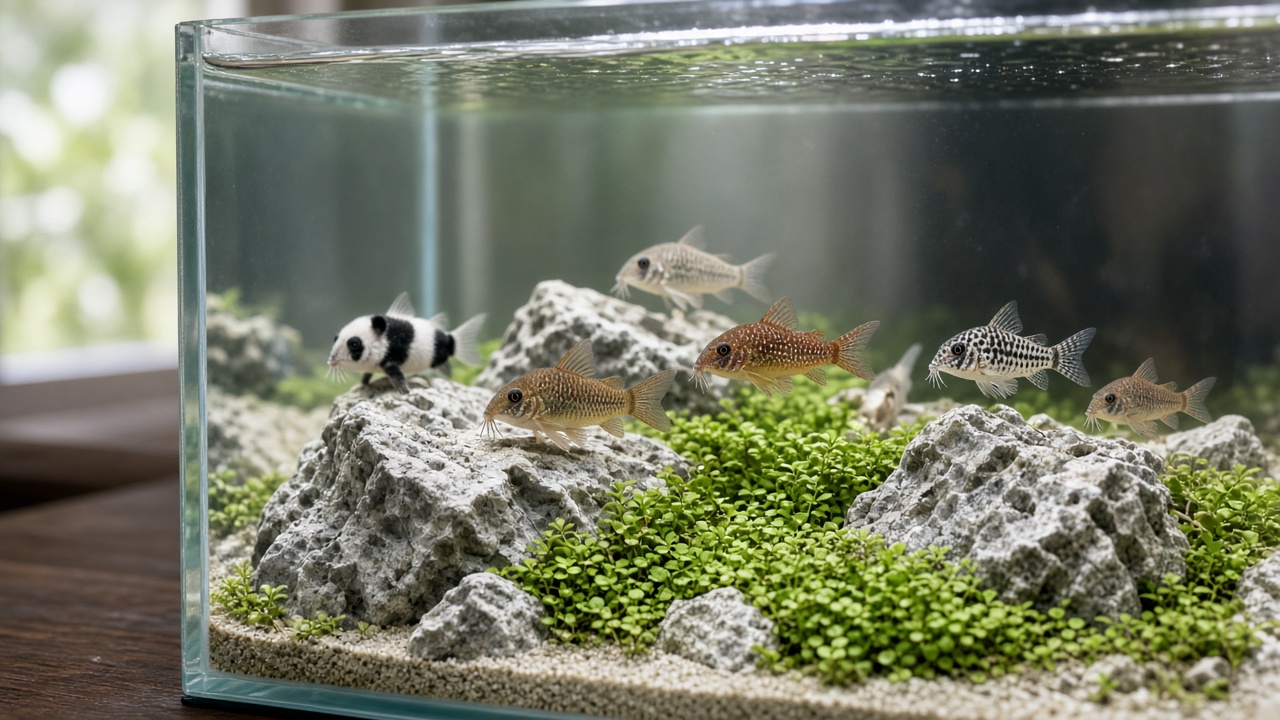
Comparing published specs shows a wide size ladder. Published maxima place Corydoras aeneus near 7.5 cm SL and Corydoras sterbai near 6.8 cm SL. Other published records place Corydoras trilineatus near 6.1 cm SL and Corydoras metae near 4.8 cm SL. Corydoras panda sits near 3.8 cm SL, Corydoras pygmaeus near 2.1 cm SL, and Corydoras splendens near 9.9 cm SL. Care profiles list Corydoras paleatus near 7.0 cm SL. Hobby guides place Brochis multiradiatus near about 9 to 10 cm. This page compares fifteen types, shared care rules, tank sizing, and common mislabels.
Include sand, sinking foods, and species-matched schools. Leave out lone “cleaner” singles and sharp gravel. Skip medication protocols that belong with a veterinarian.
Scope board:
| Include | Leave | Skip |
|---|---|---|
| Same-species groups of 6+ | Lone scavenger myths | Copper-heavy community cures |
| Sand or smooth fine gravel | Sharp coarse gravel beds | Oversized tankmates for pygmies |
| Sinking omnivore foods | Leftover flake only | Mixing look-alike wild labels blindly |
| Size-matched tank plans | Nano tanks for jumbo forms | Unverified miracle growth claims |
Compare fifteen popular types by published adult size first
Adult length drives tank choice more than juvenile store photos.
Use the table as a shopping map. Standard length excludes the tail, so total length looks a bit longer in the tank. Brochis and Scleromystax appear because shops sell them beside true Corydoras. Confirm labels when “julii” fish show reticulated heads typical of trilineatus.
| # | Common name | Scientific name | Published max size | Care cue |
|---|---|---|---|---|
| 1 | Bronze cory | Corydoras aeneus | 7.5 cm SL | Hardy beginner staple |
| 2 | Albino bronze | Corydoras aeneus | 7.5 cm SL | Same care as bronze |
| 3 | Peppered cory | Corydoras paleatus | 7.0 cm SL | Cooler band OK |
| 4 | Sterba’s cory | Corydoras sterbai | 6.8 cm SL | Warmer community fit |
| 5 | Three-lined cory | Corydoras trilineatus | 6.1 cm SL | Often sold as “julii” |
| 6 | True julii cory | Corydoras julii | About 5.0–5.2 cm | Rarer than lookalikes |
| 7 | Bandit cory | Corydoras metae | 4.8 cm SL | Dark head mask |
| 8 | Panda cory | Corydoras panda | 3.8 cm SL | Small community favorite |
| 9 | Salt-and-pepper | Corydoras habrosus | About 3.5–3.8 cm | Dwarf active forager |
| 10 | Violet cory | Corydoras similis | About 3.8 cm | Smudge near caudal |
| 11 | Pygmy cory | Corydoras pygmaeus | 2.1 cm SL | Midwater schooling dwarf |
| 12 | Tail-spot pygmy | Corydoras hastatus | About 2.5 cm | Caudal spot; midwater |
| 13 | Emerald cory | Corydoras splendens | 9.9 cm SL | Jumbo green form |
| 14 | Hognose brochis | Brochis multiradiatus | About 9–10 cm | Long snout; big tank |
| 15 | Bearded cory | Scleromystax barbatus | About 7–9 cm | Cooler room possible |
Our research team analyzed profile lengths beside database maxima so shoppers are not surprised at adulthood. Comparing published specs favors planning footprint for the largest fish in the group. Owners consistently report undersized tanks when they buy juveniles only.
Match temperature bands so Sterbai, peppered, and pandas thrive
Not every cory wants the same thermostat.
Profile ranges place many community types near about 72°F to 79°F. Sterba’s cory often sits warmer near about 75°F to 82°F, which is why keepers pair it with discus heat. Peppered and bearded forms tolerate cooler rooms near about 68°F in hobby notes. Panda profiles warn against long stretches much above about 77°F for wild-type comfort. Stable heat beats daily swings.
Temp board:
| Type cluster | Published temperature cue |
|---|---|
| Bronze / albino | About 70–81°F (21–27°C) |
| Peppered | About 72–79°F (22–26°C); cooler OK |
| Sterbai | About 75–82°F (24–28°C) |
| Panda | About 72–77°F (22–25°C) |
| Pygmy | About 72–79°F (22–26°C) |
Owners consistently report panda stress in hot community tanks built for other species. Comparing published specs still demands ammonia and nitrite at zero for every type. Pick one thermal neighborhood for the whole school. Do not mix a cool-water specialist with a long-term high-heat plan.
Size the tank to adult length and a real school, not a pair
Footprint and group size protect shy bottom fish.
Profile base sizes for many standard corys sit near about forty-five by thirty centimeters for small groups, with bronze notes nearer eighty by thirty centimeters. Pygmies can pack more bodies into that footprint, yet still need a group. Hobby guides often start panda schools in about ten to twenty gallons when filtration is solid. Emerald and hognose forms need larger community tanks suited to nine to ten centimeter adults. Always buy six or more of one species.
Schooling board:
| Size class | Practical stocking cue |
|---|---|
| Pygmy / hastatus / habrosus | Nano-capable; still 6–10+ fish |
| Panda / similis / metae | Modest footprint; group of 6+ |
| Bronze / peppered / sterbai / trilineatus | Standard community length |
| Emerald / hognose / barbatus | Large peaceful community only |
| Mixed species | Optional; each type still needs its own school |
Our research team analyzed behavior notes that treat same-species shoals as confidence tools. Comparing published specs rejects the “two cleaners” myth. Owners consistently report missing fish that were hiding alone after a tiny purchase. Measure adult length from the table before you commit.
Feed sinking foods on sand so barbels stay intact
Corys are omnivore foragers, not unpaid janitors.
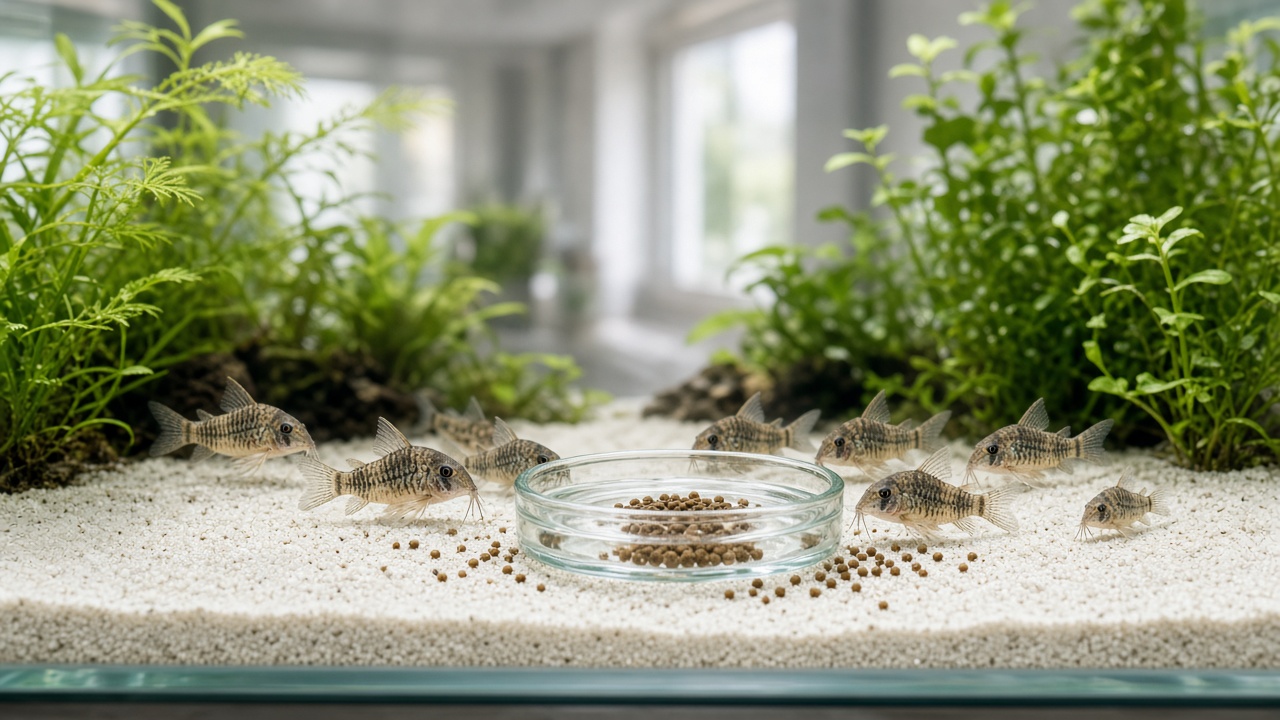
Offer quality sinking pellets or wafers as the staple. Add small frozen or live foods such as bloodworm and Artemia on a regular rhythm. Midwater pygmies still need tiny particles that reach their level. Fine sand or smooth rounded gravel protects barbels; dirty sharp gravel invites infections. Spot-feed after lights dim if fast surface fish steal every flake.
Diet checklist:
- Sinking staple sized for the species’ mouth
- Varied frozen or live foods weekly
- Clean sand vacuums that spare the biofilm lightly
- No copper meds in invertebrate-shared tanks without vet guidance
- Watch belly roundness so subordinates still eat
Owners consistently report thin corys in “they eat leftovers” tanks. Comparing published specs favors deliberate bottom feeding every day. Skip undergravel filters that trap waste in the bed. If barbels shorten, fix substrate and cleanliness before buying more fish.
Avoid mislabels: true julii versus three-lined, and CW lasers
Trade names blur species that differ in size and rarity.
Most fish sold as julii are Corydoras trilineatus, the three-lined or leopard form near 6.1 cm SL. True Corydoras julii stays nearer about 5.0 to 5.2 cm and is less common in shops. Orange and green laser forms often travel under CW numbers. Treat them as distinct purchases. Hobby charts place many near about 6 to 7.5 cm as adults. Albino bronze is still Corydoras aeneus, not a separate species. Ask for scientific names when patterns look ambiguous.
ID board:
| Shop label risk | Likely published identity | Size cue |
|---|---|---|
| “Julii” common | Often C. trilineatus | About 6.1 cm SL |
| True julii | C. julii | About 5.0–5.2 cm |
| Albino cory | C. aeneus | 7.5 cm SL |
| Orange laser | CW010 complex | About 7.5 cm hobby |
| Emerald / brochis | C. splendens / Brochis spp. | About 9–10 cm class |
Comparing published specs still rewards correct names for breeding projects. Owners consistently report surprise growth when “nano julii” were three-lined adults. Photograph purchases and keep receipts with Latin names.
Pick tank mates that cannot swallow a cory whole
Peaceful tetras and dwarf cichlids fit; big mouths do not.
Standard corys suit community tanks with small characins, rasboras, and calm dwarf cichlids. Pygmies need nano neighbors that will not eat a 2.1 cm adult. Hognose and emerald forms can share space with larger peaceful fish that would snack on pygmies. Avoid aggressive mbuna, large cichlids, and notorious fin-nippers that stress bottom schools. Quarantine new arrivals before they meet the sand crew.
Mate rules:
- Match adult mouth size to the smallest cory you keep
- Prefer calm midwater dither fish over territorial bottom rivals
- Keep shrimp only if copper stays out and fish are tiny-mouthed
- Feed multiple spots so corys are not outcompeted
- Rehome bullies that pin fish to the glass
Owners consistently report losses when angels or large gouramis share a pygmy tank. Comparing published specs treats corys as peaceful residents, not fighters. Plan the community around the cory size class in the table.
FAQ
How many Corydoras should I keep together?
Plan at least six of the same species, and more for pygmies when space allows. Mixed species groups still need each type in meaningful numbers. Pairs hide and stress more than they “clean.” Match the school to adult size so the tank is not overcrowded later. Confidence rises when fish can shoal tightly on open sand.
What is the smallest Corydoras type on this list?
Corydoras pygmaeus is published near 2.1 cm SL, with hastatus near about 2.5 cm in hobby charts. Both behave as tiny midwater schoolers more than heavy gravel diggers. They need nano-safe tank mates and fine foods. Do not house them with large community fish. Sand and gentle filtration still matter at this scale.
Which Corydoras stay comfortable in warmer tanks?
Sterba’s cory profiles often list about 75°F to 82°F, which suits many warm community layouts. Bronze types also accept a broad tropical band. Panda profiles prefer avoiding long stretches much above about 77°F. Always verify the specific profile before pairing with discus heat. Stability matters more than riding the top of any range.
Are albino corys a different species?
No. Albino fish sold in shops are typically Corydoras aeneus, the same species as bronze corys, with a published maximum near 7.5 cm SL. Care, schooling, and diet match the bronze form. Buy a proper group even when the price looks low. Color morphs do not remove the need for sand and sinking foods.
Why do shops call my fish julii when it looks reticulated?
True Corydoras julii is uncommon in the trade and published near about 5.0 to 5.2 cm. Most “julii” bags are Corydoras trilineatus near 6.1 cm SL. Pattern varies, so locality and fine spotting help experts more than casual glances. Enjoy trilineatus as an excellent beginner cory either way. Use Latin names when you breed or trade fish.
What substrate is safest for Corydoras barbels?
Fine sand or smooth rounded gravel that stays clean is the usual recommendation. Sharp, dirty coarse gravel is linked to barbel damage in care profiles. Vacuum gently so waste does not sit in the bed. Skip undergravel systems that hide decay. Healthy barbels are a husbandry scorecard, not a cosmetic detail.
How large do emerald and hognose cory types get?
Published records list Corydoras splendens near 9.9 cm SL. Hobby guides place Brochis multiradiatus near about 9 to 10 cm. Both need larger peaceful tanks than panda or pygmy schools. They suit tank mates that would eat tiny corys. Plan floor space for bulky adults, not the juveniles on the shelf.
This guide is informational only and does not replace advice from a qualified veterinarian.