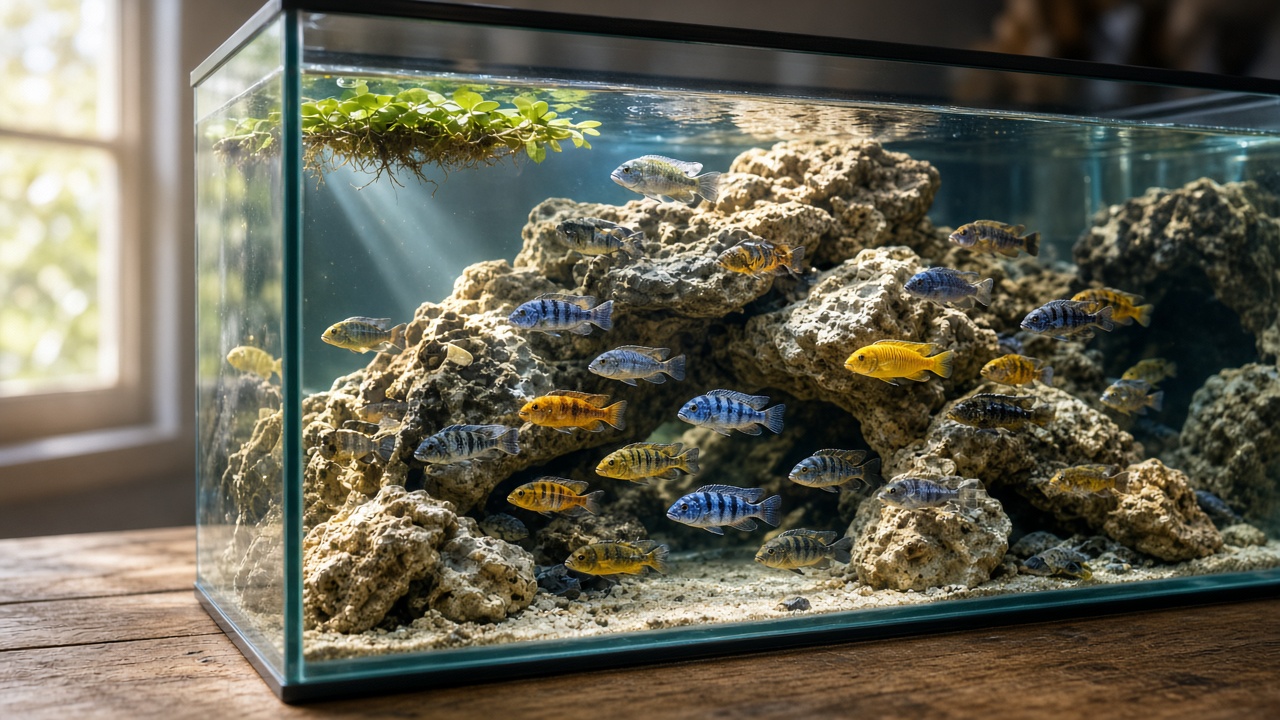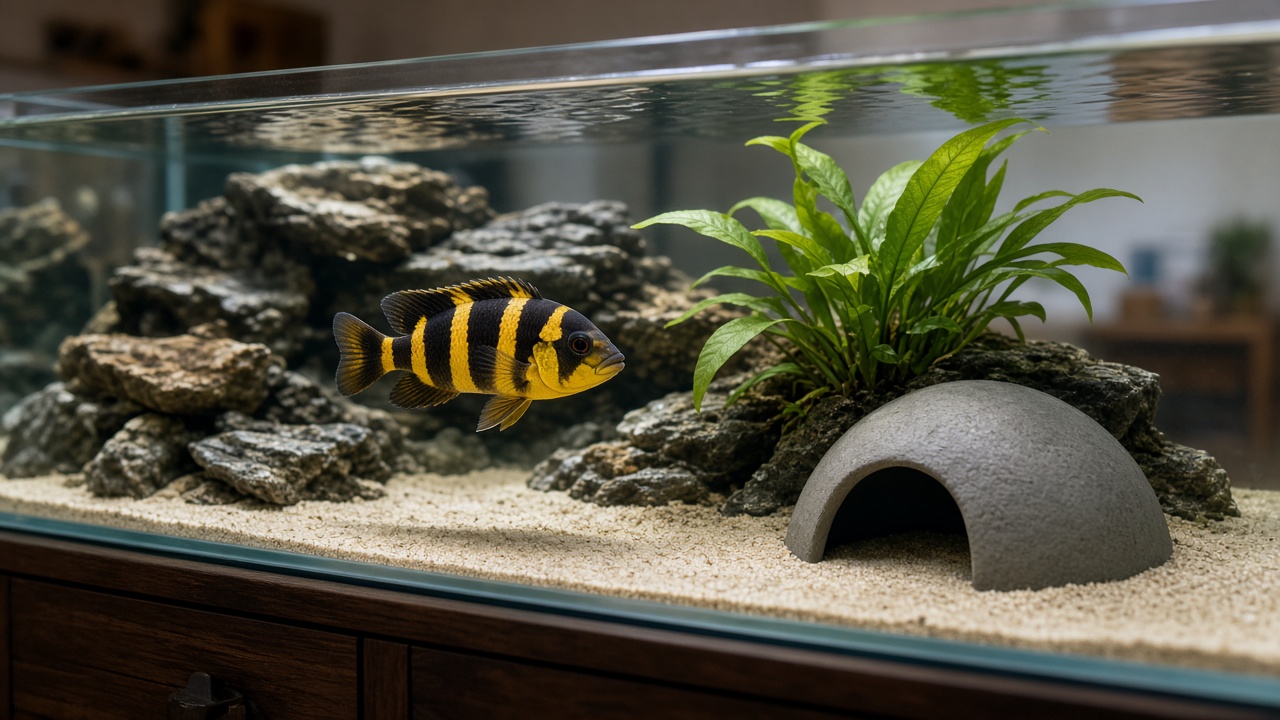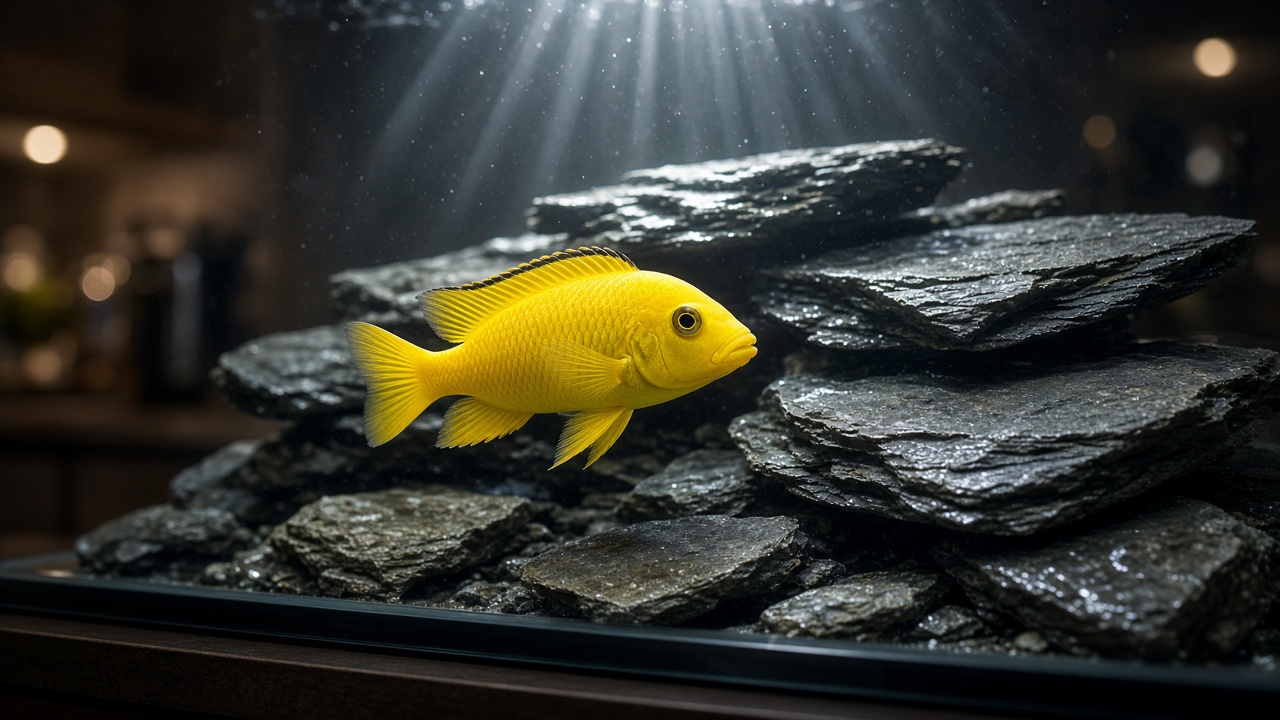
Quick answer: Keep an electric yellow cichlid in at least 41 gallons of hard, alkaline water. Feed a vegetable-heavy pellet twice a day. Stock one male with several females, or with other calm Malawi rock fish.
Electric yellow cichlids are 3.9-inch Lake Malawi rock fish that need 41 gallons, alkaline water, and vegetable-heavy food. Those figures come from the Seriously Fish species profile, not from a shop card.
This page is a published-spec care brief, not a tank-trial log, wild-fish count, or breeding report.
Selection rule: a setup enters this article only if it meets that 41-gallon floor and uses hard, alkaline water. A food enters the table only if its maker page lists crude protein and crude fat. We leave out 10- and 20-gallon kits, flakes with no analysis line, and fish that need soft or acidic water.
How large a tank an electric yellow cichlid needs
The floor is a 36-by-18-inch base, not a tall 20-gallon cube.
The Seriously Fish profile for Labidochromis caeruleus lists a standard length of 100 mm. That is 3.9 inches from snout to the base of the tail.
It is a small rock fish, not a giant Central American cichlid. The same profile sets the tank base at 90 by 45 cm, which is 36 by 18 inches.
The listed volume is about 154 liters, or about 41 US gallons.
Use that as the smallest home tank for one group. A shorter tank leaves males with nowhere to turn when they chase.
If you plan a mixed Malawi rock tank, go longer, not taller. Seriously Fish calls a 48-inch tank a good size when you want one male to spawn with several females.
Do not mix this plan with a South American cichlid plan, such as our electric blue acara tank size brief.
Plan the footprint first:
- 36 by 18 inches, about 41 gallons, for a small one-male group
- 48 inches long when you want room to spawn
- more length, not more height, when you add other rock cichlids
Water chemistry that matches Lake Malawi
These fish need hard, alkaline water, not a planted soft-water tank.
Seriously Fish lists these ranges for Labidochromis caeruleus:
- temperature 75 to 82°F (24 to 28°C)
- pH 7.7 to 8.6
- hardness 10 to 25 dGH
Keep ammonia and nitrite at zero as basic tank hygiene, not a species quirk.
If the pH falls into the mid-7s, the water no longer matches the listed range.
Seachem’s page for Malawi/Victoria Buffer states a target pH of 7.8 to 8.4. That band sits inside the Seriously Fish range.
The same Seachem page gives this dose:
- 6 g, or one level teaspoon
- for each 10 to 20 US gallons (40 to 80 L)
- each day until the pH holds
- then as needed, usually no more than once every two to three weeks
Seachem’s page says to dissolve the buffer in freshwater, then use it when you set up the tank or change water.
Do not add salt as if this were a brackish fish. The profile is freshwater, hard, and alkaline.
What to feed, and how often
Vegetable matter should make up a large share of the daily diet.
Seriously Fish says this species will take most foods. It also says spirulina flakes, blanched spinach, and similar plant foods should form a large part of the diet. Live and frozen foods can sit on top of that base.
That is the diet rule we used, and ”
Feed in short sessions so leftover pellets do not sit in the gravel.
The Fluval page for Bug Bites Cichlid Granules (S-M) sets a short feeding window. Feed only what the fish can eat in two minutes, two or three times daily.
A simple daily plan:
- Offer a small pinch of a listed pellet or granule at the first feeding.
- Stop when the fish finish in about two minutes.
- Repeat later in the day.
- Add a vegetable item on some days, such as spirulina food or blanched spinach.
- Skip a meaty treat if the fish already ate well that day.
Blanch spinach in hot water, cool it, and clip a small piece. Remove what they do not eat.
Cichlid foods we compared from maker pages
Listed protein on the four foods we compared runs from 37% to 46%.
Our research team analyzed four current maker pages and compared only the printed guaranteed analysis.
Comparing those pages, listed crude protein ran from 37% on New Life Spectrum Cichlid to 46% on Tetra Cichlid Sticks. Listed crude fat ran from 8% on two of those foods to 13.37% on Omega One Cichlid Pellets Small Sinking.
A 3.9-inch Malawi grazer does not need the highest protein number in the set. Use the table to see what each maker actually prints.
| Product | Form | Buoyancy | Crude protein | Crude fat | Moisture |
|---|---|---|---|---|---|
| New Life Spectrum Cichlid | 1 to 1.5 mm pellet | Sinking | 37% min | 8% min | 10% max |
| Omega One Cichlid Pellets Small Sinking | Small pellet | Sinking | 39.40% min | 13.37% min | 6.25% max |
| Fluval Bug Bites Cichlid Granules (S-M) | 1.4 to 2.0 mm granule | Slow sinking | 40.0% min | 12.5% min | 10.0% max |
| Tetra Cichlid Sticks | Floating stick | Floating | 46% | 8% | 8% |
The New Life Spectrum page also lists vitamin A at 10,000 IU/kg, vitamin D at 3,500 IU/kg, and vitamin E at 400 IU/kg. It lists ascorbic acid at 600 IU/kg.
Jar and bag sizes on that page are 80 g, 150 g, 300 g, 600 g, and 2,200 g.
The Omega One page lists omega-3 at 1.82% min and omega-6 at 1.18% min. Pack sizes on that page are 4.2 oz, 8 oz, 16.25 oz, and 15 lb.
The Fluval page says the first ingredient is dried black soldier fly larvae, at up to 40% of the formula. It also lists lysine at 2.2% min and calcium at 1.50% min.
The Tetra page lists vitamin D3 at 2,041 IU/kg. Listed pack sizes are 500 ml / 160 g, 1 L / 320 g, and 10 L / 2.9 kg.
Those sticks float, so they suit surface feeding more than rock grazing.
How we used the table:
- Pick a sinking pellet or granule if the fish feed along the rocks.
- Pick a lower-protein bag if you already add shrimp or worms.
- Add a plant food on the side if the bag is the 46% Tetra stick.
- Leave out any food whose maker page has no protein line.
Tank mates that share the same water
Match the water first, then how the fish act.
Seriously Fish calls this species relatively peaceful for a Malawi rock fish. Males still become territorial when they spawn.
The profile says males can chase females hard, so keep several females to each male.
The same profile says you can keep them with:
- peaceful open-water Malawi cichlids, often called haps
- other mbuna, the rock-dwelling Malawi cichlids
- some hard-water rainbowfish and some barbs or minnows
It also says a mixed mbuna tank should be stocked densely enough that no one fish owns the whole rock pile.
Do not add these mates:
- tiny shrimp or fish that fit in a 3.9-inch mouth
- tetras, discus, or other fish that need soft, acidic water
- one extra male of the same species in a short tank
- other Labidochromis forms, which the profile says can hybridize
A simple stocking rule:
- Start with one male and at least three females.
- Give each male rock caves he cannot see through.
- Add other Malawi rock fish only if the tank is already 48 inches or longer.
- Skip community “peaceful tropical” lists that assume pH near 7.0.
If you want a South American cichlid instead, use a separate tank and the acara brief linked above.
Rocks, sand, and a simple weekly routine
Caves and open lanes cut fighting more than extra gadgets.
Seriously Fish says much of the tank should be rock piles that form caves, with small open lanes between them. It calls a sandy substrate best.
That layout copies the rocky shore this species uses in Lake Malawi. It also gives females a place to hide when a male displays.
A basic build:
- Set a long tank on a stand that can hold the water weight.
- Add a sand bed, not sharp gravel.
- Stack rocks so they cannot fall. Build caves first, then leave swim lanes.
- Cycle the filter before you add fish.
- Match temperature, pH, and hardness to the ranges above.
- Add the group in one go when the cycle is done.
Leave most plants out, and let rock work be the decor.
If you want a plant, pick a tough one in a pot. Accept that the fish may dig it up.
Weekly work is dull and useful:
- test pH so it stays in the listed band
- remove leftover food
- change water and redose buffer only as the Seachem directions say
- watch for a female with a full mouth; she may be holding eggs
Seriously Fish says a female may carry 5 to 30 eggs for up to three or four weeks. She does not eat in that stretch.
Do not chase her around the tank to “check.”
Spawning water in that profile is pH 8.2 to 8.5 and 77 to 80°F.
You need a second tank only if you want to raise fry, not for the adults to live well.
FAQ
How big does an electric yellow cichlid get?
The Seriously Fish profile lists a standard length of 100 mm, or 3.9 inches. That is the body without the tail fin. Adult males are often a bit larger than females and show stronger color when they spawn.
Can I keep one in a 20-gallon tank?
No. The same profile sets the smallest listed tank at about 41 US gallons, with a 36-by-18-inch base.
A 20-gallon box is shorter and holds less water than that floor. Use it for something else.
What should I feed an electric yellow cichlid?
Use a pellet or granule with a printed protein line, then add plant foods. Seriously Fish asks for spirulina flakes and blanched spinach as a large share of the diet. Fluval’s Bug Bites Cichlid Granules page says to feed what they eat in two minutes, two or three times a day.
Are electric yellow cichlids aggressive?
They are calmer than many Malawi rock fish, but they are not a community tetra. Seriously Fish says they become territorial when they spawn, and that males may chase females. Give them caves, length, and more than one female per male.
How many should I keep together?
Keep several females for each male. Seriously Fish says at least three females per male when you want them to spawn. A lone pair in a short tank leaves the female with no place to go.
Can they live with regular tropical community fish?
Only if those fish also want hard, alkaline water. The listed pH is 7.7 to 8.6, and the hardness is 10 to 25 dGH.
Soft-water tetras, rasboras, and discus do not match that range. Pick other Malawi rock fish, or some hard-water rainbowfish, instead.
Do I need a special buffer?
You need stable alkaline water, not a brand name. If your tap water already sits in the 7.7 to 8.6 pH band and stays hard, you may not need a buffer.
If it does not, Seachem’s Malawi/Victoria Buffer page targets pH 7.8 to 8.4 at 6 g per 10 to 20 gallons.