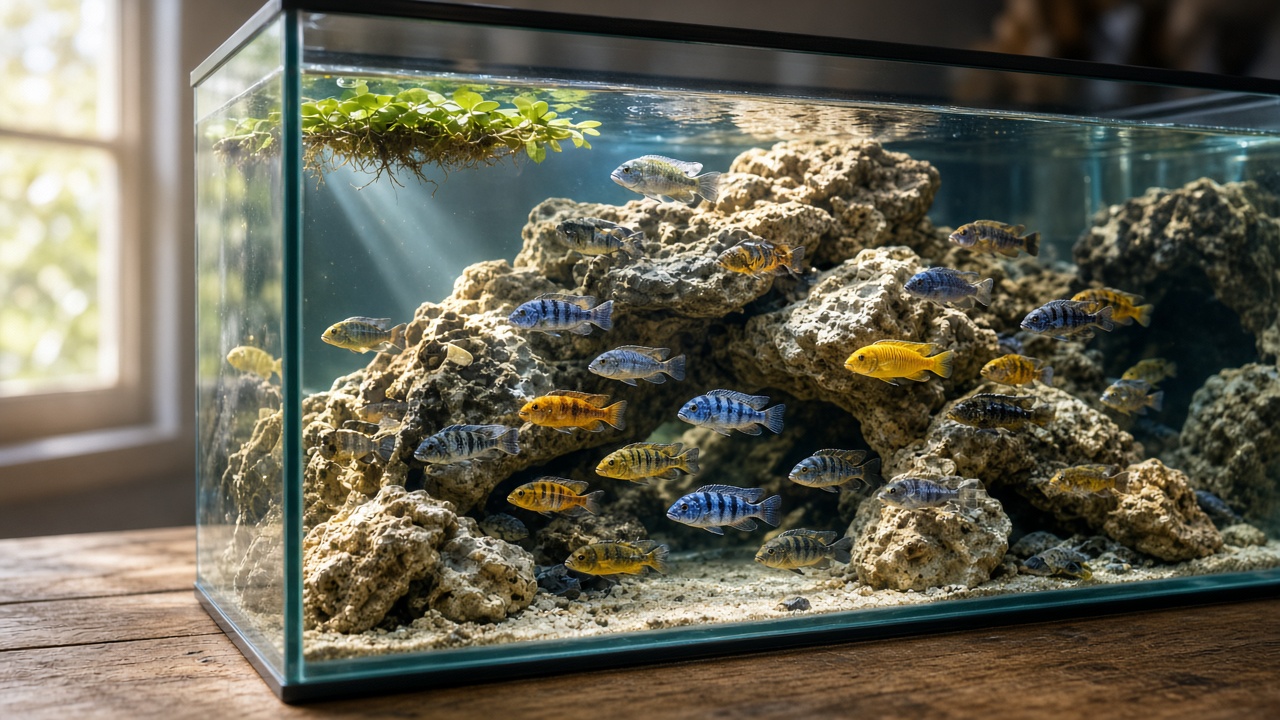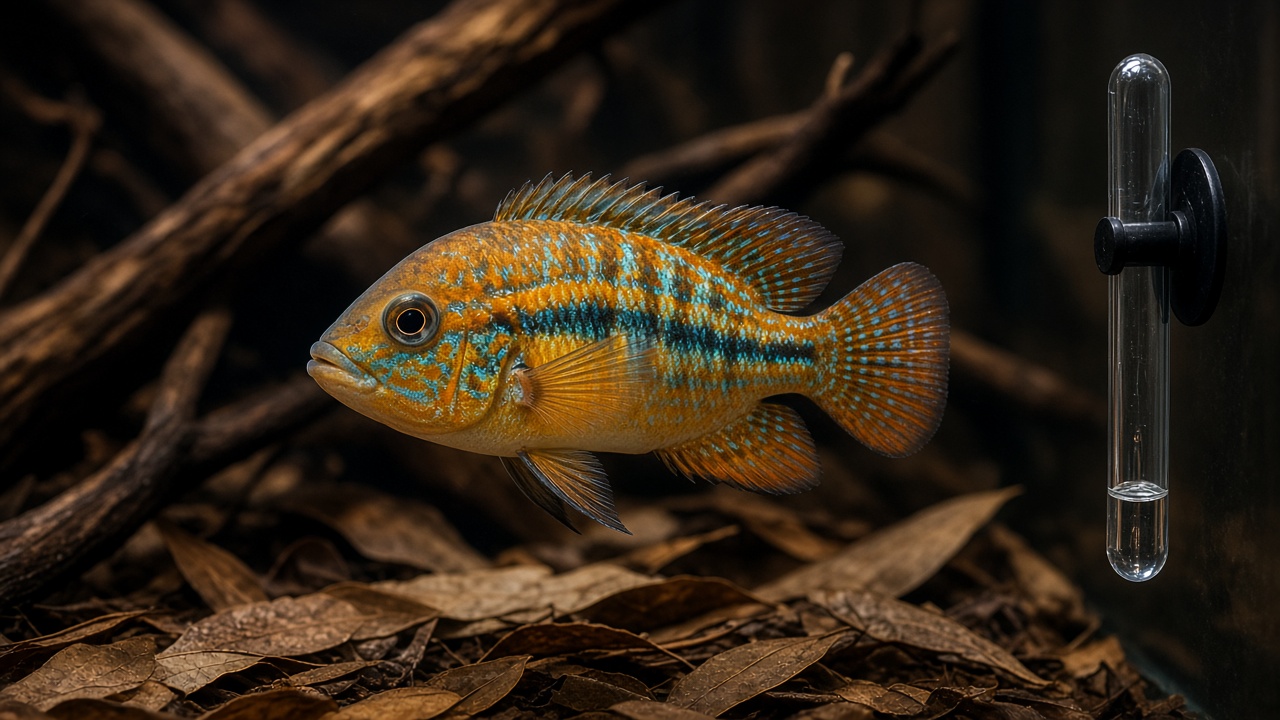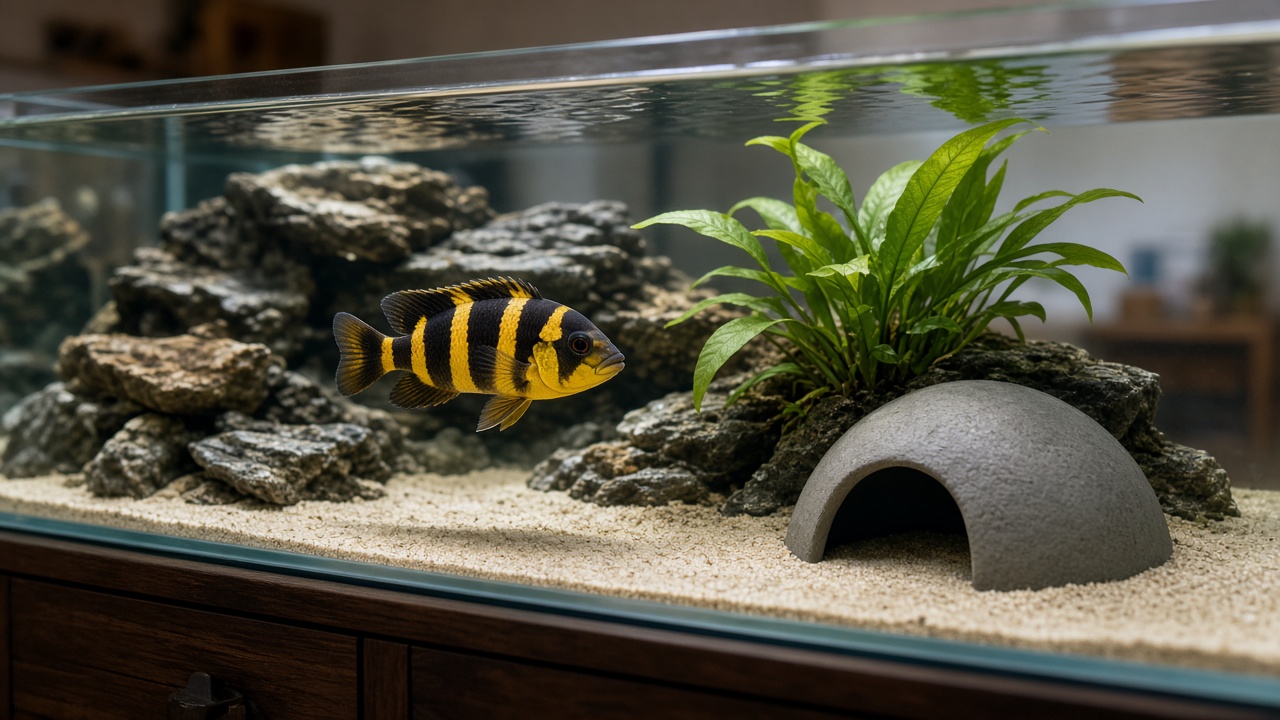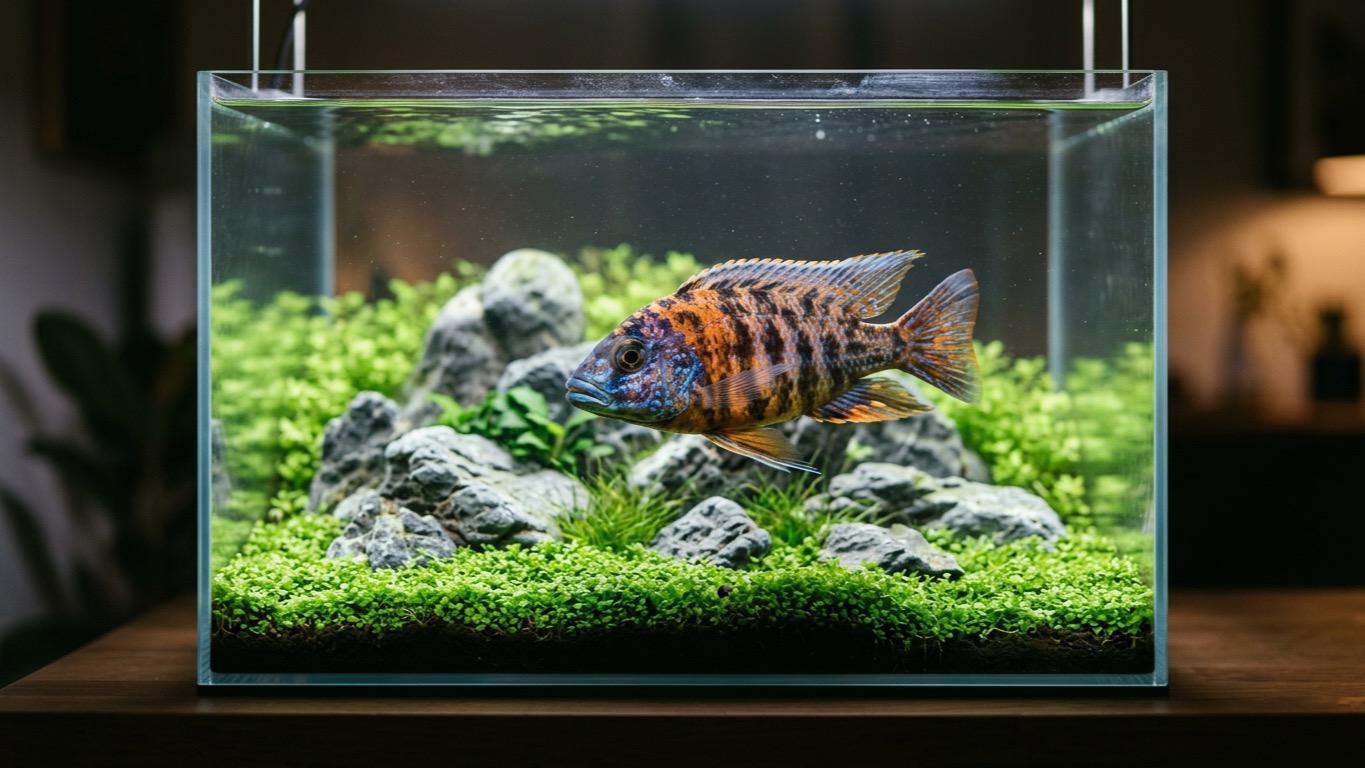
Quick answer: Keep one adult male OB peacock with several females in a 75-gallon tank. Feed a labeled cichlid pellet as the daily staple. Skip mbuna and small community fish.
An OB peacock cichlid is a captive-bred Malawi hybrid that needs 75 gallons as an adult. This page is a Waterpuppy research-desk brief on tank size, diet, and tank mates.
Our selection rule is the 75-Gallon Display Rule. We cover captive-bred OB peacock hybrids kept as display fish in freshwater tanks of 75 gallons or more. We leave out wild-caught Aulonocara lines, grow-out tubs, and mbuna-only rock piles.
What an OB peacock is, and what this page covers
An OB peacock is a captive-bred Malawi hybrid sold for blotched color, not a wild fish with one official size chart.
“OB” means orange blotch, and the pattern is a farm trait rather than a museum population. Sellers still file these fish with Aulonocara peacocks because the parent species come from Lake Malawi.
The fish you buy is almost always tank-bred, and that hybrid status is why we use a hard cutoff.
This page covers three jobs only:
- Tank volume and filter capacity from maker pages
- Diet labels we could read in full
- Tank mates that share hard, alkaline water
An OB peacock is also not a peacock gudgeon. That fish is a sleeper goby, so it needs a different tank plan.
The 75-Gallon Display Rule
We only write for display tanks of 75 gallons or more, even when a filter lists a 50-gallon floor.
A male OB peacock holds a patch of sand and rock, so other fish need a path around him. A short tank removes it.
Our research team compared published kit and filter ranges, not tank trials. Fluval’s page for the 407 Canister Filter lists a 50 to 100 US gallon capacity.
That floor is 50 gallons, and our rule is stricter on purpose. We use 75 gallons as the smallest display we will discuss.
A 75-gallon box gives more footprint than a tall 50-gallon column.
Use this volume check:
- One adult male plus two or more females: 75 gallons
- A mixed hap and peacock group: start at 75 gallons and add length
- Any plan with two males: skip it on this page
Do not scale down for a juvenile, because the rule is for the adult fish you intend to keep.
Fluval’s 407 page lists a pump output of 383 US GPH on 120 V / 60 Hz. The same page lists filter circulation at 245 US GPH.
Comparing those published specs, listed circulation sits 138 US GPH below pump output. That is about 36 percent lower once the canister is treated as a working filter. Those flow numbers fit a 75-gallon box, not a 20-gallon kit.
Water chemistry we can cite
Seachem’s Malawi/Victoria Buffer page targets pH 7.8 to 8.4 with a stated gram dose.
We do not invent a lake pH from a hobby blog, and we cite the buffer we actually read. Seachem states the blend is carbonate salts that raise KH and pH without changing GH.
Seachem’s dose is exact: use 6 g, which the page calls one level teaspoon, for each 10 to 20 US gallons. Repeat that dose each day until the target pH holds, then use it as needed.
The page says that is usually no more than once every two to three weeks.
For a 75-gallon display, that published range works out as follows:
- Low end: 22.5 g per dose day (6 g per 20 gallons)
- High end: 45 g per dose day (6 g per 10 gallons)
- After the pH holds: repeat only as Seachem states
Seachem also says to dissolve the buffer in freshwater first, then add it at setup or at a water change.
We do not state a temperature number here because no source in our set publishes a Fahrenheit range for this hybrid. Keep the heater stable, and do not chase a number
Test pH with a kit you already trust, then match Seachem’s 7.8 to 8.4 window. If your tap water already sits in that band and stays there, you may not need a daily dose.
Diet: read the label, then pick a pellet
University of Florida IFAS treats aquarium foods as specialty pet foods and tells keepers to compare guaranteed analysis numbers.
That is the Label-First Pellet Check. We do not rank flavors, and we compare published protein, fat, fiber, moisture, and pellet size.
University of Florida IFAS, in “Interpreting a Fish Food Package Label,” says ornamental aquarium fishes are specialty pet foods. The same page says labels follow FDA rules and AAFCO guidelines. It says guaranteed analysis values for fish feeds track National Research Council profiles for catfish and salmonids, plus each maker’s own work.
University of Florida IFAS gives these typical ranges for production fish feeds:
- Crude protein: 36% to 42%
- Lipid: 6% to 15%
- Crude fiber: 3% to 5%
The same page says tropical aquarium feeds typically list 35% to 50% protein. It says dry pellets often hold about 13% moisture or less, and that feeds with fiber higher than 8% have low feeding value for fish.
Our research team compared three maker pages against those IFAS bands. All three protein minima sit inside the 35% to 50% tropical range.
- Crude protein: 40.0% minimum
- Crude fat: 4.0% minimum
- Medium pellet size: about 4.8 to 5.3 mm
Baby pellets on the same Hikari page drop to a minimum of 32.0% protein. Do not treat the baby number as the adult spec.
Omega Sea’s page for Omega One Cichlid Pellets Large Sinking lists these figures:
- Crude protein: 42% minimum
- Crude fat: 12% minimum
- Crude fiber: 2.0% maximum
New Life Spectrum’s Cichlid page lists these figures:
- Crude protein: 37% minimum
- Crude fat: 8% minimum
- Crude fiber: 7% maximum
- Regular pellet size: 1 mm to 1.5 mm
- Buoyancy: negative, so most pellets sink
Comparing those three protein minima gives a 5-point spread: 37%, 40.0%, and 42%. Hikari’s 4.0% fat sits below the IFAS 6% to 15% production-lipid band.
Omega One’s 12% fat and New Life Spectrum’s 8% fat sit inside that IFAS lipid band. New Life Spectrum’s 7% maximum fiber stays under the IFAS 8% warning line.
Feed only what the fish finish, because leftover pellets rot and push ammonia up, so rotate one staple pellet, not five random snacks.
Published specs for five products we actually read
Our research team compared maker-published numbers for three pellets, one canister filter, and one buffer.
| Product | Type | Maker-published number | Second published number |
|---|---|---|---|
| Hikari Cichlid Gold Medium Floating Pellets | Daily floating pellet | 40.0% min crude protein | 4.8–5.3 mm pellet |
| Omega One Cichlid Pellets Large Sinking | Daily sinking pellet | 42% min crude protein | 12% min crude fat |
| New Life Spectrum Cichlid | Daily sinking pellet | 37% min crude protein | 1–1.5 mm sinking pellet |
| Fluval 407 Canister Filter | Canister filter | 50–100 US gal rating | 383 US GPH pump / 245 US GPH circulation |
| Seachem Malawi/Victoria Buffer | Carbonate buffer | pH 7.8–8.4 target | 6 g per 10–20 US gal |
A floating 4.8 to 5.3 mm Hikari pellet suits a large adult mouth. A 1 to 1.5 mm New Life Spectrum pellet suits a smaller fish. Omega One’s large sinking pellet puts 42% protein on the sand, where peacocks often hunt.
The Fluval 407 row is here because a 75-gallon display needs a filter rated at or above that volume. Fluval’s own range starts at 50 gallons and stops at 100 gallons. Seachem’s row is here because pH is a number you can measure.
Tank mates that fit this rule
Pair OB peacocks with other mid-sized Malawi haps or peacocks, not with mbuna or tiny community fish.
OB peacocks are open-water fish that hold sand and low rock, so they do not need a packed mbuna wall. Mbuna eat more algae and fight more in tight rock, and that mismatch starts most failed mixed tanks.
Use this mate filter:
- Yes: other peacocks and haps of similar adult bulk, with one male per color pattern
- Yes: a robust Synodontis catfish that ignores open water
- No: mbuna such as zebra or auratus types
- No: tiny tetras, guppies, or shrimp
- No: a second dominant male in the same 75-gallon box
Rules on our betta tank-mate page do not carry over. Bettas and Malawi hybrids do not share the same water or the same fight style.
Keep one male if the tank is 75 gallons, and add females so the male does not pin one fish all day. Watch the first week, and move a female that hides and loses weight.
Seachem’s page for this buffer stops at a pH of 8.4, so we stay inside 7.8 to 8.4.
A simple setup sequence
Cycle the tank, set pH with the published buffer dose, then add one male and several females.
Do the work in this order:
- Place a 75-gallon or larger tank on a stand rated for the full weight.
- Add sand and a few rock piles with open swim lanes, not a solid wall.
- Install the Fluval 407 or another filter that publishes a 75-gallon-plus rating.
- Fill, dechlorinate, and cycle until ammonia and nitrite read zero.
- Dose Seachem Malawi/Victoria Buffer at 6 g per 10 to 20 US gallons until pH holds between 7.8 and 8.4.
- Add females first, then the male, after the cycle is done.
- Feed one labeled staple pellet and match pellet size to mouth size.
Leave a bright open center, because peacocks display in the open and a cave-only layout helps mbuna, not this hybrid.
Change water on a fixed day, and redose buffer only if pH slips.
If you skip the cycle, you will chase ammonia instead of color.
FAQ
How big of a tank does an OB peacock cichlid need?
Our 75-Gallon Display Rule says 75 gallons is the smallest tank we will discuss for an adult. Fluval’s 407 page lists filters from 50 to 100 US gallons, so a 50-gallon box can hold the hardware. It does not meet our footprint rule for a male plus females.
Can I keep an OB peacock in a 55-gallon tank?
This page does not cover 55-gallon setups. A 55-gallon tank is often long but narrow, and that shape cuts the path around a territorial male. If you already own a 55, plan a move to 75 gallons before the male is full size.
What do OB peacock cichlids eat?
Use a daily cichlid pellet whose maker page lists protein in the University of Florida IFAS tropical band of 35% to 50%. Hikari Cichlid Gold Medium lists 40.0% protein, Omega One Cichlid Pellets Large Sinking lists 42%, and New Life Spectrum Cichlid lists 37%. Skip the Hikari baby spec of 32.0% protein for adults.
Can OB peacocks live with mbuna?
Not under our rule, because mbuna want rock and a heavier plant diet. OB peacocks want open sand and a protein-forward pellet. Mixing them in 75 gallons stacks two fight styles in one box, so pick one plan.
Can I keep two male OB peacocks together?
Not in the 75-gallon display this page covers, because two males will split the open floor and chase all day. If you want more color, add females or a different hap species, not a second male.
Is an OB peacock the same as a peacock gudgeon?
No, an OB peacock is a Malawi cichlid hybrid, and a peacock gudgeon is a sleeper goby. They do not share tank size, water, or diet rules, so read the peacock gudgeon page if that is the fish you bought.
Do I need Seachem Malawi/Victoria Buffer?
You need a stable pH in Seachem’s published 7.8 to 8.4 window. If your tap water already holds that band after a water change, you may not need a daily dose. If pH crashes, use the published 6 g per 10 to 20 US gallons until it holds.