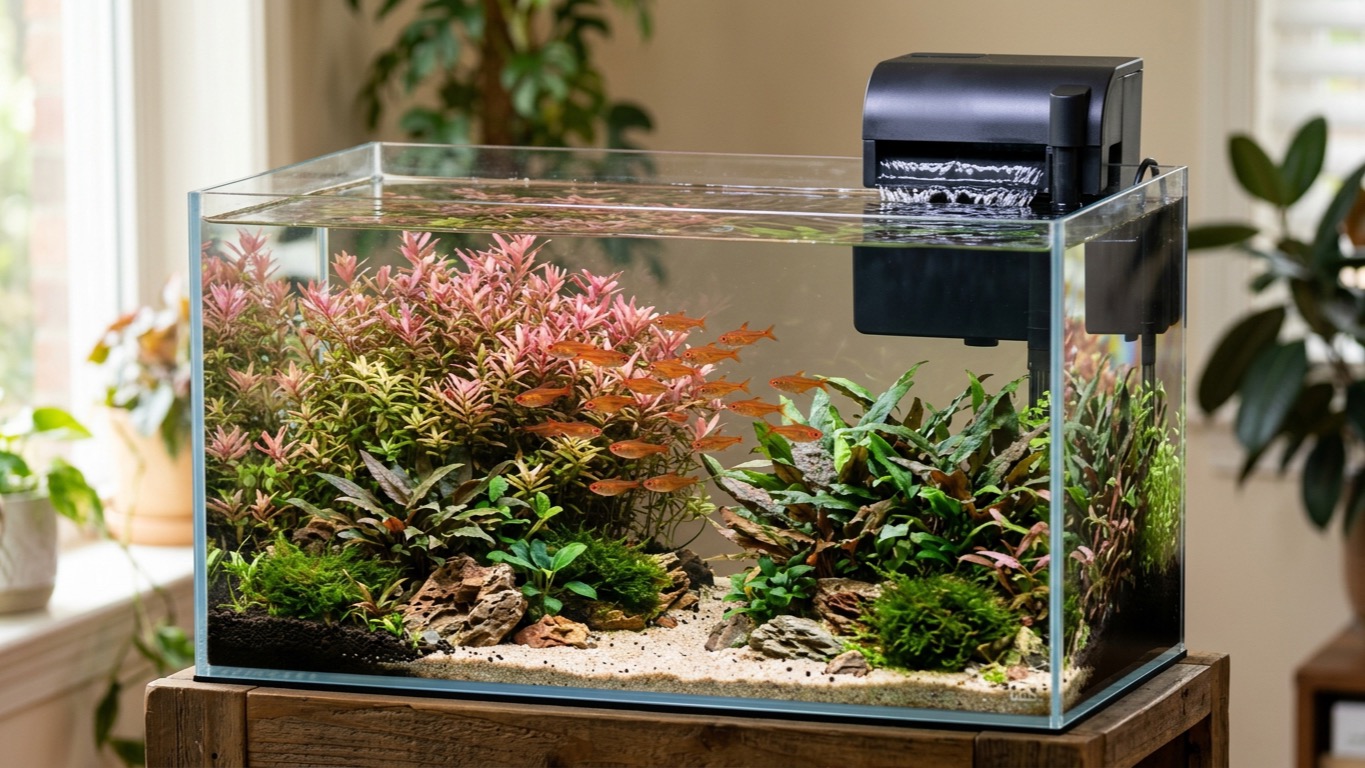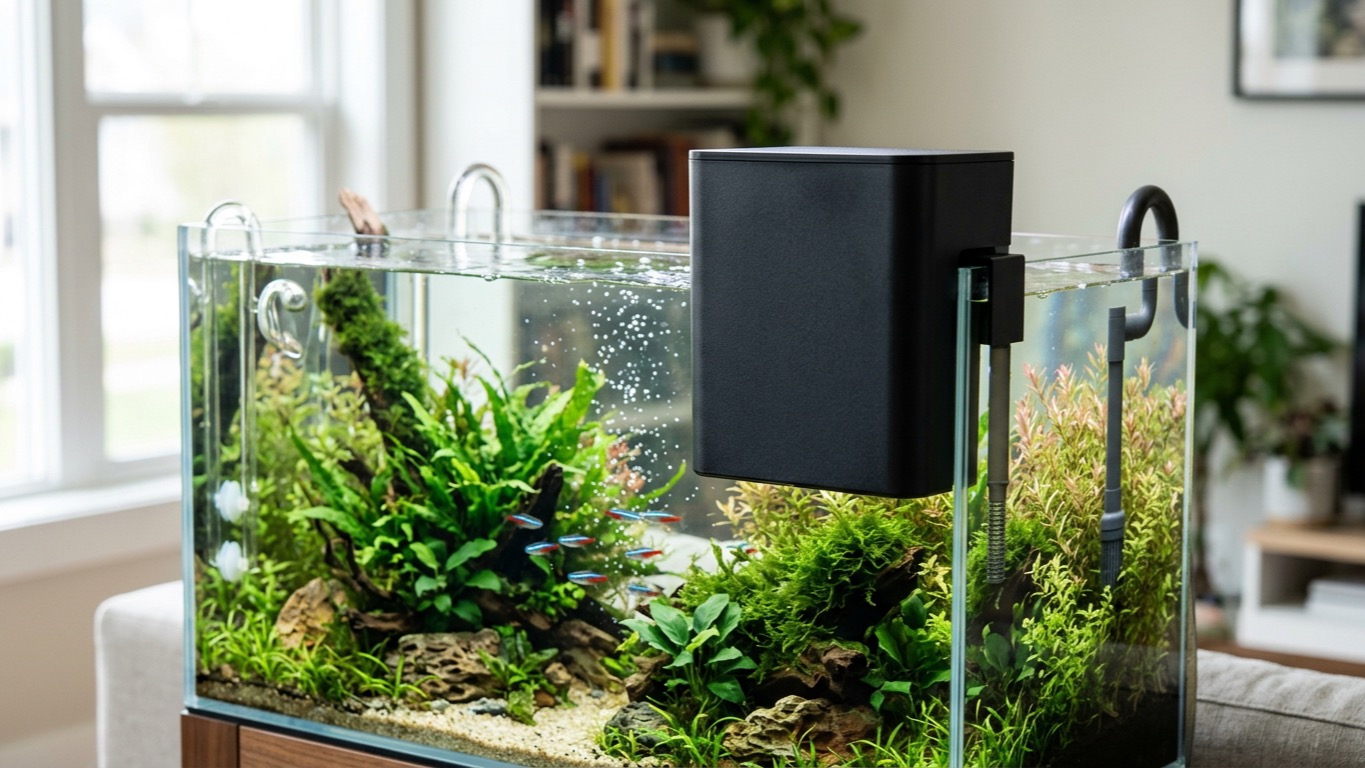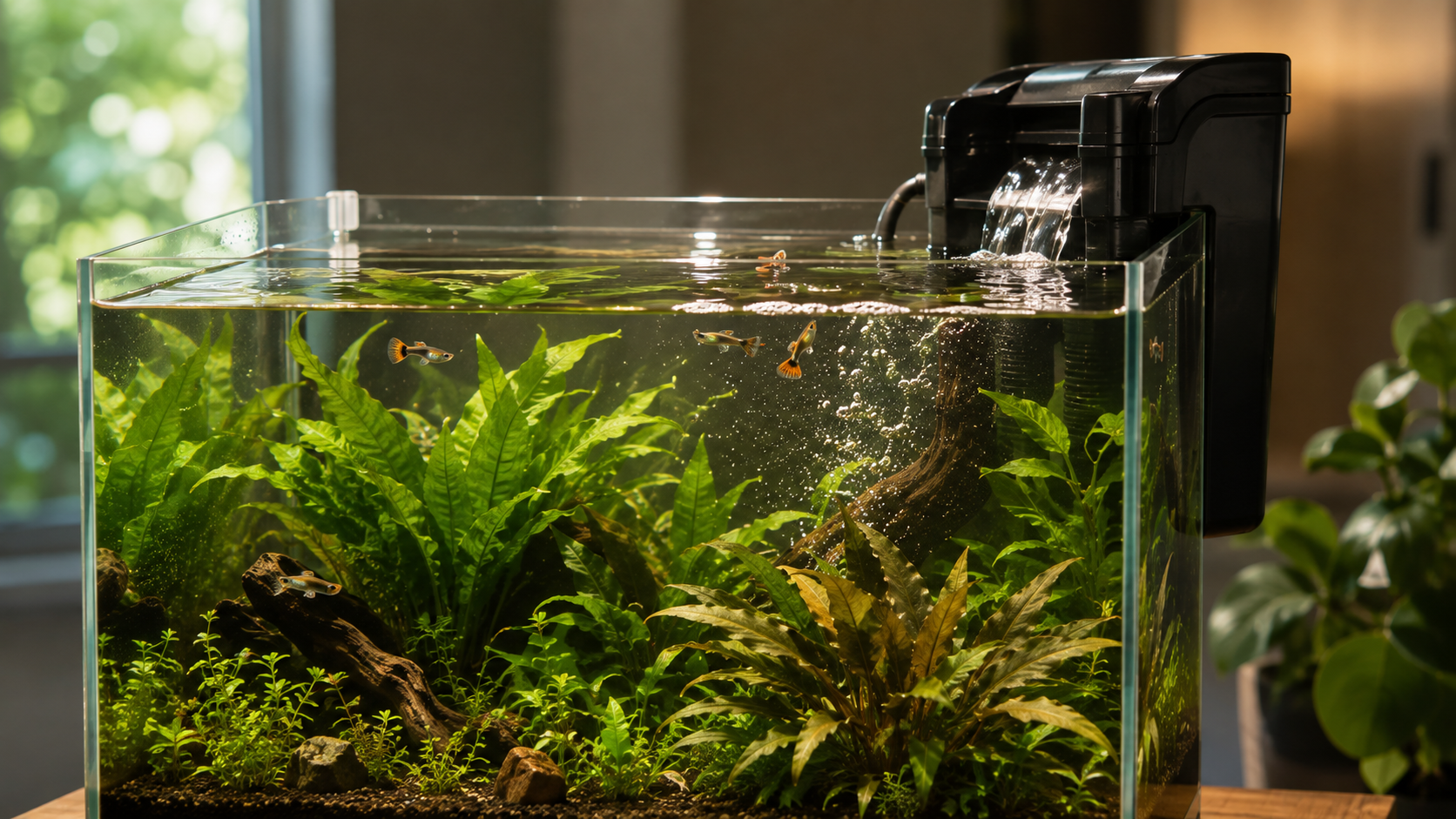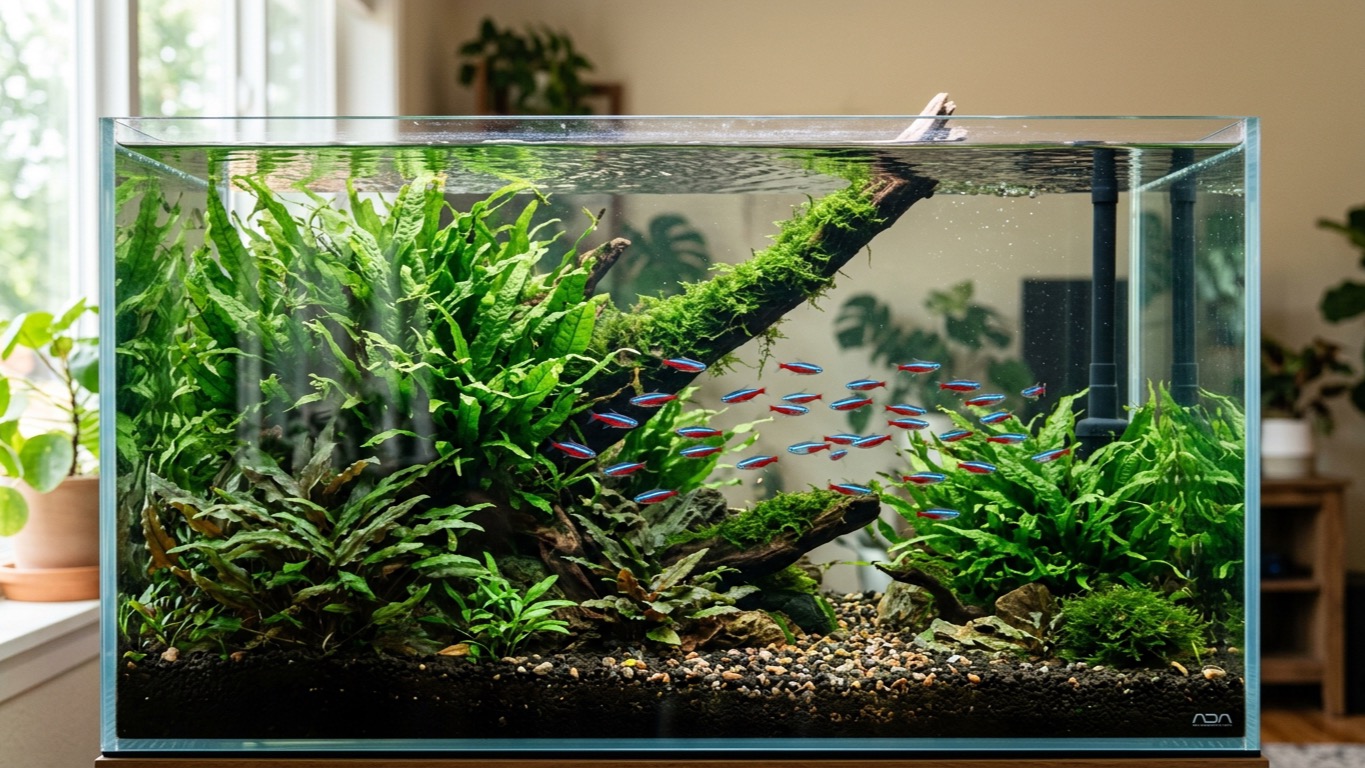
Quick answer: Set up a 10-gallon tank with a tight lid, warm treated water, and a gentle filter. Keep African dwarf frogs in a group of two or more. Skip bowls and tall, deep tanks.
A 10-gallon lidded tank with water under 12 inches is the minimum frog aquarium this desk covers.
This page is a research-desk setup brief on published specs, not a tank we cycled or an in-house water trial.
What this guide covers
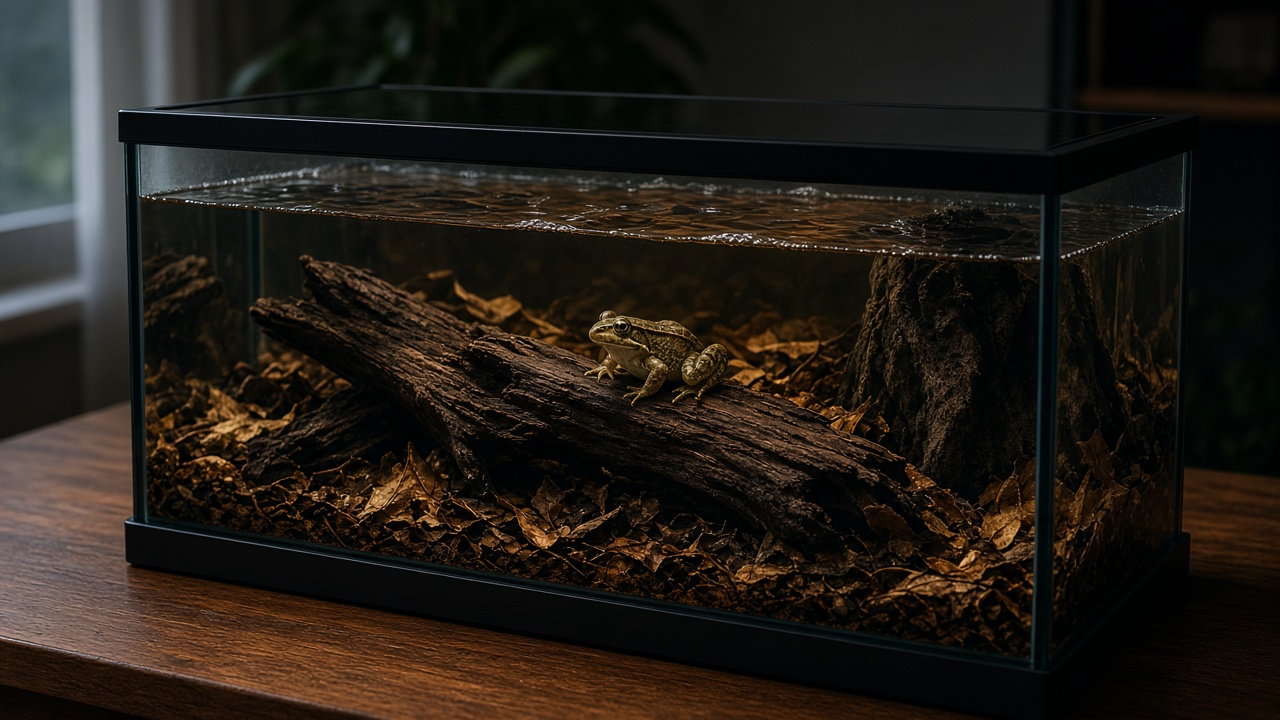
A frog aquarium here means a still, lidded home tank for fully aquatic African dwarf frogs.
We used one selection rule: the setup must be a 10-gallon or larger African dwarf frog tank. It also needs a lid and a published gentle-flow filter.
That rule let in the Aqueon Rectangle LED Kit in the 10-gallon size. It left out Pacman frogs, tree frogs, African clawed frogs, outdoor ponds, and unfiltered bowls.
Kits the maker rates under 10 gallons are not a finished home. They still appear in the table as size and flow checks.
PetSmart’s African Dwarf Frog Care Guide names the species Hymenochirus curtipes. That page lists adult size up to 2 inches, a lifespan of 5 to 8 years, and groups of at least 2.
Tank size and water depth
Takeaway: use a 10-gallon tank that stays shallow, not a tall column of water.
PetSmart’s care guide lists a tank size of 5+ gallons. The same shopping checklist says tanks of 10 gallons and larger are more stable.
Our 10-gallon floor follows that stability note, so a 5-gallon bowl fails the rule.
These frogs breathe air, and PetSmart’s care guide says they have lungs, not gills, and must reach the surface.
That page also says wild water can rise up to 24 inches, and that the frogs still prefer shallow water.
Use this tank checklist:
- Volume of 10 gallons or more
- A long, low footprint, not a tall hex or column
- Water depth kept under 12 inches after sand and décor
- A stand that can hold the filled weight
PetSmart’s setup steps state that water weighs 8.3 pounds per gallon. A 10-gallon fill is about 83 pounds of water before glass, sand, and rock.
Our research team compared two Fluval Flex kits on Fluval’s Flex 9 page. Fluval lists the Flex Aquarium Kit, 9 US Gal at 9 US gallons (34 L) and 14 by 13 by 13 inches.
The same Fluval page lists the Flex Aquarium Kit, 15 US Gal at 15 US gallons (57 L) and 16 by 15 by 15 inches. The 15-inch height fails our 12-inch water rule.
Aqueon’s Rectangle LED Kits page lists the 10-gallon kit box at 22.88 by 12.75 by 13.88 inches. That figure is the boxed kit, not a water-depth rating.
Water, heat, and conditioner doses
Takeaway: match PetSmart’s published bands, then dose Seachem Prime by the label.
PetSmart’s care guide prints this water table for African dwarf frogs:
- Temperature 70–82°F (21–28°C)
- Display range 73–79°F (23–26°C)
- pH 6.5–7.5
- Ammonia 0 ppm
- Nitrite 0 ppm
- Nitrate less than 20 ppm
- Chlorine 0 ppm
- Alkalinity 75–150 ppm
Treat tap water before it touches the tank. Seachem’s Prime page says to use 1 capful (5 mL) for each 50 US gallons of new water.
That same Seachem page says each cap thread is about 1 mL. For a 10-gallon change, the label math is 1 mL, not a full cap.
Seachem also says Prime will not impact pH. If tap water sits below PetSmart’s 6.5–7.5 band, use a labeled buffer, not extra Prime.
Our guide to raising aquarium pH walks through published buffer doses, then tells you to retest before any second dose.
Heat the water. Aqueon’s Rectangle LED Kits page says the included preset heater holds 78°F, which sits inside PetSmart’s 73–79°F display range.
Put a separate thermometer on the glass. PetSmart’s setup list tells you to run the system at least 24 hours and to set lights on a 12-hour cycle.
Cycle the tank before frogs go in, and PetSmart’s care guide says to add a bacteria starter.
Change water if ammonia or nitrite rises above 0 ppm, or if nitrate exceeds 20 ppm.
Filter, flow, and the hardware we compared
Takeaway: pick gentle published flow, then baffle any outlet that pushes frogs around.
African dwarf frogs are poor swimmers, so a strong outlet can pin them to décor or tire them on the way up for air.
Our research team compared four published flow figures:
- Top Fin BettaFlo: 20 gallons per hour, tanks up to 5 gallons
- Aqueon QuietFlow Internal Extra Small: 0–35 GPH, 0–5 gallon tanks
- Fluval Flex 9: 61 US GPH on a 9 US gallon kit
- Fluval Flex 15: 132 US GPH on a 15 US gallon kit
PetSmart’s Top Fin BettaFlo page lists 20 gallons per hour and low flow that keeps water calm. The same page says the unit is ideal for up to 5 gallon aquariums.
That filter includes a Top Fin EF-S Element cartridge. Our Top Fin EF-S filter guide covers that cartridge size and swap interval.
Aqueon’s QuietFlow Internal Extra Small page lists 0–35 GPH and a 0–5 gallon rating. It also lists a body of 4.375 by 3.25 by 6.375 inches and a cartridge change every 4 weeks.
Both internals are gentle, and both fail our 10-gallon tank rule as the only filter.
Fluval’s Flex 9 page lists 61 US GPH (230 LPH) for the 9-gallon kit, about 6.8 turnovers per hour. The same page lists 132 US GPH (500 LPH) for the 15-gallon Flex, about 8.8 turnovers per hour.
Use this filter rule:
- Prefer a maker rating that matches 10 gallons or more
- Keep outlet flow soft enough that a frog can hold a mid-water perch
- Cover large intakes so a 2-inch frog cannot wedge a limb
- Baffle a hang-on-back return with a sponge or a plant wall
Aqueon’s Rectangle LED Kits page says the 10-gallon kit includes a QuietFlow power filter and five-stage filtration. Point that return at the glass, not at the open swim path.
An air-driven sponge filter the maker rates for 10 gallons also fits the gentle-flow rule.
Our research team compared published specs on five currently sold items. This is not a ranked list.
| Product | Maker-listed size | Height or flow | Cover or cartridge |
|---|---|---|---|
| Aqueon Rectangle LED Kit (10) | Kit box 22.88 × 12.75 × 13.88 in | Heater 78°F | Full LED hood |
| Fluval Flex Aquarium Kit, 9 US Gal | 9 US gal / 34 L; 14 × 13 × 13 in | 61 US GPH | Glass cover |
| Fluval Flex Aquarium Kit, 15 US Gal | 15 US gal / 57 L; 16 × 15 × 15 in | 132 US GPH | Glass cover |
| Aqueon QuietFlow Internal Extra Small | 0–5 gal | 0–35 GPH | Cartridge every 4 weeks |
| Top Fin BettaFlo | Up to 5 gal | 20 GPH | EF-S Element cartridge |
Only the Aqueon 10-gallon LED kit meets our 10-gallon lidded-package rule, and the Flex 9 is 1 gallon short. The Flex 15 is 3 inches taller than our 12-inch water cap and lists 132 GPH.
Lids, gaps, and cord cutouts
Takeaway: a frog aquarium is not finished until the top has no frog-sized gap.
PetSmart’s care guide says these frogs may try to leave the tank. The same page says they cannot survive long out of water.
A tightly fitting lid is required, and PetSmart’s shopping checklist calls for a tight fitting aquarium top or hood with a light.
Aqueon’s Rectangle LED Kits page lists a low-profile full hood with a front feeding door and breakout sections in the back. Fluval’s Flex 9 page lists a glass cover and an easy-feed top opening.
Use that port for food, and do not leave it propped open.
Check these lid points after every water change:
- The hood or glass top sits flat on the rim
- Filter cutouts are stuffed with sponge or foam
- Heater and air-line holes have no open slot
- The water line sits below the rim, with air under the lid
Treat any open rim as an escape path, and do not run an open-top planted tank for these frogs.
Plants, sand, and resting ledges
Takeaway: give frogs soft sand, caves, and leaves near the surface.
PetSmart’s care guide asks for natural sand or gravel too big to fit in the frog’s mouth. Skip sharp gravel that can cut skin or get swallowed.
That page also wants décor they can rest on near the surface, so broad leaves and low ledges beat tall, empty water.
PetSmart lists live plants as preferred. Start with easy stems and rhizome plants from our beginner planted-tank plant list.
Keep a clear path to air, because a full carpet of floating plants can block the gulp.
Use this layout list:
- Fine sand, or smooth gravel too large to swallow
- One or two small caves on the floor
- Broad leaves or silk plants at mid-water
- Indian almond leaves, which PetSmart’s care guide says the frogs like
- Open surface on at least one long side
Do not add fish on day one. PetSmart’s care guide says to add tank mates only after the tank is cycled, and it names danios, tetras, and rasboras as usual fish choices.
That page also says frogs may eat shrimp or tiny fish. A species-only 10-gallon tank with two to four frogs is the cleaner first build.
Setup sequence from empty glass to first frogs
Takeaway: build the tank, treat the water, then wait for a cycled filter.
Follow this order:
- Place the stand. Plan for PetSmart’s 8.3 pounds per gallon, plus glass and sand.
- Rinse sand and décor in tap water only. PetSmart’s care guide says never use soap.
- Fill with tap water. Dose Seachem Prime at 5 mL per 50 US gallons of new water.
- Install the filter, heater, thermometer, and lid.
- Set heat to Aqueon’s published 78°F preset, or to PetSmart’s 73–79°F band.
- Run the tank at least 24 hours. Confirm temperature before you start a cycle.
- Cycle until ammonia and nitrite read 0 ppm and nitrate stays under 20 ppm.
- Add two or more African dwarf frogs. Feed frozen bloodworms, brine shrimp, or small carnivore pellets, which PetSmart lists as the diet.
PetSmart’s care guide also says to quarantine new animals for 30 days in a separate cycled tank. Do not handle the frogs unless you must.
FAQ
How many African dwarf frogs can live in a 10-gallon tank?
PetSmart’s care guide says to keep them in groups of at least 2. A 10-gallon tank is the smallest volume this desk covers for that group. Add frogs only after the tank is cycled.
Do African dwarf frogs need a filter?
Yes. PetSmart’s shopping checklist lists an aquarium filter sized for the tank. Use gentle published flow, then baffle a strong return.
What temperature should a frog aquarium stay at?
PetSmart’s care guide lists 73–79°F on the fact line and 70–82°F in the parameter table. Aqueon’s Rectangle LED Kits page sets the included heater at 78°F. Keep a thermometer in the water.
Can I use a 5-gallon tank?
PetSmart’s care guide lists 5+ gallons, then says 10 gallons and larger are more stable. Our selection rule starts at 10 gallons.
How much Seachem Prime do I add to a 10-gallon water change?
Seachem’s Prime page says 5 mL treats 50 US gallons of new water. That is 1 mL for 10 gallons, or about one cap thread. Dose the new water, not a guessed capful.
Why is a lid required if the frogs are fully aquatic?
PetSmart’s care guide says they may try to climb out and cannot live long on the floor. Aqueon’s LED kit hood and Fluval’s Flex cover are the lidded packages we compared. Seal cord gaps after every maintenance session.
What pH should I keep?
PetSmart’s table lists pH 6.5–7.5. Seachem’s Prime page says Prime will not impact pH. If tap water is below that band, use the buffer steps in our pH-raise guide, then retest.