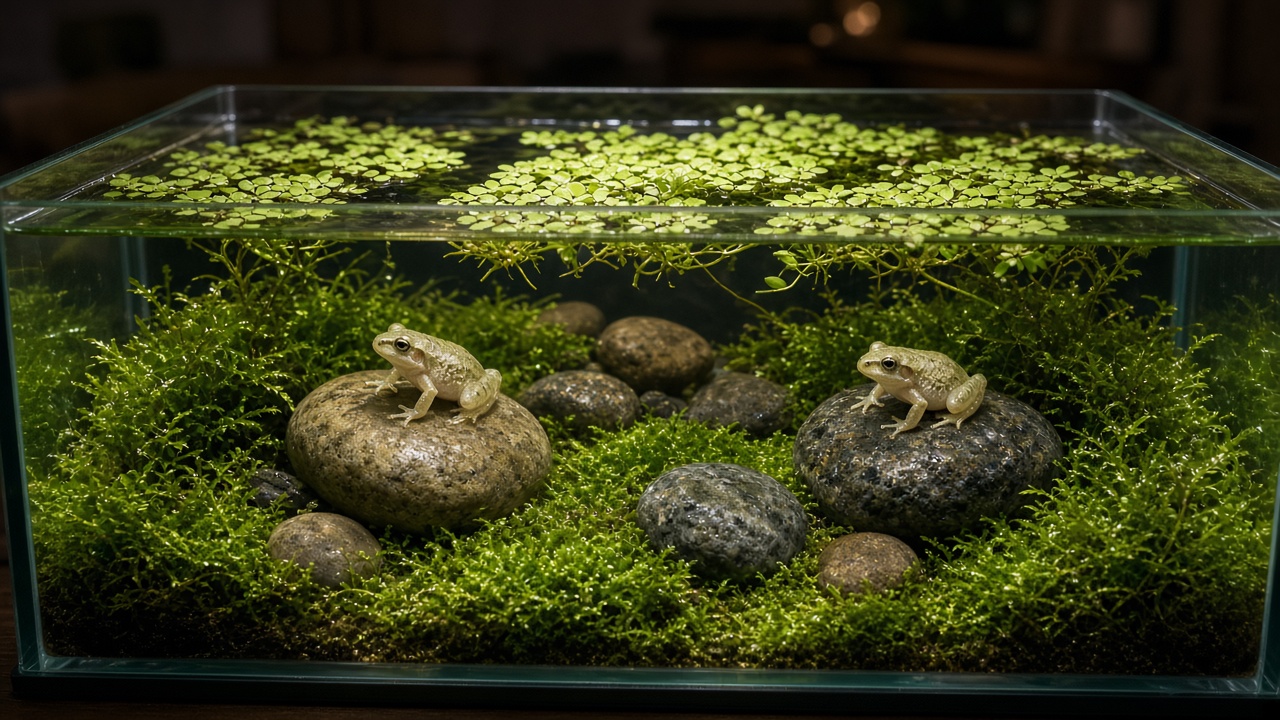
Quick answer: Start with a long 10-gallon freshwater tank or larger. Use soft filtration, a heater, sand or coarse gravel, and a tight lid. Keep an easy path to the surface for air gulps.
A solid African dwarf frog tank is about 10 gallons or more with soft flow, warm water, and a tight lid.
This page is a home-aquarium setup guide for Hymenochirus frogs. Our research team compared published lab housing protocols and maker product sheets. We did not build a demo tank for this article. We did not measure flow rates in a lab flume. We did not survey pet-store stock lists in person.
Selection rule: We include tank, filter, and heater models with published maker specs that fit small tropical freshwater setups. We also use open Hymenochirus boettgeri housing numbers from lab protocols. We exclude turtle or deep reef kits unless marked as a contrast. We skip unbranded “nano cube” claims with no dimensions on the label.
Tank size and shape come first
Footprint and height matter more than a tall show tank.
Aqueon’s Critical Dimensions sheet lists the 10 Leader aquarium at 20¼ × 10½ × 12 9/16 inches. Empty weight is listed at 11 pounds. Filled weight is listed at 111 pounds.
The same Aqueon sheet lists the 20 Long at 30¼ × 12½ × 12¾ inches. Empty weight is 25 pounds. Filled weight is 225 pounds. That longer footprint gives swimming room without a deeper climb to air.
A University of Michigan Virulence husbandry report housed groups in 38-liter glass tanks measuring 25 × 30 × 50 centimeters. An open protocols.io housing protocol sets group density at least 1.5 liters of water per frog in those standard tanks.
Rabb and Rabb’s 1963 breeding colony used aquaria 24 × 24 × 44 centimeters filled to a depth of about 10 centimeters. That shallow depth made surface access easy for air-breathing frogs.
Practical size cues:
- Prefer long, shallow rectangles over tall columns
- Treat about 10 gallons as a small-group floor, not a forever tiny cup
- Plan stand strength for the filled weight on the maker sheet
- Leave swimming lanes free of wall-to-wall clutter
Bettas also do better in thoughtful small tanks than in tiny bowls. Our what size tank does a betta need guide covers that parallel for another air-gulping pet. A turtle tank setup is a different project with basking shelves and deeper water habits.
Water targets that match published housing notes
Warm, clean, dechlorinated freshwater is the baseline.
The Virulence protocol held display systems near 25°C ± 0.5°C. Protocols.io lists a constant range from 20°C to 25°C for housing. Rabb and Rabb varied temperatures from 19°C to 30°C in their study tanks, with soft water at pH 7.6 to 7.8.
The Michigan group adjusted reverse-osmosis water with Instant Ocean sea salt at 0.5 grams per liter. They aimed for conductivity of 900 ± 100 microsiemens per centimeter and pH of 7 ± 0.4.
In cycled standard tanks they kept ammonia at or below 0.25 ppm, nitrite at 0 ppm, and nitrate at or below 40 ppm. Uncycled tanks got more frequent testing and water changes when readings climbed.
Home checklist:
- Cycle the tank before frogs arrive
- Use a conditioner that handles chlorine and chloramine
- Keep a thermometer where you can read it daily
- Change water on a schedule that holds ammonia and nitrite near zero
- Match new water temperature to the tank before you pour
Filters: soft flow beats a blast
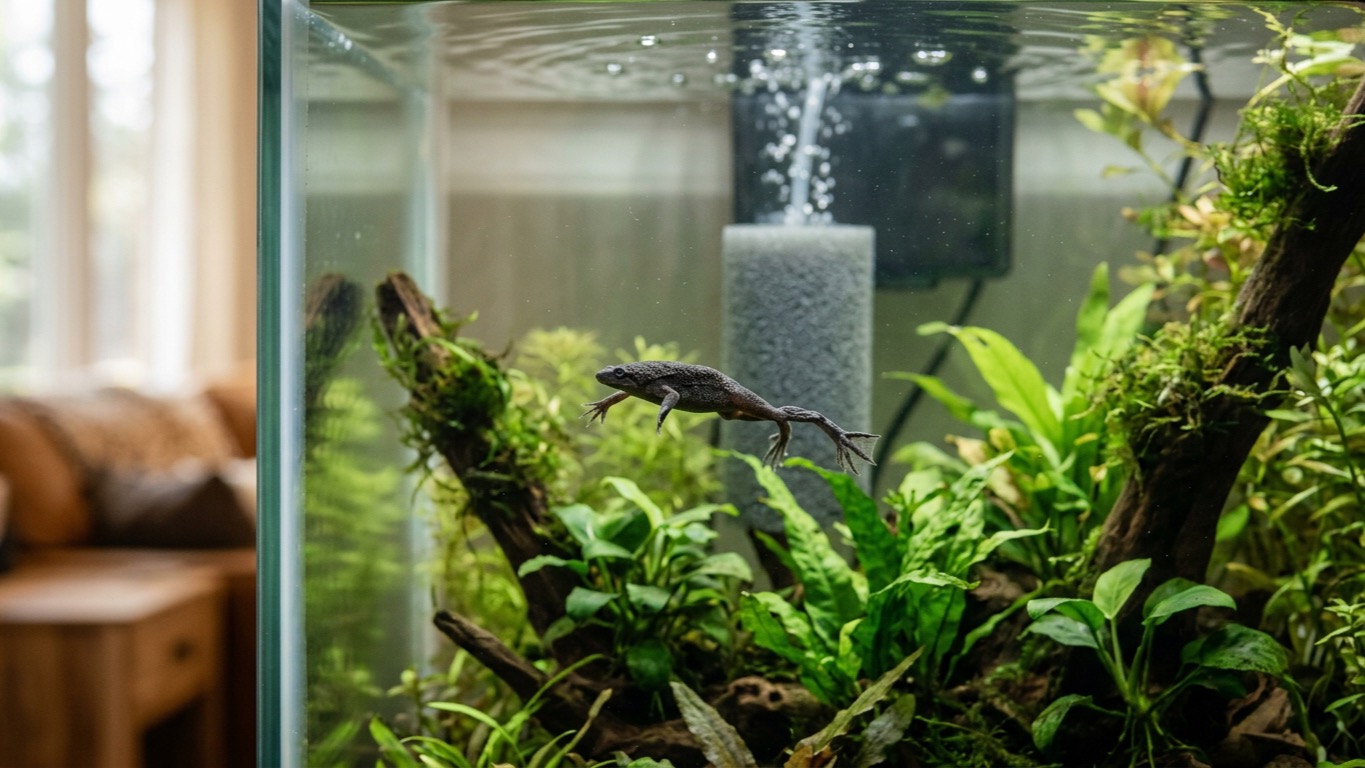
African dwarf frogs are weak swimmers in strong current. Soft biological filtration fits them better than a waterfall blast.
Aquarium Co-Op’s Green Easy Flow sponge filter page lists a pore size of about 25 ppi. The maker notes the design is gentle enough for bettas, fry, shrimp, and other slow movers. An air pump, tubing, and a check valve complete the kit.
The Virulence and protocols.io labs used internal Tetra filters on standard tanks. Whatever brand you pick, baffle the output or add a prefilter sponge so frogs are not pinned to décor.
Hang-on-back filters can work if the return is diffused. Point the spout along the glass. Avoid a jet aimed at the midwater lane frogs use to reach air.
Our deeper gear notes live on the best aquarium filter for African dwarf frogs page. Use that when you are comparing sponge, hang-on, and internal options.
Filter setup steps:
- Cycle media before heavy stocking
- Keep intakes screened so frog limbs cannot stick
- Rinse sponges in old tank water, not hot tap water
- Watch frogs after install; reduce flow if they struggle to surface
Heaters, lids, and surface access
Tropical frogs need stable warmth and a safe air gap.
EHEIM’s thermocontrol 75 page rates the heater at 75 watts for aquariums of about 60 to 100 liters. Adjustable range is listed from 18°C to 34°C. Control accuracy is listed at ±0.5°C. Cable length is about 170 centimeters. The unit is fully submersible with dry-run shut-off.
Place the heater near gentle flow so heat mixes. Use a separate thermometer. Do not guess from the dial alone.
The Virulence housing notes keep at least 1 centimeter between the lid and the water surface so adults can gulp air. Lid holes stay smaller than 1 centimeter so frogs cannot squeeze out. Frogs will climb. Gaps around cords need foam or covers.
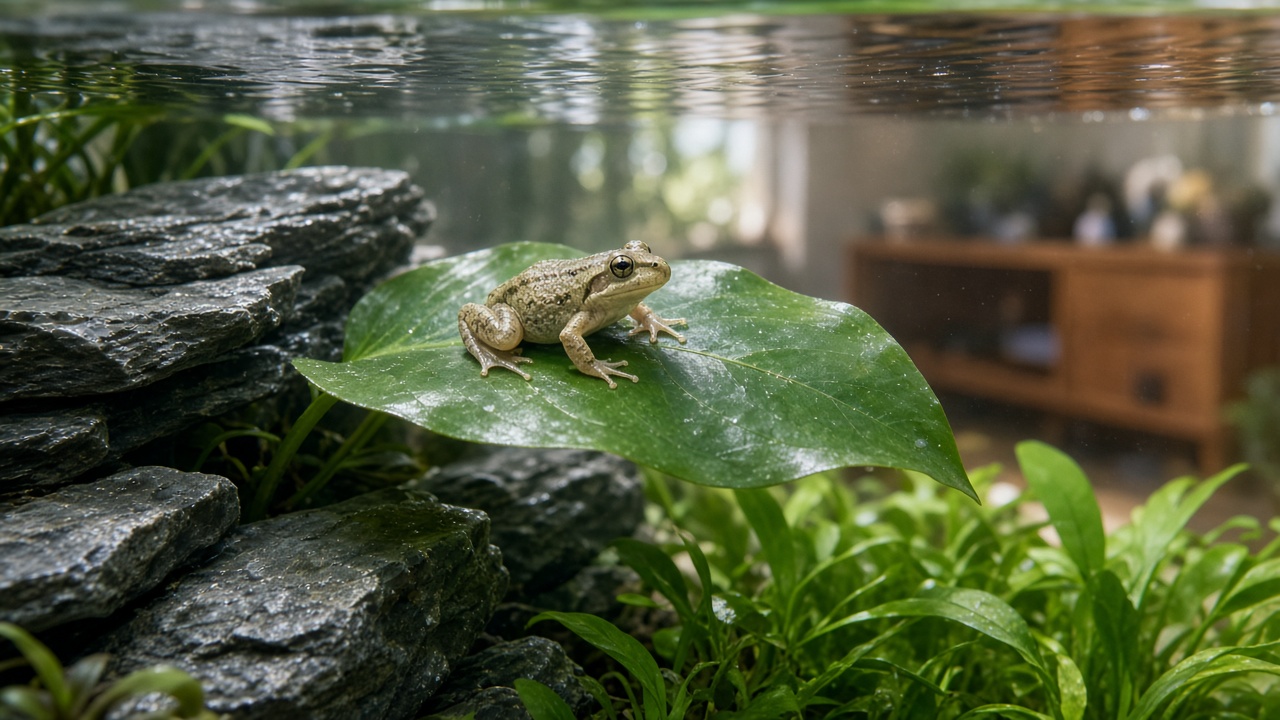
Leave resting spots near the top. Broad leaves, ledges, and floating plants cut the climb for a breath.
Substrate and décor that stay frog-safe
Soft floors and open lanes beat sharp gravel piles.
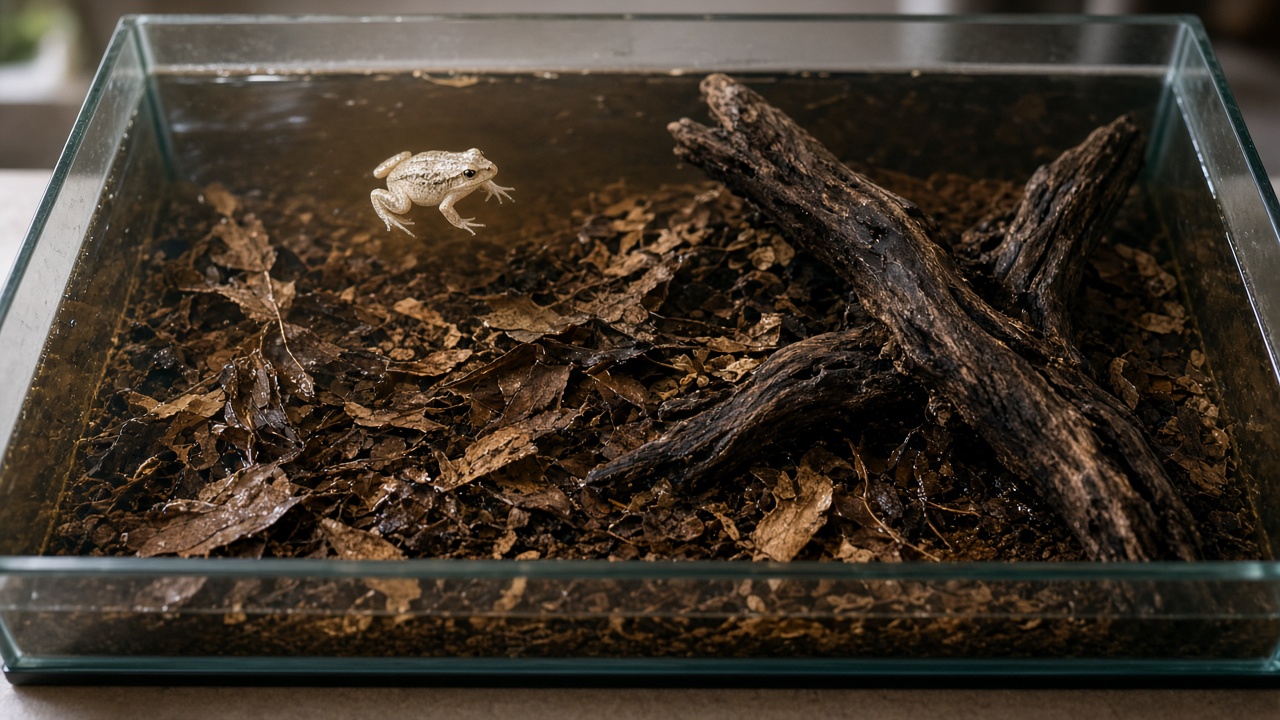
Protocols.io specifies gravel with diameter greater than 1 centimeter so frogs cannot swallow stones. Many home keepers prefer fine sand for the same reason. Avoid medium gravel that fits a frog mouth.
Add:
- Silk or live plants for cover
- Smooth caves and PVC tubes sized for easy entry and exit
- One clear feeding zone on the sand
- Floating plants or midwater rests near the surface
Skip rough driftwood points and metal décor with copper risk. Skip deep “aquascape canyons” that trap frogs far from air.
Enrichment in the Michigan protocol included about 1 centimeter of coarse gravel, artificial plants, PVC pipes, and broken terracotta pots. Items were sterilized before use and checked for sharp edges.
Gear snapshot for a starter frog tank
Comparing published attributes helps you match parts before you buy.
| Item | Maker-published cue | Why it fits frog tanks |
|---|---|---|
| Aqueon 10 Leader | 20¼ × 10½ × 12 9/16 in; filled weight 111 lb | Short climb to air; common starter footprint |
| Aqueon 20 Long | 30¼ × 12½ × 12¾ in; filled weight 225 lb | Longer swim lanes at similar height |
| Aquarium Co-Op Easy Flow sponge | ~25 ppi coarse sponge; air-driven | Soft flow for slow swimmers |
| EHEIM thermocontrol 75 | 75 W; ~60–100 L; ±0.5°C | Stable tropical heat band |
| Lab-style lid gap | ≥1 cm air space; holes <1 cm (Virulence) | Air gulps without escape routes |
Skip turtle kits with dry docks as your frog plan. Those layouts solve basking, not fully aquatic frog swimming. Buy parts for a sealed freshwater box, not a semi-aquatic dock kit.
Setup sequence you can follow once
Build in order so you do not flood a crooked stand.
- Level the stand and set the empty glass.
- Rinse substrate and décor; add them dry or wet as you prefer.
- Install heater, filter, and thermometer.
- Fill with conditioned water; start heat and filter.
- Cycle until ammonia and nitrite read safe on your kit.
- Add frogs only after the cycle holds.
- Confirm the lid gap and cord seals the same day.
Stock a small group, not a crowd. Protocols.io’s 1.5 liters per frog is a lab floor in 38-liter tanks. Home tanks still need spare volume for waste from messy meals.
Target-feed so tank mates do not steal food. Keep décor open enough for tongs to reach the sand.
After the first week, watch surfacing effort and resting height. If frogs tire on the climb, lower water slightly or add midwater rests. If they gasp at the heater outflow, move or baffle that current.
Weekly glass wiping and sponge rinses keep biofilm from choking soft filters. Small, steady maintenance beats rare deep scrubs that crash the cycle.
FAQ
What size tank do African dwarf frogs need?
A long 10-gallon tank is a common home starting point for a small group. Lab groups in the Virulence report used 38-liter tanks with at least 1.5 liters of water per frog in the protocols.io housing notes. Longer footprints beat tall cubes.
Do African dwarf frogs need a heater?
Yes in most homes. Protocols.io lists 20°C to 25°C. The Michigan protocol held systems near 25°C. An adjustable heater such as the EHEIM thermocontrol 75 (75 watts, ±0.5°C accuracy on the maker page) fits many mid-small tanks.
What filter is best for an African dwarf frog tank?
Soft biological filters work well. Aquarium Co-Op lists its Easy Flow sponge at about 25 ppi and calls it gentle for slow species. Diffuse any hang-on return so frogs can reach the surface without fighting a jet.
How deep should the water be?
Keep the climb to air short. Rabb and Rabb ran some study tanks at about 10 centimeters depth. Standard 10- and 20-long heights near 12 to 13 inches already ask frogs to swim up; do not add needless depth with tall columns.
What substrate is safe?
Use sand or very coarse gravel. Protocols.io calls for gravel larger than 1 centimeter so frogs cannot swallow it. Skip medium gravel that matches mouth size.
Do they need a lid?
Yes. The Virulence notes keep a 1-centimeter air gap under a lid with holes smaller than 1 centimeter. Frogs escape through small gaps around cords.
Can I use a turtle aquarium kit instead?
Not as a drop-in plan. Turtle setups focus on basking platforms and different water depth habits. Build a fully aquatic frog layout instead, then read turtle-specific guides only if you keep turtles.