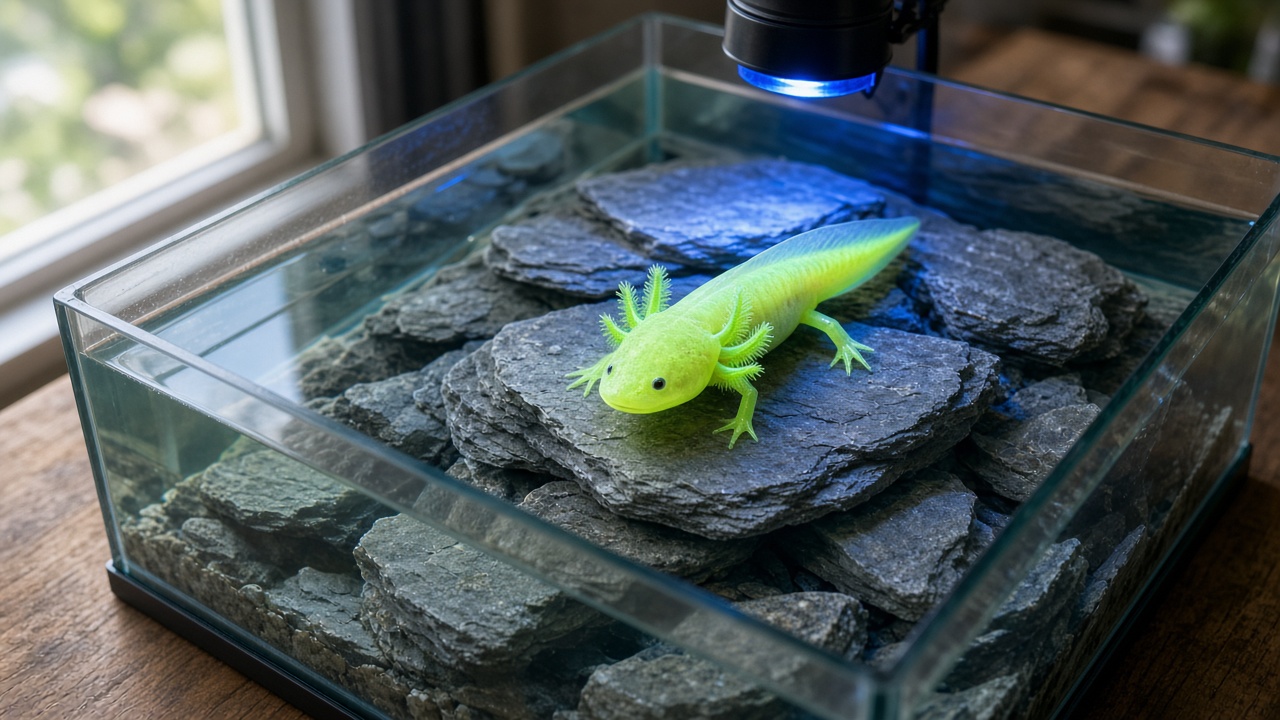
Quick answer: Ordinary axolotls do not glow in a dark room. Only GFP animals shine green when a blue or UV lamp hits them. Use a lamp only for brief checks, not as an all-night tank light.
A GFP axolotl stays dull in a fully dark room with no blue or UV lamp. This page is a desk comparison of published GFP spectra and current lamp specs.
Selection rule: We included only currently sold lamps whose maker page lists a peak wavelength in nanometers. We left out UVB reptile bulbs, glow-paint ornaments, and fixtures that publish only a Kelvin rating.
Fluorescence is not glow-in-the-dark
GFP animals re-emit incoming light, and they do not make their own light in a dark tank.
Glow-in-the-dark marketing mixes two different physics terms. Bioluminescence is light an animal makes with a chemical reaction. Fluorescence is light that arrives, gets absorbed, and comes back at a longer wavelength.
GFP means green fluorescent protein. FPbase lists EGFP, also called enhanced GFP, with a 488 nm excitation peak and a 507 nm emission peak.
FPbase’s GFP collection lists these EGFP numbers:
- Excitation peak: 488 nm
- Emission peak: 507 nm
- Stokes shift: 19 nm
- Extinction coefficient: 55,900
- Quantum yield: 0.6
- pKa: 6.0
- Mass: 26.94 kDa
Those numbers decide what a lamp can do on paper. A 488 nm peak means blue-cyan light is the listed match, while a 365 nm blacklight sits 123 nm away from that peak. A 400 nm penlight sits 88 nm away.
Turn the lamp off, and the green stops. That is the falsifiable rule in one line. If a seller promises a self-lit tank in total darkness, the claim is wrong.
Which animals carry GFP
Wild axolotls do not carry GFP, because the protein is an inserted lab marker rather than a natural morph.
The Ambystoma Genetic Stock Center grew out of the Indiana University Axolotl Colony, founded in 1957. Its husbandry guide covers water, bowls, tanks, and light hours. It does not list a UV lamp as a care item.
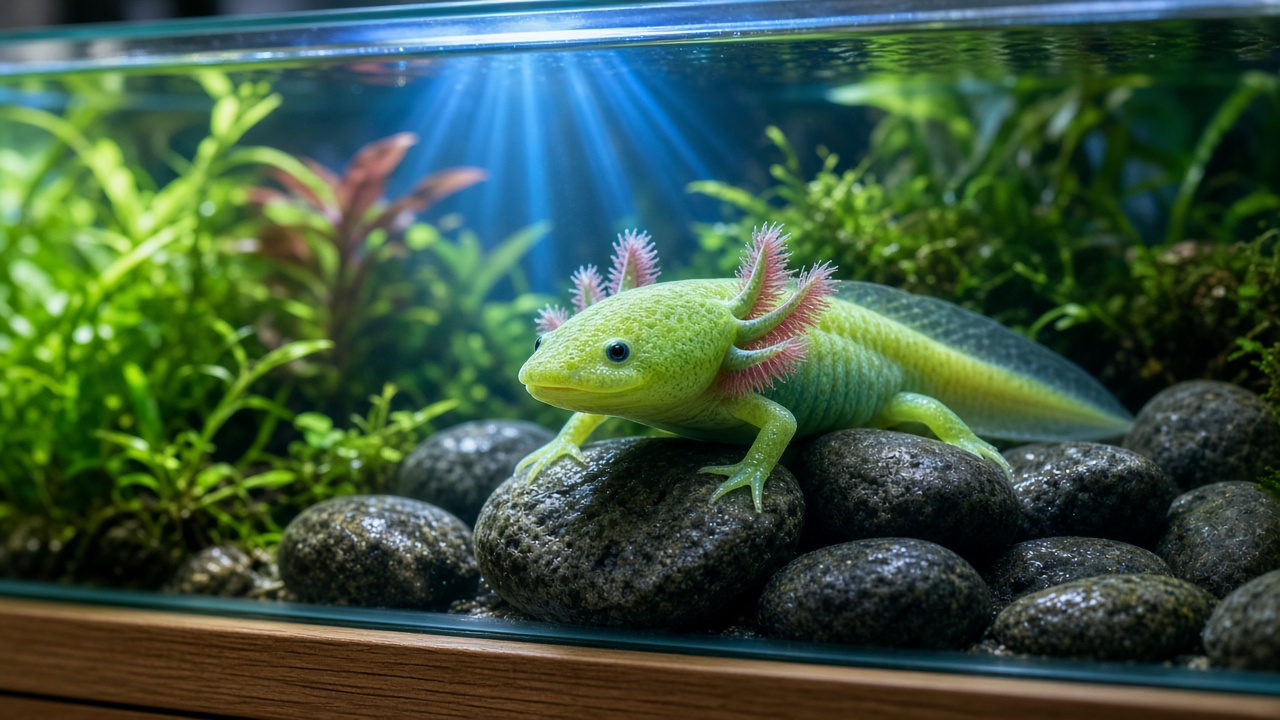
A GFP animal can sit on any color base. A pale animal often shows the green more clearly, while a dark animal can still carry the gene.
The lamp check is the only plain test, because under room light many GFP animals look like their base morph.
Some pale animals show a faint yellow-green cast, but that tint is not proof. Ask for a short clip under a listed-wavelength lamp before you buy.
GFP is not a color you add with food or paint. It is a heritable insert.
The Waterpuppy peak-gap check
Closer listed peaks beat louder marketing words. Our research team compared maker wavelengths to FPbase’s 488 nm EGFP excitation.
We call this the peak-gap check. You subtract the lamp’s listed peak from 488. A smaller gap is a closer paper match, not a brightness score.
Work the check in this order:
- Read the maker’s peak wavelength in nanometers.
- Subtract that peak from 488.
- Write the gap in nanometers.
- Note the listed irradiance or milliwatt output.
- Treat the lamp as a brief check tool, not tank lighting.
Comparing published specs on four current lamps gave these gaps:
- uvBeast V3 365nm Filtered: 123 nm gap (365 from 488)
- uvBeast V3 365nm MINI: 123 nm gap (same 365 nm peak)
- uvBeast V3 385-395nm: 93 to 103 nm gap
- Streamlight Stylus Pro USB UV: 88 nm gap (400 from 488)
The Streamlight Stylus Pro USB UV lists a 400 nm LED, which is nearer EGFP’s 488 nm peak than a 365 nm lamp. The uvBeast 385-395 nm model sits in the middle of that spread. The two 365 nm models sit farthest from the FPbase peak.
A larger gap does not mean the lamp cannot excite GFP at all. Pet sellers rarely name the exact GFP variant on the tag. If the seller will not show a glow photo, skip the sale.
Lamps that publish a peak wavelength
A listed nanometer peak is the gate for this table, so lamps without that number did not make the set.
Our research team compared four maker pages. We recorded wavelength, listed output, form, and power source.
| Product | Peak wavelength | Listed output | Form | Power source |
|---|---|---|---|---|
| uvBeast V3 365nm Filtered | 365 nm | 1,350 mW radiant; 5,400 µW/cm² at about 24 in | Full-size flashlight, triple LED | Two 18650 cells, 3.7 V, 2,600 mAh |
| uvBeast V3 365nm MINI | 365 nm | About 500 mW; 2,400 µW/cm² at about 24 in | Compact flashlight | 21700 cell with USB-C charge |
| uvBeast V3 385-395nm | 385–395 nm | 1,950 mW radiant; 8,100 µW/cm² at about 24 in | Full-size flashlight | Two 18650 cells, 3.7 V, 2,600 mAh |
| Streamlight Stylus Pro USB UV | 400 nm | 250 mW measured system output; 2.5 hour run | Penlight, 5.95 in, 1.8 oz | USB-rechargeable lithium-ion pack |
The uvBeast V3 365nm Filtered page lists triple LEDs at 1,000 mA each. It states 1,800 µW/cm² per LED and 5,400 µW/cm² total. It also lists a beam claim of 60 feet or more, which is inspection range, not a need for a ten-gallon tank.
The uvBeast V3 365nm MINI page lists about half that irradiance at the same 24-inch mark. Its 2,400 µW/cm² figure is still a published number, and the smaller body is the trade-off.
The uvBeast V3 385-395nm page lists 8,100 µW/cm² at about 24 inches, the largest irradiance figure in this set. It also lists a 10 nm band. uvBeast’s own copy says a wider band can light more materials than a narrow 5 nm band.
The Streamlight Stylus Pro USB UV page lists 400 nm, 250 mW, and a 2.5-hour run, plus a 2.5-hour recharge. Length is 5.95 inches and weight is 1.8 ounces with the battery. Streamlight lists an IPX4 water rating and built the penlight for leak dye and document checks, not aquariums.
None of these makers sell the lamp as an axolotl fixture. That is why the selection rule matters. You are borrowing an inspection tool for a brief check.
A short viewing routine
Keep the lamp off the tank clock, because a glow check is a count rather than a photoperiod.
The Ambystoma Genetic Stock Center’s husbandry guide sets ordinary light at about 14 hours a day. That figure is room light for spawning, not a UV beam. The same guide says to keep animals out of direct sun.
Use this sequence when you want to confirm GFP:
- Dim the room so stray white light does not wash the green.
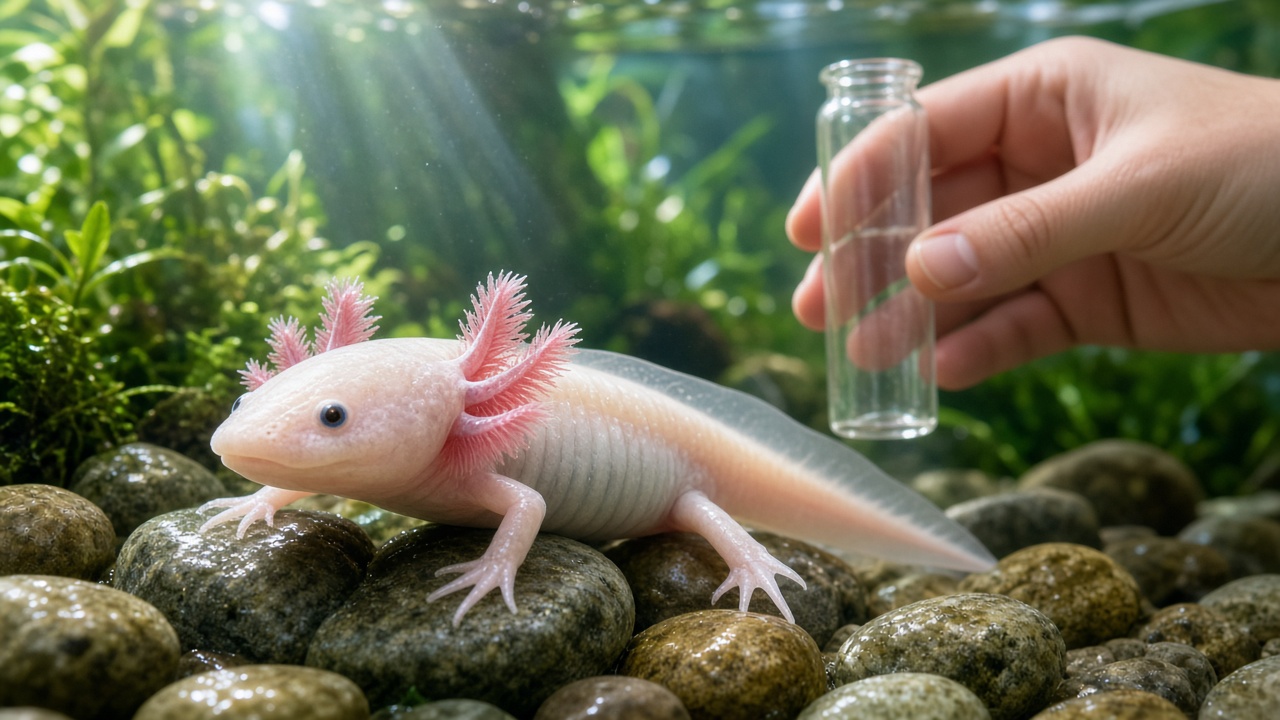
- Hold the lamp outside the glass. Do not drop it in the water.
- Aim for one or two seconds at a time. Then pause.
- Stop as soon as you see green, or as soon as you do not.
- Switch the lamp off and put it away.
Do not leave a UV flashlight on a clip as a night light, and do not use a reptile UVB tube. Those products failed our selection rule because their maker pages are not GFP-viewing listings with a stated peak for this use.
Wear the glasses that ship with some uvBeast kits if you want less purple glare. That is a viewer comfort choice. It is not a care step for the animal.
If you keep a phone camera, shoot one frame and stop, because extra passes do not change the yes-or-no result.
Tank conditions that matter more than glow
Cool, clean water keeps an axolotl alive and eating, and a glow lamp does not.
The Ambystoma Genetic Stock Center’s husbandry guide states these numbers:
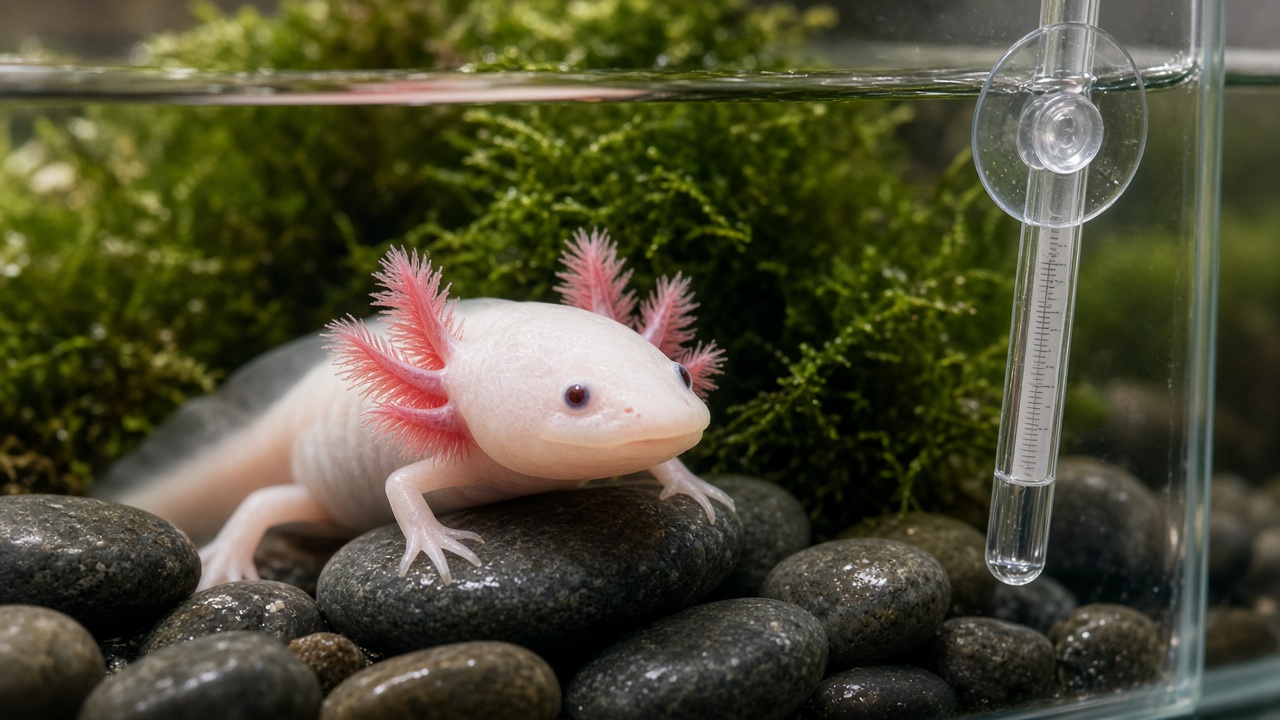
- Hold temperature at 15–18°C (60–65°F).
- Do not keep animals above about 22°C (72°F).
- Keep pH between about 6.5 and 8.
- Use a ten-gallon aquarium for two adults, as a rule of thumb.
- In bowls, a half gallon (2 liters) of water per animal is listed as adequate if you change it often.
That guide also gives a 40% Holtfreter’s mix for a 44-gallon barrel:
- KCl: 1 teaspoon
- CaCl2: 2.5 teaspoons
- MgSO4·7H2O: 2 tablespoons
- NaCl: 240 ml, measured dry in a liquid beaker
You do not need that exact barrel recipe in a home tank, but you do need hard water with no chlorine and no ammonia. Distilled-only water is a miss, because the guide says axolotls need hardness for skin.
A glow lamp will not cool a warm room, cycle a filter, or hide a stressed animal. Put the tank first. Then, if you have a GFP animal, add a listed-wavelength lamp to a drawer.
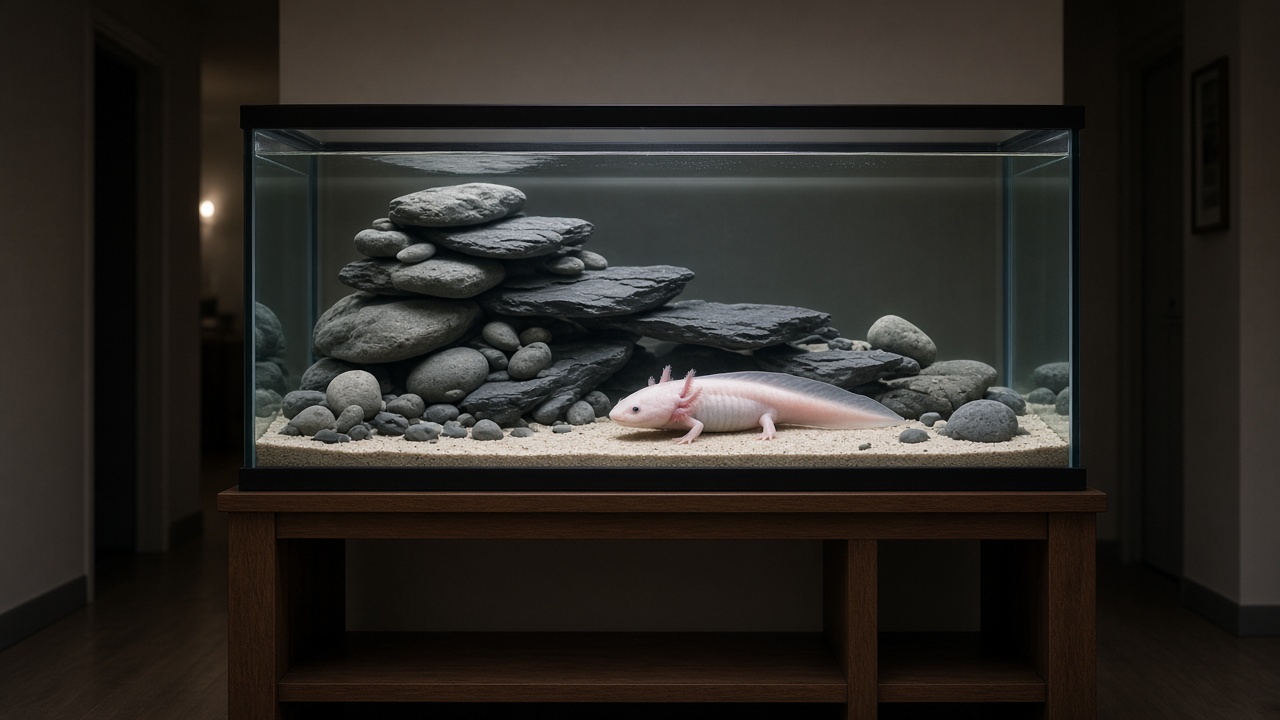
For volume, filter flow, and hides, use our axolotl tank setup guide. Pair that page with the temperature and pH numbers above.
The stock center also notes that fast current is stressful, so keep filter outflow gentle. GFP does not change that flow rule.
What a GFP label does not promise
GFP is a yes-or-no gene check for viewing, and it is not a health grade.
Sellers may add GFP to any morph name. The label does not prove age, size, or water history. It does not prove the animal was raised at 15–18°C.
Ask the seller for one still frame under a named lamp. A 400 nm penlight is enough for a yes-or-no. You do not need the 5,400 µW/cm² flashlight to confirm a young animal.
If the animal does not glow in that frame, walk away. If it does glow, still check gills, body shape, and the tank it came from.
We compared specs and did not grade breeders or review medical files. A GFP tag is a viewing trait, not a care plan.
FAQ
Do axolotls glow in the dark on their own?
No, a GFP axolotl stays dull in a fully dark room with no blue or UV lamp. The green is fluorescence, not self-made light. Switch the lamp off, and the green stops at once.
Do wild or common morphs glow under a blacklight?
No, ordinary wild-type, leucistic, or albino animals without the insert do not emit FPbase’s 507 nm EGFP green peak. GFP is an inserted lab marker, not a wild color. A lamp check is the plain test.
Which lamp wavelength matches GFP on paper?
FPbase lists EGFP excitation at 488 nm and emission at 507 nm. The Streamlight Stylus Pro USB UV at 400 nm has an 88 nm peak gap. A 365 nm lamp has a 123 nm gap. Gap is a paper match, not a rank.
Do I need a UV lamp for a healthy tank?
No, the Ambystoma Genetic Stock Center’s husbandry guide does not list a UV viewing lamp as required gear. It keeps animals at 15–18°C with about 14 hours of ordinary light. A glow lamp is optional for a check, not a husbandry need.
Can I leave a blacklight on overnight so the tank glows?
No, overnight UV is outside the stock center’s 14-hour room-light pattern. It also turns a brief check into a heat and glare source. Put the lamp away after you see a yes or a no.
How can I tell GFP from a photo without buying a lamp first?
Ask the seller for one frame taken under a named wavelength, such as 400 nm. Room-light photos often look like the base morph, and a faint yellow cast is not proof. If they cannot show the lamp frame, treat the GFP claim as unproven.
Does a stronger irradiance number mean a better glow?
Not by itself, because listed output units are not on the same scale. The uvBeast V3 385-395nm lists 8,100 µW/cm² at about 24 inches. The Streamlight Stylus Pro USB UV lists 250 mW in a 5.95-inch penlight. Match wavelength first, then pick a size you can switch off in seconds.