Quick answer: Use a high-protein tropical flake or small pellet as the daily staple. Add a fry powder when babies appear. Rotate one insect or seafood flake so the diet is not one bag forever.
Feed adult guppies a 40%+ protein flake or micro-pellet twice daily; use fry powder for newborns. This page is a label-comparison guide, and our research team did not run tank trials, assay opened bags, or rank brands.
Four of the five foods in our label set list 46% or more crude protein. We call that method the Form-First Rule: pick a swallowable form, then read the protein line.
This article may include affiliate links, and product cards with live prices are added after we publish.
How we chose which guppy foods to cover
We included a food only if it is sold now and the maker lists protein, fat, and form.
That selection rule also required a dry staple aimed at small livebearers or general tropical fish. Frozen foods, live foods, and homemade pastes did not qualify.
Here is what got in:
- One guppy-named granule: Hikari Fancy Guppy
- Two tropical flakes: TetraMin Flakes and Omega One Freshwater Flakes
- One insect flake: Fluval Bug Bites Tropical Flakes
- One fry powder: Hikari First Bites
Here is what did not get in:
- Frozen or live foods, including brine shrimp and worms
- Homemade egg-yolk pastes
- Goldfish, cichlid, or marine-only bags
- Wafers made for bottom feeders
- Any food whose maker page hid protein and fat
Our research team compared published specs on those maker pages.
Top 7 Guppy food
The picks below are the 7 guppy foods on sale right now, listed with what each suits best and an honest drawback. Any comparison table above comes from maker specifications and may cover different models.
1. Hikari Tropical Fancy Guppy Fish Food
Best for: First guppy tank daily staple
Hikari’s Fancy Guppy food is a species-labeled granule, not a generic tropical flake. The maker describes a semi-floating pellet that softens in the water for small livebearers. Owners commonly report that guppies take it quickly, and that a single jar at this price is a short-run size.
Pros: Species-specific tiny granules; Low single-jar price Cons: Small jar empties fast
2. Ultra Fresh Royal Guppy Mignon Pellet
Best for: Picky show-strain fancy guppies
Royal Guppy Mignon is sold as a tiny pellet for fancy guppies, not a crushed community flake. Ultra Fresh’s page stresses a prawn-and-spirulina mix and a mignon bite for small mouths. Owners often say picky fish take these faster than flakes, and some crush a few pellets for fry.
Pros: Tiny mignon pellet size; Guppy-labeled daily formula Cons: Costs more per ounce
3. (3 Pack) Hikari Usa Tropical Fancy Guppy For Pet Health
Best for: Multi-tank livebearer households
This listing is the same Fancy Guppy formula sold as a three-pack, not a new recipe. The published pitch stays species-specific granules for livebearers. Owners who already use the single jar treat the bundle as a restock, and three jars at $14.26 undercut buying singles at $6.85 each.
Pros: Three jars in one; Same guppy-specific recipe Cons: Still three small jars
4. Ultra Fresh Apex Guppy Fish Food
Best for: Grow-out tanks for young guppies
Apex Guppy is Ultra Fresh’s growth-oriented jar, not the Royal Mignon palatability pitch. The maker frames it as a small floating pellet for premium livebearers. Owners shopping this SKU are usually raising juveniles rather than looking for a grocery flake.
Pros: Growth-labeled guppy pellets; Small floating pellet form Cons: Pricier specialist jar
5. TetraMin Tropical Flakes Fish Food
Best for: Mixed tropical community tanks
TetraMin is a general tropical flake, not a guppy-only pellet. The maker positions it as a staple for mixed community tanks that feed at the top and midwater. Owners who keep guppies on it often crush the flakes for smaller mouths, and leftover pieces are a common water-quality complaint.
Pros: Widely sold tropical flakes; Works for mixed tanks Cons: Pieces run large for guppies
6. Aquatic Provisions Guppy Granulettes Fish Food 3.17 oz
Best for: Keepers wanting a larger jar
These granulettes are sold as a slow-sinking bite for guppies and other small-mouthed livebearers. The 3.17-ounce jar is the largest everyday pack on this list. Owners looking for a midwater feed, not a surface flake, are the usual audience.
Pros: Larger 3.17-ounce jar; Slow-sinking granule form Cons: Higher price than flakes
7. Aquatic Foods Inc. Guppy Micro Sinking Granules
Best for: Fry and shy midwater feeders
Aquatic Foods lists these as micro sinking granules with a spirulina color mix, aimed at guppies and other small community fish. The form drops through the water instead of sitting on the surface. Owners in mixed tanks say that helps shy fish and fry get a share, at a higher sticker than the trial jars above.
Pros: Micro sinking granule form; Spirulina color-mix listing Cons: Highest price on this list
Comparison: Guppy food at a Glance
Want to browse every option? See the full range of guppy food on Amazon →
Flakes, pellets, and fry food: which form fits
Match the food form to mouth size and feeding depth before you pick a brand.
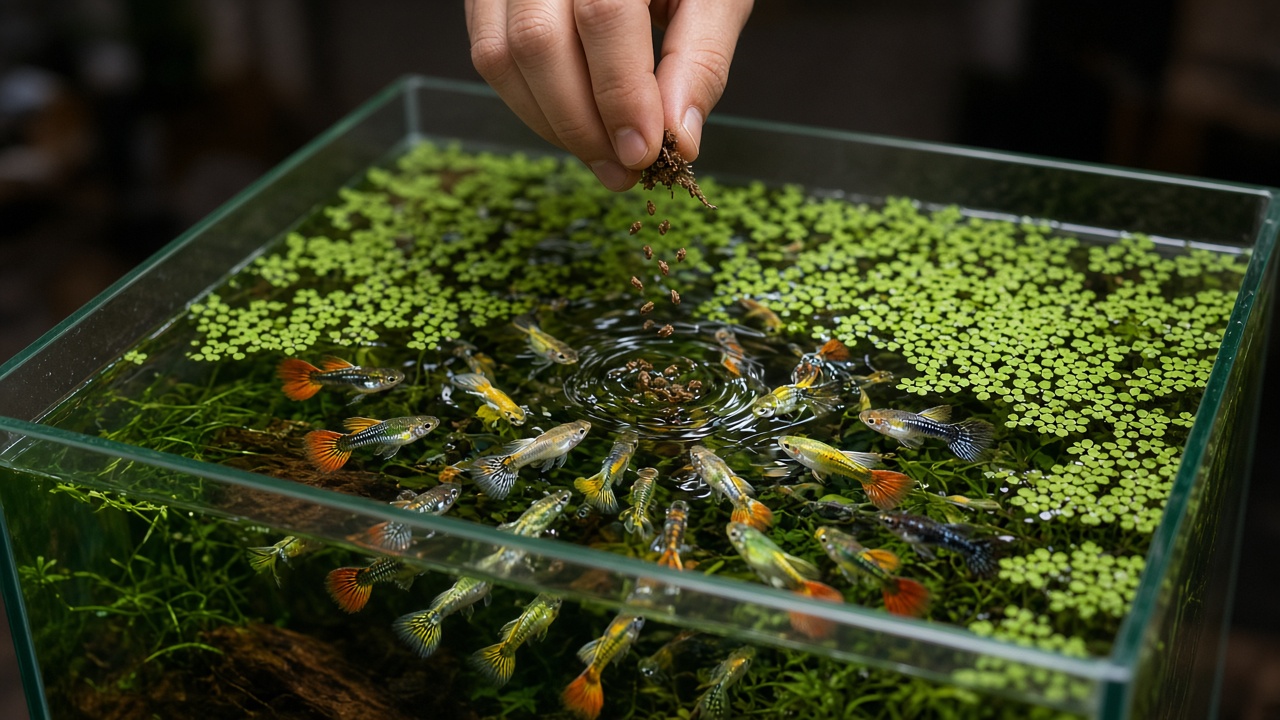
Guppies take most meals at the surface and in midwater, and they have small mouths. A flake they can nip, or a tiny granule that hangs in the water, fits that habit.
Hikari Sales USA’s Fancy Guppy page calls the food a slowly sinking, protein-rich granule. The page lists 0.77 oz (22 g) and 2.2 lb (1 kg) packs, and it says the pellet becomes soft in water without dissolving.
Tetra’s TetraMin Flakes page says the flakes float a long time, then sink slowly. That mix suits a tank that holds surface feeders and midwater fish together.
Fluval’s Bug Bites Tropical Flakes page lists a flake format and a 1.58 oz (45 g) pack. OmegaSea’s Freshwater Flakes page lists packs from 0.42 oz to 5 lb.
Fry cannot handle intact adult flakes, so they need a powder first. Hikari Sales USA’s First Bites page frames that powder as a daily diet for newborns until the young fish can take a crushed flake.
Bettas are also surface feeders, but they need a different staple. If you keep both species, use a betta-specific food for the betta instead of a shared guppy flake.
How to read a guppy food label
Read four numbers first: protein, fat, fiber, and moisture.
AAFCO’s Reading Labels page lists those four as the basic nutritional guarantees for pet food:
- Minimum crude protein
- Minimum crude fat
- Maximum crude fiber
- Maximum moisture
AAFCO’s page also explains the word “crude.” For protein, labs measure nitrogen and then multiply by 6.25, so the number is a lab method rather than a promise of meat quality.
AAFCO’s Reading Labels page states that its Model Pet Food Regulations recognize nutrient profiles only for dogs and cats. That page does not publish a guppy profile, so a fish bag cannot meet an AAFCO guppy profile.
Use the four guarantees as a comparison grid anyway, because every maker page in this set publishes them. AAFCO’s page also limits a “new or improved” claim to six months of production, so treat banner words as marketing.
Hikari Sales USA’s Fancy Guppy page lists 50% minimum crude protein and 8% minimum crude fat. That pairing is the highest protein line in this set.
OmegaSea’s Freshwater Flakes page lists 39% minimum crude protein and 11% minimum crude fat. That pairing is the lowest protein and a high fat line in this set.
Five dry foods compared by the numbers on the bag
Protein on these five labels runs from 39% to 50%, and fat runs from 3% to 11%.
Our research team lined up the maker pages and did not invent a rank column. Use the table to match form with those four AAFCO-style fields.
| Product | Form | Crude protein (min) | Crude fat (min) | Crude fiber (max) | Moisture (max) |
|---|---|---|---|---|---|
| Hikari Fancy Guppy | Slow-sinking granule | 50% | 8% | 2% | 10% |
| Hikari First Bites | Fry powder | 48% | 3% | 2% | 10% |
| TetraMin Flakes | Floating flake | 46% | 11% | 2% | 7% |
| Fluval Bug Bites Tropical Flakes | Flake | 46% | 8% | 1.5% | 6% |
| Omega One Freshwater Flakes | Flake | 39% | 11% | 2% | 8.5% |
Four of five foods list 46% or more crude protein, and only Omega One Freshwater Flakes sits under 40%.
Hikari Sales USA’s Fancy Guppy page also lists these extras:
- 1.0% minimum phosphorus
- 19,000 IU/kg minimum vitamin A
- 340 mg/kg minimum ascorbic acid
Fluval’s Bug Bites Tropical Flakes page lists these extras:
- 25,000 IU/kg minimum vitamin A
- 440 mg/kg minimum ascorbic acid
- 2.0% minimum omega-3 fatty acids
- 2.7% minimum omega-6 fatty acids
Tetra’s TetraMin Flakes page lists vitamin D3 at 1,848 IU/kg and citric acid at 293 mg/kg. Pack sizes on that page run from 20 g (100 ml) to 2.1 kg (10 L).
Hikari Sales USA’s First Bites page lists 1.3% minimum phosphorus, which is higher than the 1.0% phosphorus on the Fancy Guppy page. The same First Bites page lists only 3.0% minimum crude fat.
Ash, when listed, is a waste clue rather than a protein clue. Hikari Sales USA’s Fancy Guppy page lists 18% maximum ash, while OmegaSea lists 8% and Fluval’s flake page lists 7%.
How much to feed, and how often
Feed a portion the fish finish in the maker’s stated window, then stop.
Makers do not share one clock, so compare the two pages that publish a time:
- Hikari Sales USA’s Fancy Guppy page: feed 2 to 3 times daily. Give only what fish finish in about 1 minute, and remove leftovers after that period.
- Fluval’s Bug Bites Tropical Flakes page: feed 2 or 3 times daily. Give only what fish finish in 2 minutes.
A simple adult routine looks like this:
- Morning: pinch of flake or granule.
- Evening: a second pinch of a different staple.
- Skip a third feeding unless females are heavy with fry.
Crush large flakes between dry fingers for small adults, then drop the dust on the surface instead of a heap that sinks and rots.
If food remains after the maker’s window, you overfed, so net the waste and cut the next pinch in half.
Do not use the dog-food “cup per pound” idea, because guppies are tiny and a pinch is the unit rather than a scoop.
What to feed guppy fry
Newborn guppies need a powder or fine crumble rather than an intact adult flake.
Hikari Sales USA’s First Bites page describes a daily diet for the earliest stage. The page lists:
- 48% minimum crude protein
- 3% minimum crude fat
- 2% maximum crude fiber
- 10% maximum moisture
That fat line is much lower than Tetra’s 11% fat on TetraMin Flakes. Fry food is not just adult food that someone smashed.
A practical fry sequence:
- Days 1–14: Hikari First Bites or an equally fine powder, several tiny pinches a day.
- Weeks 3–4: mix powder with crushed TetraMin Flakes or crushed Fluval flakes.
- After the mouths widen: switch most meals to the adult staple.
If you have no fry powder, crush a 46%+ protein flake to dust. That step is a stopgap, not the same diet as First Bites.
Use a breeder box or thick plants so adults cannot eat the fry food; this desk did not time growth on either method.
Feeding mistakes that foul the tank
Most guppy food problems are leftover food rather than the wrong brand.
The common errors are easy to spot:
- One giant feeding instead of two small ones
- Using wafers that sink past the guppies
- Feeding only a 39% protein flake when a 46%+ option is on the same shelf
- Leaving Hikari’s 1-minute window or Fluval’s 2-minute window unwatched
- Storing flakes open in a hot, bright room
Hikari Sales USA’s Fancy Guppy page says leftover food can cause water-quality problems, so remove what remains. Fluval’s flake page stresses a two-minute finish for the same reason.
Rotate forms across the week with a sample plan like this:
- Five days: Hikari Fancy Guppy or TetraMin Flakes
- Two days: Fluval Bug Bites Tropical Flakes or Omega One Freshwater Flakes
That rotation follows the Form-First Rule and still gives a 40%+ protein meal on most days. The 39% Omega One bag is a seafood change, not the only food.
Do not treat color words on the front as a feeding plan. Check the protein line AAFCO describes, then feed the amount the maker timed.
FAQ
These answers restate the Form-First Rule and the numbers on the maker pages.
Do guppies need flakes or pellets?
Either form works if the piece is small and the protein line is high. Hikari Fancy Guppy sinks slowly; TetraMin Flakes and Fluval flakes stay up longer, so pick the form they finish.
What protein percent should guppy food list?
Our Form-First Rule uses 40% minimum crude protein for the daily staple. Four of five maker pages in this set list 46% or more. OmegaSea’s Freshwater Flakes page lists 39%, so we treat that bag as a rotation food rather than the only staple.
Can I feed guppy fry crushed adult flakes?
You can use crushed flakes as a stopgap, but Hikari First Bites is a different formula, with 48% protein and 3% fat. Crushed TetraMin Flakes still list 46% protein and 11% fat, and powder size matters as much as those numbers.
How many times a day should I feed adult guppies?
Hikari Sales USA’s Fancy Guppy page and Fluval’s flake page both say two or three times daily. Use the shorter 1-minute Hikari window if you mix both foods, and stop when the clock hits the maker’s limit.
Is there an AAFCO nutrient profile for guppies?
AAFCO’s Reading Labels page says no: the Model Pet Food Regulations recognize nutrient profiles only for dogs and cats. Use the four listed guarantees to compare bags, and do not look for an AAFCO guppy stamp.
Should I use betta pellets for guppies?
Betta pellets should not be the main guppy plan, because bettas are surface hunters with a different staple. Keep each species on its own food. See our best food for betta fish guide if you keep both.
Does a higher ash number mean worse food?
A higher ash number is not worse by itself. Hikari Fancy Guppy lists 18% maximum ash, and Fluval’s flakes list 7%. Ash is leftover mineral after a lab burn, so pair it with the protein line and leftover food in the tank.