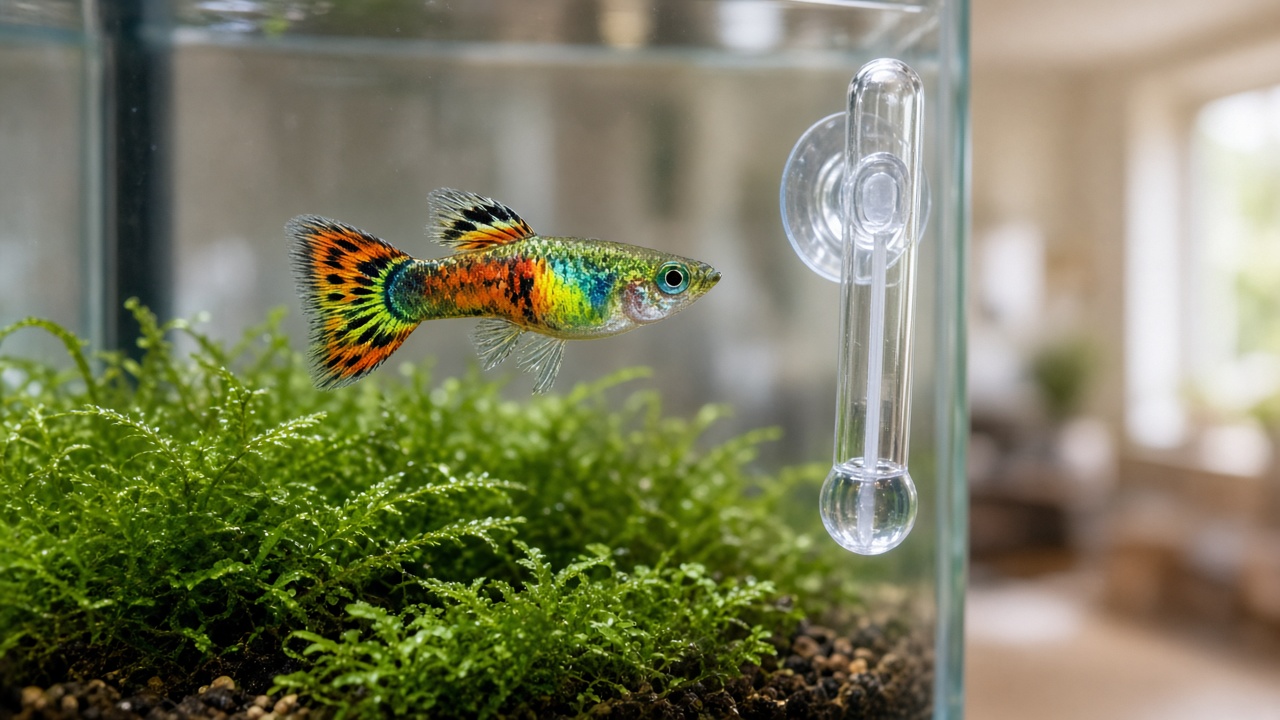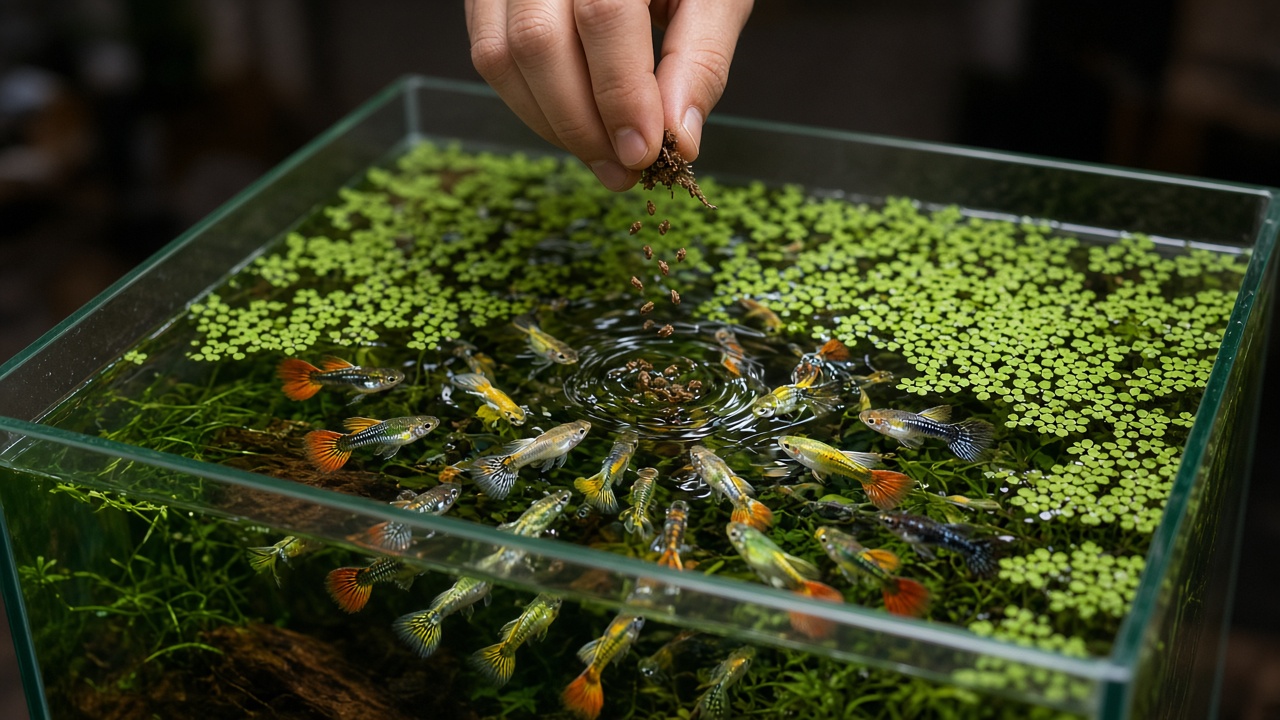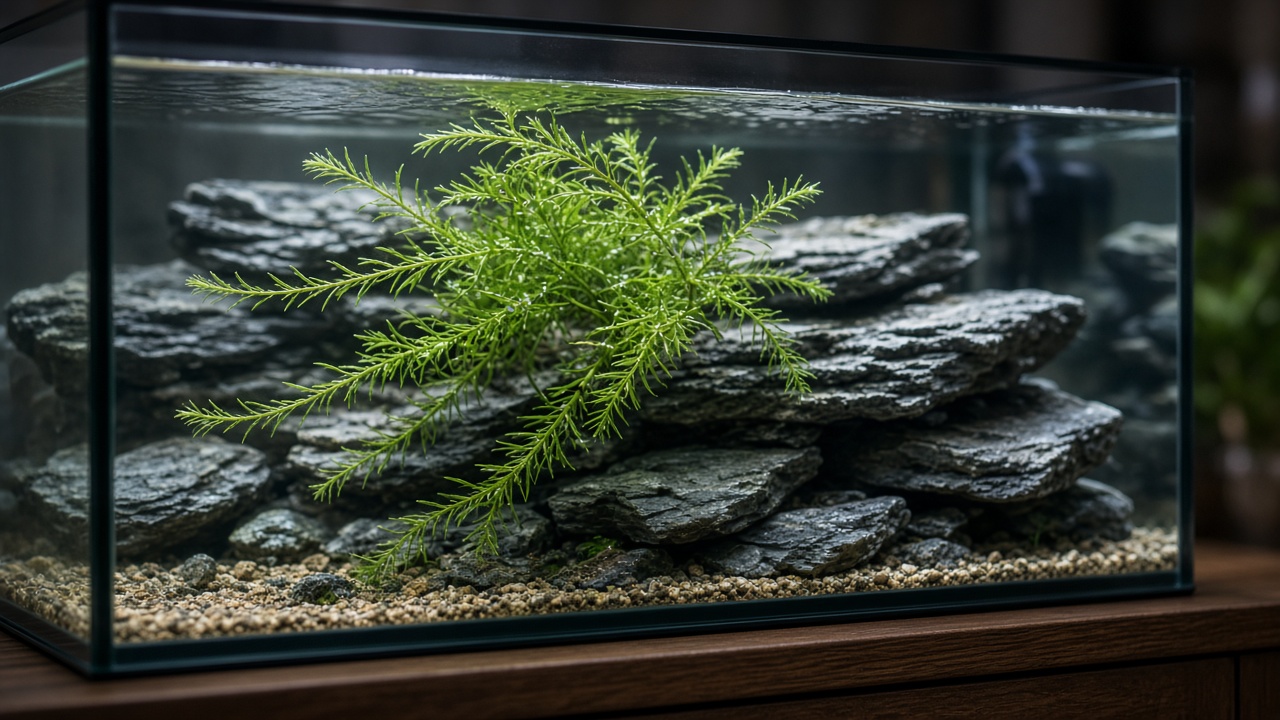
Quick answer: Keep guppy grass floating or loosely planted. Use low to medium light and skip added CO2. Trim the mass often so it does not shade other plants or clog filters.
Guppy grass is Najas guadalupensis; it grows floating or planted without added CO2.
This page is a home-aquarium research brief. Our research team compared published maker labels and Flora of North America measurements. We did not run tank trials, grow-out trials, or any lab work.
What this page covers
We cover Najas guadalupensis sold for indoor freshwater tanks, plus lights and liquids with a maker-listed dose or output.
That is our selection rule. Other Najas species, pond kits, root tabs, and CO2 systems stay out.
Tropica’s species page for Najas guadalupensis ‘Guppy Grass’ calls it an easy, fast plant from the USA and South America. The same page says hobbyists usually keep it free-floating, though it may send long, delicate roots into substrate.
Flora of North America measures stems at 11–90 cm long and 0.1–2 mm thick. Leaves run 0.3–3.3 cm long, and blades are 0.2–2.1 mm wide with 18–100 tiny teeth per side.
Internodes on that account run 0.1–9 cm, and leaf sheaths are 1–3.4 mm wide. Flowers sit 1–3 per axil, and seeds measure 1.2–3.8 mm long by 0.4–0.8 mm wide.
Flora of North America also records four subspecies in the flora. Those thin, branching stems explain why the plant snaps in your fingers and why every scrap can grow.
Tropica’s page notes dense growth that shelters fry and shrimp. If you keep livebearers, pair this plant with the stocking notes in our guppy care guide.
Floating versus planted
Float it when you want a loose cloud, and plant it only if you need a fixed clump you will still trim.
Tropica’s species page treats floating as the usual method. Planting is optional because the plant can later anchor itself.
Use floating when you want fry cover in the upper water, have no plant soil, or need a fast water-column feeder.
Use planted when you want a midground clump, or when flow keeps pushing a floating mass into the filter. You must still trim a planted clump.
If you plant, do not jam stems deep. Flora of North America lists those stems as 0.1–2 mm thick, so a heavy bury snaps them.
Leave the crown free in the water and let fine roots find the sand on their own. Do not expect a carpet, because this is a branching stem mass rather than a lawn plant.
A planted bunch can look tidy for a week, then new side shoots lift and the clump becomes a tangle again. Plan to lift and reset it.
Light
Match light to a published PAR band, then keep the daily on-time steady.
Aquarium Co-Op’s Easy Green page groups tanks by PAR, not by guesswork.
- Low light: 10–20 PAR
- Medium light: 20–35 PAR
- High light: 40–50+ PAR
Guppy grass does not need the high band. Tropica’s plant-info scale lists a medium light demand as 0.5 W/L, which is Tropica’s yardstick for “medium,” not a fixture you must buy.
The hygger 957 page lists a default Auto Cycle with daylight from 6:30 a.m. to 6:30 p.m. That is 12 hours of full-spectrum day light, and night light then runs until 11:30 p.m.
If you use that fixture, start with the 12-hour day block and dim it if algae films the glass. The same page lists 10 brightness steps and 15-minute sunrise and sunset ramps.
For a grassy tank, stay in the lower half of those 10 steps at first. Raise brightness only if the stems stay pale and stretch.
The hygger 957 26W model is sold for 18–24 inch tanks and lists 38 white LEDs at 6500K. The maker also lists a PAR figure of 243.2 for that wattage.
Hygger does not state the depth for that PAR number, so do not treat 243.2 as a reading at the sand. More light makes faster, messier growth and does not make this plant need a high-tech lamp.
Fertilizer and CO2
Dose the water column and skip added CO2 unless you already run it for other plants.
Tropica’s plant-info scale lists a medium CO2 need as 6–14 mg/L and a high need as 15–25 mg/L. Tropica’s guppy-grass text still calls the plant easy in almost any conditions, which is why we treat CO2 as optional.
Comparing published labels, the three liquids below are not the same job.
Aquarium Co-Op’s Easy Green page states:
- 1 ml per 10 gallons adds 3 ppm nitrate
- Dose once a week at 10–20 PAR
- Dose twice a week at 20–35 PAR
- Dose three times a week at 40–50+ PAR
- Aim for 20–50 ppm nitrate from this product
- NPK is 2.66-0.46-9.21
- Water-soluble iron is 0.13%
- A 500 ml bottle treats 5,000 gallons
Seachem’s Flourish page states:
- 5 mL (1 capful) per 250 L, which is 60 US gallons
- Dose once or twice a week
- Each cap thread is about 1 mL
- Refrigerate 3 months after opening
- Total nitrogen is 0.07%
- Available phosphate is 0.01%
- Iron is 0.32%
API’s Leaf Zone page states:
- 5 ml per 10 gallons (38 L)
- Dose weekly
- Sizes are 8 fl oz and 16 fl oz
- The formula uses chelated iron and potassium
Per 10 US gallons, those labels work out to:
- Easy Green: 1 ml
- API Leaf Zone: 5 ml
- Seachem Flourish: about 0.8 ml (5 mL ÷ 60 gallons)
Easy Green is the only one of the three that publishes a 3 ppm nitrate bump per dose. Flourish is a micro and trace bottle, and Leaf Zone is an iron-and-potassium leaf feed.
Pick one lane and stay there, and do not stack all three on the same day. If nitrate from Easy Green climbs past the 20–50 ppm window on that page, skip a dose. Do a water change, then resume the listed schedule.
A lean, fish-light tank often needs the Easy Green lane. A dirty, well-fed tank may only need the Flourish or Leaf Zone lane.
Trimming and disposal
Trim when the mass fills the water column or shades plants below, then bag the waste and keep it out of outdoor water.
Flora of North America records stems from 11 cm to 90 cm. In a 12–20 inch tank, that range is taller than the glass, so uncut stems will fold, tangle, and block light.
Use this trim method:
- Lift one handful at a time.
- Cut above a branch node with scissors.
- Keep the greener, newer tips.
- Discard brown, hollow, or slime-coated stems.
- Float or pin the keepers.
Stems snap, and that is normal because each piece can grow. Check the filter intake after every trim, since fine leaves lodge in sponges and impellers.
Do not release trimmings into ponds, ditches, or storm drains. Flora of North America records this species in lakes, rivers, and canals, so treat tank waste as trash.
If you share cuttings, send them wet in a sealed bag and tell the next keeper the same disposal rule. A closed trash bag is the clean end of the job.
Gear we compared
We compared five currently sold items whose maker pages list a dose, size, or output number.
We skipped any product that lacked a maker spec we could read.
| Product | Maker-listed type | Maker-listed key number | Maker-listed use |
|---|---|---|---|
| Tropica Najas guadalupensis ‘Guppy Grass’ 1-2-GROW (146 TC) | Tissue-culture plant | Fast, easy stem; usually free-floating | Float or let it anchor |
| Aquarium Co-Op Easy Green | All-in-one liquid | 1 ml / 10 gal adds 3 ppm nitrate | 1× weekly at 10–20 PAR |
| Seachem Flourish | Micro and trace liquid | 5 mL / 250 L (60 US gal) | 1–2× weekly |
| API Leaf Zone | Iron and potassium liquid | 5 ml / 10 gal (38 L) | Weekly |
| hygger 957 26W | Planted LED | 38 × 6500K whites; maker PAR 243.2 | 18–24 inch tanks |
No rank is implied. Match the row to your tank width and your fertilizer lane.
The hygger 957 line also lists PAR from 201 on the 20W model to 420.1 on the 72W model. Wider tanks use higher wattage SKUs on that same page, with 20W listed for 12–18 inch tanks and 72W listed for 48–55 inch tanks.
Seachem’s Flourish iron figure (0.32%) is higher than Easy Green’s water-soluble iron (0.13%). Easy Green still supplies far more nitrogen per listed dose, which is why the two bottles are not substitutes.
The hygger 957 page also lists an IP68 splash rating and a 1.2 mm aluminum shell. Keep the bar above the waterline, because the same page says the light is not for submersion.
When stems melt or turn brown
New bunches often shed a few pale stems after a move, which is a shock rather than a reason to add extra fertilizer.
Pull the mushy pieces so they do not rot on the sand, and keep the green tips floating. If most of the bunch turns clear and slimy, start again with a smaller, greener piece.
Brown tips under strong light can mean the mass is too thick. Thin it, then drop brightness one or two of the hygger 957’s 10 steps.
Green dust on the glass often means the Easy Green schedule is ahead of plant use. Skip a dose, then confirm you are still inside Aquarium Co-Op’s 20–50 ppm nitrate window before you resume.
Slow flow helps the floating form. A strong spray bar will push the mass into one corner and shred the tips. Aim the outlet along the glass, not through the cloud.
FAQ
Does guppy grass need to be planted?
No. Tropica’s species page says it is usually kept free-floating and may later send fine roots into the substrate. Plant only if you want a fixed clump and will still trim.
Does it need CO2?
No. Tropica describes it as easy under almost any conditions. Tropica’s general CO2 scale (6–14 mg/L medium, 15–25 mg/L high) is a yardstick for demanding plants, not a requirement for this one.
How much light does it need?
Low to medium is enough. Aquarium Co-Op defines low as 10–20 PAR and medium as 20–35 PAR. The hygger 957 default day block is 12 hours, so start there and shorten the day if algae appears.
How often should I fertilize?
Follow the bottle you chose. Easy Green is 1 ml per 10 gallons, once a week at 10–20 PAR. API Leaf Zone is 5 ml per 10 gallons weekly, and Seachem Flourish is 5 mL per 60 US gallons once or twice a week.
How big does it get?
Flora of North America lists stems 11–90 cm long and leaves 0.3–3.3 cm long. In a home tank, uncut stems will reach the surface and then tangle.
Why does it keep breaking?
The stems are thin. Flora of North America lists them at 0.1–2 mm thick, so handle by the handful rather than pulling one strand. Broken tips are still usable.
Is it only for guppies?
No. Tropica notes shelter for fry and shrimp, and livebearers use it well. The plant is the same species either way.