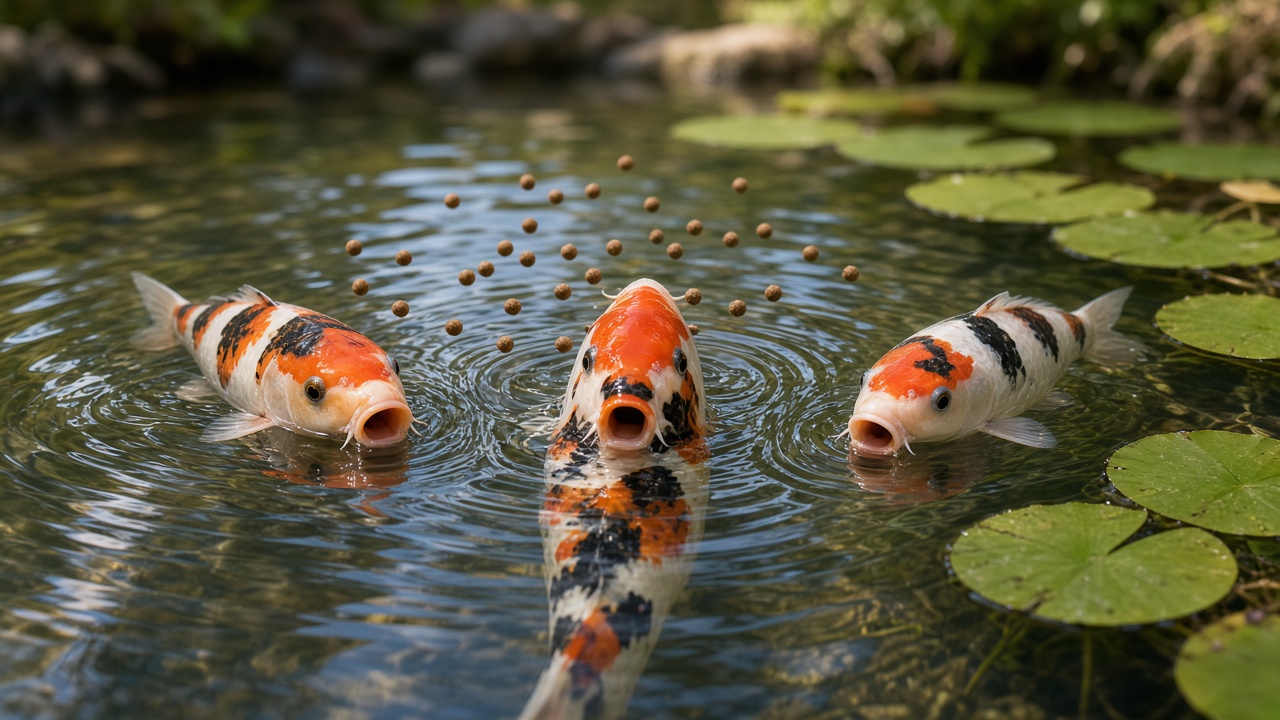
Quick answer: Feed a floating pellet with 35% or more protein in warm water. Switch to a wheat-germ formula when the pond cools. Match pellet size to the smallest fish.
Four of five maker labels our research team compared list at least 35% minimum crude protein.
This page is a label-comparison brief from a home-aquarium research desk. We did not run pond trials, open factory bags, or publish a ranked list of the five foods.
How we chose which foods appear here
We only cover floating daily or seasonal diets whose makers publish a full guaranteed analysis.
A food is in if it is sold now as a daily or seasonal koi pellet. It must float, and the maker’s own page must list protein, fat, and fiber. A food is out if it is a treat, a sinking-only show diet, or a bag whose analysis appears only on a store listing.
Our research team compared five current maker pages under that rule:
- Hikari Gold
- Hikari Wheat-Germ Formula, floating
- Kaytee Koi’s Choice
- Blue Ridge Growth Large Pellet
- Mazuri Koi Platinum Nuggets
We compared printed guarantees, pellet notes, and feeding bands, and we did not score flavor, color gain, or pond growth.
Top 7 Koi fish food
The picks below are the 7 koi fish foods on sale right now, listed with what each suits best and an honest drawback. Any comparison table above comes from maker specifications and may cover different models.
1. Kaytee Koi's Choice Floating Fish Food for Koi
Best for: Budget-conscious pond owners seeking reliable daily nutritio
We compared various entry-level options and found this to be a staple for those managing large ponds on a budget. Owners report that the pellets maintain their buoyancy well, preventing excess waste from sinking to the bottom.
Pros: Affordable price point; Reliable floating formula Cons: Basic nutritional profile
2. Tetra Pond Koi Vibrance Soft Sticks
Best for: Enhancing natural coloration in mature koi
This formula is designed for hobbyists focused on aesthetic appeal. Owners report that consistent feeding leads to more vibrant reds and oranges, though the premium price reflects the specialized ingredients.
Pros: Color-enhancing ingredients; Soft texture for easier digestion Cons: Higher cost per ounce
3. Blue Ridge Koi Platinum Pro 41% Protein Fish Food
Best for: Rapid growth and muscle development
We compared this to standard feeds and noted its focus on high-protein development for show-quality fish. Owners report significant size gains, though they warn that the rich formula necessitates a robust filtration system.
Pros: High protein content; Professional-grade formulation Cons: Requires careful water quality management
4. TetraPond Variety Blend
Best for: Providing nutritional variety for mixed-species ponds
This blend is an excellent choice for those keeping koi alongside goldfish or other pond inhabitants. Owners report that the variety keeps feeding time engaging, as different fish gravitate toward the assorted shapes and textures.
Pros: Multiple food types included; Encourages natural foraging Cons: Some fish may pick favorites
5. Mazuri Koi Floating Pond Nuggets
Best for: High-density nutrition for professional breeding environment
Mazuri is often associated with zoo and commercial settings, making this a top tier choice for serious enthusiasts. Owners report that the nuggets are highly palatable and provide a balanced diet that supports long-term health.
Pros: Nutritionally dense nuggets; Proven professional track record Cons: Bulk packaging may be cumbersome
6. TetraPond Koi Growth Soft Sticks Pond Fish Food
Best for: Supporting juvenile koi during peak growth seasons
We compared this growth-specific formula to standard staples and found it ideal for younger fish needing extra calories. Owners report that the soft texture is particularly helpful for smaller koi that may struggle with harder, larger pellets.
Pros: Formulated for rapid development; Soft sticks reduce choking risks Cons: Not suitable for cold water temperatures
7. Hikari 4.4-Pound Staple Floating Pellets for Koi and Pond Fish
Best for: Year-round maintenance for established pond ecosystems
Hikari is widely regarded as a gold standard for consistent, clean-burning koi food. Owners report that this staple diet is reliable for daily use, noting that it produces very little waste compared to cheaper alternatives.
Pros: Highly digestible formula; Maintains water clarity Cons: Plain nutritional profile
Comparison: Koi fish food at a Glance
| Product | Best for | Approx. price | Where to buy |
|---|---|---|---|
| Kaytee Koi's Choice Floating Fish Food for Koi | Budget-conscious pond owners seeking reliable daily nutritio | $24.90 | Check price |
| Tetra Pond Koi Vibrance Soft Sticks | Enhancing natural coloration in mature koi | $48.97 | Check price |
| Blue Ridge Koi Platinum Pro 41% Protein Fish Food | Rapid growth and muscle development | $39.25 | Check price |
| TetraPond Variety Blend | Providing nutritional variety for mixed-species ponds | $22.24 | Check price |
| Mazuri Koi Floating Pond Nuggets | High-density nutrition for professional breeding environment | $47.99 | Check price |
| TetraPond Koi Growth Soft Sticks Pond Fish Food | Supporting juvenile koi during peak growth seasons | $46.97 | Check price |
| Hikari 4.4-Pound Staple Floating Pellets for Koi and Pond Fish | Year-round maintenance for established pond ecosystems | $36.29 | Check price |
Want to browse every option? See the full range of koi fish food on Amazon →
What protein the current labels list
Warm-water staples on this page sit between 32% and 36% minimum protein.
Protein is the first number most shoppers check, and it is easy to verify on the bag. The maker’s guaranteed analysis states a minimum crude protein percent, and our research team found a four-point spread across the five labels.
Minimum crude protein on those pages:
- Hikari Wheat-Germ Formula, floating: 32%
- Hikari Gold: 35%
- Kaytee Koi’s Choice: 35.0%
- Blue Ridge Growth Large Pellet: 36.00%
- Mazuri Koi Platinum Nuggets: 36.0%
Four of the five bags sit at 35% or higher, and the wheat-germ bag is the exception at 32%. Hikari presents that formula as a cooler-water daily diet, not a peak-summer growth bag.
Fat and fiber move more than protein. Minimum crude fat on the same pages runs from 3% to 6.00%, and fiber listings run from 4.0% to 6.0%. The wheat-germ page lists fiber as a 4.0% minimum, not a maximum.
Phosphorus, when listed, stays in a tight band:
- Hikari Wheat-Germ Formula, floating: 0.7% minimum
- Blue Ridge Growth Large Pellet: 0.75% minimum
- Kaytee Koi’s Choice: 0.8% minimum
- Mazuri Koi Platinum Nuggets: 0.90% minimum
- Hikari Gold: 1.0% minimum
Read protein with the first ingredient. Kaytee’s page lists fish meal first, while Blue Ridge and Mazuri both list dehulled soybean meal first, then grain, then fish meal.
Season and water temperature
Follow the temperature bands printed on the bag, not the calendar month.
Koi eat more when water is warm and less when water is cool. The five makers do not share one cutoff, so use a pond thermometer and match the bag you bought.
Hikari’s Gold page sets these bands:
- 68–86°F (20–30°C): feed 2 to 4 times per day
- 59–68°F (15–20°C): feed no more than twice daily
- 52–59°F (11–15°C): switch to Wheat-Germ Formula
- Below 52°F (11°C): use Wheat-Germ Formula
Hikari’s Wheat-Germ Formula page sets these bands:
- 64–86°F (18–30°C): feed 2 to 4 times per day
- 41–64°F (5–18°C): feed no more than twice daily
- Below 41°F (5°C): do not feed
Kaytee’s Koi’s Choice page sets these bands:
- Above 60°F: feed one to five times daily
- 50–60°F: feed one or two times daily
- Below 50°F: feed every other day
- Below 40°F: do not feed
Mazuri’s Platinum Nuggets page does not print a winter cutoff. It says to feed 1 to 3 times per day, and only as much as fish finish in 5 minutes.
Those bands disagree on the last feeding of the year. Kaytee allows every-other-day feeding below 50°F, then stops at 40°F. Hikari Wheat-Germ stops at 41°F, and Hikari Gold wants a wheat-germ switch near 52°F.
If two bags in your shed disagree, follow the stricter stop. Feed during the warmer part of a cool day, as both Hikari pages say for the middle bands. Do not chase one warm afternoon after a cold week.
Pellet size for mixed ponds
Buy a pellet the smallest koi in the pond can swallow without struggle.
A large koi can eat a small pellet, but a small koi cannot break a large pellet. Hikari’s koi pellet-size guide says to pick the smaller size when mixed lengths share a pond.
Hikari’s size guide lists these diameters:
- Hikari Gold mini: 3.2–3.7 mm
- Hikari Gold medium: 4.8–5.3 mm
- Hikari Gold large: 7.2–8.2 mm
- Hikari Wheat-Germ floating mini: 3.5–4.0 mm
- Hikari Wheat-Germ floating medium: 5.0–5.5 mm
- Hikari Wheat-Germ floating large: 8.0–9.0 mm
The same guide marks fish length icons from about 3.1 inches (8 cm) to about 11.8 inches (30 cm). Use those marks as a starting point, then watch the smallest mouth at the first feeding.
Maker pages also use fish length instead of millimeters:
- Blue Ridge Growth Large Pellet is for koi and goldfish over 5 inches
- Mazuri Koi Platinum Nuggets are for koi 6 inches or larger
- Mazuri prints the nugget as 5/32 inch by 3/16 inch length
If you keep short yearlings with big adults, buy the small Gold or wheat-germ pellet instead of hoping they can handle a large one.
Five current foods, compared by label
The five foods differ more on fat, fiber, and size than on protein.
This table uses only attributes the makers print. It has no rank or price column.
| Product | Min. crude protein | Min. crude fat | Fiber on the label | Min. phosphorus | Form and size note |
|---|---|---|---|---|---|
| Hikari Gold | 35% | 3% | 5% max. | 1.0% | Floating; medium pellet 4.8–5.3 mm |
| Hikari Wheat-Germ Formula (floating) | 32% | 4.0% | 4.0% min. | 0.7% | Floating; medium pellet 5.0–5.5 mm |
| Kaytee Koi’s Choice | 35.0% | 5.0% | 4.0% max. | 0.8% | Floating pellets; year-round feeding notes |
| Blue Ridge Growth Large Pellet | 36.00% | 6.00% | 5.00% max. | 0.75% | For koi over 5 inches |
| Mazuri Koi Platinum Nuggets | 36.0% | 3.0% | 6.0% max. | 0.90% | 5/32 in. × 3/16 in. nugget; koi 6 inches+ |
A few extra numbers sit only on the Mazuri page:
- Vitamin C: not less than 1,000 mg/kg
- Omega-3 fatty acids: not less than 0.90%
- Vitamin E: not less than 50 IU/kg
- Calcium: 1.0% minimum and 1.5% maximum
- Store at 75°F (24°C) or colder, about 50% relative humidity
- Use within 1 year of the bag date
Hikari Gold is the color-and-warm-water daily diet in this set. Hikari Wheat-Germ Formula is the cool-water daily diet. Kaytee Koi’s Choice is the one bag that prints year-round feeding steps on the same page.
Blue Ridge Growth Large Pellet is the highest-fat bag here, at 6.00% minimum. Mazuri Koi Platinum Nuggets add the vitamin C and omega-3 guarantees. Pick by pond job, not by a score.
Warm, growing fish match Gold, Blue Ridge, or Mazuri. Shoulder-season fish match wheat-germ. One-bag keepers who want printed cool-water steps can stay on Kaytee and follow its 40°F stop.
How much and how often to feed
Feed only the amount of pellets the fish finish in five minutes, then stop.
Every maker on this page uses a short clock, not a scoop-per-fish chart.
Time limits the makers print:
- Hikari Gold: all the fish will completely consume within 5 minutes
- Hikari Wheat-Germ Formula: the same 5-minute finish
- Mazuri Koi Platinum Nuggets: readily consume in 5 minutes
- Kaytee Koi’s Choice: fully consumed within 5 to 10 minutes, then remove uneaten food
Summer frequency, when the pond is in the warm band:
- Hikari Gold: 2 to 4 feedings per day at 68–86°F
- Hikari Wheat-Germ Formula: 2 to 4 feedings per day at 64–86°F
- Kaytee Koi’s Choice: 1 to 5 feedings per day above 60°F
- Mazuri Koi Platinum Nuggets: 1 to 3 feedings per day
Several small meals beat one dump, because leftover pellets soak, sink, and load the filter. If food is still on the surface after the clock, scoop it out.
Bag sizes on the maker pages:
- Hikari Gold: 17.6 oz, 4.4 lb, 11 lb, and 22 lb
- Kaytee Koi’s Choice: 3 lb, 10 lb, and 25 lb
- Blue Ridge Growth Large Pellet: 14 lb, 25 lb, and 50 lb
- Mazuri Koi Platinum Nuggets: 20 lb (formula 5M80)
Buy a bag you can finish while it still smells clean and dry. Mazuri tells you to reseal the bag and to skip moldy or insect-hit feed.
Indoor tubs, leftover food, and other tanks
The same koi pellet can foul a small indoor tank faster than an outdoor pond.
Most koi live outdoors, though some spend a season in a tub or indoor tank. The protein and pellet rules stay the same, but the waste math does not.
A handful that vanishes in a large pond can spike ammonia in a small tub. Size indoor filtration for leftover food, not just for fish length.
A filter and heater in one holds a small indoor tub at a steady band but cannot erase a heavy feeding.
New water is a separate problem, because uneaten pellets feed bacteria that consume oxygen and raise ammonia. A pond or tank that is still cycling cannot handle a summer feeding schedule. See how long to cycle a fish tank before you ramp up meals.
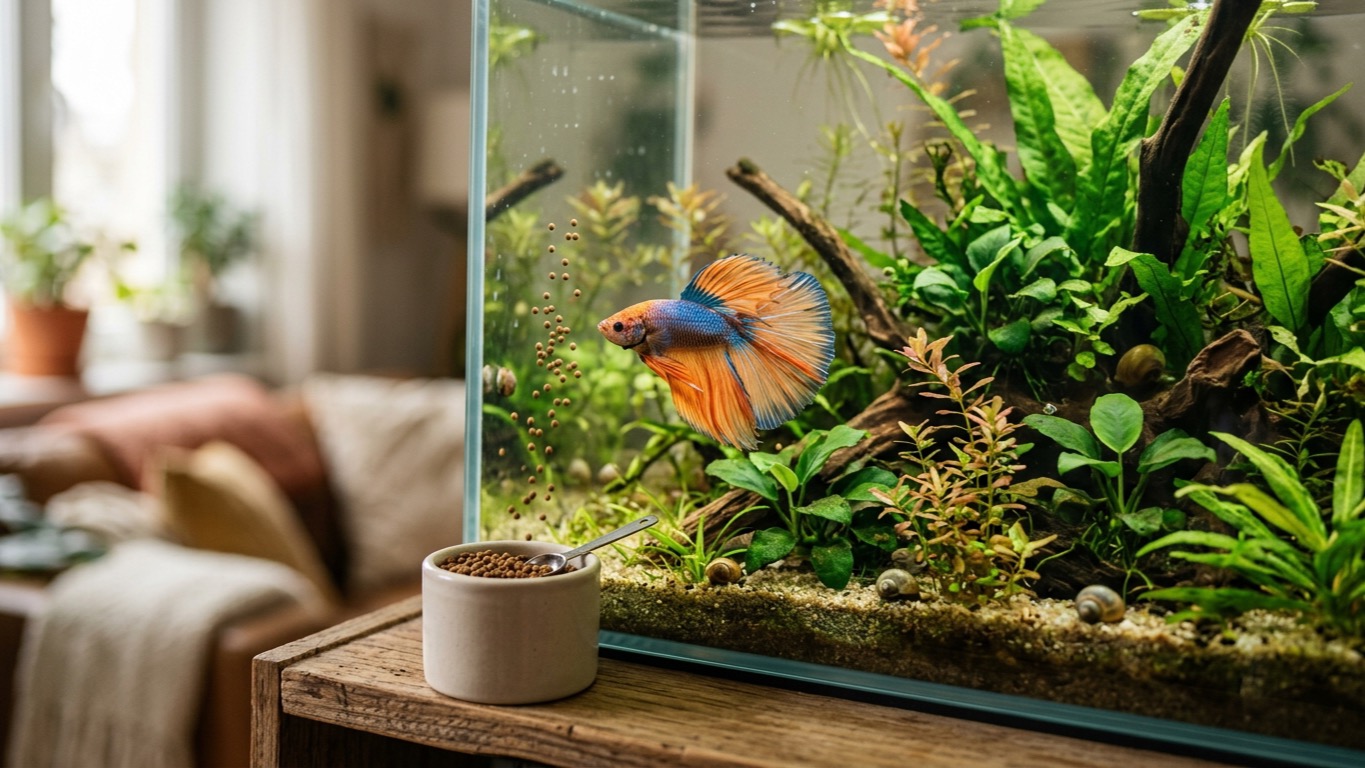
Indoor community fish do not use these pond bags. A betta needs a small, dense diet made for a tiny stomach, so use our best food for betta fish page for that job.
FAQ
How much protein should koi food have?
For warm-water daily feeding, look for about 35% minimum crude protein. Four of the five labels our research team compared meet that mark: Hikari Gold and Kaytee list 35%, and Blue Ridge and Mazuri list 36%. The wheat-germ bag lists 32% and is the cool-water pick in this set.
When should I stop feeding koi in winter?
Follow the bag you are using. Kaytee’s page says do not feed below 40°F, and Hikari’s Wheat-Germ Formula page says do not feed below 41°F. Hikari Gold already wants a wheat-germ switch below 52°F.
What pellet size should I buy?
Match the smallest koi. Hikari’s size guide puts Gold medium pellets at 4.8–5.3 mm and Gold large pellets at 7.2–8.2 mm. Blue Ridge’s large pellet page is for fish over 5 inches, and Mazuri’s nuggets are for fish 6 inches or larger.
Is wheat-germ food only for winter?
No. Hikari’s Wheat-Germ Formula page also allows 2 to 4 feedings per day at 64–86°F. That page is built for cooler water and easier digestion. Many keepers still switch to it when Hikari Gold tells them to change formulas near 52–59°F.
How often should I feed in summer?
Use the warm band on your bag. Hikari Gold says 2 to 4 times per day at 68–86°F, and Kaytee says one to five times daily above 60°F. Mazuri says 1 to 3 times per day, and you still stop when the 5-minute clock is up.
Can pond goldfish eat these koi foods?
Yes, when they meet the length notes. Hikari Gold’s page also names larger goldfish. Blue Ridge lists koi and goldfish, and Mazuri names goldfish over 6 inches.
Does leftover food stall a new pond?
It can, because pellets that sit become waste and waste becomes ammonia. A new pond or tank that is still cycling has little capacity for extra waste, so feed a short pinch and remove leftovers.