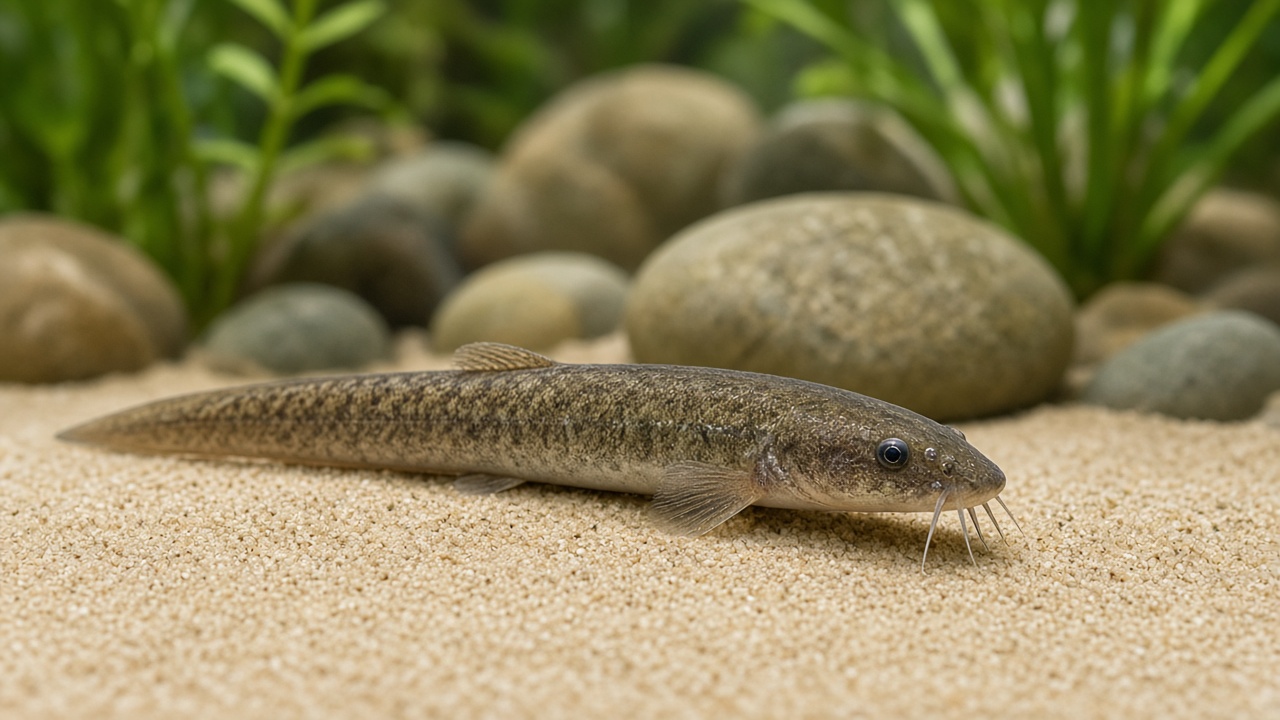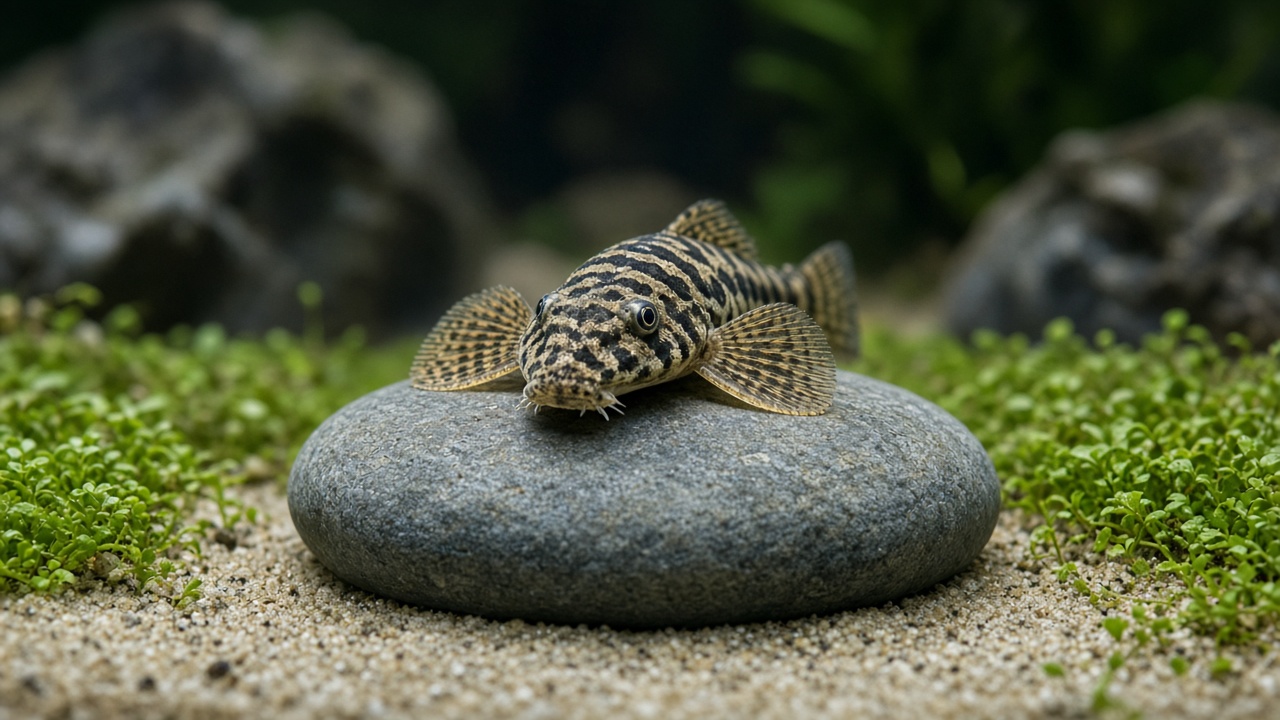
Quick answer: Keep a hillstream loach in a long tank with strong current and high oxygen. Feed biofilm and sinking algae wafers. Skip warm, still community tanks.
A hillstream loach is a 5.7 cm stream grazer that needs fast, cool, high-oxygen water. This page is a research-desk spec brief; we did not run tank trials, breed groups, or measure oxygen in house.
Our selection rule includes only currently sold canisters, wavemakers, and algae wafers whose maker pages list a numeric flow, wattage, or guaranteed analysis. We left out heaters, décor, medications, and foods with no published protein number.
What the name “hillstream loach” actually points to
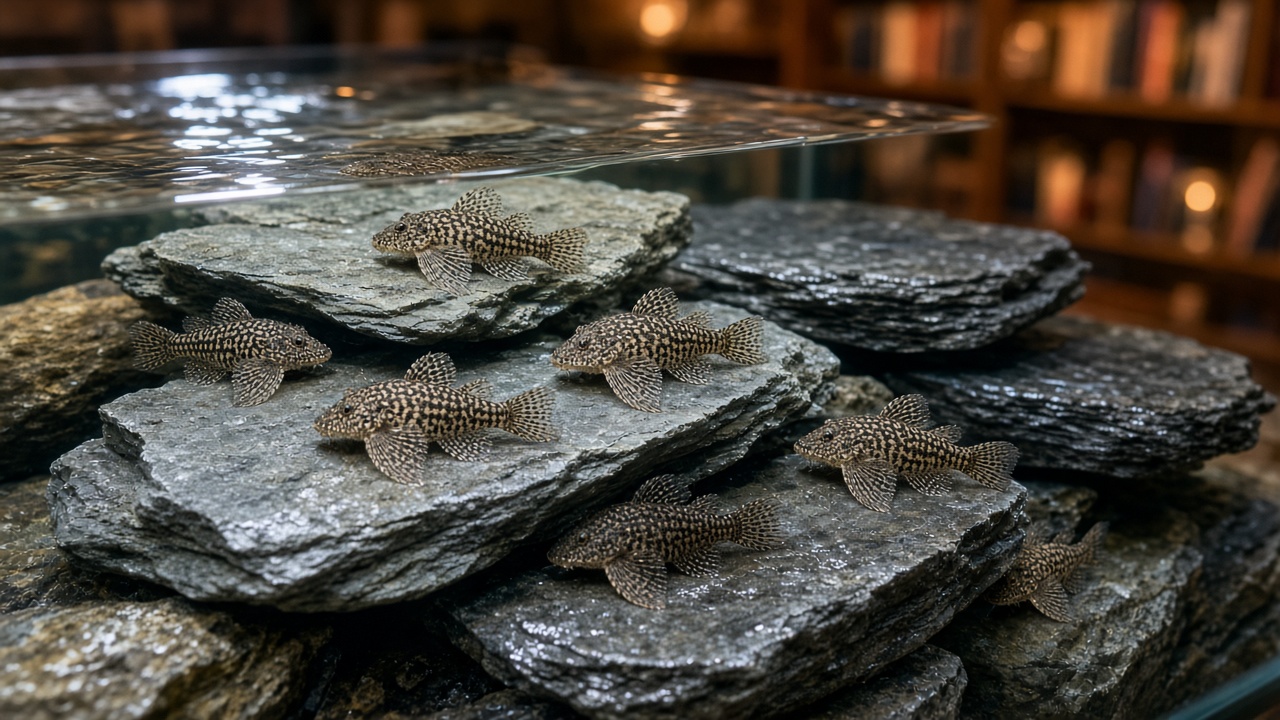
The fish sold under this name is a small riffle specialist, not a six-inch catfish.
FishBase’s species summary for Sewellia lineolata lists a maximum standard length of 5.7 cm. That record cites Freyhof and Serov, 2000, and places the species in Gastromyzontidae.
FishBase also lists 31 to 32 vertebrae and 38 to 49 lateral-line scales. Those counts identify the fish and do not set a legal tank volume.
The IUCN Red List assessment by Huckstorf and Freyhof is narrower on range than FishBase. It treats the species as extant in central Viet Nam river systems. FishBase instead lists China, Viet Nam, and Cambodia as the published range.
Our research team compared those two published maps and did not declare one of them correct. The IUCN assessment is dated 5 September 2010 and was published in 2011 as Vulnerable.
The assessors cite a decline of at least 30 percent in abundance between 2000 and 2009. They name overfishing, dam building, and siltation from deforestation, and they state that no conservation measures are in place.
FishBase and IUCN agree on wild diet and daytime feeding on stone film. Notes include benthic invertebrates plus algae on horizontal and vertical rock faces. Both sources say the fish searches that periphyton by day.
FishBase adds current speeds from the same 2000 review of the genus. The fish occurs where velocity stays at or below 0.2 m per second, and also where velocity exceeds 1 m per second. That spread is a published habitat range, not a pump setting you can copy.
FishBase estimates trophic level at 2.7, plus or minus 0.24, from food items.
Flow: use the maker’s circulation number
A hillstream loach clings in current, so pump output and filter circulation are different published numbers.
Fluval’s 07 Series page lists the Fluval 307 Canister Filter at 303 US GPH pump output. Filter circulation is listed at 206 US GPH at 120 V / 60 Hz. The same page rates that canister for aquariums from 40 to 70 US gallons.
Our research team divided those published figures instead of inventing a turnover rule. 206 divided by 70 is about 2.9 filtered tank volumes per hour at Fluval’s top listed size. 206 divided by 40 is about 5.2 volumes per hour at the bottom of that band.
Fluval’s 07 Series page lists the Fluval 407 Canister Filter at 383 US GPH pump output and 245 US GPH circulation. The page rates that model for 50 to 100 US gallons and lists 23 W at 120 V / 60 Hz. The Fluval 307 listing on the same series page is 16 W.
Circulation is about 68 percent of pump output on the Fluval 307 and about 64 percent on the Fluval 407. Those ratios come from Fluval’s own paired numbers, not from a tank trial. A canister in those gallon bands still does not match the 1 m per second current FishBase records.
Extra unfiltered flow has to come from a wavemaker aimed along the long axis of the tank. hygger’s Aquarium Wavemaker Pump page lists a 4 W model at 792 GPH for 3 to 15 gallon tanks. It lists a 6 W model at 1320 GPH for tanks from 16 to 105 gallons.
Those hygger GPH figures are open-flow ratings, not the same kind of number as Fluval’s filter circulation. Do not add a wavemaker GPH to a canister GPH as if both were filtered flow.
- Use a Fluval 307 inside Fluval’s 40 to 70 US gallon band for the listed 206 GPH of filtered flow.
- Use a Fluval 407 inside Fluval’s 50 to 100 US gallon band for the listed 245 GPH circulation.
- Add the hygger 6 W, 1320 GPH head when the tank sits inside hygger’s 16 to 105 gallon band.
- Skip the hygger 4 W, 792 GPH head on those larger tanks; hygger lists it for 3 to 15 gallons.
- Aim the wavemaker down the long axis so water moves over rock and then breaks the surface.
Aim canister returns so they ruffle the surface instead of dumping into a dead corner.
We did not write a gallon minimum copied from other care pages, because 5.7 cm does not convert into a legal tank volume. Fluval’s 40 to 70 US gallon band is a filter rating, not a species law.
Oxygen falls when water warms
Cool, moving, surface-broken water holds more oxygen than a warm, still glass box.
The USGS dissolved-oxygen chapter states that rule in plain field-manual terms. Lower water temperature and higher pressure raise the amount of oxygen that can dissolve. Higher temperature and higher conductivity lower the amount that water can hold.
The same USGS chapter gives a worked freshwater example with a published table value. At 20.0°C and 750 mm of mercury, table 6.2-2 lists oxygen solubility as 8.97 mg/L. After the chapter’s salinity correction in that example, the figure becomes 8.73 mg/L.
We did not log oxygen in an aquarium and are reporting USGS table math only. FishBase labels the climate zone as tropical, which is not a license for a still, hot display tank. Warmer water, per the USGS chapter, simply holds less dissolved oxygen.
IUCN and FishBase both place the fish in rapids, riffles, and fast streams that stay mixed by moving water. A lid-tight tank with no surface ripple does the opposite job. We did not copy a hobby-blog temperature band; the hard number we can defend is 8.97 mg/L at 20.0°C.
- Hold water nearer the USGS 20.0°C example than a hot room spike so solubility stays closer to 8.97 mg/L.
- Break the surface with the filter return or the wavemaker so gas exchange stays active.
- Leave open water above the rocks; do not bury the surface under floating plants.
- If the room runs hot, cut heater use and other heat load before you add fish.
Algae diet: wild gut contents plus one wafer spec
Wild fish in this genus graze stone film and do not live on leftover flakes.
FishBase and IUCN both record algae plus benthic invertebrates in the gut and in field notes. FishBase’s trophic level of 2.7 matches that mixed, low-to-mid diet. A sinking wafer stands in for film; it is not a meat feast.
Hikari Sales USA’s Algae Wafers page lists a sinking disc of about 17.0 to 18.0 mm. The guaranteed analysis on that page is:
- Crude protein: 33.0% minimum
- Crude fat: 4.0% minimum
- Crude fiber: 3.0% maximum
- Moisture: 10.0% maximum
- Ash: 17.0% maximum
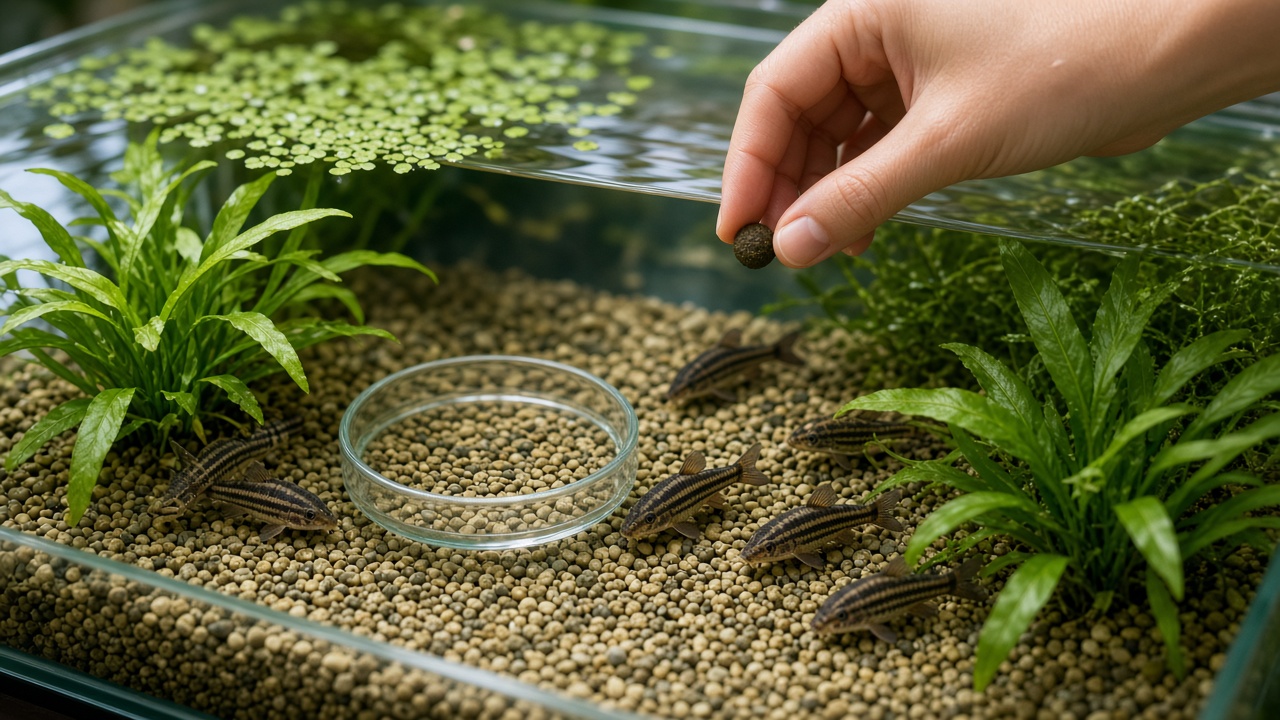
Hikari’s feeding line is numeric: feed no more than the fish will finish within two hours. Remove what remains after that window so leftover paste does not sit in the current. Hikari notes that many bottom feeders are nocturnal and may be fed late in the day.
FishBase and IUCN both describe Sewellia lineolata as active by day on stone faces. For this species, place the wafer on a rock in daylight and pull leftovers at two hours.
- Grow film on smooth stones for several weeks before the fish arrive.
- Offer one Hikari Tropical Algae Wafer on a flat rock, not as a midwater flake.
- Watch the 17.0 to 18.0 mm disc for Hikari’s two-hour feeding window, then remove leftovers.
- Add a small animal item only as a side, because wild guts also hold invertebrates.
- Do not rely on leftover flakes from midwater fish as the only daily ration.
Attribute grid for the five products we pulled
These five items met the selection rule and are compared by listed attributes, not by rank.
| Product | Type | Maker-listed output or size | Listed power or analysis | Maker-listed use range |
|---|---|---|---|---|
| Fluval 307 Canister Filter | Canister filter | 303 US GPH pump; 206 US GPH circulation | 16 W at 120 V / 60 Hz | 40–70 US gal |
| Fluval 407 Canister Filter | Canister filter | 383 US GPH pump; 245 US GPH circulation | 23 W at 120 V / 60 Hz | 50–100 US gal |
| hygger Aquarium Wavemaker Pump 4W | Wavemaker | 792 GPH | 4 W | 3–15 gal |
| hygger Aquarium Wavemaker Pump 6W | Wavemaker | 1320 GPH | 6 W | 16–105 gal |
| Hikari Tropical Algae Wafers | Sinking wafer | 17.0–18.0 mm disc | 33.0% min. crude protein | Algae-eating bottom feeders |
Read the table from left to right when you match gear to a tank. Match volume to Fluval’s listed gallon band first, then add extra current from hygger’s listed band. Keep the Hikari disc on the two-hour clock from the maker page.
Tank mates: match the current
Tank mates fail when they need still, warm, planted water that this loach cannot use.
FishBase lists wild neighbors such as Annamia normani, Schistura species, Glyptothorax, and Rhinogobius. Those names are riffle fishes from field notes, not a shopping list. IUCN places the habitat in permanent rivers, streams, and creeks, including waterfalls.
Neither FishBase nor IUCN publishes a head-count rule for a home aquarium, so this brief sets no “keep three” stocking number. Skip fish that rest on the same rocks and fight for the same film. Skip fish that need a still, heavily planted box with weak flow.
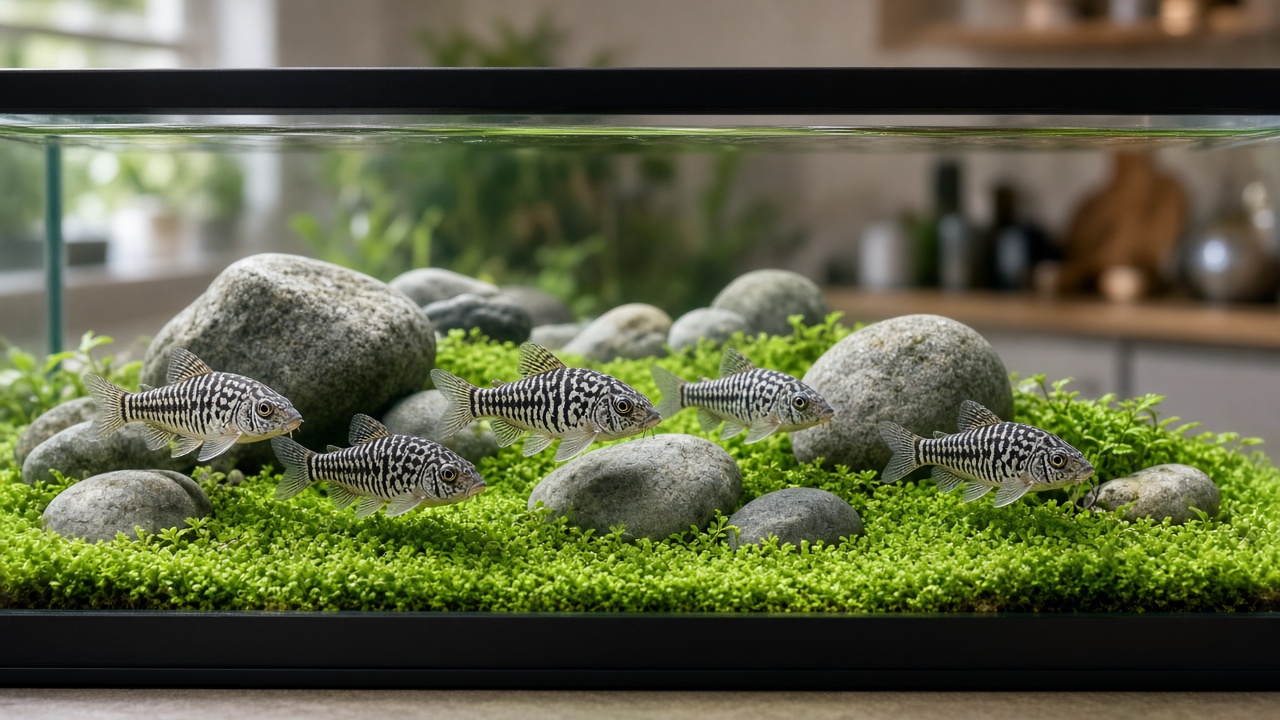
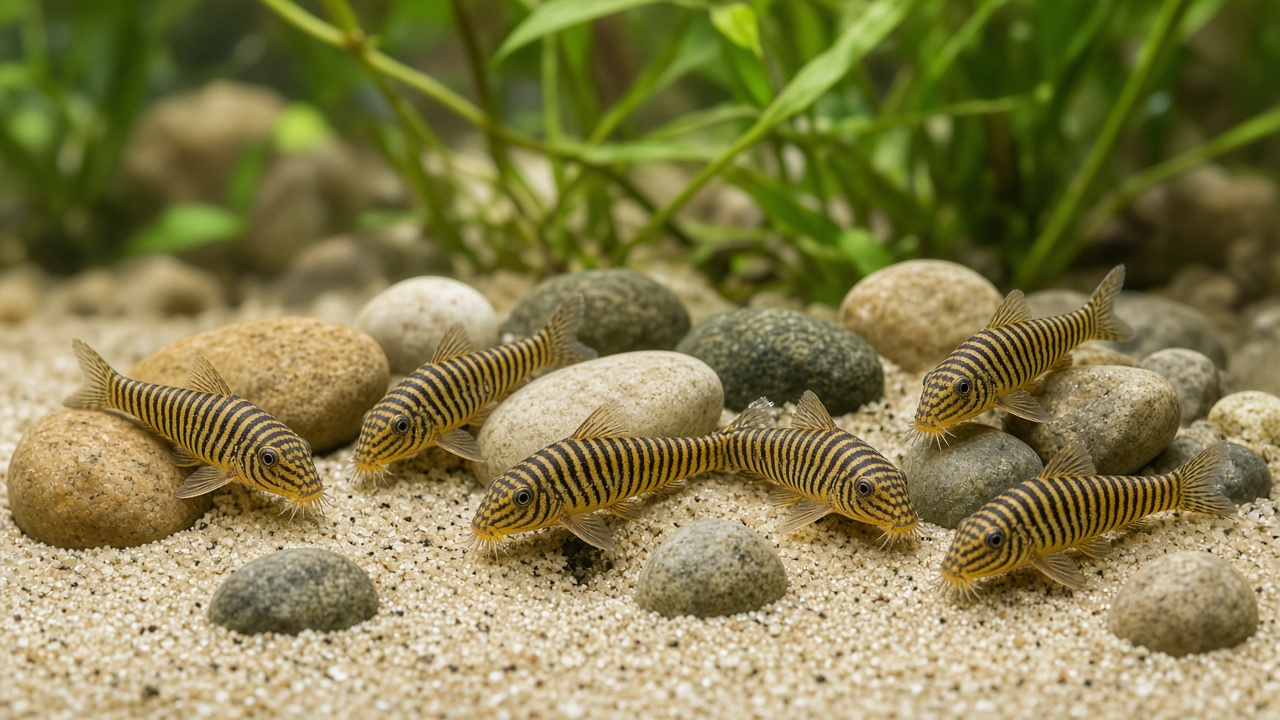
A kuhli loach wants calmer water and cover, which is the opposite current. Do not copy a kuhli setup onto a hillstream loach.
A mate-check list:
- Use the same cool, high-flow water, or do not add the extra fish.
- Pick midwater swimmers that ignore the rock film and do not pick at the loach.
- Skip large cichlids and other strong suckerfish that claim the same stones.
- Skip a still-water shrimp colony if the wavemaker pins the shrimp in place.
FAQ
What is a hillstream loach?
It is the trade name most often used for Sewellia lineolata. FishBase lists that species at 5.7 cm standard length in the family Gastromyzontidae. IUCN assesses it as Vulnerable and maps the extant range to central Viet Nam drainages.
Do hillstream loaches eat only algae?
FishBase and IUCN both record algae and benthic invertebrates, so the answer is no. FishBase’s trophic level of 2.7 fits that mix, and Hikari Tropical Algae Wafers stand in for film rather than replacing it.
How much flow does a hillstream loach need?
FishBase records wild current from 0.2 m per second up to more than 1 m per second. Fluval lists 206 US GPH of circulation on the Fluval 307. That filtered number still needs a wavemaker if you want a long, shallow river path.
Can they live in a warm, still community tank?
Not under the rule this page uses. USGS lists 8.97 mg/L oxygen solubility at 20.0°C and 750 mm Hg. Warmer, still water holds less oxygen and has none of the riffle habitat FishBase and IUCN describe.
When should I feed algae wafers?
Our editorial team says to feed no more than fish will eat in two hours and then remove leftovers. FishBase and IUCN describe this species as day-active, so place the 17.0 to 18.0 mm disc on a rock in daylight.
Are hillstream loaches the same as kuhli loaches?
A hillstream loach is a flattened riffle grazer that lives on current-swept rock, so the two fish are not the same. A kuhli loach is a slender burrower that uses calmer water and cover.
Why does IUCN list them as Vulnerable?
The IUCN Red List assessment dated 5 September 2010 cites a decline of at least 30 percent between 2000 and 2009. Assessors name overfishing, dam building, and silt from deforestation. They also state that no conservation measures are in place.