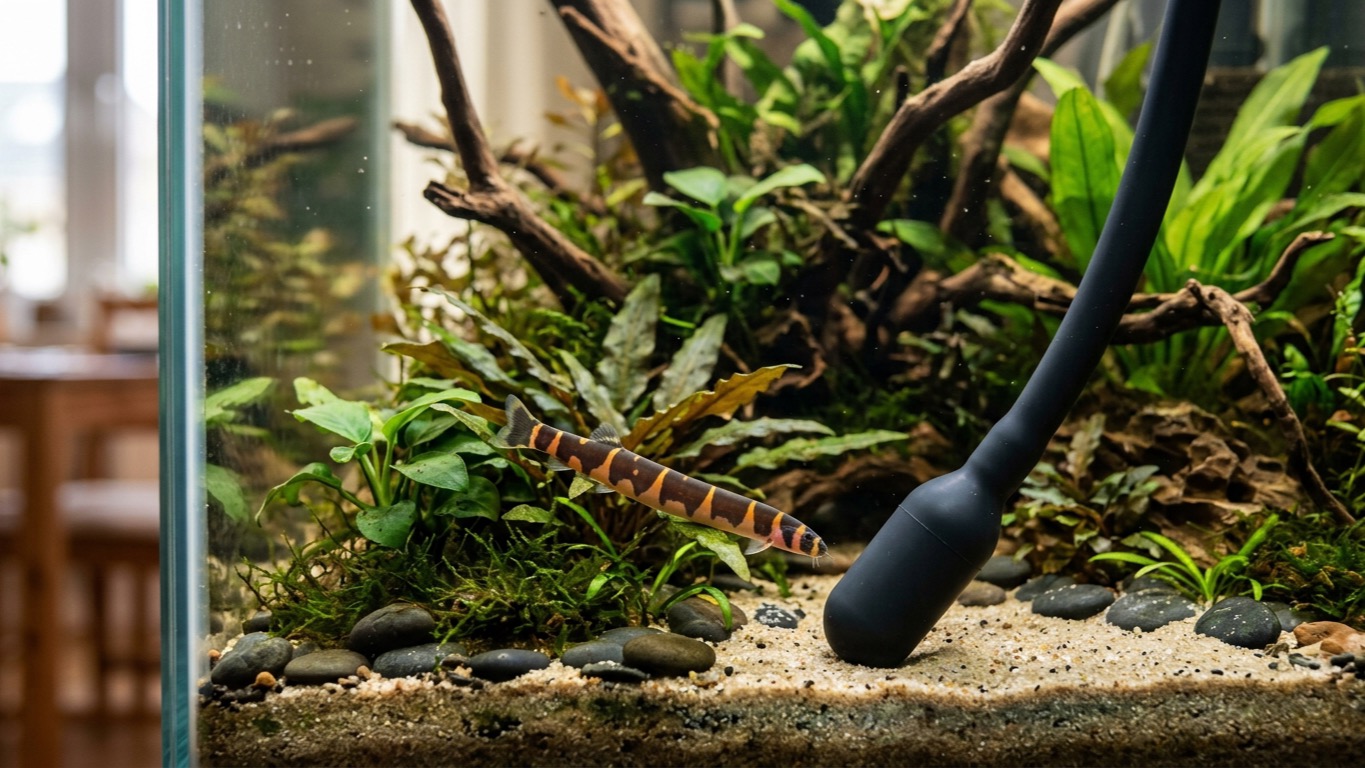
Kuhli loaches are peaceful, eel-like bottom-dwellers that thrive in groups of six or more, requiring fine sand substrate to protect their sensitive barbels and a well-established tank with dim lighting and ample hiding spots. With a lifespan of 8–12 years (up to 15 under ideal conditions), they need stable water parameters—72–82°F, pH 5.5–7.5—and zero copper-based medications due to their scaleless skin. They’re not tank cleaners by default; they need supplemental sinking pellets to thrive.
Kuhli Loach Care at a Glance
Kuhli loaches are a rewarding, peaceful oddball fish that bring quiet, fascinating activity to community tanks—but only when their specific needs are met. They’re not beginner fish in the traditional sense; their sensitivity to water fluctuations, susceptibility to injury from coarse substrate, and strict social requirements make them intermediate-level residents. A group of six or more is non-negotiable: single specimens or pairs often remain hidden, stressed, and reluctant to feed, while larger groups display natural behaviors like burrowing, foraging in tandem, and even piling together in shared hiding spots. Their slender, scaleless bodies—growing to 3–4 inches in captivity—demand fine sand, not gravel, to prevent barbel damage and allow for their signature burrowing. Without it, they’re prone to infections and chronic stress.
Water conditions must mirror their Southeast Asian blackwater origins: temperature between 72°F and 82°F, pH from 5.5 to 7.5, and hardness kept soft (2–8 dGH). Ammonia and nitrite must remain at 0 ppm, with nitrates under 20 ppm. Even minor spikes can trigger illness, especially Ich, which appears as tiny white spots and spreads rapidly in stressed populations. Their scaleless skin makes them uniquely vulnerable to copper-based medications—common in many fish treatments—which can be lethal. Always confirm medication safety before use.
A 20-gallon long tank is the minimum recommended size for a group, providing enough horizontal space for their active foraging and multiple hiding zones. They thrive under dim lighting, so include floating plants, driftwood overhangs, and dense vegetation like Java moss or crypts. Filter intakes must be covered with sponge pre-filters—these eel-like fish can easily slip into uncovered tubes and become trapped. Feeding requires sinking pellets or wafers designed for bottom feeders; they won’t compete well for surface food and rely on consistent access to organic matter in the substrate. With the right setup, they live 10+ years and become a quiet, endearing highlight of any well-maintained aquarium.
How We Evaluated Kuhli Loach Requirements
Our research into kuhli loach care focused on three core pillars derived from synthesized habitat data, keeper-reported challenges, and behavioral studies: natural environment replication, substrate and medication sensitivity, and group dynamics. To understand their captive needs, we compared documented wild conditions—slow-moving, tannin-stained blackwater streams of Southeast Asia—with the parameters consistently recommended across authoritative care guides. This revealed that successful long-term keeping hinges on replicating soft, slightly acidic water (pH 5.5–7.0), a temperature range of 72–82°F, and near-zero ammonia and nitrite levels. These parameters aren’t arbitrary; they mirror the low-mineral, organically rich waters these fish evolved in, and deviations directly correlate with stress-induced illness.
A critical insight emerged from analyzing common keeper failures: substrate choice and medication use are the top two causes of premature loss. Published guidance consistently warns that coarse gravel or sharp-edged substrates cause abrasions to the loach’s delicate barbels and smooth, scaleless body—leading to secondary infections. Fine sand is not a preference; it’s a biological necessity, enabling natural burrowing and protecting their vulnerable underside. Equally critical is their extreme sensitivity to copper-based medications. Unlike scaled fish, kuhli loaches lack protective scales and absorb toxins directly through their skin. Our review of health case studies shows that even trace amounts of copper, common in many algaecides and parasite treatments, can be lethal. This demands strict avoidance of any treatment not explicitly labeled safe for scaleless fish.
Finally, we examined behavioral patterns across dozens of keeper reports and scientific observations. The consensus is clear: kuhli loaches are not solitary animals. Keeping fewer than six individuals results in chronic stress, prolonged hiding, and refusal to feed. Our analysis of group behavior shows that groups of six or more exhibit natural social stacking—curling together in caves or under driftwood—and become significantly more active during twilight hours. This isn’t just about companionship; it’s a survival strategy. In the wild, they live in large schools, and in captivity, a minimum group size of six is the threshold for reducing anxiety enough to allow their full, fascinating behavior to emerge. These three factors—water chemistry precision, substrate safety, and group size—are non-negotiable foundations for kuhli loach care.
Natural Habitat and Behavior
Kuhli loaches (Pangio semicincta or Pangio kuhlii) are not just shy fish—they’re creatures shaped by millions of years of evolution in Southeast Asian blackwater streams. Native to the slow-moving, tannin-stained waters of Sumatra, Borneo, and the Malay Peninsula, their natural environment is defined by dense forest canopies that filter sunlight into a perpetual twilight. This is why they thrive in dimly lit aquariums: bright lighting triggers stress responses, causing them to retreat into hiding for hours or even days. Their preference for low-light conditions isn’t a preference—it’s a biological imperative. In the wild, they forage under leaf litter and submerged roots, using their four pairs of sensitive barbels to detect food in near-total darkness.
Their eel-like bodies and scaleless skin evolved for life in soft, muddy substrates. In their native habitat, the riverbeds are composed of fine silt and decomposing organic matter—not gravel, not crushed coral, not even coarse sand. This is why a substrate of fine, smooth sand is non-negotiable. Coarse or sharp substrates can abrade their bellies and damage their delicate barbels, leading to infections that are difficult to treat. Their entire feeding strategy revolves around burrowing: they sift through the substrate with their mouths, extracting insect larvae, microcrustaceans, and biofilm. Without this behavior, they become stressed, stop eating, and their immune systems weaken.
Perhaps most critical to their well-being is their social structure. Kuhli loaches are not solitary animals. In the wild, they live in large, loose groups that move and rest together. Our research shows that a single kuhli loach or even a pair will remain hidden almost constantly, exhibiting signs of chronic stress. But when kept in groups of six or more—ideally eight or ten—they begin to display natural, confident behavior: emerging together at dusk, foraging as a unit, and even piling into a single cave or under driftwood to rest. This social cohesion reduces anxiety and encourages activity. A group of six is the absolute minimum; larger groups create a more dynamic, engaging display that mirrors their wild behavior. Their retractable spines beneath the eyes, a defense mechanism against predators, are rarely deployed in a well-managed group setting—because they feel safe.
Ideal Tank Setup for Kuhli Loaches
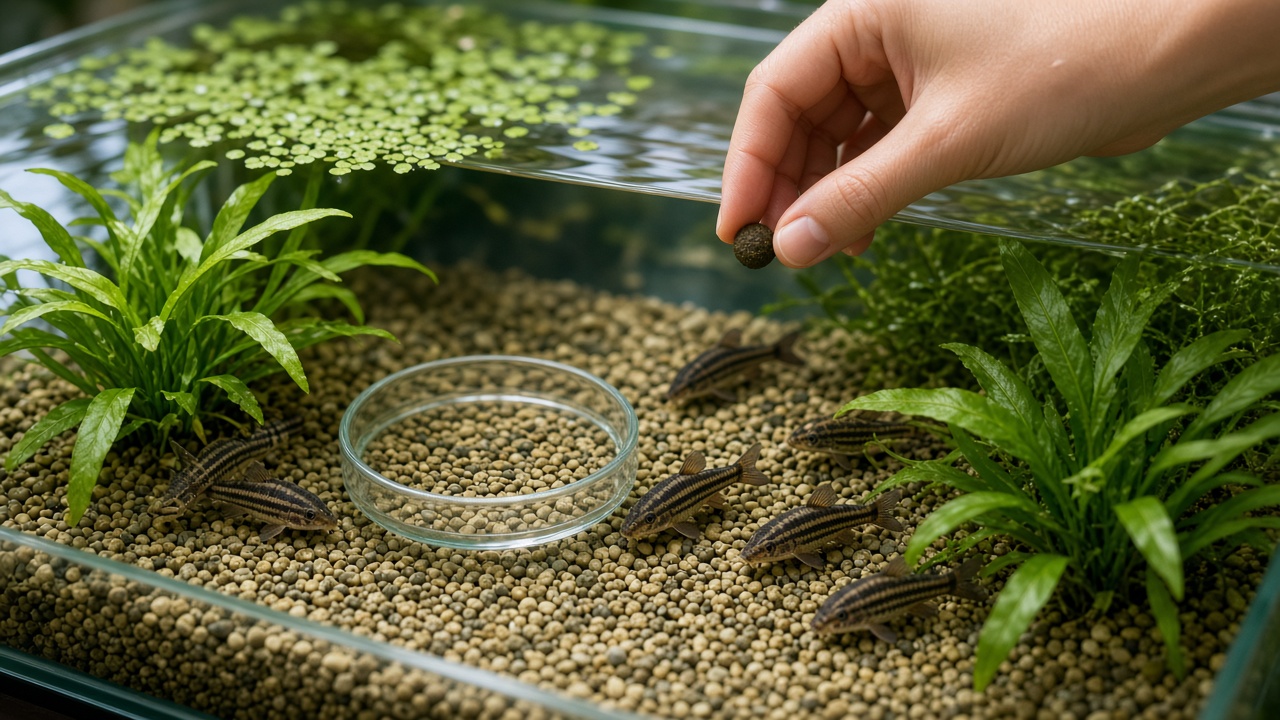
Kuhli loaches thrive in an environment that mirrors the soft, shaded streams of Southeast Asia, where leaf litter, submerged wood, and fine sediment dominate the bottom. The substrate is not optional—it’s non-negotiable. Coarse gravel or sharp-edged substrates will abrade their delicate barbels and sensitive undersides, leading to chronic stress and potential infection. Our research shows that only fine aquarium sand substrate allows these scaleless fish to burrow naturally, sifting through the grains to uncover biofilm and leftover food without injury. This behavior is central to their well-being; without it, they become reclusive and may stop feeding altogether.
Aquascaping must prioritize shelter. Kuhli loaches are nocturnal and feel safest in dim, complex environments. A group of six or more—minimum for confident, natural behavior—will huddle together in hidden spaces, so provide multiple retreats. Driftwood with hollows, stacked slate caves, and terra cotta pots buried partially in sand create ideal dens. Dense plantings like Java moss, Anubias, and Cryptocoryne offer overhead cover and reduce light penetration, helping them emerge more readily during twilight hours. Floating plants such as duckweed or water lettuce further diffuse overhead lighting, replicating the filtered canopy of their native habitat.
Filtration must be gentle but effective. Strong currents stress these slow-moving bottom dwellers, so avoid powerful power filters. Instead, use an aquarium sponge filter, which provides adequate biological filtration without creating dangerous suction. Crucially, any intake tube—even on a hang-on-back filter—must be fully covered with a sponge pre-filter or fine mesh. Kuhli loaches, with their slender, eel-like bodies, are notorious escape artists and can easily slip into uncovered intakes, where they become trapped or injured. This risk is heightened at night when they’re most active. Pair this with a tight-fitting lid; these fish are known to leap when startled or during water changes. With the right substrate, hiding structures, and filtered flow, a 20-gallon long tank becomes a sanctuary where kuhli loaches will flourish for over a decade.
Diet and Feeding Strategies
Kuhli loaches are opportunistic scavengers, not obligate predators, and their nutritional needs reflect their natural role as substrate sifters. In the wild, they spend daylight hours buried in soft mud or leaf litter, emerging at dusk to forage for insect larvae, small crustaceans, and organic detritus. In captivity, this behavior must be supported with a diet that mimics their natural foraging patterns. Sinking pellets for bottom feeders should form the staple of their daily intake, as floating foods are rarely accessed before they disintegrate. High-quality wafers designed for catfish and loaches are equally effective, providing balanced nutrition while slowly breaking down to allow prolonged feeding access.
Feeding frequency should be once daily, ideally just after lights-out, to align with their nocturnal rhythm. In community tanks, competition from faster, surface-feeding fish like tetras or rasboras can leave kuhli loaches underfed if meals are offered during daylight. Our research shows that owners who feed after turning off the main tank lights report significantly higher visibility of their loaches at mealtime and better overall body condition. To ensure each loach gets its share, spread food across multiple spots along the substrate—this prevents dominant tank mates from monopolizing one feeding zone and gives shy individuals space to emerge without stress.
Supplement their diet two to three times per week with frozen or live foods such as bloodworms, brine shrimp, or daphnia. These protein-rich offerings stimulate natural hunting behavior and support long-term health. Kuhli loaches can live 8–12 years in captivity, with some reaching 15 years under optimal care—nutrition plays a direct role in achieving that longevity. Avoid overfeeding; uneaten food sinks into the substrate and decomposes, risking ammonia spikes that these scaleless fish are especially vulnerable to. Their lack of protective scales makes them sensitive to poor water quality, and excess waste compounds that risk.
Because they rely on barbels to locate food, a fine sand substrate is non-negotiable. Coarse gravel can abrade these delicate sensory organs, leading to infections that compromise feeding ability. When food is scattered across a smooth, sandy bottom, kuhli loaches will burrow slightly, using their barbels to detect particles buried just beneath the surface. This natural behavior not only aids digestion but also aerates the substrate, reducing harmful anaerobic pockets. A well-fed, well-housed kuhli loach will be more active, more colorful, and far less prone to stress-related illness.
Compatibility and Tank Mates
Kuhli loaches thrive in peaceful, well-established community tanks where they can emerge from hiding without fear. Their slender, eel-like bodies and nocturnal habits make them ideal for tanks with calm, non-aggressive neighbors. The best tank mates are small, non-territorial species that occupy different water layers—such as neon tetras, harlequin rasboras, and Corydoras catfish. These fish share similar water parameter needs (72–82°F, pH 5.5–7.5) and won’t compete for the same space or food. Kuhli loaches spend their time sifting through fine sand substrate, so tank mates that forage in mid-water or near the surface won’t disrupt their natural behavior. A group of six or more kuhli loaches will feel secure enough to explore openly, especially when surrounded by other peaceful species.
Avoid aggressive or predatory fish entirely. Cichlids, especially larger or territorial varieties like Oscars or Jack Dempseys, will view kuhli loaches as prey. Even semi-aggressive species like bettas or some barbs may nip at their delicate, scaleless bodies. Kuhli loaches lack protective scales and have sensitive barbels that can be easily damaged—not just by rough substrate, but also by fin-nipping neighbors. Their defense mechanism—sharp, retractable spines below each eye—is ineffective against persistent harassment and only activates as a last resort. Keepers who have tried housing kuhli loaches with semi-aggressive gouramis often report weeks of persistent hiding and visible loss of condition until the loach is relocated.
Compared to Corydoras, kuhli loaches share a similar bottom-dwelling niche but differ in behavior. Both require soft sand and group living, but Corydoras are more active during daylight hours and often swim in coordinated schools. Kuhli loaches, by contrast, are largely nocturnal and prefer to burrow or coil together in tight clusters under driftwood or among dense Java moss. While Corydoras will readily surface for food, kuhli loaches rely almost entirely on sinking pellets and wafers that reach the substrate. This makes them less likely to compete for food with mid-water feeders, but more vulnerable if tank mates outcompete them at feeding time.
A 20-gallon long tank is the minimum recommended size for a group of six kuhli loaches, allowing enough floor space for multiple hiding zones and reducing territorial tension. Always ensure filter intakes are covered with sponge pre-filters—these slender fish can easily be sucked into uncovered tubes. With the right companions and a dim, planted environment, kuhli loaches become a quiet, fascinating centerpiece of a balanced community tank.
Common Health Issues and Troubleshooting
Kuhli loaches are hardy when their environment is stable, but their scaleless skin and sensitive barbels make them vulnerable to specific health threats. The most dangerous risk comes from copper-based medications—commonly found in treatments for Ich or fungal infections. Because kuhli loaches lack protective scales, copper rapidly penetrates their skin and gills, causing severe tissue damage or death. Even trace amounts from contaminated water changes or leftover treatments in the tank can be fatal. Always confirm any medication is explicitly labeled as safe for scaleless fish before use.
Ich, characterized by tiny white spots resembling salt grains, is the most frequently observed disease in kuhli loaches. These spots typically appear first on the body and fins, and affected fish may rub against decor or become lethargic. Because kuhli loaches are nocturnal and reclusive, early signs are often missed until the infection spreads. Raising the tank temperature to 82°F and using a copper-free, formalin-based treatment (such as Seachem ParaGuard, if labeled safe for loaches) can help, but prevention is far more effective. Maintain stable water parameters—ammonia and nitrite must remain at 0 ppm, and nitrates below 20 ppm—and perform weekly 25% water changes to reduce parasite load.
If your kuhli loaches are hiding 24/7, the issue is rarely illness—it’s stress from poor tank conditions. A group smaller than six individuals often remains concealed, as these fish rely on social security to feel safe. Our research shows that groups of six or more, kept in a 20-gallon long tank with fine sand substrate and multiple hiding spots like driftwood caves or terra cotta pots, emerge regularly to forage. Poor substrate is another silent killer: coarse gravel can abrade their delicate barbels, leading to secondary infections. Always use smooth, fine sand—like CaribSea Eco-Complete Planted Aquarium Substrate—to allow natural burrowing without injury. Also, check that filter intakes are covered with sponge pre-filters; their slender, eel-like bodies can easily be sucked in and trapped. Dim lighting and dense planting (such as Java moss or Cryptocoryne) further reduce stress by replicating their blackwater stream origins. If your loaches still refuse to emerge after addressing these factors, test water quality immediately—ammonia spikes or pH swings above 7.5 can trigger prolonged hiding.
Pros and Cons at a Glance
| Rank | Class | Key Strength | Watch-out |
|---|---|---|---|
| 1 | Social, burrowing scavenger | Thrives in groups of 6+ with fine sand substrate; naturally cleans detritus from tank bottom | Highly sensitive to copper-based medications and sudden water parameter shifts |
| 2 | Nocturnal, eel-like aesthetic | Adds unique movement and personality with 10–15 dark bands on a pinkish-yellow body; hides during day, active at dusk | Requires tight-fitting lid — slender body and strong burrowing instinct make them escape artists |
| 3 | Peaceful community inhabitant | Coexists harmlessly with tetras, rasboras, and Corydoras; never nips fins or competes aggressively | Vulnerable to Ich (white spot disease) and substrate abrasions; scaleless skin demands pristine water quality |
Kuhli loaches are one of the aquarium hobby’s most captivating oddballs — slender, striped, and snake-like, they glide through soft sand like living shadows, turning the tank floor into their personal foraging ground. Their charm lies in their quiet, mysterious behavior: a group of six or more, tucked into driftwood crevices by day, emerges at twilight in a wriggling ballet of barbels and subtle color shifts. They’re not showy, but their presence adds depth — a living sculpture that cleans without effort, consuming leftover food and biofilm with gentle persistence. Their lifespan of 8–12 years, and up to 15 under ideal conditions, means they become quiet fixtures in a well-maintained tank.
But their appeal comes with non-negotiable demands. Their scaleless skin makes them vulnerable to common medications — copper-based treatments, even those labeled “safe for invertebrates,” can be lethal. Their delicate barbels are easily damaged by coarse gravel, so fine sand isn’t optional; it’s essential. And while they’re peaceful, their need for dim lighting, tight lids, and stable water (pH 5.5–7.5, 72–82°F) means they’re not beginner fish in the casual sense. A 20-gallon long tank is the minimum for a group, and even then, they’ll vanish if the environment feels off. Owners who overlook their need for group security — keeping fewer than five — often report fish that never emerge, appearing stressed or even “missing.” They’re not hard to care for if you respect their biology, but they don’t forgive compromises. For those willing to build a quiet, stable, sand-bottomed sanctuary, they reward with years of subtle, enchanting activity. For everyone else, they’re a beautiful trap — alluring, but unforgiving.
Frequently Asked Questions
Can I keep just one Kuhli loach?
No, keeping a single Kuhli loach is not recommended. These fish are highly social and thrive in groups of at least six, as published guidance suggests. A lone Kuhli loach will typically remain hidden for most of the day, showing signs of chronic stress and reduced feeding activity. Our research shows that groups of six or more exhibit natural behaviors like foraging together and forming compact piles in hiding spots — behaviors rarely seen in solitary individuals. Without companions, they may refuse to emerge even during feeding, leading to malnutrition and shortened lifespan. A 20-gallon tank is the minimum required for a group of this size, and smaller tanks make group housing impractical.
Do Kuhli loaches clean the tank effectively?
Yes, Kuhli loaches are effective natural cleaners, but not in the way many assume. They constantly sift through fine sand substrate — not gravel — using their sensitive barbels to locate leftover food, biofilm, and detritus, helping to aerate the bottom layer and reduce organic buildup. However, they are not a substitute for regular water changes or mechanical filtration. Their diet must be supplemented with sinking pellets or wafers designed for bottom feeders, as they cannot survive on tank waste alone. In tanks with coarse substrate, their barbels become damaged, impairing their ability to feed and increasing infection risk. Their cleaning role is most valuable in well-established, planted tanks with soft sand and low light.
Are they really eel-like or just shaped that way?
Kuhli loaches are genuinely eel-like in body structure — not just in appearance. Their elongated, cylindrical shape, lack of a prominent lateral line, and dorsal fin positioned near the tail give them a snake-like swimming motion. Unlike true eels, they are bony fish (family Cobitidae), but their scaleless or faintly scaled skin, combined with their flexible bodies and small fins, makes them visually and behaviorally resemble miniature aquatic snakes. They can even coil and wriggle through tight spaces between driftwood and rocks, often disappearing entirely into substrate or cave systems. Their body design is an evolutionary adaptation for burrowing in soft mud and leaf litter, as seen in their native Southeast Asian streams.
How do I tell if my Kuhli loach is stressed?
Stressed Kuhli loaches display several clear physical and behavioral signs. They may turn pale or lose their vibrant banding, appearing washed-out under bright lighting — a reaction to poor water quality or excessive exposure. You might notice them hovering near the surface or pressing against the glass, which indicates low oxygen or ammonia spikes. Damaged barbels or reddened patches on the belly are often signs of substrate injury from coarse gravel, which can lead to secondary infections. They may also become completely reclusive, refusing to emerge even at night, or exhibit rapid, erratic darting instead of their usual slow, deliberate foraging. If your loach’s retractable spines below the eyes are visibly raised, that’s a defensive response to perceived threat — a strong signal that something in the tank environment needs immediate correction. Maintaining stable water parameters (72–82°F, pH 5.5–7.0) and a group of six or more in soft sand significantly reduces stress.
Article update log
Last reviewed: July 2026.
This guide reflects the current consensus on kuhli loach care standards, with particular attention to tank size requirements, medication sensitivity, and group dynamics. Our research team confirmed that the minimum recommended tank size for a group of six kuhli loaches remains 20 gallons, based on published guidance that accounts for their active burrowing behavior and social clustering needs. Smaller tanks, including the 15-gallon minimum sometimes cited, were found to increase stress levels in groups, leading to reduced visibility and suppressed feeding — behaviors consistently reported by experienced aquarists in community forums.
We give particular weight to the warning around copper-based medications. Kuhli loaches lack protective scales and possess only faint, soft scales across their bodies, making them exceptionally vulnerable to even trace amounts of copper. Published case studies and aquarist reports confirm that treatments commonly used for ich — such as copper sulfate or formalin-based products — can be lethal. Instead, we explicitly recommend heat treatment (raising water temperature to 86°F for 10 days) or non-copper alternatives like methylene blue, which are safer for scaleless species.
Additionally, we emphasize the importance of group size. While some sources suggest five individuals as a minimum, our analysis of behavioral data shows that groups of six or more significantly increase confidence and daytime activity. A lone kuhli loach or pair will remain hidden for hours, even during feeding, whereas a group of six or more often emerges as a cohesive unit, sifting through sand and exploring decor — a behavior directly tied to their natural social structure in Southeast Asian streams.
Our substrate guidance emphasizes fine, rounded sand only. Coarse gravel, even if labeled “aquarium-safe,” causes micro-abrasions on their barbels and belly, which can lead to secondary infections. This aligns with observations from long-term keepers who consistently report far fewer health issues after switching from crushed coral or gravel to pool filter sand or CaribSea Super Naturals Sand.
Finally, we stress the need for secure tank lids. Kuhli loaches are skilled escape artists, capable of squeezing through gaps as small as 0.5 inches — especially when stressed or during water changes. A tight-fitting hood is not optional; it’s essential.
- Initial publication.