Quick answer: FishBase does not publish a maximum age for common angelfish. Plan the tank for Aqueon’s 55-gallon adult floor, 78–84°F water, and weekly changes. Those printed conditions are what keep an adult from dying young.
FishBase lists no maximum age for Pterophyllum scalare, so no year count is a published species fact. This page is a desk comparison of FishBase species fields and Aqueon’s printed care numbers.
Our research team used one selection rule, the 55-Gallon Adult Rule. A housing or gear number enters this page only if it can serve a fish Aqueon says needs 55 gallons when full grown. We left out marine angelfish, nano tanks, and any year count that did not appear on the pages we read.
We compared published specs from FishBase and Aqueon’s angelfish care guide, and we left out medical plans, breeding programs, and forum age claims.
The published record has size, not years
FishBase prints length and weight for this species, and it leaves maximum age blank.
That blank is the honest answer to how long angelfish live. A year count that is not on FishBase or Aqueon’s care guide stays off this page.
FishBase’s size and stocking fields are:
- Maximum length: 10.5 cm total length
- A second published maximum length: 15 cm total length
- Maximum published weight: 25.00 g
- Aquarium keeping: groups of 5 or more
- Minimum aquarium size: 100 cm
- IUCN status: Least Concern, assessed November 20, 2020
Those two length figures are not the same claim, yet 10.5 cm and 15 cm both appear on FishBase’s species page.
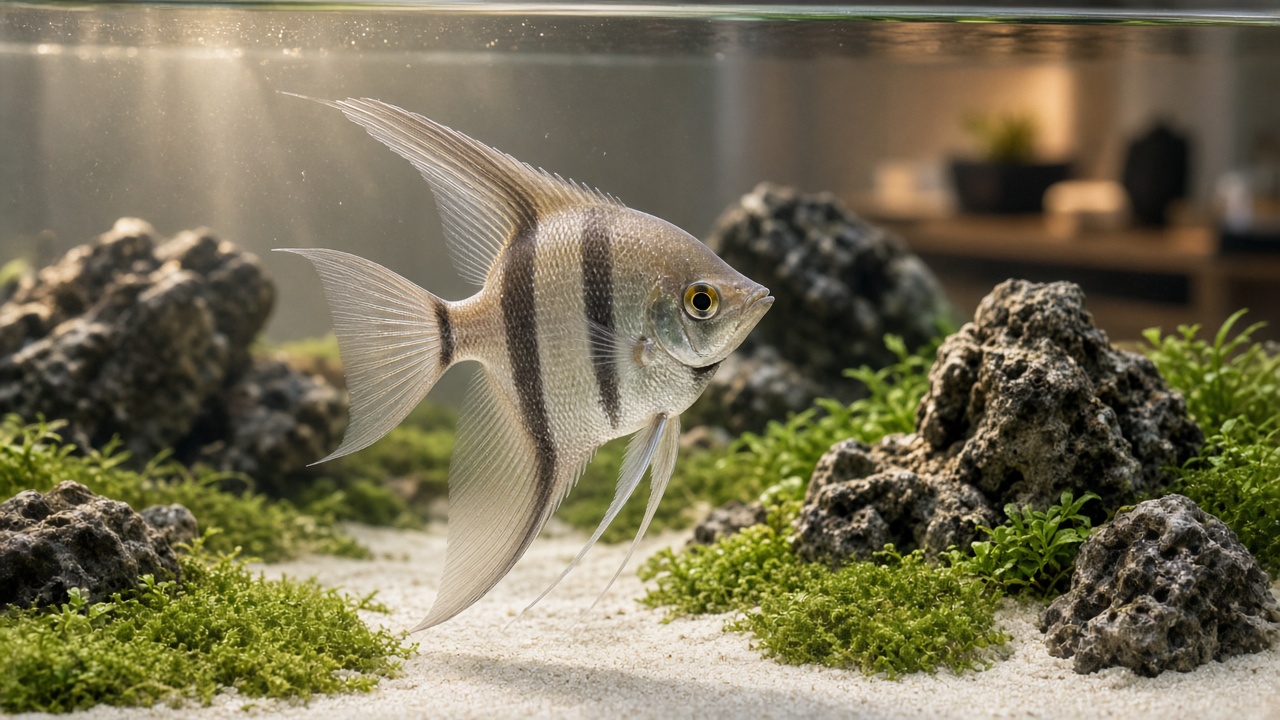
A 15 cm body is a tall, disc-shaped adult, not the small fish in a store bag. Aqueon says full-grown fish need 55 gallons or larger, and that volume line is about adult body shape, not a year clock.
FishBase also estimates high resilience, with a minimum population doubling time of less than 15 months. That wild-stock note is not a pet year count.
Our page on how long betta fish live can quote a printed year range, but the angelfish pages we read do not.
Our page on how long goldfish live can quote record-book clocks, and this desk found no matching clock for Pterophyllum scalare.
What shortens life first
Crowding, heat swings, and leftover food cut life before old age does.
Aqueon says angelfish grow quite large, so a tank under 55 gallons is already below that adult floor.
Aqueon also says they will eat smaller fish, which is a mouth-size risk, not a mood label.
The same care guide says pairs can chase tankmates when they spawn, and stress and torn fins follow that chase.
Water outside Aqueon’s 78° to 84°F band is too cool or too warm. Aqueon says they prefer slightly warmer water than many community fish.
If you keep them with discus, Aqueon says to stay above 82°F, a roommate rule, not a second lifespan.
Dirty water is the silent cut. Aqueon tells you to filter well and change water on a printed schedule, and an uncycled tank cannot follow that schedule yet.
Read our page on how long to cycle a fish tank before you add the first fish.
The 55-gallon adult rule
Aqueon’s care guide sets 55 gallons or larger for a full-grown angelfish, and that volume is our floor.
We named that line the 55-Gallon Adult Rule, a published housing floor, not a new study.
FishBase prints a different unit, a minimum aquarium size of 100 cm, which is tank length, not gallons.
Those two published floors do not convert cleanly, so we keep both numbers and do not invent a third.
Aqueon also says tall tanks are best, because the fish is tall, with long fins, so height matters as much as gallons.
Aqueon says water flow should be gentle, because strong current drags those fins.
Aqueon’s décor list is specific:
- Large broadleaf plants
- Driftwood set vertically
- A few floating plants for shade
- Fine to medium smooth gravel
Sharp décor can tear fins, and long fins are part of why Aqueon wants gentle flow and tall tanks.
Aqueon says they are generally peaceful, but they are still cichlids and can fight when pairing.
Suitable tankmates on Aqueon’s page include:
- Larger tetras and rasboras
- Gouramis
- Peaceful barbs
- Rainbowfish
- Corydoras and other medium catfish
Tiny fish that fit in a mouth do not belong on that list.
FishBase’s group note is 5 or more fish, while Aqueon talks about pairs that spawn and chase. A 55-gallon tank can hold a pair, but a group of 5 needs more than the adult floor.
We do not invent a gallons-per-fish add-on, because neither page prints that extra number.
Water numbers Aqueon actually prints
Aqueon’s care guide prints temperature, pH, hardness, and change size, and those four lines are the working water plan.
Printed water numbers from Aqueon’s angelfish page:
- Temperature: 78° to 84°F
- pH: 6.8 to 7.8
- Hardness: 3° to 8° dKH (54 to 145 ppm)
- Water changes: 10% weekly, or 25% every other week
Pick one change size and keep it, and do not skip a week because the water looks clear.
Aqueon says to treat tap water with Aqueon Water Conditioner before you refill, and Seachem’s Prime page says the product removes chlorine and chloramine.
Seachem’s Prime page gives a dose you can measure: 1 capful (5 mL) for each 50 US gallons of new water.
Seachem also prints these dose notes:
- Each cap thread is about 1 mL
- A double dose is allowed for high chloramine
- Up to 5 times the normal dose may be used for nitrite in an emergency
- Use a half dose if temperature is above 86°F and chlorine or ammonia is low
- The bind lasts up to 48 hours
- You may dose again every 24 to 48 hours
For a 55-gallon adult tank, a 10% weekly change is about 5.5 gallons of new water, so measure that small Prime dose.
Seachem lists bottle sizes of 50 mL, 100 mL, 250 mL, 500 mL, 1 L, 2 L, and 4 L.
You cannot see ammonia by eye, and API’s Freshwater Master Test Kit page says most water problems are invisible.
API’s page says the kit measures six aquarium levels, including ammonia, pH, high-range pH, nitrite, and nitrate.
The kit comes with four test tubes, a holding tray, and a laminated color card, and API says to test weekly.
Ammonia or nitrite above zero means the cycle is not holding, so change water and do not add more fish.
Gear that fits a 55-gallon adult tank
We only compared gear whose maker-listed size can serve Aqueon’s 55-gallon adult floor, which is the same 55-Gallon Adult Rule applied to filters and conditioners.
We left out nano filters and any model listed only for tanks under 55 gallons.
Fluval’s 407 page lists a 50 to 100 US gallon range, and that range includes the 55-gallon floor.
The same Fluval page lists these 407 numbers:
- Pump output: 383 US GPH
- Filter circulation: 245 US GPH
- Vertical pre-filter: 1074 cm²
- Basket volume: 4.2 L
- Size: 9.5 in long, 7 in wide, 19.3 in high
Use the lower 245 GPH figure when you plan flow, not the 383 GPH pump number. 245 GPH is circulation after hoses and media.
Fluval’s 407 page also lists the 307 as a 40 to 70 US gallon canister. That range still includes 55 gallons, so the 307 stays in.
Aqueon’s PRO QuietFlow page lists Size 10, 20, 30, 50, and 75, and we kept only Size 50 and Size 75.
Aqueon describes a 5-stage system with a NoDrip cartridge and a self-priming pump. The listing we read does not print a gallons-per-hour number.
| Product | Maker-listed type | Key listed spec | Fits the 55-gallon adult floor? |
|---|---|---|---|
| Fluval 407 Canister Filter | Canister filter | 50–100 US gal; 245 US GPH circulation | Yes |
| Fluval 307 Canister Filter | Canister filter | 40–70 US gal on the 407 series list | Yes |
| Aqueon PRO QuietFlow Size 50 | 5-stage hang-on filter | Listed Size 50 | Size class matches a 55-gallon tank |
| Aqueon PRO QuietFlow Size 75 | 5-stage hang-on filter | Listed Size 75 | Yes |
| API Freshwater Master Test Kit | Liquid test kit | 6 water levels; 4 tubes; weekly use | Monitoring, not tank volume |
| Seachem Prime | Water conditioner | 5 mL per 50 US gal | Dose scales to a 55-gallon change |
Aqueon says flow should be gentle, so spread a 407’s 245 US GPH circulation across a 55-gallon tank.
Food dose and leftover waste
Leftover food becomes waste, and waste is the clock you can see on a test kit.
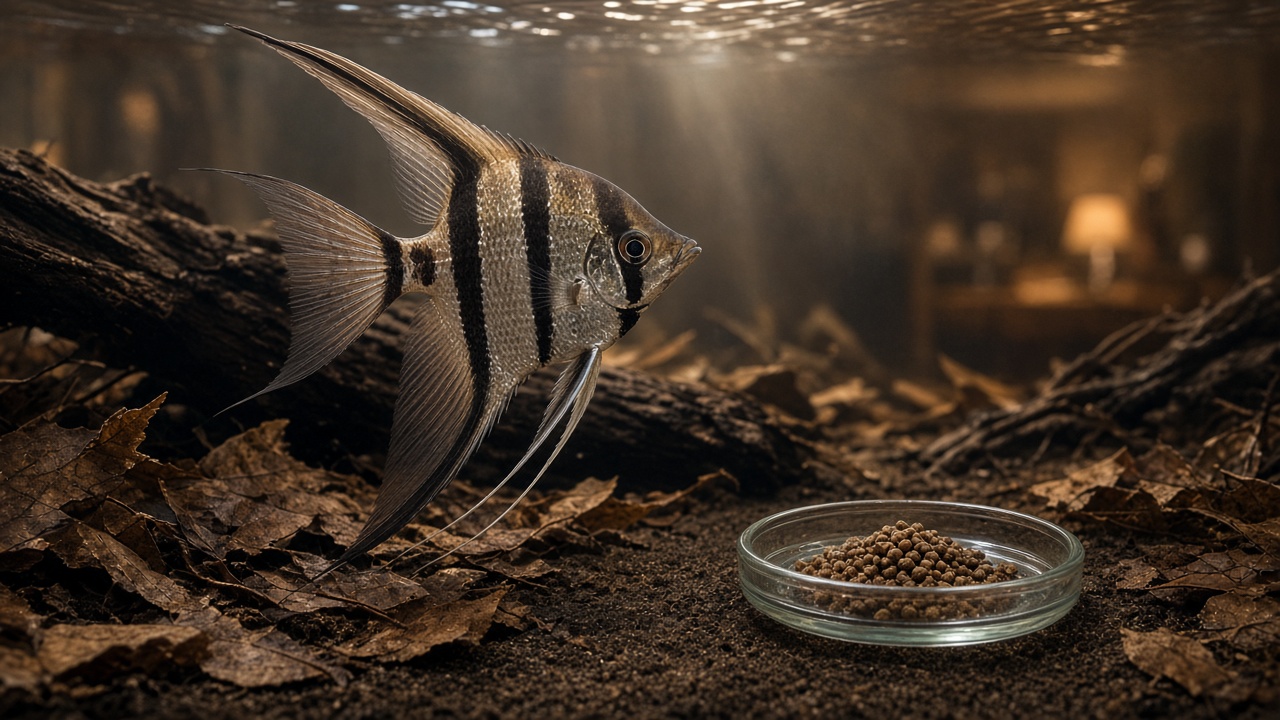
Aqueon says angelfish are omnivores that feed at the surface or mid-water and also forage on the bottom.
Aqueon’s printed feeding rules are:
- Rotate the diet daily
- Feed only what they can eat in 2 to 3 minutes
- Feed once or twice a day
- Use frozen or live food as treats, or to help induce spawning
Aqueon’s care guide names Aqueon Tropical Flakes, Color Flakes, Tropical Granules, and Shrimp Pellets as staples.
A simple way to stay inside that window:
- Offer a pinch of flake or granule.
- Watch for 2 minutes.
- Stop if food is still falling.
- Skip the second daily feeding if nitrate is climbing.
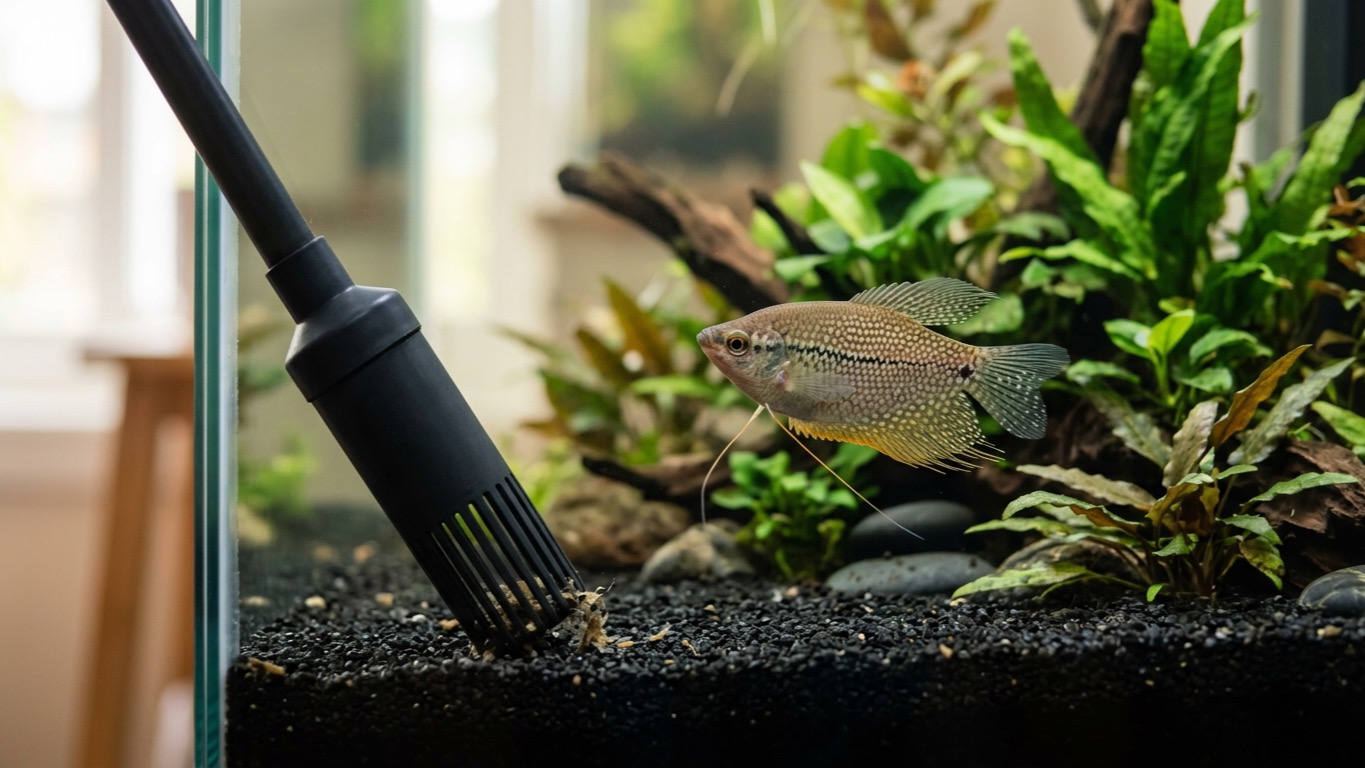
- Vacuum leftover food on change day.
Overfeeding is an easy way to push a 55-gallon tank into ammonia, and API’s weekly test is how you catch that early.
FAQ
These answers stay inside the pages we compared.
How long do angelfish live?
FishBase lists no maximum age for Pterophyllum scalare, and Aqueon’s care guide also prints no year count. Plan for years of care around Aqueon’s 55-gallon, 78–84°F, and weekly-change lines, not around a year number those pages do not print.
How big of a tank does an adult angelfish need?
Aqueon says 55 gallons or larger when full grown, and tall tanks are best. FishBase lists a minimum aquarium size of 100 cm and groups of 5 or more. A pair can fit the 55-gallon floor, but a group of 5 needs more than that floor.
What water temperature should I use?
Aqueon prints 78° to 84°F, and if you keep them with discus, Aqueon says to stay above 82°F. Seachem’s Prime page uses a half dose above 86°F when chlorine or ammonia is low, which is a dose note, not a target temperature.
How often should I change the water?
Aqueon lists 10% each week or 25% every other week, and you should treat new tap water first. Seachem’s Prime page doses 5 mL per 50 US gallons of new water.
Can I keep one angelfish alone?
Aqueon describes community tanks and spawning pairs, while FishBase says to keep groups of 5 or more. Neither page forbids a single fish, but FishBase’s group note is the published social line. A single adult still needs the 55-gallon floor.
How much should I feed an angelfish?
Aqueon says feed what they can eat in 2 to 3 minutes, once or twice a day. Rotate flake, granule, and shrimp pellet foods named on that care guide, and remove leftovers so waste does not rise.
Do I need to cycle the tank first?
Aqueon’s change schedule assumes a working filter, and an uncycled tank will show ammonia and nitrite on the API kit. Use our page on how long to cycle a fish tank for that wait. Add fish only after ammonia and nitrite stay at zero.