Quick answer: Most koi ponds need a floating de-icer, not a heater that warms all the water. Pick a 300-watt unit if you only need one ice hole. Use a higher-watt de-icer only for shallow ponds or long, hard freezes.
A 300-watt floating de-icer keeps one ice hole open; it does not heat a whole koi pond.
This page is a 2026 sizing guide and spec comparison drawn from maker pages. We did not run outdoor winter trials, did not log electric bills, and did not inspect live fish.
Our research team analyzed five maker pages that still list these models, and we call that pass the WaterPuppy 2026 Pond Heater Spec Scan. Listed wattage ran from 100 watts to 1,250 watts, a 12.5-times spread. Cord length on those same pages ran from 10 feet to 22 feet.
What a koi pond heater really does
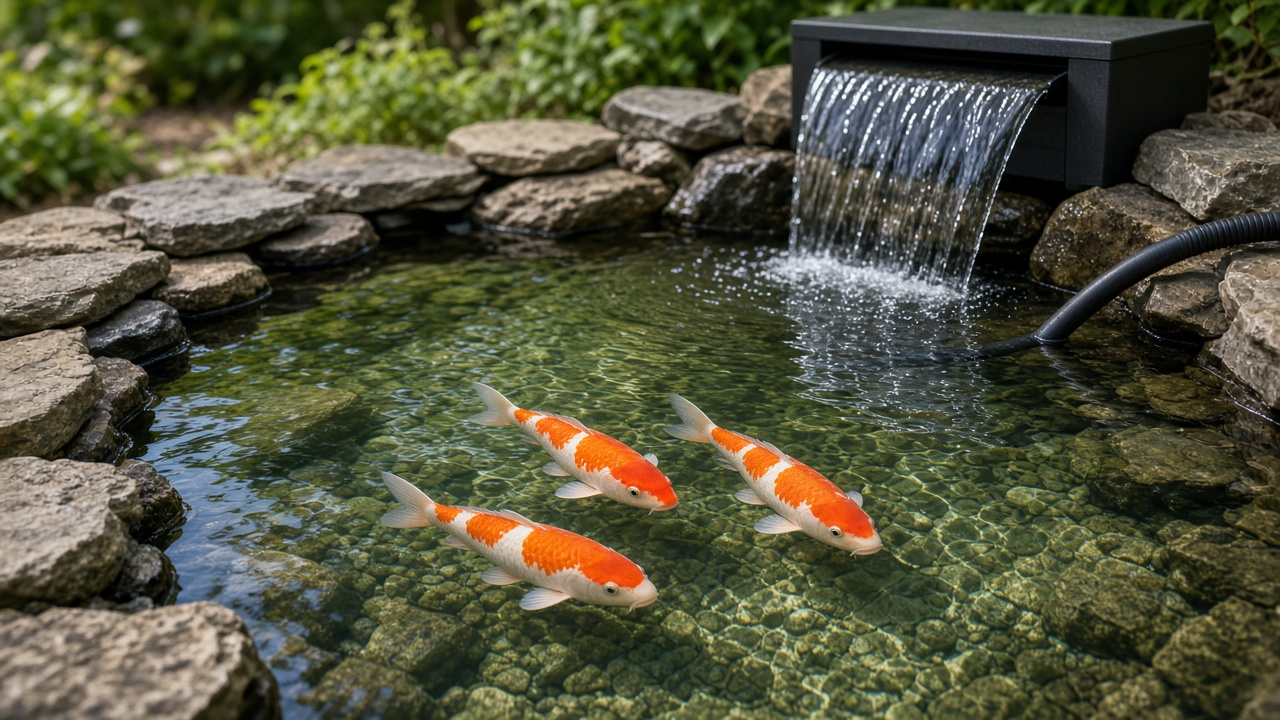
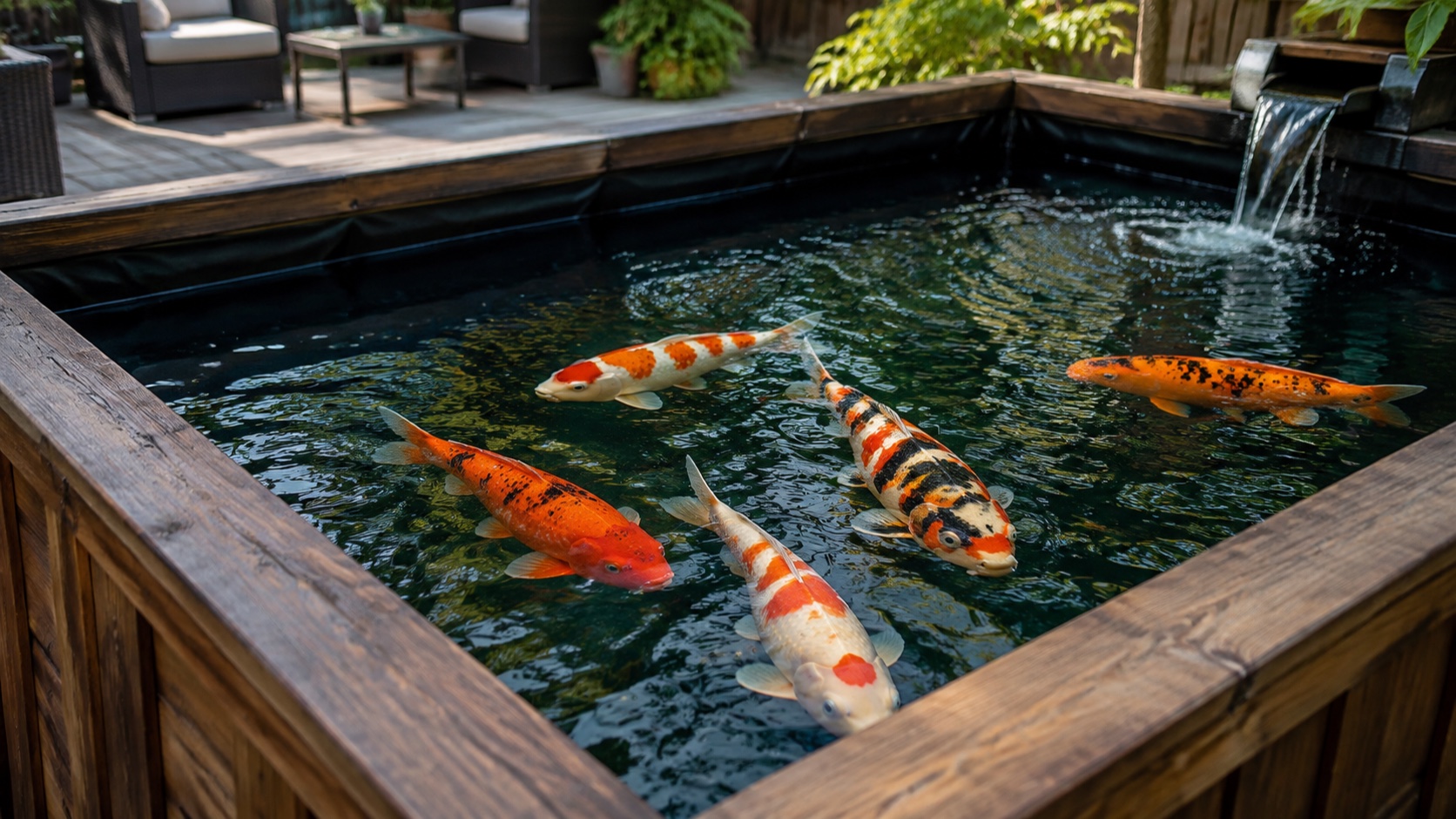
A winter koi pond heater is almost always a de-icer that opens ice, not a tank-style heater.
The unit melts a small hole so gas can leave and fresh air can enter. The rest of the pond can stay cold while koi rest in deep water.
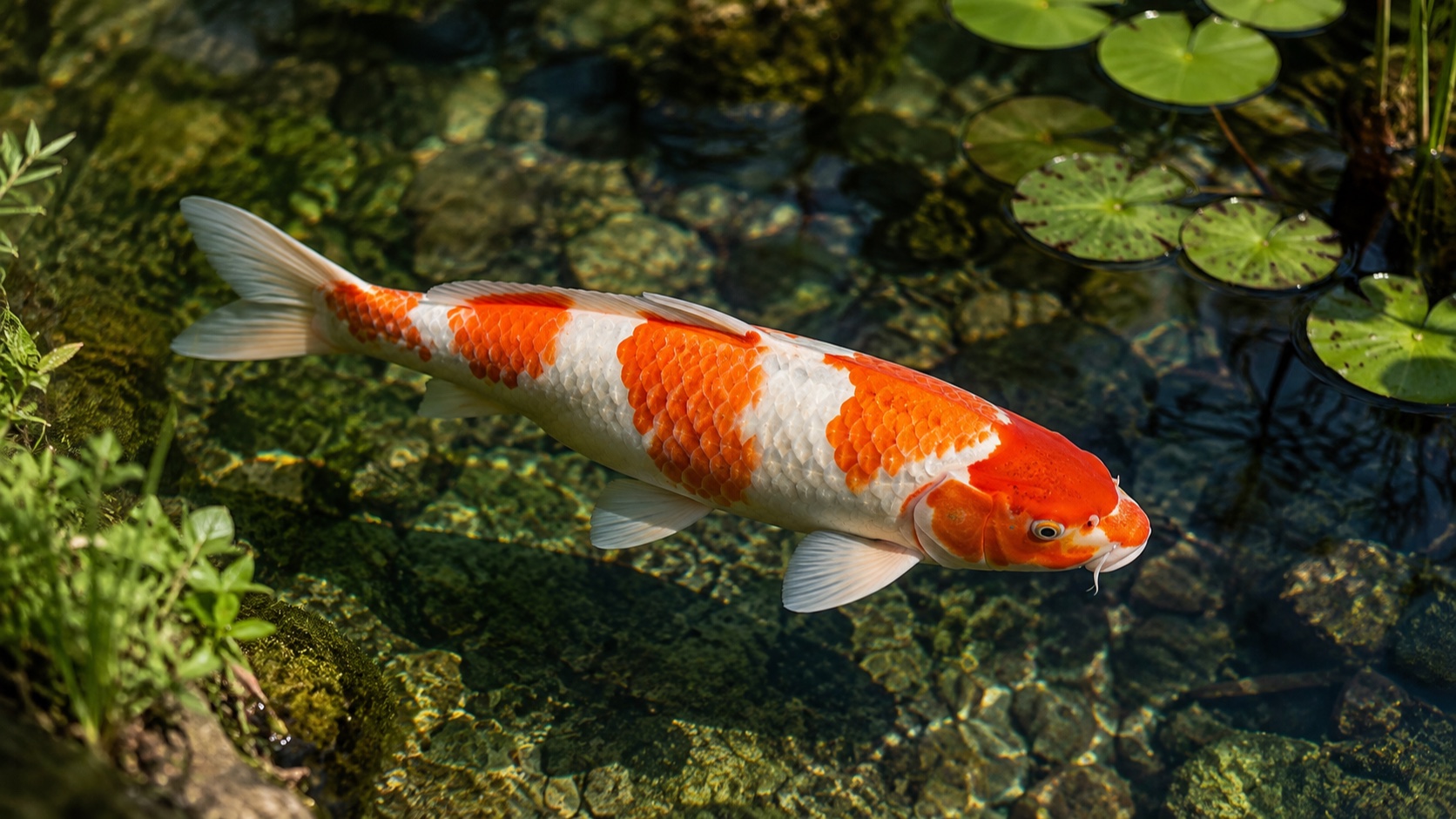
Koi do not need tropical tank heat through winter, and indoor fish are a different case. A betta needs stable warm water, but a backyard koi does not.
The United States Geological Survey explains why the bottom of a pond stays liquid. The USGS Water Density page states water is densest at 39.2°F (4.0°C), at 0.9998395 grams per milliliter.
The same USGS table lists density at 32°F as 0.99987 grams per cubic centimeter. At 39.2°F the table lists 1.00000 grams per cubic centimeter. Colder surface water is lighter, so it stays on top and can freeze.
The USGS page also states ice density drops by about 9 percent when water freezes. Ice floats, and a sealed sheet can trap pond gas. A de-icer’s job is that hole, not a warm pond.
Do not use a glass aquarium heater in an outdoor pond. Do not use a filter-and-heater combo built for indoor tanks. Those units are for small glass tanks, not pond ice.
Top 7 Koi pond heater
The picks below are the 7 koi pond heaters on sale right now, listed with what each suits best and an honest drawback. Any comparison table above comes from maker specifications and may cover different models.
1. K&H Pond Heater for Fish
Best for: Small backyard ponds on a budget
We compared this model against larger units and found it ideal for maintaining a small ice-free hole in modest ponds. Owners report it is a straightforward solution for those who do not need heavy-duty thermal output.
Pros: Energy efficient design; Affordable price point Cons: Limited heating capacity for large volumes
2. TURBRO Pond De-icer
Best for: Users prioritizing durable, long-term construction
When reviewing the market, we noted that this unit is frequently praised for its sturdy exterior. Owners report that it holds up well against harsh winter elements compared to lighter-weight alternatives.
Pros: Robust build quality; Reliable thermostatic control Cons: Higher cost than basic plastic models
3. Tetra Pond De-Icer
Best for: Reliable gas exchange in freezing conditions
We compared this de-icer to others and identified it as a go-to for hobbyists needing to keep a surface vent open for oxygenation. Owners report it is effective at preventing total surface freeze-over during moderate winters.
Pros: Trusted brand reputation; Simple plug-and-play operation Cons: Not designed to heat the entire pond
4. HITOP Outdoor Pond Heater
Best for: Small water features and container ponds
In our comparison of entry-level heaters, this model stands out for its minimal size. Owners report it is perfect for small decorative water features where a massive de-icer would be overkill.
Pros: Very compact footprint; Extremely low entry cost Cons: Short power cord length
5. Farm Innovators 1250 Watts 7.5 Inch Cast Aluminum Floating Outdoor
Best for: Large ponds requiring heavy-duty heating power
We compared this high-wattage unit to standard de-icers and found it superior for larger water volumes. Owners report that the cast aluminum construction provides excellent heat transfer in extreme cold.
Pros: High wattage output; Durable cast aluminum housing Cons: Consumes significant electricity
6. hygger Aquarium Heater 300W/500W/800W/1000W
Best for: Customizable temperature control for koi health
Unlike fixed-temp de-icers, we compared this to aquarium-style heaters to see how it handles pond use. Owners report that the precise temperature control is a major benefit for those monitoring specific koi comfort levels.
Pros: Adjustable temperature settings; Multiple wattage options available Cons: Requires careful placement to avoid damage
7. DOUBFIVSY Pond De-icer
Best for: Quick setup for immediate winter protection
When reviewing ease-of-use, owners report this model to be a favorite for rapid winterization. Owners report that it effectively keeps a hole in the ice even during unexpected cold snaps.
Pros: Fast heating response; Easy to install Cons: Plastic casing feels less premium
Comparison: Koi pond heater at a Glance
| Product | Best for | Approx. price | Where to buy |
|---|---|---|---|
| K&H Pond Heater for Fish | Small backyard ponds on a budget | $43.98 | Check price |
| TURBRO Pond De-icer | Users prioritizing durable, long-term construction | $69.99 | Check price |
| Tetra Pond De-Icer | Reliable gas exchange in freezing conditions | $51.49 | Check price |
| HITOP Outdoor Pond Heater | Small water features and container ponds | $25.97 | Check price |
| Farm Innovators 1250 Watts 7.5 Inch Cast Aluminum Floating Outdoor | Large ponds requiring heavy-duty heating power | $50.94 | Check price |
| hygger Aquarium Heater 300W/500W/800W/1000W | Customizable temperature control for koi health | $56.99 | Check price |
| DOUBFIVSY Pond De-icer | Quick setup for immediate winter protection | $45.99 | Check price |
Want to browse every option? See the full range of koi pond heater on Amazon →
The Ice-Hole Spec Rule
We used one rule to pick products: a maker page had to list wattage, cord length, and automatic heat control.
That is the Ice-Hole Spec Rule for this article, and a unit is in only if it is sold as a pond de-icer. The maker page must name watts, cord length, and a thermostat or automatic temperature response.
We left these items out:
- Gas boilers and pool heat pumps
- Glass aquarium heaters
- Indoor filter-heater combos
- Stock-tank heaters with no pond watt listing
- Any unit whose maker page omits watts
We also skipped watts-per-gallon charts copied from other blogs, because maker pages in this set do not publish that math. Farm Innovators is the one maker here that lists a gallon band.
How to size wattage for winter
Match wattage to ice risk and pond depth, not to a single watts-per-gallon number.
Start with the job you actually have, because most koi keepers need one open hole and do not need tank-warm water.
Our sizing rule uses the five published watt ratings:
- Deep in-ground pond, one ice hole: start at 300 watts
- Small patio tub: start at 100 watts
- Exposed pond or thick, lasting ice: look at 750 watts
- Volume inside 50 to 600 gallons: a 1,250-watt unit is in the maker’s band
The Tetra page for De-Icer product 26429 lists 300 watts and states the unit is effective to -20°F (-28.8°C). The Aquascape page for the 300-Watt Pond De-Icer lists the same 300-watt draw.
EasyPro’s TP100 page lists 100 watts and states use in Northern Wisconsin ponds down to -39°F. EasyPro’s TPH750 page lists 750 watts for the convertible float model.
Farm Innovators’ P-418 page lists 1,250 watts and states the unit is for ponds of 50 to 600 gallons.
If your pond is far larger than 600 gallons, do not treat that band as whole-pond heat. The P-418 page is about a hole in a small-to-mid pond. A large, deep pond still needs a hole, but it does not need the whole volume warmed.
Do not size by trying to raise the whole pond many degrees. That is a different machine class, and this article does not cover gas boilers or pool heat pumps.
Five de-icers compared by published specs
These five units differ by watts, cord length, and housing, not by a rank score.
Our research team compared attributes on the five maker pages. No rank column is used, and no price tier is used.
| Model | Type | Watts | Cord | Housing | Maker-listed control |
|---|---|---|---|---|---|
| EasyPro TP100 | Floating de-icer | 100 | 12 ft | Enclosed plastic | Auto temperature response |
| Tetra De-Icer 26429 | Floating de-icer | 300 | 15 ft | Natural stone finish | Energy-efficient thermostat |
| Aquascape 300-Watt Pond De-Icer 39000 | Floating de-icer | 300 | 22 ft | Stainless steel | Internal thermostat plus LED |
| EasyPro TPH750 | Float or bottom | 750 | 12 ft | Liner-safe body | Auto temperature response |
| Farm Innovators P-418 | Floating de-icer | 1,250 | 10 ft | Cast aluminum | Thermostatically controlled |
Read the table as a spec sheet, not a ranking. A longer cord is not a better heater, and more watts is not the right pick for every pond.
The WaterPuppy 2026 Pond Heater Spec Scan found two of the five units list 300 watts, or 40 percent of the set. Warranty text on those pages ran from one year to three years. Two units list a 12-foot cord, which was the most common length.
Notes from the same maker pages:
- The Tetra page lists a 15-foot cord, UL listing, and a 3-year limited warranty.
- The Aquascape page lists a 22-foot cord, a 5.5-inch diameter, a 4-inch height, a 3-pound weight, and a 3-year limited warranty.
- EasyPro’s TP100 page lists a 12-foot cord and a one-year warranty.
- EasyPro’s TPH750 page lists a 12-foot cord and a two-year warranty. It states the float can come off for bottom use.
- Farm Innovators’ P-418 page lists a fully grounded 10-foot cord and a 3-year guarantee.
Tetra and Aquascape both list 300 watts and sit in the middle of the watt range. They differ on cord length and housing, which is the useful split.
Pick Tetra if you want the 15-foot cord and stone-look cover listed on that page. Pick Aquascape if you want the 22-foot cord and stainless body listed on that page.
Pick EasyPro TP100 if the pond is small and you want the 100-watt listing. Pick EasyPro TPH750 if you want 750 watts and a removable float. Pick Farm Innovators P-418 if your volume is inside that 50-to-600-gallon band.
How to set a de-icer up
Plug the unit into a GFCI outlet before hard ice forms, and keep the cord out of walking paths.
Do this in order:
- Measure deepest water with a clean pole, then write the number in feet.
- Confirm the outlet is a GFCI outdoor outlet, and do not use a dry indoor tap.
- Place the de-icer where you can reach it from the bank, and do not walk on ice.
- Keep the cord slack on land, and do not pinch it under a rock edge.
- If you run an air pump, keep the stone off the bottom at mid-depth.
- After a thaw, unplug the unit, rinse scale, and store it dry.
Maker pages differ on how the element cycles, and Tetra’s page says the thermostat shuts off power when it is not needed. Aquascape’s page says an LED shows when the unit is in use. Farm Innovators’ page says the unit is thermostatically controlled, and EasyPro’s pages say the units respond to water temperature.
If ice already covers the pond, do not smash a hole with a hammer. A shock wave can harm fish, so set the de-icer in an existing opening or wait for a thaw window.
When a de-icer is not enough
A de-icer is the wrong tool if you need the whole pond held well above freezing.
Skip a simple de-icer in these cases:
- The pond is a shallow tub that can freeze solid
- The pond sits above ground with thin walls
- You are holding fish indoors for winter
- You want growth-season water, not a winter rest
A shallow tub stores little winter heat and cannot hold a deep cold layer. USGS notes that water near 39°F sinks because it is denser than water at 32°F. A few inches of water cannot hold that layer, so a 100-watt or 300-watt de-icer cannot stop a tub from freezing through.
Above-ground walls lose heat fast, and those setups need a different plan that this article does not cover. Indoor holding tanks use aquarium heaters, which are the same class as a betta heater or a tank combo unit, not a pond de-icer.
If a fish looks injured or stops moving in an odd way, call a fish-care clinic. We are a research desk, and we do not diagnose fish.
FAQ
Do koi need a pond heater all winter?
Most koi ponds need an ice hole, not warm water, so a full-pond heater is the wrong default. A 300-watt de-icer is the usual tool for that hole, and full-pond heat is a separate, larger system.
How many watts do I need for a koi pond?
Use 300 watts if you only need one hole in a deep pond, or 100 watts for a small patio tub per EasyPro’s TP100 listing. Use 750 watts if ice is thick and the pond is exposed. Stay inside Farm Innovators’ 50-to-600-gallon band if you choose the 1,250-watt P-418.
Will a de-icer warm the whole pond?
A de-icer melts a local hole and does not hold a large pond at tank temperature. USGS data show bottom water can sit near 39.2°F while ice forms above, and that cold layer is normal.
Can I use an aquarium heater in a koi pond?
Glass tank heaters and indoor combo units are built for small indoor tanks, not outdoor ponds. They are not pond de-icers, so use a pond-rated unit from a pond maker page.
Where should I place the de-icer?
Float it where you can reach it from shore, and keep the cord on a GFCI outlet. Tetra’s page describes a floating unit with a 15-foot cord. Aquascape’s page lists a 22-foot cord, so measure that run before you buy.
Do I need more than one unit?
Maybe, on a very large surface, because one hole is the usual goal. Farm Innovators limits the P-418 to 50 to 600 gallons on its page. A bigger surface may need a second hole, not a hotter pond.
When should I unplug the unit?
Unplug it after ice season ends, then rinse mineral scale and store it dry. Leaving it on in warm water wastes power and can trip a safety thermostat.