Quick answer: Most indoor betta tanks need a heater because room air is cooler than the water band. Size the heater from published watt charts. Then confirm the water with a thermometer.
A betta needs a heater unless tank water stays 76–85°F day and night.
This page is a temperature-math note from our research desk. Our research team compared published specs and did not log home tanks or run overnight heater trials.
The 10°F lift rule we used
The 10°F Lift Rule is the gap between Aqueon’s 68°F room floor and its 78°F tank preset.
A tank enters this article only if it is a still-water indoor aquarium of 5 to 20 gallons holding one Betta splendens. Bowls under 5 gallons stay out, and so do ponds, shipping cups, and tanks over 20 gallons.
We used one maker’s published numbers for that lift. Aqueon’s setup page bases its heater chart on a room of 68°F to 72°F, and Aqueon’s preset heater page sets the water at 78°F.
Subtract those figures and the lift is 6°F to 10°F. If the room sits at the low end of Aqueon’s chart, the tank must rise 10°F.
A heater does that work, and the room does not.
Aqueon’s cold-weather page says bettas do best between 76°F and 85°F. A 78°F preset sits inside that band, and a 68°F room does not.
Tank volume still matters because a small box of water loses heat faster. That is why we also point readers to what size tank a betta needs. A larger still-water tank changes slower, but it does not remove the lift.
What published ranges actually say
Three published ranges sit behind the 76–85°F band we use as the pass-fail line.
FishBase lists Betta splendens as tropical at 24°C to 30°C, which converts to 75.2°F to 86°F.
Aqueon’s cold-weather page narrows the hobby target to 76°F to 85°F for bettas. It gives other tropical fish 75°F to 80°F.
Aqueon’s setup page tells keepers to set an adjustable heater to 75°F to 80°F for tropical fish. That band overlaps the betta range, but it is not a reason to skip a heater.
The University of Florida IFAS page describes wild water, not a living room. It reports a Thailand site at 29.9°C, about 86°F, with a range of about 27.0°C to 31.5°C.
That same IFAS page gives other wild numbers that show a warm, shallow habitat.
- Average depth: about 5.0 cm, or 2 inches
- Depth range: about 2.0 cm to 9.4 cm
- Average dissolved oxygen: about 3.8 mg/L
- Average pH: 5.47
FishBase also lists pH 6.0 to 8.0 and hardness 5 to 19 dH. Those figures are water chemistry, not a heater substitute.
FishBase lists a maximum length of 6.5 cm total length. That size figure does not change the temperature math, but it does show this is a small tropical fish.
The IFAS page says bettas thrive in warmer water and do not do well in cold water. For an unfiltered, unheated container, it says room air should stay at no less than 22°C, or 71.6°F.
That 71.6°F figure is air, not water, and it still sits below Aqueon’s 76°F water floor. Even that air minimum does not clear the water band.
When we would skip a heater
We skip a heater only when measured tank water stays inside 76°F to 85°F all day and all night.
Feeling the glass is not a measurement, and a wall thermostat is not a measurement either.
Use a thermometer in the water and read it in the morning and at night. If both readings stay inside 76°F to 85°F, the heater is optional for that week.
The IFAS page allows an unheated container only when room air stays at or above 22°C, which is 71.6°F air. Water can still sit cooler than air after a night drop, so we still require water readings.
Summer does not get an automatic pass. Air conditioning can hold a room near 72°F, the top of Aqueon’s room chart, while the water still sits below 76°F.
A heater-free week can fail the next week. Recheck after a cold front, a night drop, or a moved tank.
We do not treat a bowl as a heater-free plan. Our selection rule starts at 5 gallons, and Aqueon’s heater chart also starts at 5 gallons, so we have no wattage row below that.
Wattage math for 5 to 20 gallon tanks
Aqueon’s cold-weather page uses 5 watts per gallon at or below 55 gallons, and 3 watts per gallon above 60 gallons.
Our tanks sit in the first group, so 5 watts per gallon is the starting math.
- 5 gallons × 5 watts = 25 watts
- 10 gallons × 5 watts = 50 watts
- 20 gallons × 5 watts = 100 watts
Aqueon’s own chart does not sell a 25-watt row. Its setup-page chart starts at 50 watts for a 5-gallon tank at a 5°F, 10°F, or 15°F lift in a 68°F to 72°F room.
Here is the 5 to 20 gallon slice of Aqueon’s setup-page chart.
- 5 gallons: 50 watts at a 5°F, 10°F, or 15°F lift
- 10 gallons: 50 watts at a 5°F, 10°F, or 15°F lift
- 20 gallons: 50 watts at a 5°F lift; 100 watts at a 10°F or 15°F lift
Aqueon’s preset heater page matches the small-tank end. It calls the 50-watt unit ideal for aquariums up to 20 gallons and preset to 78°F, plus or minus 1°F.
That plus-or-minus 1°F band is 77°F to 79°F, which still sits inside 76°F to 85°F.
Compare the two Aqueon methods on a 20-gallon tank. The 5 watts per gallon rule asks for 100 watts. The chart asks for 50 watts at a 5°F lift and 100 watts at a 10°F or 15°F lift.
Our 10°F Lift Rule uses the 10°F column, so 20 gallons maps to 100 watts.
For 5 and 10 gallons, both methods land on 50 watts once you use Aqueon’s published starting size. The 5-watt math wants 25 watts at 5 gallons, but the chart will not go that low, so use 50 watts.
Aqueon’s setup page says to use more than one heater at 100 gallons or larger. That case is outside our selection rule.
Aqueon’s cold-weather page says to use a larger heater or a second heater in a cold room, including exterior walls and outside doors. If your room sits below 68°F, treat the lift as larger than 10°F and use the 15°F column.
How to install and check the water
A heater setting is not the water temperature. Aqueon’s setup page says the actual water can differ because circulation and tank location change the reading.
Use a separate stick-on thermometer on the outside glass, above the gravel and far from the heater. Aqueon’s setup page gives that placement.
Keep it out of direct sun, and check the temperature often, daily if possible, as Aqueon’s cold-weather page says.
Install steps, from Aqueon’s heater-tips page:
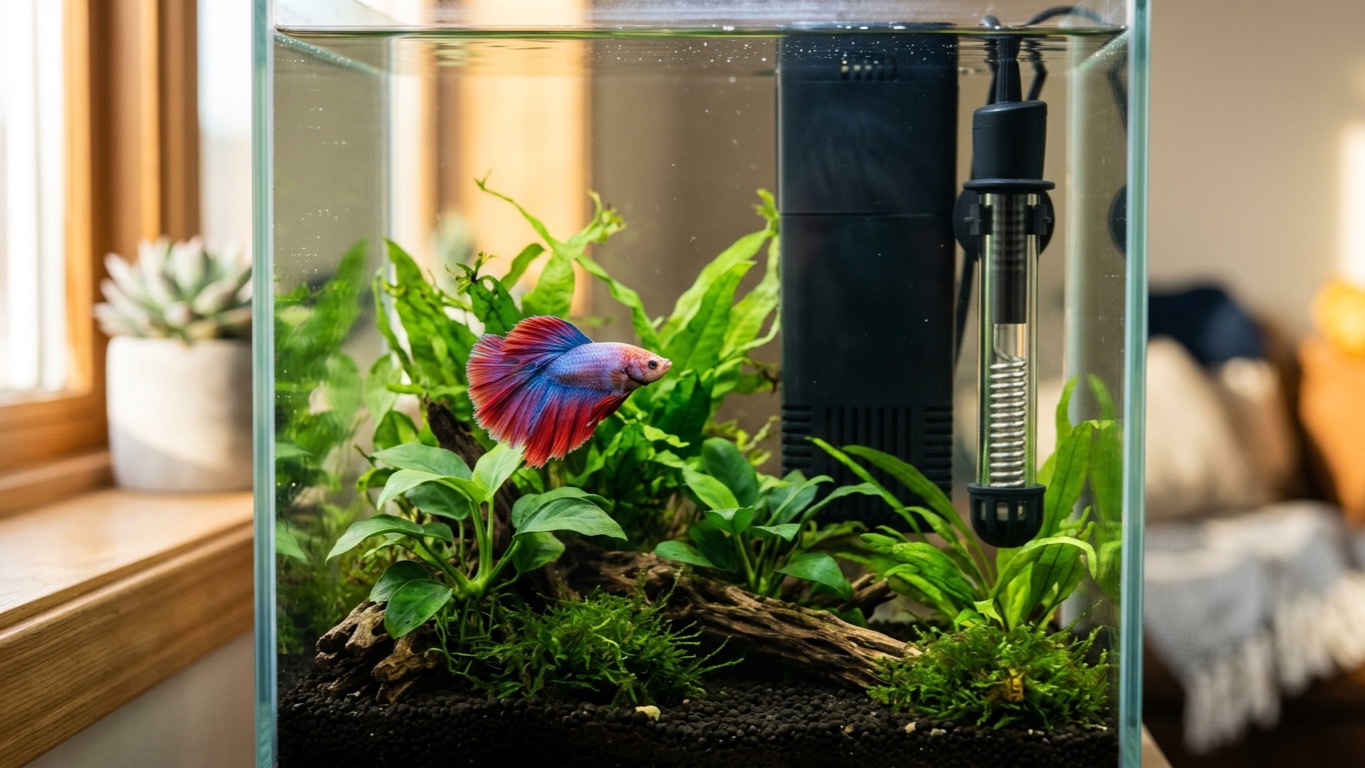
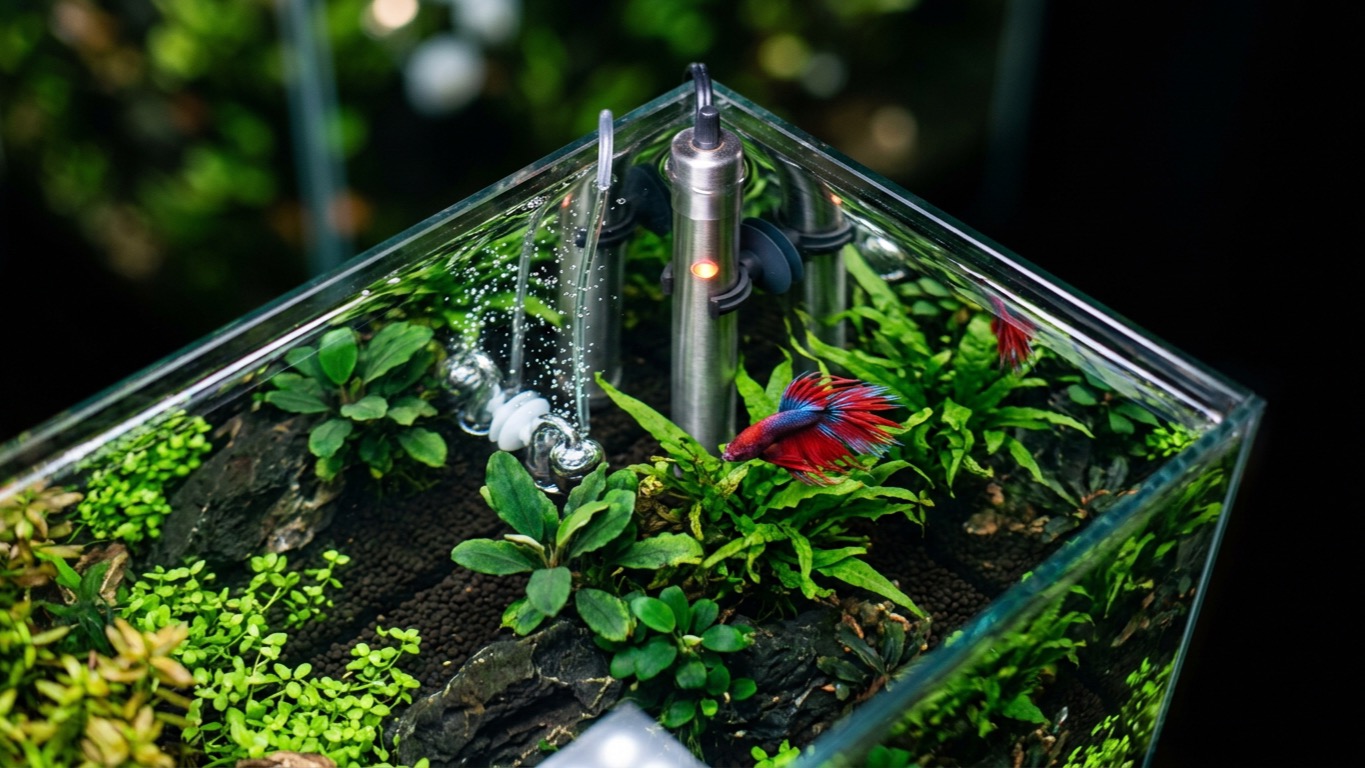
- Place the heater near a filter inlet, outlet, or pump so water moves past it.
- Keep décor off the heater so water can pass around the tube.
- After you place the heater in the water, wait at least 30 minutes. Then plug it in.
- After any dial change, wait several hours. Then read the thermometer.
- Before you take a heater out, unplug it and let it cool at least 30 minutes.
Aqueon’s setup page also says to set an adjustable heater to 75°F to 80°F and to install it before you plug it in. Fill the tank to 1 inch below the rim.
Do not chase a number by large jumps, because Aqueon’s cold-weather page says not to change the water temperature suddenly.
Gravel and plants change flow, not the target band. Keep the heater clear of substrate piles and dense live plants. The 76–85°F water band does not change.
The IFAS page says bettas prefer calm water, so heavy flow can stress them. Place the heater in gentle current, and do not point a strong outlet at the fish to spread heat.
Night drops, summer rooms, and what we left out
Night is the usual failure point, because a room can sit at 72°F at dinner and sit lower at dawn.
We stayed with Aqueon’s room band of 68°F to 72°F. If your room falls below 68°F at night, the lift is larger than 10°F.
Read the water at first light, and if it is under 76°F the tank needs a heater. A summer afternoon reading cannot cancel a dawn reading.
Air conditioning creates the same gap in reverse season. A 72°F room matches the top of Aqueon’s room chart, but it is still 6°F below a 78°F tank target.
Aqueon’s setup page says to keep tanks off exterior doors in cold climates because drafts can drop the water. It also says to avoid heating vents and direct sun, because those spots swing.
The IFAS page notes April and May as the breeding season in Thailand, when wild fish move to shallow edges. Home tanks do not get that seasonal warm-up from a calendar. They get it from a heater or from measured warm rooms.
The IFAS page also reports males grown 8 to 12 weeks in bottles. Those farm figures explain why a store cup can look fine at room air, but they are not a home-tank heater plan.
FishBase notes that holding males in very small containers should be discouraged, which supports our 5-gallon floor but is not a wattage figure.
We also left out ponds and any ranked buyer’s list. This is a yes-or-no temperature note, not a product roundup.
If your tank is larger than 20 gallons, stop here and use Aqueon’s full chart on the setup page. Do not stretch our 5 to 20 gallon math.
If your tank is smaller than 5 gallons, we have no wattage row to quote. The temperature band is unchanged, but the heater-size math is not in our set.
FAQ
Do betta fish need a heater in a 5-gallon tank?
Yes, if the water cannot stay 76°F to 85°F day and night. Aqueon’s chart assigns 50 watts to a 5-gallon tank at a 5°F, 10°F, or 15°F lift. Aqueon’s room basis for that chart is 68°F to 72°F.
Can I skip a heater if my house stays warm?
Only if the tank water stays 76°F to 85°F in the morning and at night. Aqueon’s betta band is water, not room air. The IFAS air floor of 71.6°F for an unheated container is still cooler than 76°F water.
What temperature should a betta tank be?
Aqueon’s cold-weather page says bettas do best between 76°F and 85°F. Aqueon’s preset heater page is set to 78°F, plus or minus 1°F. FishBase’s broader species range is 24°C to 30°C, or 75.2°F to 86°F.
Is a 50-watt heater enough for 20 gallons?
Aqueon’s setup chart lists 50 watts at a 5°F lift on 20 gallons, and 100 watts at 10°F or 15°F. Our 10°F Lift Rule therefore uses 100 watts for 20 gallons in a 68°F room aimed at 78°F.
Do I still need a thermometer with a preset 78°F heater?
Yes, because Aqueon’s setup page says the real water temperature can differ from the dial when circulation and tank location change. Aqueon’s preset page allows plus or minus 1°F, which is still a reason to read the water.
Does summer air conditioning replace a heater?
Usually no, because a 72°F cooled room matches the top of Aqueon’s 68°F to 72°F room chart. A 78°F tank target still needs a 6°F lift, so check dawn water and keep the heater if it falls below 76°F.
How long should I wait after I install or move a heater?
Aqueon’s heater-tips page says to wait at least 30 minutes after placing a heater before you plug it in. It says to wait several hours after a dial change before you trust the new reading. Unplug and cool a heater for at least 30 minutes before you take it out.